Bite-sized Insights about
 
Providing you with data-based insights about things happening around you.
Popular Insights
  • Nigeria was the seventh most populous nation in the world in 2020, with 206.1 million people. Projected to reach a population of 401.3 million by 2050, Nigeria will rank third after India (1st) and China (2nd). According to Institut national d'études démographiques' projections, Nigeria, Ethiopia, DR Congo, Egypt, Tanzania, and Kenya will be among the world’s top 20 most populous countries by 2050.

    See more

    As of 2022, the top five African countries indebted to the World Bank — Nigeria, Egypt, Ethiopia, Kenya, and Tanzania — accounted for 46% of the continent's outstanding debt with the institution.

    Forty-eight African countries collectively owed around $125 billion, representing 31% of the total global debt of $408 billion. These are the top ten countries from 1970 to 2022.

    See more
  • The 2024 Global Peace Index reveals a decline in peacefulness in 97 countries, the highest since the index began.

    Nigeria is among the nations affected by regional conflicts and rising violence. With a peace index score of 2.91, Nigeria is facing increasing challenges.

    A deteriorating peace score impacts foreign investment and economic stability. Global economic losses due to violence reached $19.1 trillion in 2023.

    See more

    The FAAC's revenue distribution from 2017 to August 2023 highlights the dominance of Delta, Akwa Ibom, Rivers, and Bayelsa states in allocations. Despite Lagos' economic prominence, it ranked fifth. Here is the distribution of revenue among states between 2017 and August 2023.

    See more
  • A Trend of Adult literacy rates of African countries

    Between 2018 and 2021, adult literacy rates across African nations exhibited significant disparities. Seychelles and South Africa led with literacy rates of 96% and 95%, respectively, indicating a high proportion of literate adults. Conversely, Chad had the lowest literacy rate during this period.

    These statistics underscore the uneven progress in educational attainment across Africa, highlighting the need for targeted interventions to improve literacy in lower-performing nations.

    See more
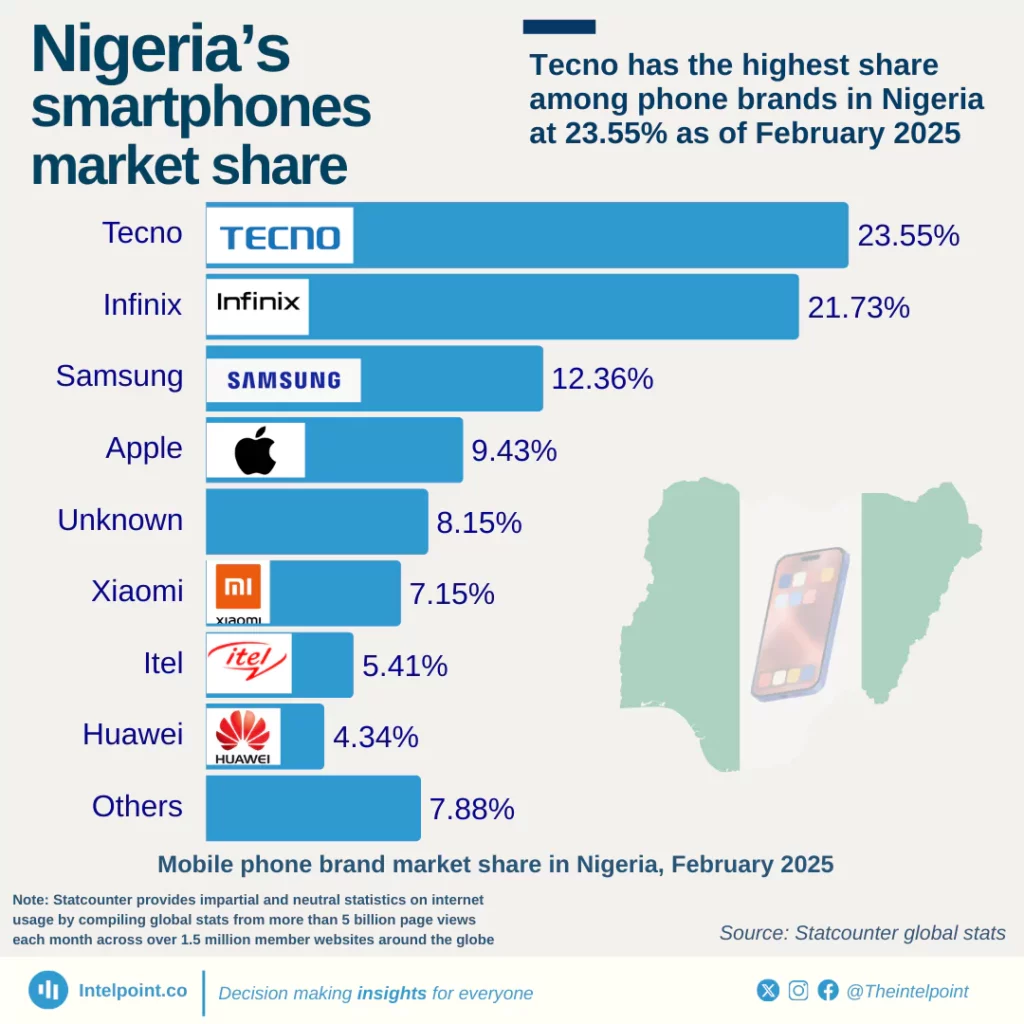
    Countries by Global Innovation Index 2024

    The Global Innovation Index 2024 reveals a striking contrast in innovation performance between countries globally and across Africa. Switzerland leads the global rankings with an impressive score of 67.5, followed by Sweden (64.5) and the USA (62.4), highlighting their sustained investments in research, development, and technological advancement.

    In Africa, Mauritius takes the top spot with a score of 30.5, followed closely by Morocco (28.8) and South Africa (28.3). However, even Africa's most innovative nations achieve less than half the score of global leaders, indicating a significant innovation gap.

    Nigeria ranks 15th in the African ranking and 113th globally, out of 133 countries, with a score of 17.1.
    See more

  • The FAAC's revenue distribution from 2017 to August 2023 highlights the dominance of Delta, Akwa Ibom, Rivers, and Bayelsa states in allocations. Despite Lagos' economic prominence, it ranked fifth. Here is the distribution of revenue among states between 2017 and August 2023.

    See more
  • MTN Nigeria has dominated the country's telecommunications market over the years, accounting for the largest market share. All four operators, apart from 9mobile, recorded a significant increase in their subscriber base between May 2014 and March 2024.

    See more
  • The 2024 Global Peace Index reveals a decline in peacefulness in 97 countries, the highest since the index began.

    Nigeria is among the nations affected by regional conflicts and rising violence. With a peace index score of 2.91, Nigeria is facing increasing challenges.

    A deteriorating peace score impacts foreign investment and economic stability. Global economic losses due to violence reached $19.1 trillion in 2023.

    See more

Other Insights
  • North America leads globally with 60.2% iPhone usage, making it the largest iPhone market.
  • Oceania follows at 58.9%, showing similar consumer preferences to North America.
  • Africa has the lowest iPhone share (14.7%), highlighting a significant adoption gap.
  • Nigeria aligns with the continental trend at 14.1%, reinforcing that the gap is structural, not country-specific.
See more

Key takeaways:

  • Nigeria recorded its first crude oil imports in a decade in 2025, marking a structural shift in trade dynamics.
  • Imports accounted for 11% of total crude oil trade in 2025.
  • Total crude oil trade grew sharply from ₦7 trillion in 2016 to ₦53.2 trillion in 2025, indicating long-term expansion.
  • Exports remain dominant, contributing ₦47.4 trillion in 2025 despite the emergence of imports.
  • 2024 was the peak year for crude oil trade at ₦55.3 trillion, followed by a slight decline in 2025.
  • The 2020 dip of ₦9.4 trillion highlights vulnerability to global shocks, likely tied to oil price and demand disruptions.
See more
  • Nominal spending surged, but inflation and naira depreciation eroded real gains. From ₦921 billion in 2012 to ₦6.57 trillion in 2025, the absolute figure may seem dramatic, but Nigeria's security challenges intensified over the same period.
  • Defence commanded over 21% of the budget in 2013. From 2024 to 2026, that figure has fallen below 14%, with 2026 hitting a historic low of 9.3%.
  • Boko Haram, banditry, and separatist tensions peaked in 2020, resulting in a cut that saw defence's share fall to just 9.2%, the lowest on record at that point.
  • The jump to ₦6.57trn (13.2%) in 2025 marks the sharpest year-on-year absolute increase in the dataset. But 2026 reversed this again, with the rate dropping to 9.3%.
See more
  • The 2019 number revealed the truth — years of underdiagnosis were corrected in a single year when PEPFAR restructured testing entirely.
  • The 76% decline from 2019 to 2024 is one of the most significant HIV reductions in Africa in a single decade.
  • One year of disruption in 2020 erased an entire year of progress, creating a backlog that took until 2022 to clear.
  • With PEPFAR's $1.2 billion pipeline cut, fewer Nigerians are being tested, meaning fewer cases appear on paper while the virus spreads undetected.
See more
  • Nigeria recorded the largest petrol price increase in Africa, rising 39.5% between February 23 and March 16, 2026.
  • Egypt experienced a 14.3% increase, making it one of the largest price jumps in Africa.
  • Nigeria’s increase is more than double that of Egypt.
  • A number of African countries recorded very small price changes, including Tanzania (2.7%), Morocco (2.1%), and South Africa (1%).
  • A few countries actually saw declines in fuel prices, including Madagascar (-3.9%) and Zambia (-4.6%).
  • During the period, petrol prices remained unchanged in 28 African countries.
See more
  • 13 out of 35 AFCON tournaments (37.1%) have been won by host nations
  • A larger share — 22 tournaments (62.9%) — were won by visiting teams.
  • The early AFCON years (1960s–1980s) saw more frequent home wins compared to recent decades.
  • Egypt has the most home-soil victories (3), followed by Ghana (2)
  • Despite high expectations, several hosts have failed to win.
  • Hosting provides crowd support and familiarity, but also brings heightened expectations and pressure.
See more
  • Bola Tinubu won the 2023 election with just 36.6% of the valid votes.
  • There is a clear downward trend in winners’ vote share since 2011, with each election producing a less dominant winner.
  • Peak dominance occurred in 2007, when Umaru Musa Yar'Adua won with 69.6% of the votes.
  • The total votes secured by winners have dropped sharply, from over 24 million (2003–2007) to 8.8 million in 2023.
  • In 2023, over 60% of valid votes went to candidates who lost.
See more
  • Nigeria’s youngest serving governor is Usman Ahmed Ododo of Kogi state at 48 years old.
  • The oldest serving governors are Bala Mohammed and Hope Uzodimma, both aged 67.
  • President Bola Ahmed Tinubu is 73 years old, making him older than every sitting governor.
  • Tinubu is 25 years older than the youngest governor and six years older than the oldest governors.
  • A number of governors are in their late 50s, including Seyi Makinde, Hyacinth Alia, and Ahmadu Umaru Fintiri.
  • The age distribution suggests that Nigeria’s state leadership is largely dominated by experienced, older political figures rather than younger politicians.
See more
  • The All Progressives Congress (APC) currently controls 31 out of Nigeria’s 36 state governors' seats.
  • This means about 86.1% of Nigeria’s governors belong to the APC, showing the party’s strong dominance at the state level.
  • Only five states are governed by parties other than the APC.
  • The People's Democratic Party governs two states, making it the largest opposition presence among governors.
  • The Labour Party, APGA, and Accord Parties control one state governorship each.
  • With most states now aligned with the ruling party, the balance of political power at the state level in Nigeria is heavily tilted toward the APC.
See more
  • Crude oil alone accounts for 55.7% of all exports. Remove it and Nigeria runs a ₦26.7tn trade deficit. The entire surplus rests on one commodity.
  • Nigeria imports ₦31.97tn in manufactured goods but exports only ₦2.50tn, a 12-to-1 ratio that reflects near-total dependence on foreign industrial output.
  • Nigeria exports ₦25.3tn in petroleum products yet imports ₦13.3tn of refined petroleum. Africa's top oil producer still can't fully process its own crude.
  • Despite Nigeria's vast farmland, agri-exports (₦5.07tn) barely exceed agri-imports (₦4.76tn). The sector earns almost nothing net.
See more
  • Over 85x growth in 20 years; total pension contributions grew from ₦15.6 billion in 2004 to ₦1.37 trillion in 2024.
  • In Q1–Q3 2025, private-sector contributions (₦744 billion) surpassed those of the public sector (₦574 billion).
  • Contributions declined in 2015 and 2016 as crashing oil revenues choked government remittances, and again in 2021 amid COVID-19 disruptions.
  • Each time, the system recovered within a year, proving its foundations hold even under severe macro pressure
See more
  • Life Business was the single largest segment, and its 70.3% jump signals that more Nigerians are thinking seriously about financial protection for their families.
  • Miscellaneous, the smallest segment, posted the biggest growth at 86.7%, suggesting new and unconventional insurance products are gaining serious traction.
  • Aviation & Marine nearly doubled, with 79.9% growth in a sector tied to trade and logistics, reflecting Nigeria's expanding import/export activity and the rising cost of cargo and aircraft risk coverage.
  • Motor (52.5%), Fire (53.3%), and General Accident (49.6%) grew by roughly half, indicating broad-based sector expansion rather than isolated pockets of growth.
See more
1 2 3 4 5 6 126
  • East Africa has the highest Crime Index in Africa (6.02).
  • North Africa is experiencing the fastest rise in criminality (+0.57 since 2019).
  • West Africa remains one of the most exposed regions (5.49).
  • Southern Africa has the lowest index (4.88) but is still increasing.
  • All African regions recorded an increase in criminality between 2019 and 2025.
Read more
  • Lagos dominates Nigeria’s subnational debt profile, accounting for 26.1% of domestic debt and 21.8% of external debt.
  • Six states account for 52% of domestic debt.
  • The same group contributes 40% of the external debt
  • Rivers ranks second in domestic debt (9.5%) but has a significantly lower external debt (3.8%).
  • Kaduna emerges as a major external borrower (13.7%) despite not appearing among the top domestic debt states.
Read more
  • Africa accounts for 3% of Nobel laureates despite being home to 18% of the world's population.
  • South Africa leads with 11 of the continent's 30 wins.
  • Peace accounts for 13 wins, with Africa recognised most for its resilience and moral courage.
  • Science remains the next frontier, with just eight wins across medicine, physics, and chemistry.
Read more
  • Sudan leads globally with 10.1 million IDPs.
  • 6 out of 14 countries with over 1 million IDPs are in Africa.
  • Syria has the highest displacement intensity (26.2% of its population).
  • Nigeria’s 3.6 million IDPs are large in absolute terms but represent only 1.5% of its population.
  • DR Congo (5.2mn) and Somalia (3.5mn) continue to face chronic, multi-year displacement crises.
  • Non-African countries like Colombia (7.1 million) and Ukraine (3.8 million) show that displacement is a global issue.
Read more
  • Company income tax collections rose from ₦1.7tn in 2022 to ₦5.0tn in 2025.
  • Finance & Insurance more than doubled its share, from 12.4% to 30.0%.
  • Finance became the largest single sector in the tax mix by 2025.
  • Manufacturing remained important, but its share fell from 27.9% to 17.7%.
  • ICT saw one of the sharpest declines, from 21.6% to 6.5%.
  • Mining & quarrying gained weight, rising from 8.4% to 14.5%.
  • Wholesale & retail also increased, from 3.6% to 7.0%.
  • The tax base became less evenly distributed across sectors.
Read more
  • Illegal lab-made drugs are Nigeria’s highest-scoring crime market at 8.5.
  • Six other markets score 8.0, showing broad criminal-market severity.
  • Human trafficking remains one of Nigeria’s most entrenched illicit markets.
  • Financial crimes also remain a top-tier threat with a score of 8.0.
  • Resource-related criminality is also severe, with non-renewable resource crimes at 8.0. Wildlife crime is not marginal; it scores 7.5.
  • Cyber-dependent crimes are lower than the top criminal markets, but still elevated at 6.5.
Read more
1 2 3 4 5 6 252

Can’t find what you’re looking for? Please fill the form below
Contact Form Demo
SIGN UP TO OUR NEWSLETTER
Get periodic updates about the African startup space, access to our reports, among others.
Subscribe Here
Subscription Form

A product of Techpoint Africa. All rights reserved