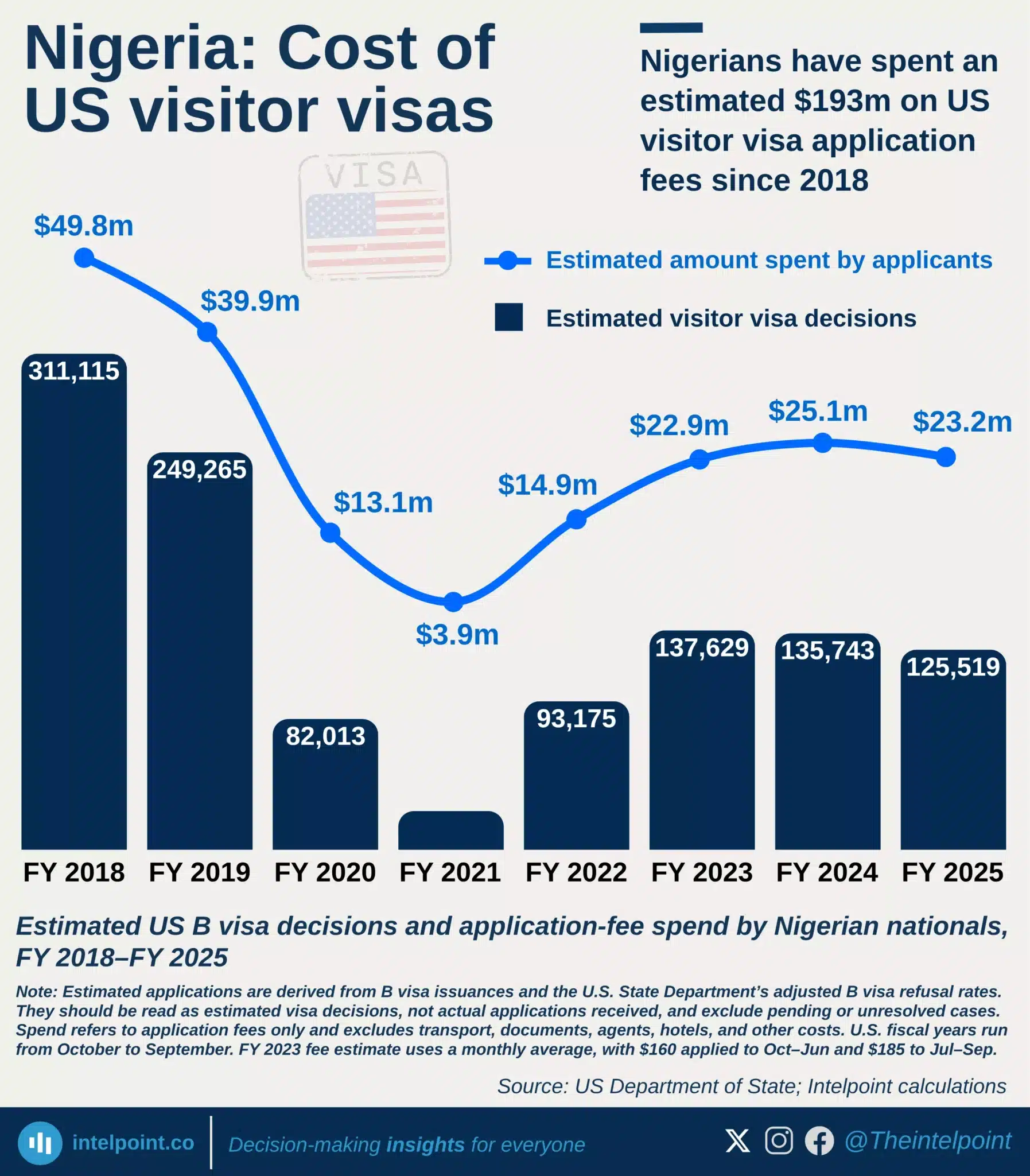
Nigerians have spent an estimated $193 million on U.S. visitor visa application fees since 2018

  • Estimated visitor visa fee spending reached $193 million between FY 2018 and FY 2025.
  • Applicants paid the fee whether their visas were approved or refused.
  • Estimated spending peaked at $49.8 million in FY 2018.
  • Spending recovered to $25.1 million in FY 2024 before falling to $23.2 million in FY 2025.
  • The estimates exclude transport, documents, agents, accommodation and other related costs.

Nigerians spent an estimated $193 million on US visitor visa application fees between FY 2018 and FY 2025.

For most of the period, each B visa application cost $160, before the fee increased to $185 in June 2023. Applicants paid this fee whether their visa was approved or refused.

The estimates cover B visa applications that received a decision, based on visa issuances and adjusted refusal rates. Estimated spending peaked at $49.8 million in FY 2018, fell sharply during the pandemic, and recovered to $25.1 million in FY 2024 before easing to $23.2 million in FY 2025.

The figures exclude pending or unresolved cases and do not include transport, documents, agents, accommodation, or other related costs.
Source:

US Department of State, Intelpoint calculations

Period:

FY 2018-FY 2025
HTML code to embed chart
Want a bespoke report?
Reach out
Tags
Related Insights

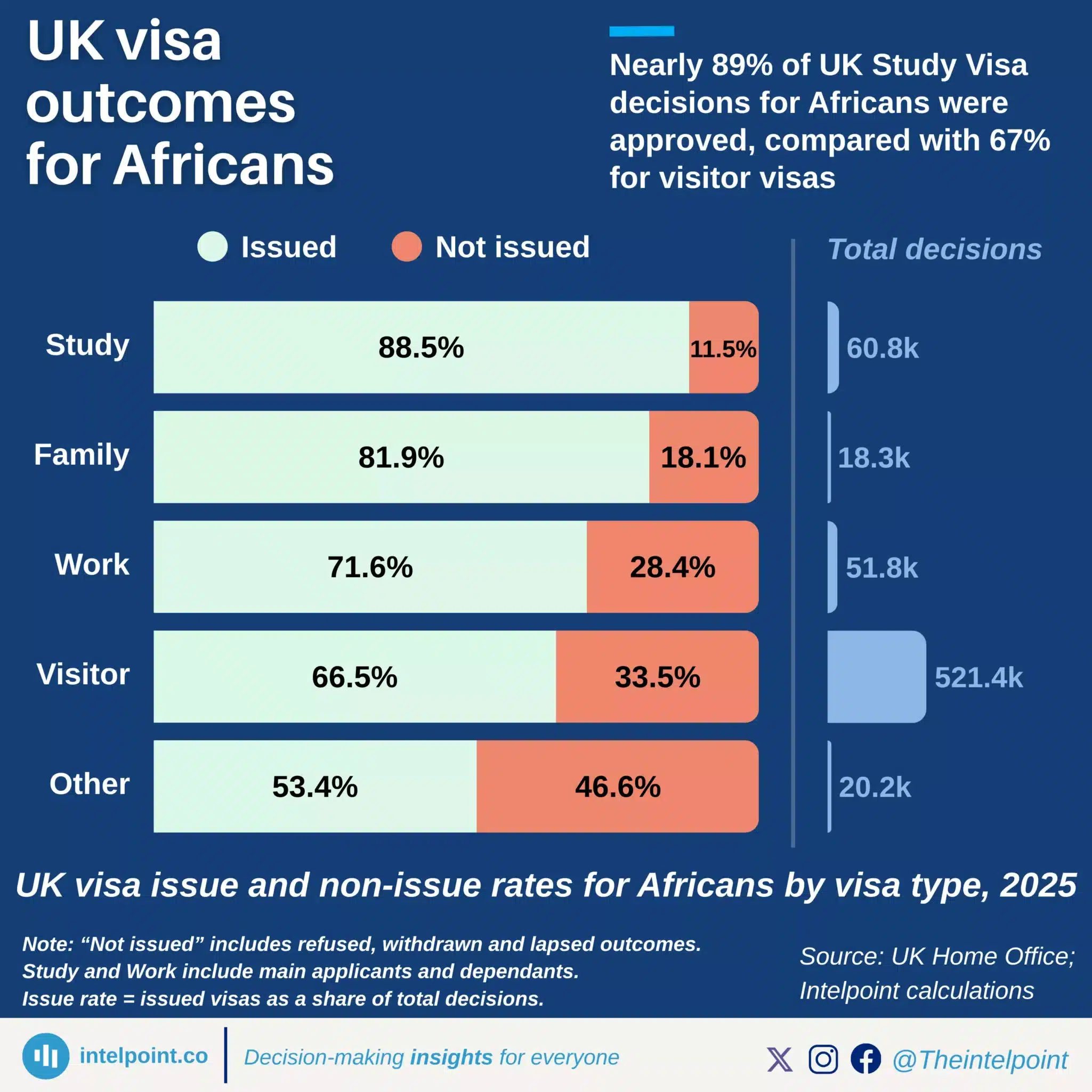
Nearly 89% of UK Study Visa decisions for Africans were approved, compared with 67% for visitor visas
  • The UK made 672,400 visa decisions involving African applicants in 2025.
  • Visitor visas dominated the decisions, accounting for 521,400, or about 78% of the total.
  • Study visas had the highest issue rate, with 88.5% of decisions resulting in issued visas.
  • Visitor visas had a much lower issue rate at 66.5%, despite having the largest decision volume.
  • Work visa decisions had a 71.6% issue rate, below the global work visa average of 86.5%.
  • Other visa routes had the lowest issue rate, with only 53.4% of decisions resulting in issued visas.

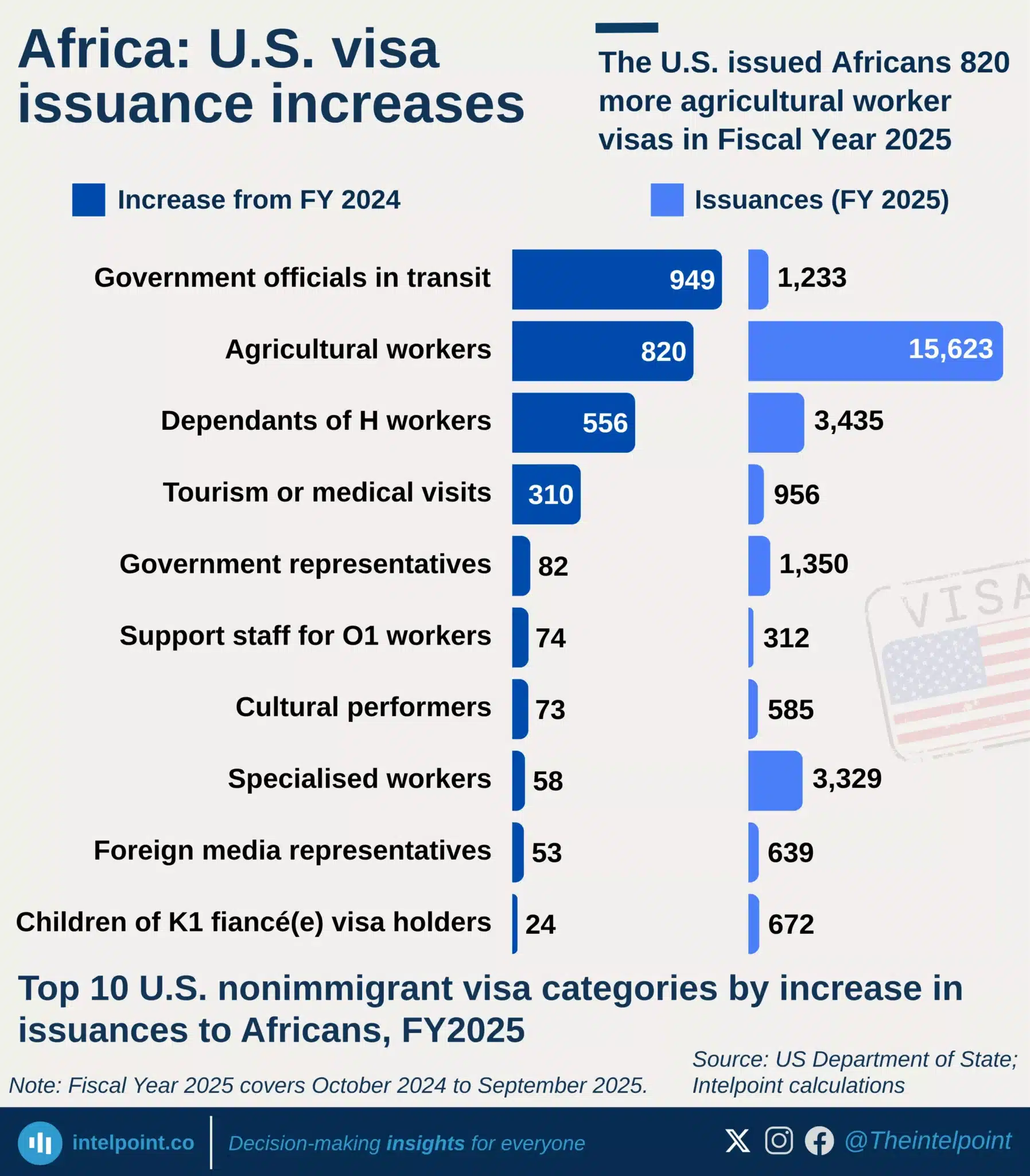
The U.S. issued Africans 820 more agricultural worker visas in Fiscal Year 2025
  • U.S. nonimmigrant visa issuances to Africans fell by 23.6% to 413,259.
  • Twenty-five visa categories still recorded increases despite the overall decline.
  • C3 visas posted the largest numerical increase, rising by 949.
  • H2A agricultural worker visas increased by 820 to 15,623.
  • B1/B2 visitor visas recorded the biggest decline, falling by 109,653.

14 African nations affected as the US expands temporary visa restrictions to include Nigeria
  • Africa is the hardest-hit region, with 14 countries under partial visa restrictions, including Nigeria, limiting travel for business, tourism, and study.
  • Temporary bans target B‑1/B‑2 visas for business and tourism, and may also affect F‑1 student, M‑1 vocational, and J exchange visitor visas, impacting students, trainees, and cultural exchange participants.
  • Other affected regions include the Caribbean, Asia, and South America, showing the temporary restrictions span multiple continents.
  • Exemptions exist for lawful permanent residents, diplomats, and travellers with valid pre-existing visas, so not all citizens from these countries are blocked from entering the US.
 

Nearly 2.8 million African-born immigrants live in the US as of 2023, led by Nigeria, Ethiopia, and Egypt
  • In 2023, the total number of African-born immigrants in the US was about 2.79 million.
  • Western Africa is the largest source region, contributing 1.08 million immigrants (39%), led by Nigeria (476k).
  • Eastern Africa is the second-largest source (28%), dominated by Ethiopia (278.2k).
  • Northern Africa accounts for 17%, mainly from Egypt (225.7k).
  • Central Africa contributes 8%, with Cameroon (90.7k) as the top country.
  • Southern Africa is smaller at 5%, almost entirely from South Africa (133.4k).
  • Five countries—Nigeria, Ethiopia, Egypt, Cameroon, and South Africa—together make up nearly half of all African-born immigrants in the US.

H-1B visa programme shows rising demand with 427k petitions filed in 2024
  • Petitions peaked in 2022, with 474,301 filed, but only 442,043 approved, marking the widest gap in the five-year period.
  • 2021 was unique, as approvals (407,071) actually exceeded the number of petitions filed (398,269), reflecting carryovers or adjustments from prior years.
  • 2023 saw the lowest filings and approvals, at just under 387,000 each, signalling reduced demand or stricter caps.
  • By 2024, filings rebounded to over 427,000, but approvals lagged at 399,402, continuing the trend of more petitions being filed than granted.

Nigerian nationals received 880 H-1B visas in FY 2024, with the highest number of approvals recorded in December 2023
  • Nigeria received a total of 880 H-1B visas in FY 2024, averaging about 73 per month.
  • December 2023 was the peak month, with 118 issuances, while June 2024 recorded the lowest at just 46.
  • Issuances fluctuated throughout the year, reflecting no clear upward trend but significant month-to-month volatility.
  • Despite peaks and dips, overall activity remained steady, with most months ranging between 60–90 approvals.

POPULAR TOPICS
SIGN UP TO OUR NEWSLETTER
Get periodic updates about the African startup space, access to our reports, among others.
Subscribe Here
Subscription Form

A product of Techpoint Africa. All rights reserved