Bite-sized Insights about
 
Providing you with data-based insights about things happening around you.
Popular Insights
  • Africa's sanitation crisis is alarming, with 17 of the top 20 countries having the highest open defecation rates.

    Eritrea (67%), Niger (65%), and Chad (63%) lead, putting millions at risk of disease.

    Even Nigeria, the most populous African country, has 18% of its population practising it.

    See more
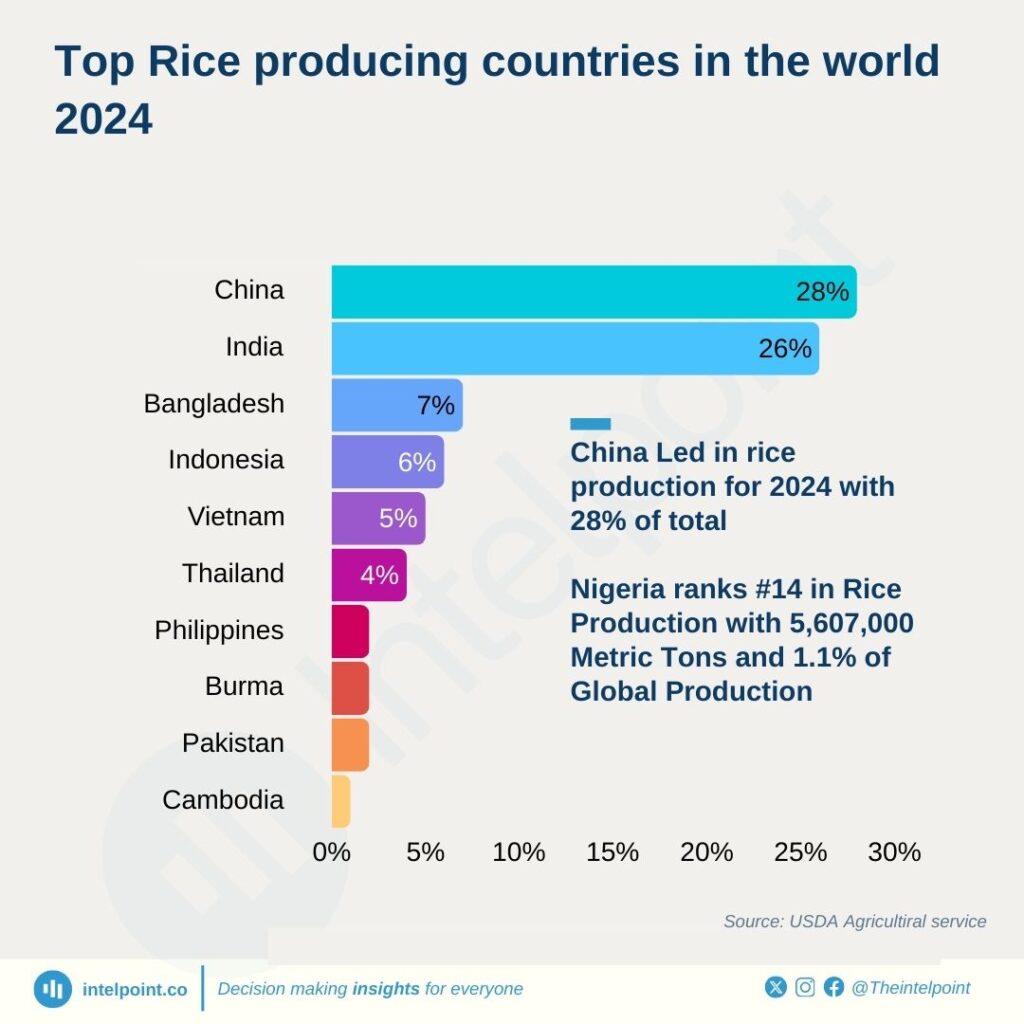
    top rice producing countries for 2024
    • 1990-2000: In this decade, China and India accounted for over 50% of the world's total output, with other dominant rice producers being Indonesia, Vietnam, and Bangladesh, with production figures falling between 20 and 30 million metric tons.
    • 2001-2010: China and India remained the two top producers, with China producing 140 million metric tons annually and India 100 million metric tons annually. 
    • 2011-2020: China and India continue to lead at about 150 million and 105 million metric tons, respectively. 
    • 2021-2024: China and India continued to lead. China reached 144.62 million metric tons in 2023/2024, and India accounted for 137.83 million metric tons.
    See more
  • The 2024 Global Peace Index reveals a decline in peacefulness in 97 countries, the highest since the index began.

    Nigeria is among the nations affected by regional conflicts and rising violence. With a peace index score of 2.91, Nigeria is facing increasing challenges.

    A deteriorating peace score impacts foreign investment and economic stability. Global economic losses due to violence reached $19.1 trillion in 2023.

    See more

    The FAAC's revenue distribution from 2017 to August 2023 highlights the dominance of Delta, Akwa Ibom, Rivers, and Bayelsa states in allocations. Despite Lagos' economic prominence, it ranked fifth. Here is the distribution of revenue among states between 2017 and August 2023.

    See more
  • A Trend of Adult literacy rates of African countries

    Between 2018 and 2021, adult literacy rates across African nations exhibited significant disparities. Seychelles and South Africa led with literacy rates of 96% and 95%, respectively, indicating a high proportion of literate adults. Conversely, Chad had the lowest literacy rate during this period.

    These statistics underscore the uneven progress in educational attainment across Africa, highlighting the need for targeted interventions to improve literacy in lower-performing nations.

    See more
    Countries by Global Innovation Index 2024

    The Global Innovation Index 2024 reveals a striking contrast in innovation performance between countries globally and across Africa. Switzerland leads the global rankings with an impressive score of 67.5, followed by Sweden (64.5) and the USA (62.4), highlighting their sustained investments in research, development, and technological advancement.

    In Africa, Mauritius takes the top spot with a score of 30.5, followed closely by Morocco (28.8) and South Africa (28.3). However, even Africa's most innovative nations achieve less than half the score of global leaders, indicating a significant innovation gap.

    Nigeria ranks 15th in the African ranking and 113th globally, out of 133 countries, with a score of 17.1.

    See more

  • A Trend of Adult literacy rates of African countries

    Between 2018 and 2021, adult literacy rates across African nations exhibited significant disparities. Seychelles and South Africa led with literacy rates of 96% and 95%, respectively, indicating a high proportion of literate adults. Conversely, Chad had the lowest literacy rate during this period.

    These statistics underscore the uneven progress in educational attainment across Africa, highlighting the need for targeted interventions to improve literacy in lower-performing nations.

    See more
  • MTN Nigeria has dominated the country's telecommunications market over the years, accounting for the largest market share. All four operators, apart from 9mobile, recorded a significant increase in their subscriber base between May 2014 and March 2024.

    See more
  • The 2024 Global Peace Index reveals a decline in peacefulness in 97 countries, the highest since the index began.

    Nigeria is among the nations affected by regional conflicts and rising violence. With a peace index score of 2.91, Nigeria is facing increasing challenges.

    A deteriorating peace score impacts foreign investment and economic stability. Global economic losses due to violence reached $19.1 trillion in 2023.
    See more

Other Insights
  • South Africa leads in headcount, with seven billionaires, more than other African countries.
  • Nigeria leads in wealth, with four billionaires worth $47.5 billion, $4.5 billion more than the combined $43 billion of South Africa's seven billionaires.
  • Nigeria's billionaires are richer individually, with an average net worth of $11.9 billion, compared with South Africa's $6.1 billion.
  • North Africa punches below its weight: Egypt, Morocco, and Algeria have ten billionaires combined but just $31.4 billion in total wealth.
  • East Africa barely registers: Tanzania and Zimbabwe each have just one billionaire, both worth $2.1 billion.


See more

Fuel prices from Dangote Refinery reached an all-time high of ₦1,175 per litre in March 2026.

The lowest recorded price in the period was ₦699 per litre in December 2025, showing a wide price swing.

The jump from ₦699 to ₦1,175 happened in roughly four months.

  • Prices earlier in the timeline hovered mostly between ₦820 and ₦987 during late 2024 and much of 2025.
  • The December 2025 price cut was aimed at making locally refined fuel more competitive against imports.
  • After the price drop, fuel costs began rising again in early 2026, reaching ₦995 by early March before climbing further.
  • Global geopolitical tensions affecting oil markets contributed to the upward pressure on prices.
See more
  • Internationally authorised Nigerian banks have raised and injected over ₦3.3 trillion in new capital since March 2024.
  • The recapitalisation exercise is being driven by the Central Bank of Nigeria’s requirements, with the deadline expected in March 2026.
  • Zenith Bank currently has the highest capital among the banks shown, reaching about ₦614 billion.
  • Access Holdings has about ₦602.8 billion in total capital.
  • Fidelity Bank raised the largest single capital injection in the group, about ₦437.85 billion, pushing its total capital to ₦564.5 billion.
  • FCMB has the highest previous capital base among the banks listed (₦266.5 billion) before the recapitalisation injection.
See more
     
  • The Strait of Malacca is the world’s most important oil chokepoint, carrying about 24–25% of global oil supply in recent years.
  • The Strait of Hormuz moves around 20–23% of global oil supply, making it the second-largest energy transit chokepoint.
  • The Cape of Good Hope carries about 9–10% of global oil flows, and its share tends to increase when other chokepoints face disruptions.
  • The Bab el-Mandeb saw a sharp drop in oil flow share from about 9% in 2023 to around 4% in 2024, reflecting security concerns affecting shipping in the Red Sea corridor.
  • Oil transported through the Suez Canal and the SUMED pipeline system dropped significantly after 2023, falling from about 8.6% to below 5%, showing how quickly routes shift during geopolitical tensions.
  • The Strait of Malacca’s share has remained consistently high and stable, indicating its structural importance to Asian energy demand.
  • Alternative routes like the Cape of Good Hope in South Africa are longer but strategically crucial, especially when Middle Eastern chokepoints become unstable.
See more
  • Seven of nine exchanges posted positive growth, signalling broad-based expansion across African equity markets in 2025.
  • Ghana Stock Exchange led all exchanges in growth rate, rising 133.86% across the year — the sharpest single-year gain in this dataset.
  • The Johannesburg Stock Exchange closed Q4 at $1.3 trillion, making it by far the largest exchange on the continent by market capitalisation.
  • The Stock Exchange of Mauritius and MERJ Exchange (Seychelles) were the only two exchanges to contract, declining 2.61% and 8.02% respectively.
See more
  • Life Business was the single largest segment, and its 70.3% jump signals that more Nigerians are thinking seriously about financial protection for their families.
  • Miscellaneous, the smallest segment, posted the biggest growth at 86.7%, suggesting new and unconventional insurance products are gaining serious traction.
  • Aviation & Marine nearly doubled, with 79.9% growth in a sector tied to trade and logistics, reflecting Nigeria's expanding import/export activity and the rising cost of cargo and aircraft risk coverage.
  • Motor (52.5%), Fire (53.3%), and General Accident (49.6%) grew by roughly half, indicating broad-based sector expansion rather than isolated pockets of growth.
See more
  • Export values have grown over 400%, rising from ₦11.8 trillion in 2013 to a peak of ₦55.3 trillion in 2024, a fivefold increase driven by rising oil prices and a weaker naira.
  • 2015 and 2016 were the hardest years, with export values crashing as low as ₦6.8 trillion in 2015, reflecting the brutal impact of the global oil price collapse on Nigeria's most critical export.
  • The most explosive growth came from 2023 onwards, with values surging past ₦29 trillion in 2023 and peaking at ₦55.3 trillion in 2024, largely driven by the naira depreciation following Nigeria's 2023 foreign exchange reforms.
  • The first nine months of 2025 saw a slower pace than the previous year, with ₦37.7 trillion recorded between Q1 and Q3, lower than the ₦41.5 trillion recorded during the same period in 2024.
See more
 
  • Local companies dominated CIT contributions in most years, accounting for over 50% of payments in 9 of 11 periods between 2015 and 2025 (Q1–Q3).
  • Foreign companies briefly closed the gap in 2023, contributing 49%, the closest they have come to matching local firms.
  • Local companies recorded their strongest share in 2021 at 65%, marking the widest gap between local and foreign contributors.
  • “Other payments” peaked during the pandemic, rising to 17% in 2020 before dropping to 0% from 2022 onward.
See more
  • The highest number of grid collapses in the past 16 years occurred in 2010, with 42 incidents recorded.
  • During Goodluck Jonathan’s administration, Nigeria’s grid collapsed an average of 24.4 times a year, the highest among the three administrations.
  • Under Muhammadu Buhari, the annual average dropped to 12.8 collapses per year, indicating improved grid stability compared to earlier years.
  • Under Bola Ahmed Tinubu, the average has fallen further to about 6.7 collapses annually.
  • 2016 recorded the highest number of collapses during the Buhari administration, with 28 incidents.
  • The most stable years in the dataset were 2020 and 2021, with only four collapses each.
See more
  • 26 companies on NGX are valued above ₦1 trillion.
  • MTN Nigeria leads at ₦16.38 trillion, making it the most valuable listed company.
  • The top three firms (MTN Nigeria, BUA Foods, and Dangote Cement) are far ahead of the rest, each exceeding ₦13 trillion.
  • 9 of the 26 companies are in the financial services sector.
  • Telecoms and manufacturing dominate the upper tier, highlighting infrastructure and essential services as market anchors.
  • Energy companies are firmly positioned, reflecting their central role in the economy.
  • Market concentration is high, as a few giants carry disproportionate weight relative to the 122 sub-₦1 trillion firms.
  • Sector diversity exists within the top 26, but most belong to industries tied to basic economic activity rather than emerging tech or high-growth startups.
See more
 
  • Over 551,800 Africans were recruited by European powers during World War I.
  • Approximately 86,100 African recruits died, representing a 13.5% fatality.
  • North Africa supplied the most recruits (260,000), slightly ahead of West Africa (250,600).
  • West Africa recorded the highest deaths (36,500) among the regions.
  • East Africa contributed 117,900 recruits, with 13,200 deaths.
  • Southern Africa’s involvement was significantly smaller — 9,500 recruits and 560 deaths.
  • Africa’s participation was geographically uneven, shaped by colonial control and military strategy.
  • More than one in eight recruits did not return, highlighting the human cost beyond battlefield narratives.
See more
  • Nigeria’s 2026 defence budget is $3.9 billion, placing it far below the top global spenders.
  • It is just 0.5% of the US’ $831.5 billion budget, highlighting a massive scale difference.
  • Compared to China ($303 billion), Nigeria’s budget is only 1.3%.
  • Nigeria’s allocation equals 1.8% of Russia’s $212.6 billion allocation.
  • Even a mid-tier top spender like Australia ($57.4 billion) has a budget almost 15x Nigeria’s.
  • Nigeria’s budget is only 3.6% of India’s $109 billion defence allocation.
  • European powers such as the UK ($88.5 billion), France ($67.2 billion), and Germany ($127.4 billion) all have defence budgets that dwarf Nigeria’s allocation
See more
1 3 4 5 6 7 126
  • Nigeria’s total VAT rose from ₦2.5tn in 2022 to ₦8.6tn in 2025.
  • VAT collections more than tripled in four years.
  • Local VAT remained the largest source of VAT throughout the period.
  • Local VAT increased from ₦1.5tn to ₦4.5tn.
  • Local VAT averaged 54.4% of total VAT between 2022 and 2025.
  • Import VAT also grew strongly, from ₦521.5bn to ₦2.0tn.
  • Other payment channels rose from ₦510.8bn to ₦2.1tn.
  • VAT growth is increasingly being driven by non-import activity.
Read more
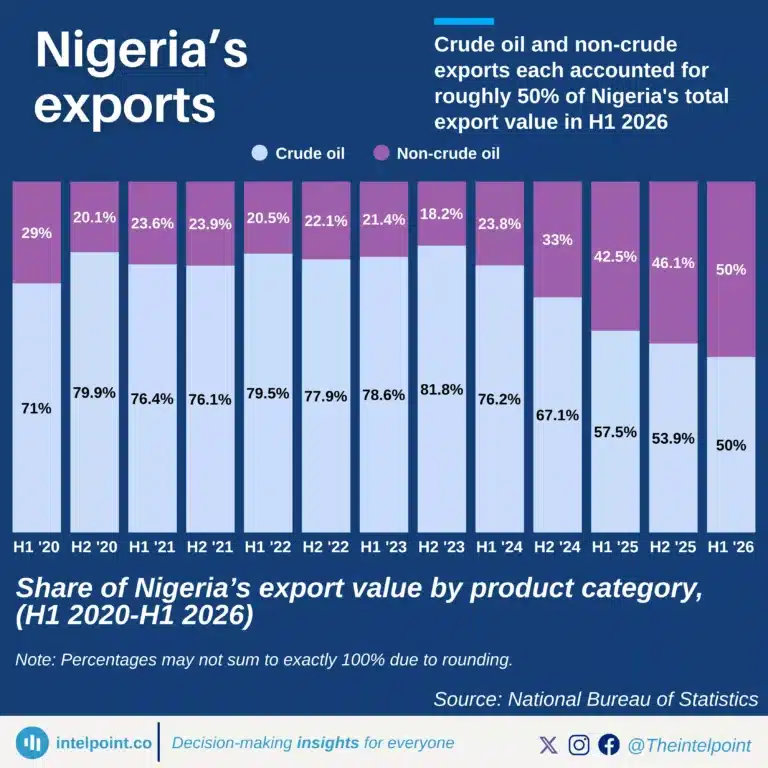
  • In 2025, non-oil export growth (36%) was 6x higher than oil (6%).
  • In 2024, non-oil exports grew by 189% vs oil’s 108%.
  • Total exports still heavily depend on oil.
  • Export value rose from ₦36 trillion in 2023 to ₦85.1 trillion in 2025.
Read more
  • Global terrorism deaths declined significantly by about 27.6%, from 7,714 in 2024 to 5,582 in 2025.
  • Nigeria recorded a sharp 46.2% increase in terrorism-related deaths, rising from 513 to 750.
  • Burkina Faso saw a major decline of 44.8%, dropping from 1,532 to 846 deaths.
  • Niger also improved, with deaths falling by 25.5% to 703.
  • Democratic Republic of the Congo recorded an increase of 27.9%, showing mixed trends within Africa.
  • Pakistan saw a slight increase of 5.7%, indicating relatively stable but still elevated risk.
Read more
  • Sudan has the highest displacement burden in Africa, with 10.1 million IDPs and 20% of its population affected.
  • Somalia follows with 18.4% of its population displaced.
  • High-intensity displacement is concentrated in conflict-prone regions like the Sahel and the Horn of Africa.
  • Burkina Faso (8.8%) and the Central African Republic (8.4%) show how smaller countries can face severe proportional impact.
  • Nigeria’s 3.6 million IDPs are one of the largest in absolute terms, but at 1.5%, the relative impact is lower than many peers.
Read more
  • Agriculture’s share of Nigeria’s capital imports peaked at 5.46% in 2021
  • After 2025, agriculture's share started falling sharply, reaching 0.72% in 2025.
  • Between 2017 and 2021, the sector experienced consistent growth in both value and share.
  • Capital import value peaked at at $489.9 million in 2019.
Read more
  • Africa ranks last globally in governance quality with a score of 0.4.
  • Europe and North America (0.668) outperform Africa by a significant margin.
  • Nigeria ranks 116th out of 120 countries.
  • Governance directly affects economic outcomes such as investment, business growth, and living standards.
Read more
1 3 4 5 6 7 252

Can’t find what you’re looking for? Please fill the form below
Contact Form Demo
SIGN UP TO OUR NEWSLETTER
Get periodic updates about the African startup space, access to our reports, among others.
Subscribe Here
Subscription Form

A product of Techpoint Africa. All rights reserved