Bite-sized Insights about
 
Providing you with data-based insights about things happening around you.
Popular Insights
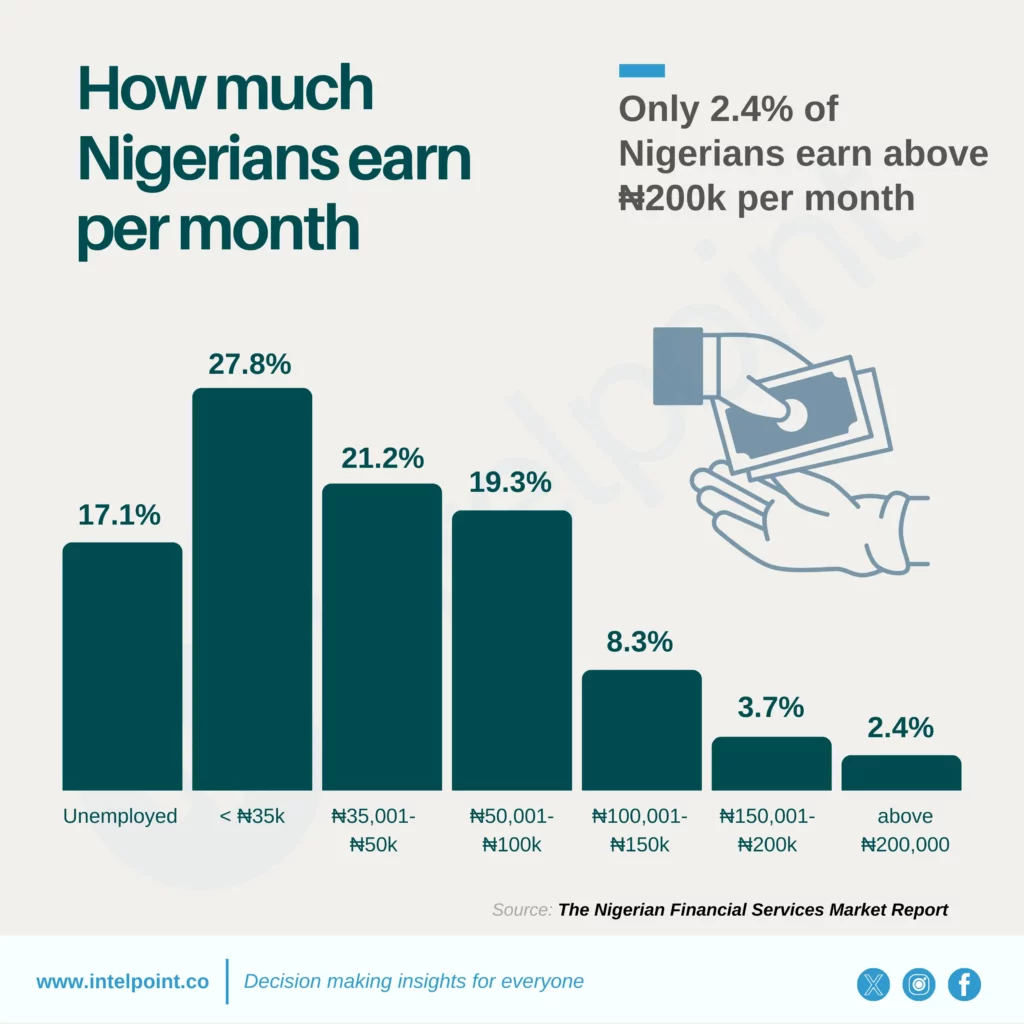
  • Only 10% of Nigerians earn above ₦100,000, according to the Nigerian Financial Services Market Report. This aligns with most reports about Nigeria, and it's in sharp contrast to the narratives online.
    See more

    MTN Nigeria has dominated the country's telecommunications market over the years, accounting for the largest market share. All four operators, apart from 9mobile, recorded a significant increase in their subscriber base between May 2014 and March 2024.

    See more
  • The 2024 Global Peace Index reveals a decline in peacefulness in 97 countries, the highest since the index began.

    Nigeria is among the nations affected by regional conflicts and rising violence. With a peace index score of 2.91, Nigeria is facing increasing challenges.

    A deteriorating peace score impacts foreign investment and economic stability. Global economic losses due to violence reached $19.1 trillion in 2023.

    See more

    The FAAC's revenue distribution from 2017 to August 2023 highlights the dominance of Delta, Akwa Ibom, Rivers, and Bayelsa states in allocations. Despite Lagos' economic prominence, it ranked fifth. Here is the distribution of revenue among states between 2017 and August 2023.

    See more
  • A Trend of Adult literacy rates of African countries

    Between 2018 and 2021, adult literacy rates across African nations exhibited significant disparities. Seychelles and South Africa led with literacy rates of 96% and 95%, respectively, indicating a high proportion of literate adults. Conversely, Chad had the lowest literacy rate during this period.

    These statistics underscore the uneven progress in educational attainment across Africa, highlighting the need for targeted interventions to improve literacy in lower-performing nations.

    See more
    Countries by Global Innovation Index 2024

    The Global Innovation Index 2024 reveals a striking contrast in innovation performance between countries globally and across Africa. Switzerland leads the global rankings with an impressive score of 67.5, followed by Sweden (64.5) and the USA (62.4), highlighting their sustained investments in research, development, and technological advancement.

    In Africa, Mauritius takes the top spot with a score of 30.5, followed closely by Morocco (28.8) and South Africa (28.3). However, even Africa's most innovative nations achieve less than half the score of global leaders, indicating a significant innovation gap.

    Nigeria ranks 15th in the African ranking and 113th globally, out of 133 countries, with a score of 17.1.

    See more

  • Only 10% of Nigerians earn above ₦100,000, according to the Nigerian Financial Services Market Report. This aligns with most reports about Nigeria, and it's in sharp contrast to the narratives online.
    See more
  • MTN Nigeria has dominated the country's telecommunications market over the years, accounting for the largest market share. All four operators, apart from 9mobile, recorded a significant increase in their subscriber base between May 2014 and March 2024.

    See more
  • The 2024 Global Peace Index reveals a decline in peacefulness in 97 countries, the highest since the index began.

    Nigeria is among the nations affected by regional conflicts and rising violence. With a peace index score of 2.91, Nigeria is facing increasing challenges.

    A deteriorating peace score impacts foreign investment and economic stability. Global economic losses due to violence reached $19.1 trillion in 2023.

    See more

Other Insights
  • Global oil consumption rose from about 30.9 million barrels per day in 1965 to 101.4 million barrels per day in 2024, more than tripling over the period.
  • Asia Pacific saw the biggest structural shift in global oil demand, increasing its share from 10.7% in 1965 to 37.9% in 2024 to become the world’s largest oil-consuming region.
  • Africa accounted for just 1.9% of global oil consumption in 1965 and 4.5% in 2024, staying below 5% for nearly 60 years.
  • The global centre of oil demand has gradually shifted away from Western economies toward Asia, reflecting industrialisation, urbanisation, and population growth across the region.
  • Africa’s modest share of global oil demand highlights the continent’s relatively low industrial energy consumption despite rapid population growth.
See more
  • South Africa’s Koeberg has been Africa’s only commercial nuclear power station since 1984.
  • Africa produced just 7.8 TWh of nuclear power in 2024, far below France’s 380 TWh and the US’ 823 TWh.
  • Egypt’s El Dabaa plant could change Africa’s nuclear map, adding 4,800 MW when completed.
  • Africa’s nuclear challenge is no longer just generation, but whether countries can finance, regulate, build, and sustain nuclear programmes.
See more
  • Nigeria recorded its highest terrorism-related fatalities in 2014 and 2015, with 2,101 and 2,003 deaths respectively.
  • Fatalities fell sharply after the peak years, but Nigeria has still averaged over 600 terrorism deaths annually since then.
  • Hostage incidents have become more prominent, reaching a series high of 455 hostages in 2024.
  • The data shows Nigeria’s terrorism problem has shifted from peak insurgency-era mass fatalities to persistent violence involving killings, kidnappings, and hostage-taking.
See more
  • Mauritius leads Africa on the Productive Capacities Index with a score of 55.02, ranking 56th globally.
  • Seychelles, South Africa, and Cape Verde complete Africa’s top four, but none enters the global top 50.
  • Nigeria ranks much lower at 167th globally, with a score of 30.68, despite being one of Africa’s largest economies.
  • The ranking shows that economic size does not always translate into stronger productive foundations like human capital, ICT, energy, transport, and institutions.
See more
  • Zimbabwe’s lithium production rose from 900 metric tons in 2014 to an estimated 28,000 metric tons in 2025.
  • Its share of global lithium production increased from 2.8% in 2014 to 9.7% in 2025.
  • The biggest jump came after 2023, with production rising from 3,400 metric tons to 22,000 metric tons in 2024.
  • Zimbabwe is now a much more important player in the global battery supply chain, driven by rising EV and energy storage demand.
See more
  • MTN held more than half of active mobile lines in most Nigerian states as of December 2025.
  • Ekiti recorded MTN’s highest share at 69.6%, followed by Imo at 64.1% and Anambra at 63.4%.
  • Borno was Airtel’s only leading state, with 56.9% of active mobile lines.
  • Globacom did not lead any state, but it had notable shares in Kogi, Edo, Ondo, FCT, and Oyo.
See more
  • MTN held over 50% of active internet subscriptions in most Nigerian states as of December 2025.
  • Ekiti had MTN’s highest share at 70.6%, followed by Imo at 64% and Anambra at 63.7%.
  • Borno was the only state where Airtel led, with 56.6% of active internet subscriptions.
  • Globacom did not lead any state, but it had notable shares in Edo, Kogi, Ondo, Oyo, and Bayelsa.


See more
  • Africa received 66% of IDA’s FY2025 commitments.
  • Africa’s total IDA allocation was $22.4 billion out of $33.8 billion.
  • Nigeria was the largest borrower from the DA globally, with $3.1 billion in loans.
  • Bangladesh ranked second with $3 billion.
  • Six of the top ten borrowers were African countries.
  • Nigeria accounted for 9.3% of total FY2025 IDA commitments.
See more
 
  • Domestic share rose steadily from 34% in 2021 to 45% in 2025, gaining eleven percentage points in five years.
  • Export share fell from 66% to 55%, losing ground every year without a single recovery.
  • 2023 was the sharpest single-year shift; domestic share jumped seven points, from 36% to 43%.
  • The gap between export and domestic share has narrowed from 32 to just 10 points.
See more
  • Oyo reduced external and domestic debt by the end of 2025.
  • External debt fell faster than domestic debt.
  • External debt declined more consistently over the period.
  • Oyo’s local debt peaked around 2022–2023 before falling back.
  • The state appears to have prioritised reducing FX exposure.
See more
  • Seychelles has Africa’s strongest passport.
  • Mauritius is the only other African country with a passport close to Seychelles'.
  • South Africa leads the mainland pack, but still trails the island leaders by a wide margin.
  • No country outside the top three crosses a mobility score of 100.
  • Visa-required destinations still dominate for every passport in the top ten, except Seychelles and Mauritius.
See more
  • Nigeria faces visa requirements in nearly half of Africa.
  • West Africa is Nigeria’s easiest mobility zone.
  • Beyond its West African neighbors, the Nigerian passport unlocks visa-free entry to only four other African nations
  • ECOWAS is the biggest reason for Nigeria’s visa-free access to its neighbours.
  • Visa openness drops sharply outside West Africa.
  • Africa’s free-movement agenda is still uneven in practice.
  • Business mobility remains constrained by visa friction.
See more
1 2 3 127
  • Global oil consumption rose from about 30.9 million barrels per day in 1965 to 101.4 million barrels per day in 2024, more than tripling over the period.
  • Asia Pacific saw the biggest structural shift in global oil demand, increasing its share from 10.7% in 1965 to 37.9% in 2024 to become the world’s largest oil-consuming region.
  • Africa accounted for just 1.9% of global oil consumption in 1965 and 4.5% in 2024, staying below 5% for nearly 60 years.
  • The global centre of oil demand has gradually shifted away from Western economies toward Asia, reflecting industrialisation, urbanisation, and population growth across the region.
  • Africa’s modest share of global oil demand highlights the continent’s relatively low industrial energy consumption despite rapid population growth.
Read more
  • South Africa’s Koeberg has been Africa’s only commercial nuclear power station since 1984.
  • Africa produced just 7.8 TWh of nuclear power in 2024, far below France’s 380 TWh and the US’ 823 TWh.
  • Egypt’s El Dabaa plant could change Africa’s nuclear map, adding 4,800 MW when completed.
  • Africa’s nuclear challenge is no longer just generation, but whether countries can finance, regulate, build, and sustain nuclear programmes.
Read more
  • Nigeria recorded its highest terrorism-related fatalities in 2014 and 2015, with 2,101 and 2,003 deaths respectively.
  • Fatalities fell sharply after the peak years, but Nigeria has still averaged over 600 terrorism deaths annually since then.
  • Hostage incidents have become more prominent, reaching a series high of 455 hostages in 2024.
  • The data shows Nigeria’s terrorism problem has shifted from peak insurgency-era mass fatalities to persistent violence involving killings, kidnappings, and hostage-taking.
Read more
  • Mauritius leads Africa on the Productive Capacities Index with a score of 55.02, ranking 56th globally.
  • Seychelles, South Africa, and Cape Verde complete Africa’s top four, but none enters the global top 50.
  • Nigeria ranks much lower at 167th globally, with a score of 30.68, despite being one of Africa’s largest economies.
  • The ranking shows that economic size does not always translate into stronger productive foundations like human capital, ICT, energy, transport, and institutions.
Read more
  • Zimbabwe’s lithium production rose from 900 metric tons in 2014 to an estimated 28,000 metric tons in 2025.
  • Its share of global lithium production increased from 2.8% in 2014 to 9.7% in 2025.
  • The biggest jump came after 2023, with production rising from 3,400 metric tons to 22,000 metric tons in 2024.
  • Zimbabwe is now a much more important player in the global battery supply chain, driven by rising EV and energy storage demand.
Read more
  • MTN held more than half of active mobile lines in most Nigerian states as of December 2025.
  • Ekiti recorded MTN’s highest share at 69.6%, followed by Imo at 64.1% and Anambra at 63.4%.
  • Borno was Airtel’s only leading state, with 56.9% of active mobile lines.
  • Globacom did not lead any state, but it had notable shares in Kogi, Edo, Ondo, FCT, and Oyo.
Read more
1 2 3 254

Can’t find what you’re looking for? Please fill the form below
Contact Form Demo
SIGN UP TO OUR NEWSLETTER
Get periodic updates about the African startup space, access to our reports, among others.
Subscribe Here
Subscription Form

A product of Techpoint Africa. All rights reserved