Bite-sized Insights about
 
Providing you with data-based insights about things happening around you.
Popular Insights
  • Inflation rate in Nigeria increased to 31.7% in February 2024. Nigeria has the 13th highest inflation rate out of 186 countries and territories as of February 2024.

    The data showcases Argentina leading with 276%, followed by Lebanon and Syria. Seven of the top fifteen are African.

    See more
    Over the past ten years, there has been a rising trend of fraud and forgery cases in Nigerian banks. Although there was an 88% increase in reported cases in 2021, there was a 27% decrease in 2022, resulting in a 221% increase in financial losses of ₦9.5 billion.
    See more
  • The 2024 Global Peace Index reveals a decline in peacefulness in 97 countries, the highest since the index began.

    Nigeria is among the nations affected by regional conflicts and rising violence. With a peace index score of 2.91, Nigeria is facing increasing challenges.

    A deteriorating peace score impacts foreign investment and economic stability. Global economic losses due to violence reached $19.1 trillion in 2023.

    See more

    The FAAC's revenue distribution from 2017 to August 2023 highlights the dominance of Delta, Akwa Ibom, Rivers, and Bayelsa states in allocations. Despite Lagos' economic prominence, it ranked fifth. Here is the distribution of revenue among states between 2017 and August 2023.

    See more
  • A Trend of Adult literacy rates of African countries

    Between 2018 and 2021, adult literacy rates across African nations exhibited significant disparities. Seychelles and South Africa led with literacy rates of 96% and 95%, respectively, indicating a high proportion of literate adults. Conversely, Chad had the lowest literacy rate during this period.

    These statistics underscore the uneven progress in educational attainment across Africa, highlighting the need for targeted interventions to improve literacy in lower-performing nations.

    See more
    Countries by Global Innovation Index 2024

    The Global Innovation Index 2024 reveals a striking contrast in innovation performance between countries globally and across Africa. Switzerland leads the global rankings with an impressive score of 67.5, followed by Sweden (64.5) and the USA (62.4), highlighting their sustained investments in research, development, and technological advancement.

    In Africa, Mauritius takes the top spot with a score of 30.5, followed closely by Morocco (28.8) and South Africa (28.3). However, even Africa's most innovative nations achieve less than half the score of global leaders, indicating a significant innovation gap.

    Nigeria ranks 15th in the African ranking and 113th globally, out of 133 countries, with a score of 17.1.

    See more

  • Countries by Global Innovation Index 2024

    The Global Innovation Index 2024 reveals a striking contrast in innovation performance between countries globally and across Africa. Switzerland leads the global rankings with an impressive score of 67.5, followed by Sweden (64.5) and the USA (62.4), highlighting their sustained investments in research, development, and technological advancement.

    In Africa, Mauritius takes the top spot with a score of 30.5, followed closely by Morocco (28.8) and South Africa (28.3). However, even Africa's most innovative nations achieve less than half the score of global leaders, indicating a significant innovation gap.

    Nigeria ranks 15th in the African ranking and 113th globally, out of 133 countries, with a score of 17.1.

    See more
  • Only 10% of Nigerians earn above ₦100,000, according to the Nigerian Financial Services Market Report. This aligns with most reports about Nigeria, and it's in sharp contrast to the narratives online.
    See more
  • The 2024 Global Peace Index reveals a decline in peacefulness in 97 countries, the highest since the index began.

    Nigeria is among the nations affected by regional conflicts and rising violence. With a peace index score of 2.91, Nigeria is facing increasing challenges.

    A deteriorating peace score impacts foreign investment and economic stability. Global economic losses due to violence reached $19.1 trillion in 2023.
    See more

Other Insights
     
  • Local companies dominated CIT contributions in most years, accounting for over 50% of payments in 9 of 11 periods between 2015 and 2025 (Q1–Q3).
  • Foreign companies briefly closed the gap in 2023, contributing 49%, the closest they have come to matching local firms.p
  • Local companies recorded their strongest share in 2021 at 65%, marking the widest gap between local and foreign contributors.
  • “Other payments” peaked during the pandemic, rising to 17% in 2020 before dropping to 0% from 2022 onward.
See more
  • Niger (76%), the Central African Republic (61%), and Chad (61%) top the global list, meaning the majority of women in these countries marry as children.
  • Seven of the top ten countries by prevalence are African, showing that child marriage is most entrenched relative to population on the continent.
  • Countries in South Asia — Bangladesh (51%) and Nepal (35%) — and Latin America — Suriname (36%) and Belize (34%) — also feature, highlighting the global nature of the challenge.
  • While some countries have larger populations, this list ranks the share of girls affected, not the absolute number, meaning even smaller populations can show extreme societal impact if the prevalence is high.
See more
  1. Nigeria ranks first with 7.3 million estimated users — over 2.8 million more than Egypt.
  2. Egypt (4.5 million) and South Africa (3.1 million) follow, forming the top three markets.
  3. The top three countries account for nearly 60% of the total users across the ten listed countries.
  4. The gap between first (7.3 million) and tenth (Tunisia, 322,000) is more than 6.9 million users, highlighting wide market disparities.
See more
  • Since its 2019 IPO, Jumia Group has accumulated over $1 billion in total losses, with 2019 marking its highest annual loss at $254.2 million.
  • Losses remained elevated between 2020 and 2022, consistently exceeding $180 million annually despite post-IPO restructuring efforts.
  • From 2023 onwards, annual losses dropped sharply — falling below $105 million for the first time since listing — following the shutdown of underperforming business units across African markets.
  • By 2025, losses declined further to $60.1 million, representing the company’s lowest annual loss in nine years and signalling the sustained impact of its cost-reduction strategy.
See more
  • With revenue per screen of ₦ 271.6 million, EbonyLife Cinemas outperforms other top cinemas in West Africa.
  • Several Genesis and FilmHouse branches fall within the strong mid-tier cluster, with revenue per screen ranging from ₦100 million to ₦160 million.
  • Lower-tier cinemas still generate ₦40 million to ₦70 million per screen
  • Revenue per-screen metric reveals the operational efficiency of the cinemas
See more
 
  • Nigeria is the fastest to reach $100B — 34 years, achieving the milestone in 1994.
  • Ethiopia took the longest — 81 years, reaching the mark in 2022 after decades of gradual expansion.
  • Resource-driven economies reached the threshold faster, including Angola (36 years) and Algeria (43 years).
  • North African economies crossed earlier, with Egypt (1989) and Morocco (2008) benefiting from diversified economic bases.
  • South Africa reached $100B as early as 1988, reflecting its long-standing industrial and financial depth.
  • Ghana is among the slowest climbers (68 years), but its recent 2025 milestone shows the impact of sustained reforms and growth.
  • Speed varies widely (34 to 81 years), showing that growth paths across Africa are shaped by very different economic realities.
See more
  • South Africa leads with 61 facilities, accounting for 21.6% of the continent’s total
  • Nigeria (25) and Kenya (19) complete the top three countries with major digital infrastructure hubs
  • Many countries operate with fewer than five facilities
  • Eighteen countries have just one data centre each
  • As cloud adoption, fintech, streaming, and AI grow, new regional hubs are likely to emerge beyond today’s leaders.
See more
  • Ogun has become Nigeria’s second-largest industrial centre, with major clusters in Ota, Sagamu, and Ifo.
  • Limestone mining triggered a boom in cement production and heavy industry.
  • Infrastructure-Enabled Expansion: strategic projects such as the Oyan Dam and the Agro-Cargo Airport supported industrial and demographic growth.
  • Rapid population growth, particularly from Lagos spillover, fuelled labour supply and urban development.
See more
  • Nigeria has nine of the top ten highest-grossing cinemas in Anglophone West Africa.
  • Lagos hosts six of the top ten cinemas and leads the region in both revenue and admissions.
  • Silverbird Ikeja recorded the highest revenue (₦1.1 billion) and the highest admissions (217,000).
  • Cinema chains control all top ten positions, showing strong brand dominance across the region.
See more
  • The South West hosts 82 of Nigeria’s 309 universities (27%), the largest share nationwide.
  • Ogun State alone accounts for 24 universities, nearly one in every three institutions in the South West.
  • The South West has 18 more universities than North Central (64), the second-highest zone.
  • The gap between the highest zone (82) and the lowest zone (21) is 61 universities, underscoring the regional imbalance.
See more
  • Dangote Cement remains Africa’s largest cement company, despite a steep 24.3% revenue drop from $3.2 billion to $2.4 billion
  • Revenue declines were widespread, affecting major players including BUA Cement (-11.2%) and Lafarge Africa (-19.8%).
  • The downturn among top Nigerian producers suggests strong pressure in one of Africa’s largest cement markets
  • PPC recorded a relatively mild decline (-1.1%), showing more stable performance
  • Ciments du Maroc (+4.8%) and Bamburi Cement (+14.8%) posted growth, highlighting regional demand resilience.
  • Smaller positive gains from firms like Sinai Cement and Sephaku Holdings suggest selected markets are still expanding
See more
  • Africa had 249 data centres as of February 2026
  • South Africa leads with 61 facilities, accounting for 25% of the continent’s total
  • Nigeria (25) and Kenya (19) complete the top three countries with major digital infrastructure hubs
  • Many countries operate with fewer than five facilities
  • A dozen countries have just one data centre
  • Infrastructure concentration means cross-border data dependence for many smaller economies.
  • As cloud adoption, fintech, streaming, and AI grow, new regional hubs are likely to emerge beyond today’s leaders.
See more
1 4 5 6 7 8 126
  • Israel Adesanya has not won a bout since regaining middleweight gold at UFC 287 in April 2023, marking a nearly three-year drought from the winner's circle.
  • Adesanya has lost his past four consecutive appearances, a sharp contrast to his earlier career, where his elite striking defence made stoppage losses rare.
  • Adesanya has been tested at the highest level and has come up short each time, with all four defeats arriving between 2023 and 2026.
  • Six of his losses have come in the past five years of his career.
Read more
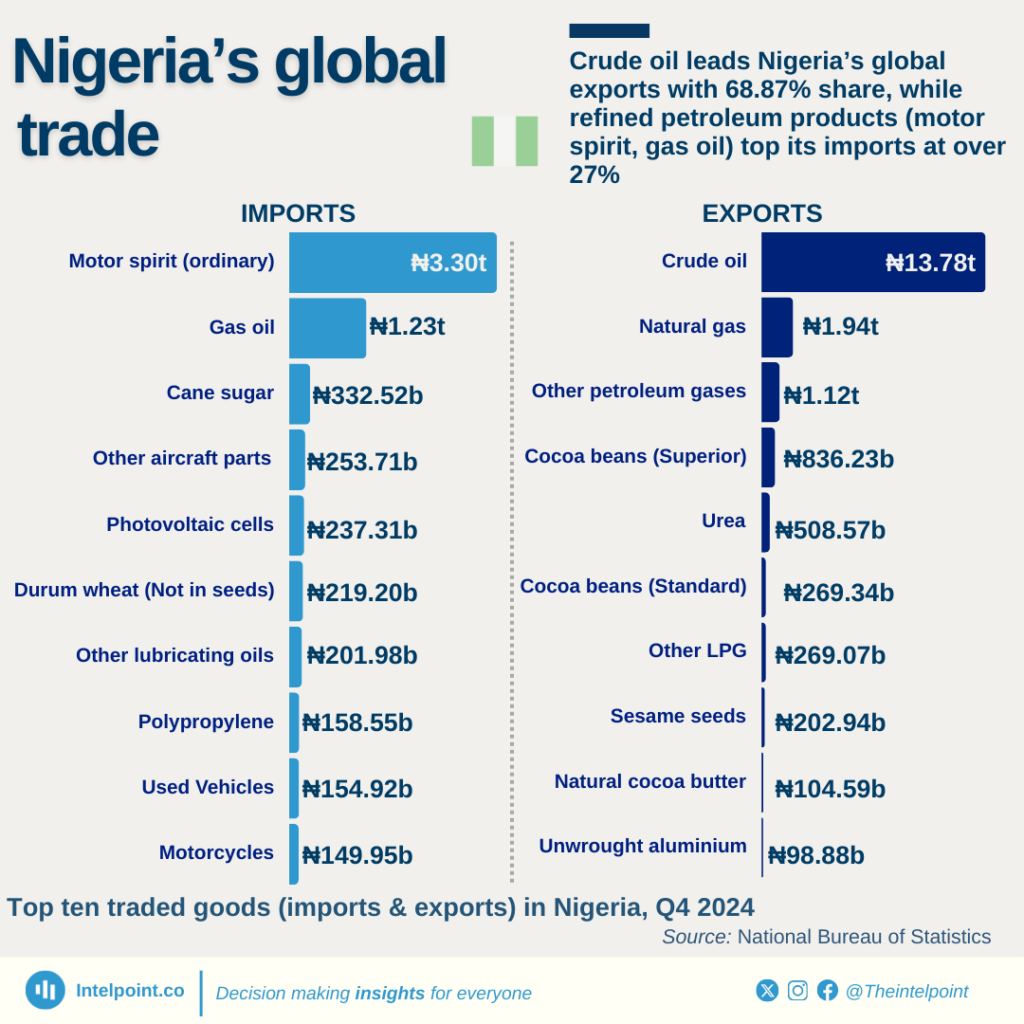
  • Asia is Nigeria’s top import source in 2025.
  • The highest import value from Asia was recorded in Q1 at ₦8.7 trillion.
  • Imports from Europe surged to ₦8.6 trillion in Q2 but declined to ₦6.6 trillion by Q4.
  • Imports from America showed continuous growth, rising from ₦2.9 trillion in Q1 to ₦6.6 trillion in Q4.
  • Imports from Africa remained below ₦1 trillion across most quarters.
Read more
  • China’s exports to Nigeria increased by 40.4%,
  • China's exports moved from ₦ 14.1 trillion in 2024 to ₦ 19.8 trillion in 2025.
  • Growth was consistent across all four quarters.
  • Quarter 2 saw the highest growth at 80%, jumping from ₦3.0tn to ₦5.4tn.
  • Quarter 4 recorded a modest 4.3% rise.
Read more
  • Crude oil dominated Nigeria’s exports in all quarters of 2025
  • Q1 recorded the highest oil dependency at 81.5%.
  • Non-oil exports peaked in Q2 at 24.2%, representing the strongest diversification point in 2025.
  • The oil share dropped to its lowest in Q2 (75.8%), but still remained dominant.
Read more
  • Nigeria's total capital imports surged to $23.2bn in 2025, the highest level recorded in the entire 2014 to 2025 period.
  • Foreign Portfolio Investment dominated in 2025, claiming 85 cents of every dollar imported, up sharply from 68% in 2024.
  • Foreign Direct Investment has remained consistently weak, never exceeding 20% across all eleven years, and falling to just 4% in 2025.
  • The "Others" category, which peaked at 61% in 2023, has collapsed to just 11% in 2025, reflecting a dramatic shift toward portfolio-driven capital flows
Read more
  • Inflows surged from $3.9B in 2023 to $23.2B in 2025, near the all-time record.
  • Banking and financing captured 87% of all inflows.
  • Agriculture got $167M, oil and gas $18M, and construction $6M, .
  • The recovery is real, but it is not yet reaching ordinary Nigerians.
Read more
1 4 5 6 7 8 252

Can’t find what you’re looking for? Please fill the form below
Contact Form Demo
SIGN UP TO OUR NEWSLETTER
Get periodic updates about the African startup space, access to our reports, among others.
Subscribe Here
Subscription Form

A product of Techpoint Africa. All rights reserved