Bite-sized Insights about
 
Providing you with data-based insights about things happening around you.
Popular Insights
  • Crude oil exports, which made up 81% of Nigeria's export value in 2023 have increased in three consecutive years since 2021. After a 36% decline in 2020, exports increased by 53% in 2021, 46% in 2022, and 37% in 2023 to reach ₦29 trillion.

    See more
    Top ten African countries by estimated number of films produced annually

    The Nigerian movie industry, mainly financed via public or private funding and international grants, produces the most films in Africa, yearly. Nigeria produced more than double the number of films that the Ghanaian and Kenyan movie industries produce annually.

    See more
  • The 2024 Global Peace Index reveals a decline in peacefulness in 97 countries, the highest since the index began.

    Nigeria is among the nations affected by regional conflicts and rising violence. With a peace index score of 2.91, Nigeria is facing increasing challenges.

    A deteriorating peace score impacts foreign investment and economic stability. Global economic losses due to violence reached $19.1 trillion in 2023.

    See more

    The FAAC's revenue distribution from 2017 to August 2023 highlights the dominance of Delta, Akwa Ibom, Rivers, and Bayelsa states in allocations. Despite Lagos' economic prominence, it ranked fifth. Here is the distribution of revenue among states between 2017 and August 2023.

    See more
  • A Trend of Adult literacy rates of African countries

    Between 2018 and 2021, adult literacy rates across African nations exhibited significant disparities. Seychelles and South Africa led with literacy rates of 96% and 95%, respectively, indicating a high proportion of literate adults. Conversely, Chad had the lowest literacy rate during this period.

    These statistics underscore the uneven progress in educational attainment across Africa, highlighting the need for targeted interventions to improve literacy in lower-performing nations.

    See more
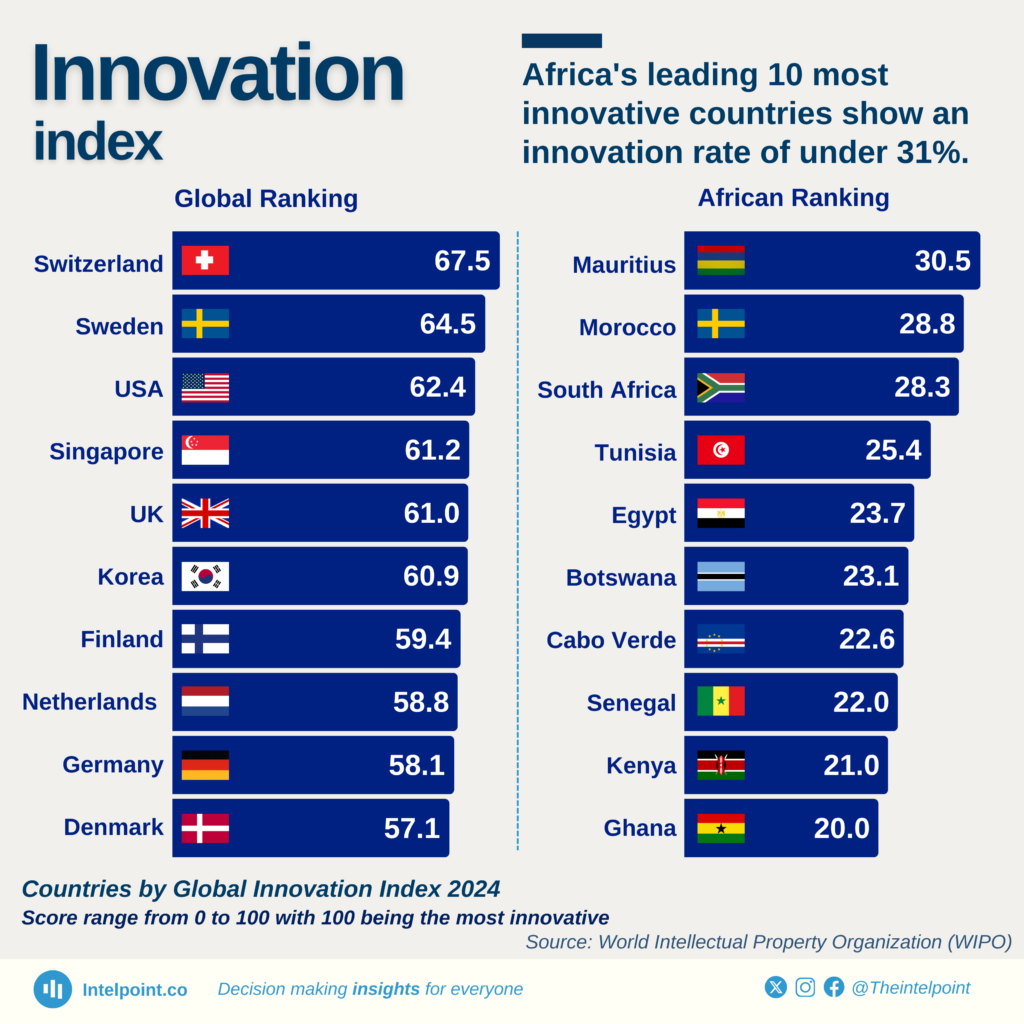
    Countries by Global Innovation Index 2024

    The Global Innovation Index 2024 reveals a striking contrast in innovation performance between countries globally and across Africa. Switzerland leads the global rankings with an impressive score of 67.5, followed by Sweden (64.5) and the USA (62.4), highlighting their sustained investments in research, development, and technological advancement.

    In Africa, Mauritius takes the top spot with a score of 30.5, followed closely by Morocco (28.8) and South Africa (28.3). However, even Africa's most innovative nations achieve less than half the score of global leaders, indicating a significant innovation gap.

    Nigeria ranks 15th in the African ranking and 113th globally, out of 133 countries, with a score of 17.1.

    See more

  • Nigeria was the seventh most populous nation in the world in 2020, with 206.1 million people. Projected to reach a population of 401.3 million by 2050, Nigeria will rank third after India (1st) and China (2nd). According to Institut national d'études démographiques' projections, Nigeria, Ethiopia, DR Congo, Egypt, Tanzania, and Kenya will be among the world’s top 20 most populous countries by 2050.

    See more
  • MTN Nigeria has dominated the country's telecommunications market over the years, accounting for the largest market share. All four operators, apart from 9mobile, recorded a significant increase in their subscriber base between May 2014 and March 2024.

    See more
  • The 2024 Global Peace Index reveals a decline in peacefulness in 97 countries, the highest since the index began.

    Nigeria is among the nations affected by regional conflicts and rising violence. With a peace index score of 2.91, Nigeria is facing increasing challenges.

    A deteriorating peace score impacts foreign investment and economic stability. Global economic losses due to violence reached $19.1 trillion in 2023.
    See more

Other Insights
  • Rack Centre leads Nigeria’s live capacity with 13.5 MW
  • Africa Data Centres (10 MW) and Equinix (8.8 MW) form the next tier of large operators
  • Lagos dominates capacity, reinforcing its role as Nigeria’s primary digital infrastructure hub
  • Several operators have major expansion plans, including Africa Data Centres (+10.65 MW addition) and OADC Lagos (+24.5 MW addition)
See more
  • Lagos hosts 21 of Nigeria’s 25 data centres.
  • Only Lagos, Abuja, and Kano currently host data centres.
  • Abuja holds 12% of the country’s data centres despite being the capital.
  • Kano’s single facility accounts for just 4% and highlights the limited digital infrastructure in northern Nigeria.
  • The distribution shows a high geographic concentration risk; national digital operations rely heavily on Lagos.
  • Lagos’ dominance reflects its advantages: commercial activity, connectivity, and proximity to submarine cable landings.
See more
  • The proposed 2027 election budget of ₦873.8 billion is the highest in Nigeria’s history.
  • The 2027 figure is 2.5 times higher than the ₦355.3 billion spent in 2023.
  • Election costs have increased every cycle since 1999.
  • Spending has grown from ₦32 billion in 1999 to ₦874 billion in 2027.
  • In dollar terms, the 2027 cost is estimated at about $625.9 million.
  • Nigeria has spent approximately ₦1.9 trillion—including the 2027 proposed cost—on elections since the start of the Fourth Republic.
  • Currency depreciation has influenced the dollar-equivalent fluctuations over time.
See more
  • Export value more than doubled from $9.72 billion in 2016 to $24.91 billion in 2025.
  • Trade rose steadily between 2016 and 2019, then surged sharply in 2021.
  • Exports declined for three consecutive years (2022–2024) after the 2021 peak.
  • 2025 marks the highest export value in the ten-year period.
See more
  • Rivers, Lagos, and Ogun lead the ranking, covering most operating costs from their own revenue.
  • Jigawa, Bayelsa, and Yobe are the most dependent on federal allocations, with internal revenue covering only a fraction of expenses.
  • Higher-ranked states demonstrate stronger economic resilience and better domestic revenue mobilisation.
  • Lower-ranked states need to grow internal revenue or reduce operating expenses to improve financial self-sufficiency.
See more
  • Nigeria leads by a clear margin, receiving the highest export value at $24.91bn.
  • Large, diversified economies dominate the top tier, with South Africa and Egypt ranking among the biggest destinations.
  • Resource-linked trade remains significant, with countries like Liberia and Algeria absorbing substantial export value.
  • Trade reach is geographically diverse, spanning West, East, and North Africa, including GhanaTanzaniaKenyaMorocco, and Guinea.
See more
  • Exports more than doubled in a decade, with trade rising from $92.27 billion in 2016 to $225 billion in 2025, a 144% increase.
  • The largest single jump occurred between 2020 and 2021, when exports surged by more than $34 billion.
  • From 2021 to 2024, exports climbed every year, reaching $178.91 billion before the latest surge.
  • The increase from $178.91 billion in 2024 to $225 billion in 2025 signals a new growth surge after several years of gradual increases.
See more
     
  • The NFF’s allocation of ₦2.31 billion is under 1.1% of the total sports budget.
  • The National Sports Commission HQ gets the most, with ₦203.6 billion, over 96% of the total.
  • The National Institute for Sports is to receive ₦4.12 billion, highlighting minimal federal investment in sports development.
  • Budget heavily favours administration over football development and grassroots programs.
See more
  • Active bank accounts grew from 65 million in 2016 to over 320 million in 2025 — almost a fivefold increase.
  • Bank accounts per 100 people rose from about 32 in 2017 to nearly 135 in 2025.
  • Nigeria now averages more than one bank account per person.
  • The fastest growth phase occurred between 2019 and 2024.
  • Digital banking and fintech adoption played a major role in the surge.
  • The jump after 2020 suggests technology-driven access, not just population growth.
  • Multiple account ownership is now common among users.
See more
  • Jigawa has the highest share of unregistered businesses in Nigeria (96.1%) in 2025.
  • Over half (20) of Nigerian states have more than 50% of businesses operating informally.
  • Informality is not limited to poorer states; Lagos and Rivers both exceed 65%.
  • Southern and northern states alike show high informality, indicating a nationwide challenge.
  • Only a small group (10) of states have informality rates below 30%.
  • Kaduna records the lowest share of unregistered businesses (10.3%)
See more
  • Only nine African artistes have won multiple Grammy Awards, highlighting how rare repeat wins remain at the global level.
  • Angélique Kidjo and Ladysmith Black Mambazo lead Africa with five wins each, but Ladysmith holds the record for the most nominations (17).
  • High nomination counts do not guarantee wins; Seal (15 nominations) and Tems (8 nominations) have fewer wins than peers with far fewer nominations.
  • Recent entrants are closing the gap quickly, with Tyla converting 100% of her two nominations into wins.
See more
1 5 6 7 8 9 126
  • North America leads globally with 60.2% iPhone usage, making it the largest iPhone market.
  • Oceania follows at 58.9%, showing similar consumer preferences to North America.
  • Africa has the lowest iPhone share (14.7%), highlighting a significant adoption gap.
  • Nigeria aligns with the continental trend at 14.1%, reinforcing that the gap is structural, not country-specific.
Read more
Key takeaways:
  • Nigeria recorded its first crude oil imports in a decade in 2025, marking a structural shift in trade dynamics.
  • Imports accounted for 11% of total crude oil trade in 2025.
  • Total crude oil trade grew sharply from ₦7 trillion in 2016 to ₦53.2 trillion in 2025, indicating long-term expansion.
  • Exports remain dominant, contributing ₦47.4 trillion in 2025 despite the emergence of imports.
  • 2024 was the peak year for crude oil trade at ₦55.3 trillion, followed by a slight decline in 2025.
  • The 2020 dip of ₦9.4 trillion highlights vulnerability to global shocks, likely tied to oil price and demand disruptions.
Read more
  • Nominal spending surged, but inflation and naira depreciation eroded real gains. From ₦921 billion in 2012 to ₦6.57 trillion in 2025, the absolute figure may seem dramatic, but Nigeria's security challenges intensified over the same period.
  • Defence commanded over 21% of the budget in 2013. From 2024 to 2026, that figure has fallen below 14%, with 2026 hitting a historic low of 9.3%.
  • Boko Haram, banditry, and separatist tensions peaked in 2020, resulting in a cut that saw defence's share fall to just 9.2%, the lowest on record at that point.
  • The jump to ₦6.57trn (13.2%) in 2025 marks the sharpest year-on-year absolute increase in the dataset. But 2026 reversed this again, with the rate dropping to 9.3%.
Read more
  • The 2019 number revealed the truth — years of underdiagnosis were corrected in a single year when PEPFAR restructured testing entirely.
  • The 76% decline from 2019 to 2024 is one of the most significant HIV reductions in Africa in a single decade.
  • One year of disruption in 2020 erased an entire year of progress, creating a backlog that took until 2022 to clear.
  • With PEPFAR's $1.2 billion pipeline cut, fewer Nigerians are being tested, meaning fewer cases appear on paper while the virus spreads undetected.
Read more
  • Nigeria recorded the largest petrol price increase in Africa, rising 39.5% between February 23 and March 16, 2026.
  • Egypt experienced a 14.3% increase, making it one of the largest price jumps in Africa.
  • Nigeria’s increase is more than double that of Egypt.
  • A number of African countries recorded very small price changes, including Tanzania (2.7%), Morocco (2.1%), and South Africa (1%).
  • A few countries actually saw declines in fuel prices, including Madagascar (-3.9%) and Zambia (-4.6%).
  • During the period, petrol prices remained unchanged in 28 African countries.
Read more
  • 13 out of 35 AFCON tournaments (37.1%) have been won by host nations
  • A larger share — 22 tournaments (62.9%) — were won by visiting teams.
  • The early AFCON years (1960s–1980s) saw more frequent home wins compared to recent decades.
  • Egypt has the most home-soil victories (3), followed by Ghana (2)
  • Despite high expectations, several hosts have failed to win.
  • Hosting provides crowd support and familiarity, but also brings heightened expectations and pressure.
Read more
1 5 6 7 8 9 252

Can’t find what you’re looking for? Please fill the form below
Contact Form Demo
SIGN UP TO OUR NEWSLETTER
Get periodic updates about the African startup space, access to our reports, among others.
Subscribe Here
Subscription Form

A product of Techpoint Africa. All rights reserved