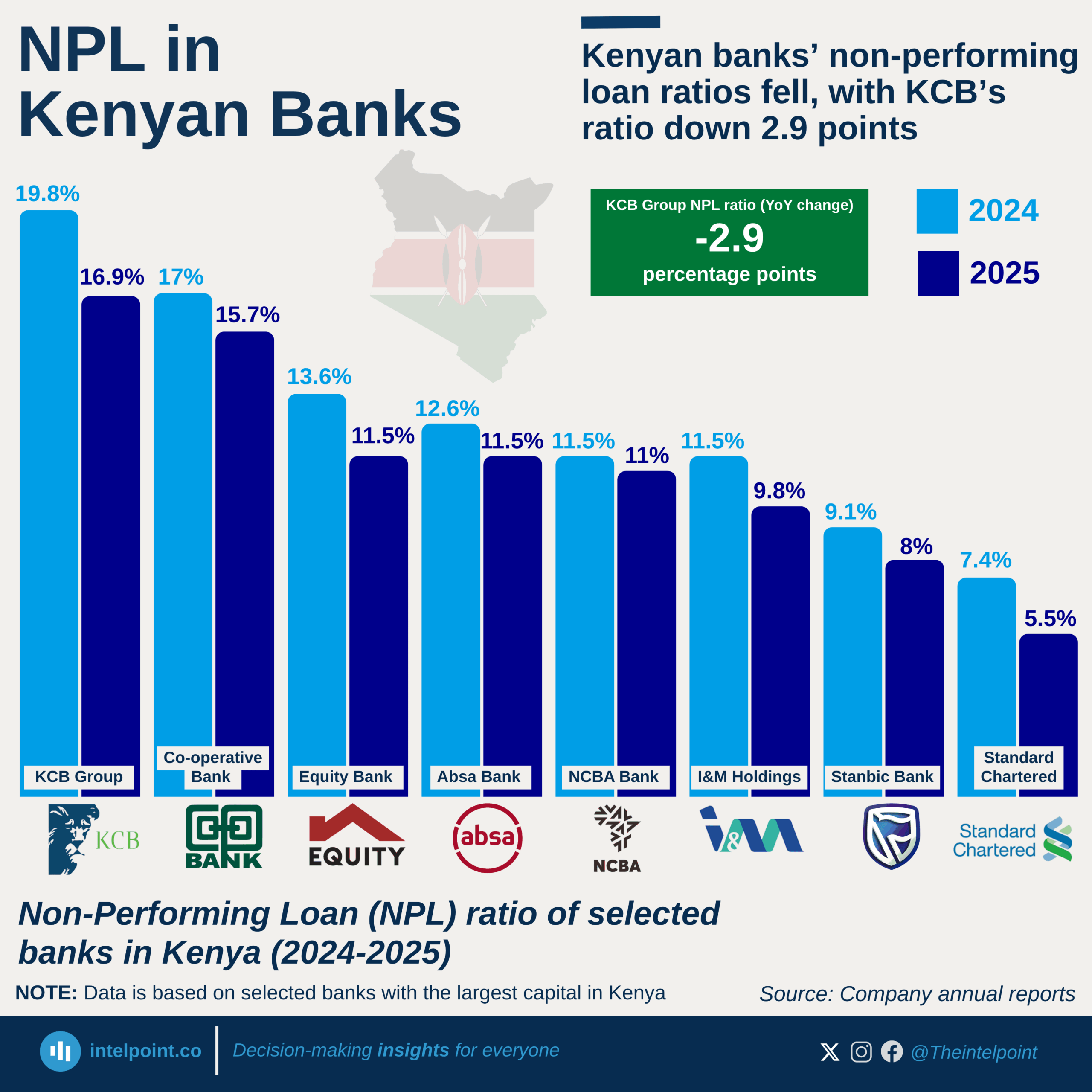
Kenyan banks’ non-performing loan ratios fell, with KCB’s ratio down 2.9 points

Key takeaways:

  • All eight selected Kenyan banks reduced their NPL ratios in 2025.
  • KCB recorded the largest improvement, with a 2.9% point drop.
  • KCB still had the highest NPL ratio in the group at 16.9%.
  • Co-operative Bank remained highly stressed at 15.7%, despite some improvement.
  • Equity Bank and Absa Bank Kenya both ended 2025 at 11.5%.
  • Standard Chartered Kenya had the lowest NPL ratio in the group at 5.5%.

In 2025, asset-quality pressure in Kenyan banking improved for most of the large banks. All eight selected banks show a decline in the non-performing loan ratio, with the largest decline in KCB Group. At the top end, KCB Group still had the highest NPL ratio among the banks at 16.9%, followed closely by Co-operative Bank at 15.7%.

The sector backdrop supports that reading, with the Central Bank of Kenya saying the industry gross NPL ratio rose to 17.6% in April 2025, from 17.2% in February, before easing to 16.5% in November 2025, with reductions seen in sectors such as mining and quarrying, energy and water, personal and household, and transport and communication.

At the bank level, the pattern is mixed but directionally better than the 2024 high mark for several lenders. KCB Group’s FY2025 investor presentation shows its NPL ratio improved to 16.9% from 19.8% in FY2024. Equity Group also improved, with its FY2025 NPL ratio at 11.5%, down from 13.6% in FY2024, after having risen from 12.1% in FY2023. These are not trivial improvements; they point to more aggressive recoveries, restructurings, write-offs, and tighter underwriting.
Source:

Company annual reports

Period:

2024-2025
HTML code to embed chart
Want a bespoke report?
Reach out
Tags
Related Insights

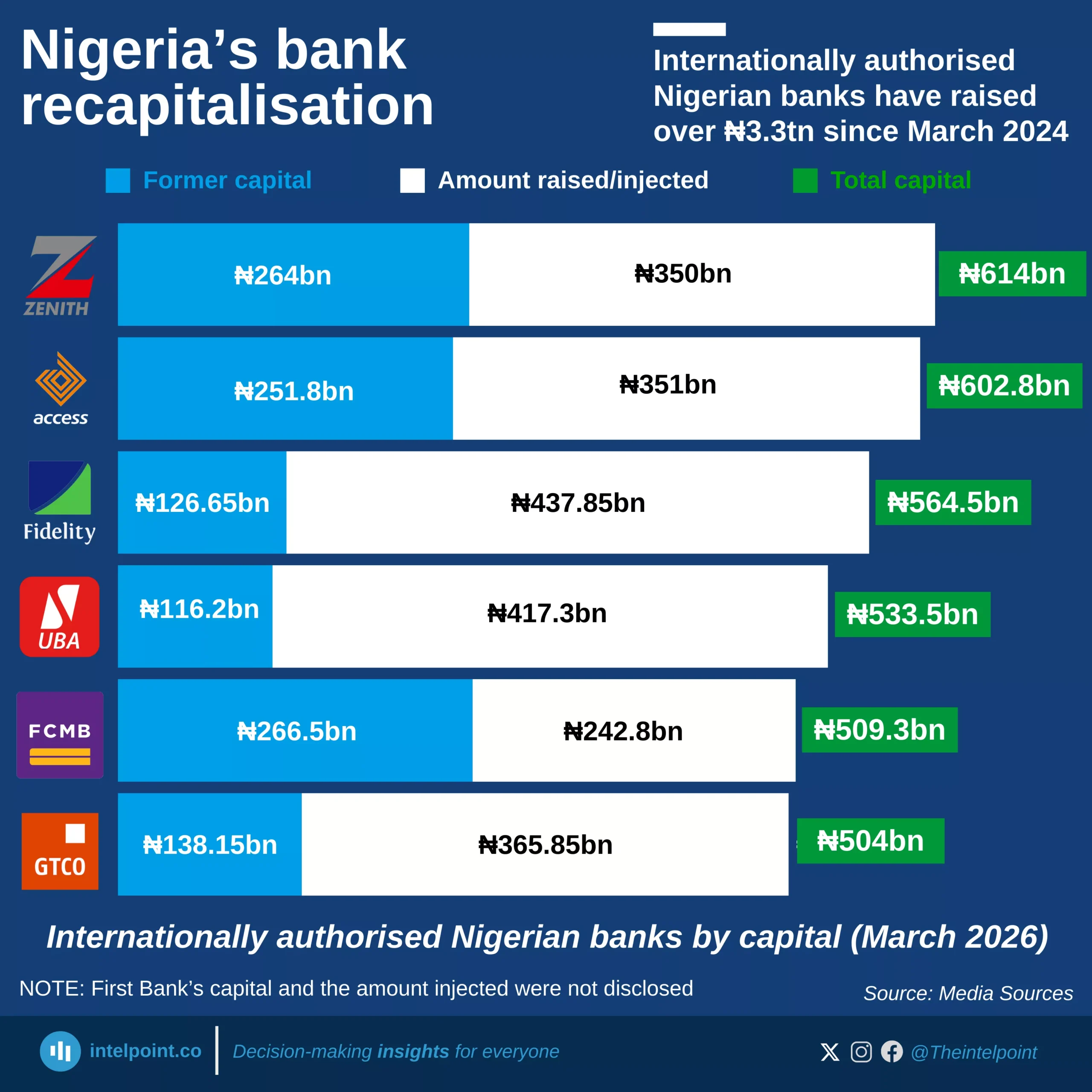
Internationally authorised Nigerian banks have raised over ₦3.3tn since March 2024
  • Internationally authorised Nigerian banks have raised and injected over ₦3.3 trillion in new capital since March 2024.
  • The recapitalisation exercise is being driven by the Central Bank of Nigeria’s requirements, with the deadline expected in March 2026.
  • Zenith Bank currently has the highest capital among the banks shown, reaching about ₦614 billion.
  • Access Holdings has about ₦602.8 billion in total capital.
  • Fidelity Bank raised the largest single capital injection in the group, about ₦437.85 billion, pushing its total capital to ₦564.5 billion.
  • FCMB has the highest previous capital base among the banks listed (₦266.5 billion) before the recapitalisation injection.

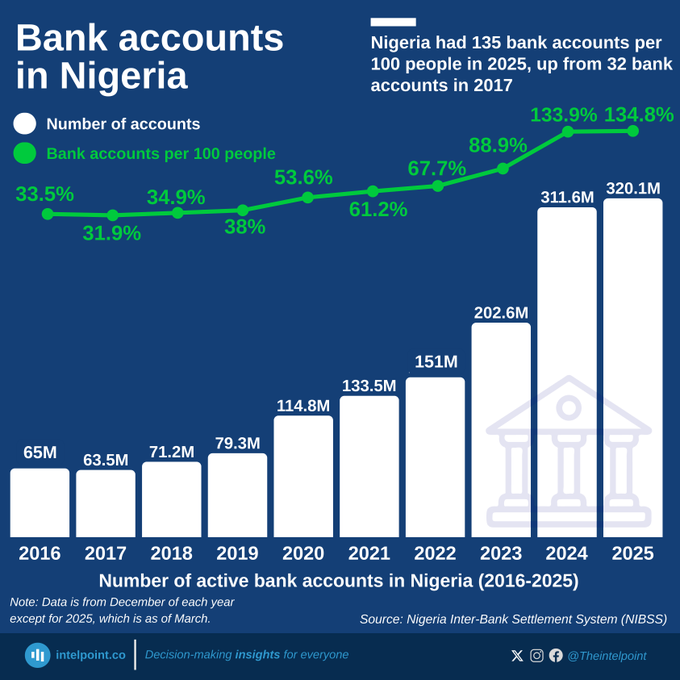
Nigeria had about 135 bank accounts per 100 people in 2025, up from 32 bank accounts in 2017
  • Active bank accounts grew from 65 million in 2016 to over 320 million in 2025 — almost a fivefold increase.
  • Bank accounts per 100 people rose from about 32 in 2017 to nearly 135 in 2025.
  • Nigeria now averages more than one bank account per person.
  • The fastest growth phase occurred between 2019 and 2024.
  • Digital banking and fintech adoption played a major role in the surge.
  • The jump after 2020 suggests technology-driven access, not just population growth.
  • Multiple account ownership is now common among users.

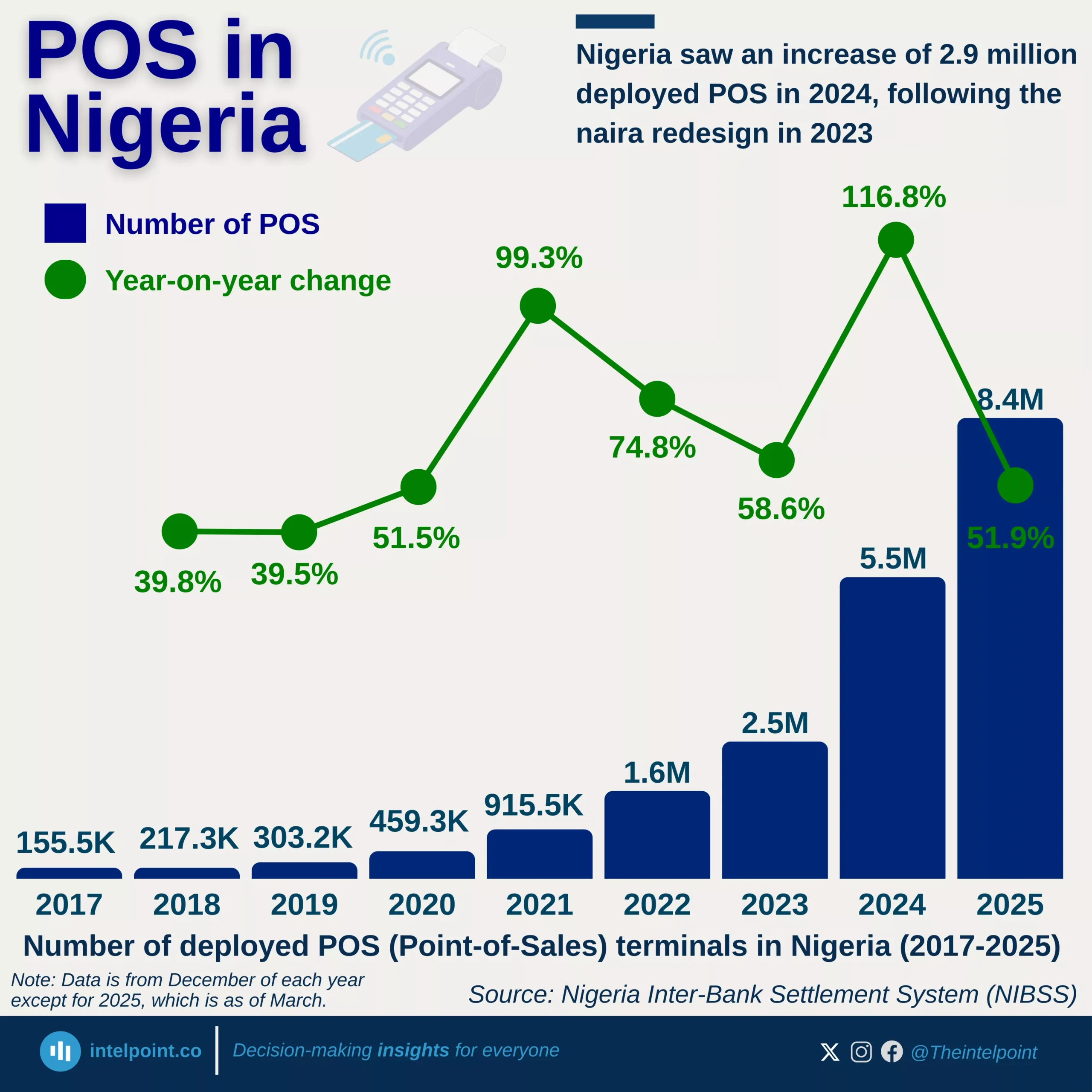
Nigeria saw an increase of 2.9 million deployed POS in 2024, following the naira redesign in 2023
  • Deployed POS terminals grew from about 156,000 in 2017 to 8.4 million in 2025.
  • Nigeria added more than eight million terminals in eight years, indicating rapid adoption of digital payments.
  • Growth accelerated sharply after 2020, marking a major shift toward cashless transactions.
  • The highest year-on-year growth (116.8%) occurred in 2024, following the naira redesign.
  • About three million terminals were added in 2024 alone.
  • POS agents became critical financial access points during the period of cash shortage.
  • POS terminals now function as mini-banks in many communities.
  • Financial inclusion has expanded through agent-based banking and POS networks.

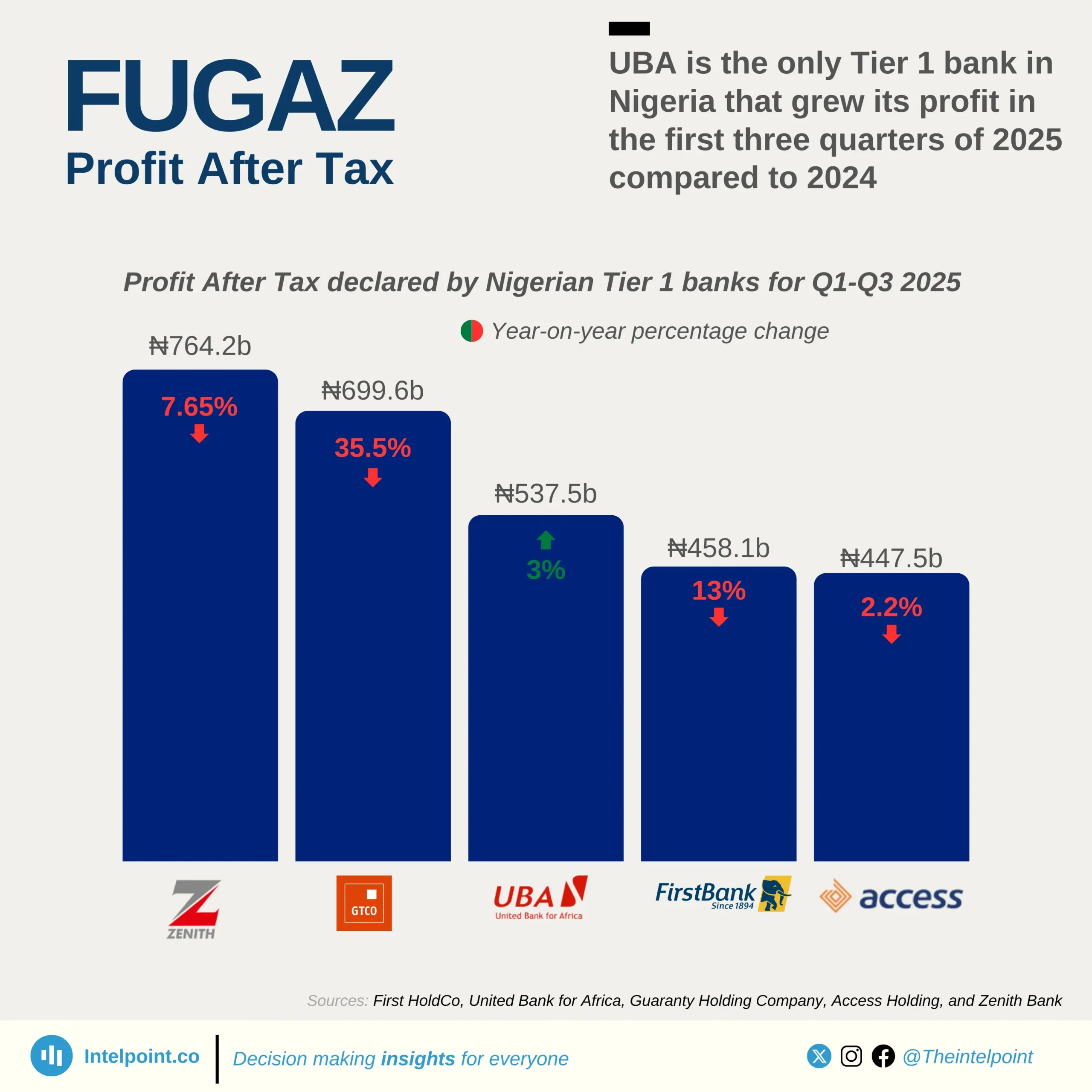
UBA is the only Tier 1 bank in Nigeria that grew its profit in the first three quarters of 2025 compared to 2024
  • FUGAZ posted a combined ₦2.91 trillion in profit from Q1 to Q3 of 2025.
  • Access Bank recorded the lowest PAT among the FUGAZ
  • UBA recorded a 3% year-on-year increase in PAT
  • FUGAZ recorded an average year-on-year percentage change of -11.2% for the period

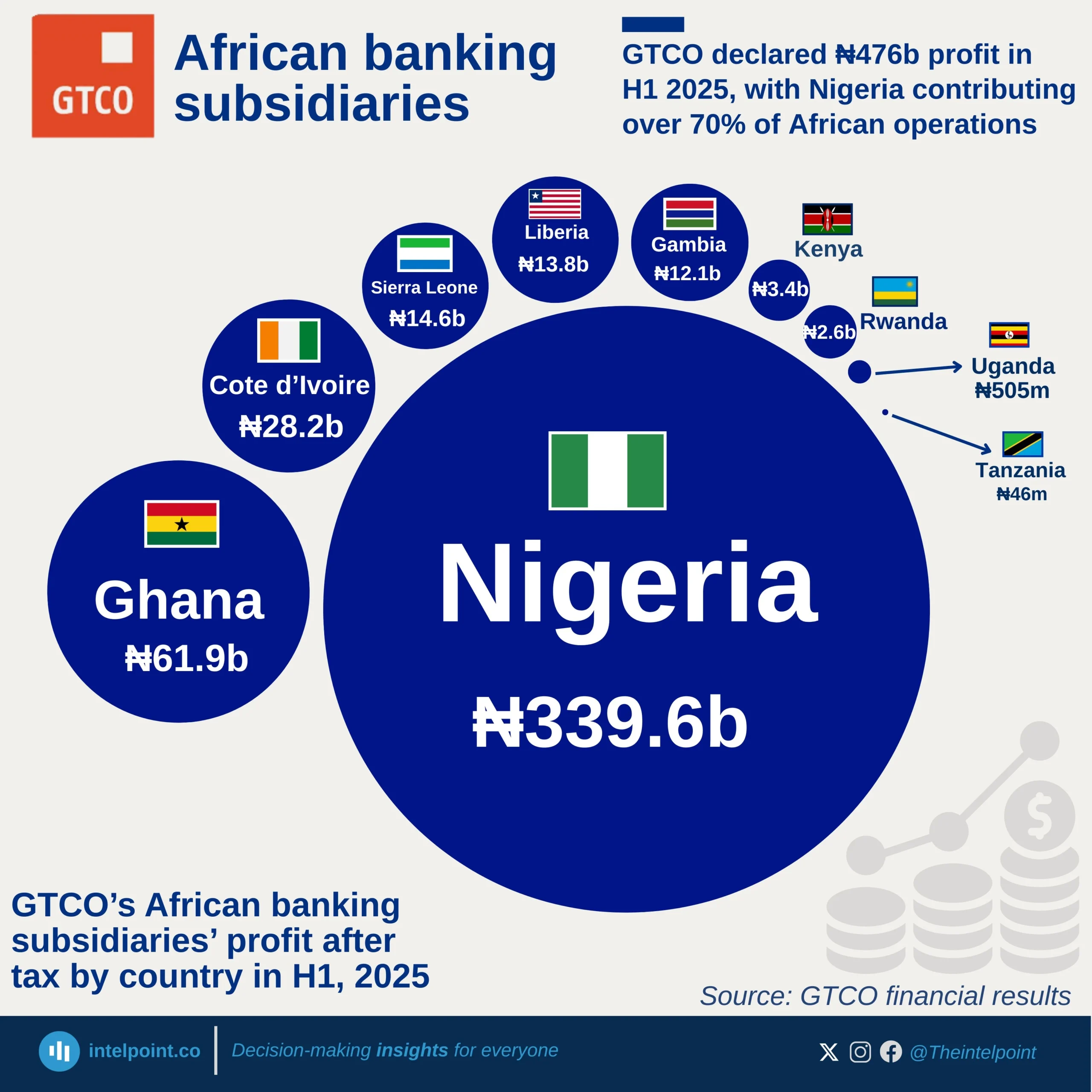
GTCO declared ₦476b profit in H1 2025, with Nigeria contributing over 70% of African operations
  • Nigeria dominates with ₦339.6b, contributing over 70% of GTCO’s total profit after tax in Africa.
  • Ghana (₦61.9b) and Côte d’Ivoire (₦28.2b) followed as the strongest non-Nigerian subsidiaries.
  • Tanzania (₦46m) and Uganda (₦505m) contributed negligible profits compared to peers.
  • GTCO subsidiaries across Africa collectively generated around ₦476b profit after tax in the first half of 2025.

GTCO declared ₦476b profit in H1 2025, with Nigeria contributing over 70% of African operations
  • Nigeria dominates with ₦339.6b, contributing over 70% of GTCO’s total profit after tax in Africa.
  • Ghana (₦61.9b) and Côte d’Ivoire (₦28.2b) followed as the strongest non-Nigerian subsidiaries.
  • Tanzania (₦46m) and Uganda (₦505m) contributed negligible profits compared to peers.
  • GTCO subsidiaries across Africa collectively generated around ₦476b profit after tax in the first half of 2025.

POPULAR TOPICS
SIGN UP TO OUR NEWSLETTER
Get periodic updates about the African startup space, access to our reports, among others.
Subscribe Here
Subscription Form

A product of Techpoint Africa. All rights reserved