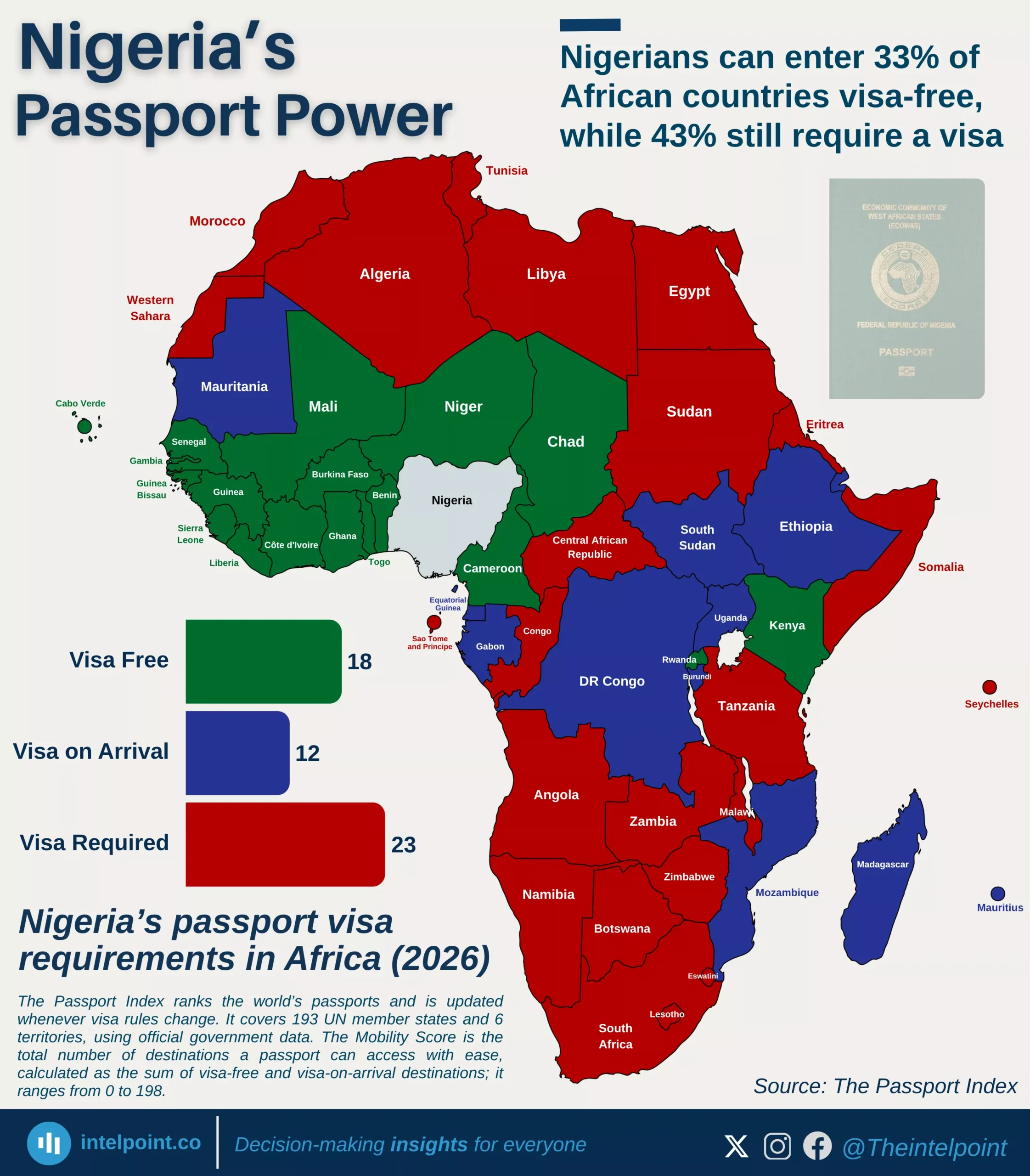
Nigerians can enter 33% of African countries visa-free, while 43% still require a visa

  • Nigeria faces visa requirements in nearly half of Africa.
  • West Africa is Nigeria’s easiest mobility zone.
  • Beyond its West African neighbors, the Nigerian passport unlocks visa-free entry to only four other African nations
  • ECOWAS is the biggest reason for Nigeria’s visa-free access to its neighbours.
  • Visa openness drops sharply outside West Africa.
  • Africa’s free-movement agenda is still uneven in practice.
  • Business mobility remains constrained by visa friction.

The map shows that Nigerians can travel visa-free to 18 African countries and get a visa on arrival in 12 more, yet still need a visa for 23 countries. That means many African destinations remain closed, rather than being open on easy terms. Access is not just limited; intra-African mobility is still far less seamless than the continent’s integration agenda suggests.

Nigeria’s easiest access is concentrated in West Africa, where ECOWAS has a long-established visa-free movement for up to 90 days among member states. That is why much of the green on the map clusters around Nigeria. Beyond that zone, the picture becomes patchier. The African Development Bank’s 2025 Africa Visa Openness Report still describes visa openness across the continent as uneven, even after a decade of reforms tied to the AU’s free movement goals and African Continental Free Trade Area (AfCFTA) ambitions.

A trader in Lagos may find it easy to move goods and people across nearby ECOWAS markets, but the same person hits more paperwork once the journey shifts toward North, Central, or parts of Southern Africa. That matters because travel friction slows deals, raises trip costs, and weakens regional business networks. It is one reason the AfDB keeps linking visa openness to trade, investment, and continental integration — movement is not just about tourism, it is part of how markets connect.
Source:

The Passport Index

Period:

2025
HTML code to embed chart
Want a bespoke report?
Reach out
Tags
Related Insights

Nigerians have spent an estimated $193 million on U.S. visitor visa application fees since 2018
  • Estimated visitor visa fee spending reached $193 million between FY 2018 and FY 2025.
  • Applicants paid the fee whether their visas were approved or refused.
  • Estimated spending peaked at $49.8 million in FY 2018.
  • Spending recovered to $25.1 million in FY 2024 before falling to $23.2 million in FY 2025.
  • The estimates exclude transport, documents, agents, accommodation and other related costs.

The U.S. issued Africans 820 more agricultural worker visas in Fiscal Year 2025
  • U.S. nonimmigrant visa issuances to Africans fell by 23.6% to 413,259.
  • Twenty-five visa categories still recorded increases despite the overall decline.
  • C3 visas posted the largest numerical increase, rising by 949.
  • H2A agricultural worker visas increased by 820 to 15,623.
  • B1/B2 visitor visas recorded the biggest decline, falling by 109,653.

Southern Africa houses 6 of the top 10 African countries with the strongest passports
  • Seychelles has Africa’s strongest passport.
  • Mauritius is the only other African country with a passport close to Seychelles'.
  • South Africa leads the mainland pack, but still trails the island leaders by a wide margin.
  • No country outside the top three crosses a mobility score of 100.
  • Visa-required destinations still dominate for every passport in the top ten, except Seychelles and Mauritius.

14 African nations affected as the US expands temporary visa restrictions to include Nigeria
  • Africa is the hardest-hit region, with 14 countries under partial visa restrictions, including Nigeria, limiting travel for business, tourism, and study.
  • Temporary bans target B‑1/B‑2 visas for business and tourism, and may also affect F‑1 student, M‑1 vocational, and J exchange visitor visas, impacting students, trainees, and cultural exchange participants.
  • Other affected regions include the Caribbean, Asia, and South America, showing the temporary restrictions span multiple continents.
  • Exemptions exist for lawful permanent residents, diplomats, and travellers with valid pre-existing visas, so not all citizens from these countries are blocked from entering the US.
 

Nearly 2.8 million African-born immigrants live in the US as of 2023, led by Nigeria, Ethiopia, and Egypt
  • In 2023, the total number of African-born immigrants in the US was about 2.79 million.
  • Western Africa is the largest source region, contributing 1.08 million immigrants (39%), led by Nigeria (476k).
  • Eastern Africa is the second-largest source (28%), dominated by Ethiopia (278.2k).
  • Northern Africa accounts for 17%, mainly from Egypt (225.7k).
  • Central Africa contributes 8%, with Cameroon (90.7k) as the top country.
  • Southern Africa is smaller at 5%, almost entirely from South Africa (133.4k).
  • Five countries—Nigeria, Ethiopia, Egypt, Cameroon, and South Africa—together make up nearly half of all African-born immigrants in the US.

South Africa leads Africa in travel and tourism competitiveness, ranking 55th worldwide
  • South Africa leads Africa on the 2024 Global Travel & Tourism Index, ranking 55th worldwide with a TTI score of 3.99.
  • Mauritius and Egypt follow closely, placing 57th and 61st globally, both scoring just below 4.0, showing strong competitiveness.
  • North Africa dominates the list, with Egypt, Morocco, and Tunisia all making the top 10, highlighting the region’s strategic tourism appeal.
  • Rwanda and Namibia stand out despite being ranked lower globally (93rd and 95th), reflecting progress in tourism development in smaller economies.

POPULAR TOPICS
SIGN UP TO OUR NEWSLETTER
Get periodic updates about the African startup space, access to our reports, among others.
Subscribe Here
Subscription Form

A product of Techpoint Africa. All rights reserved