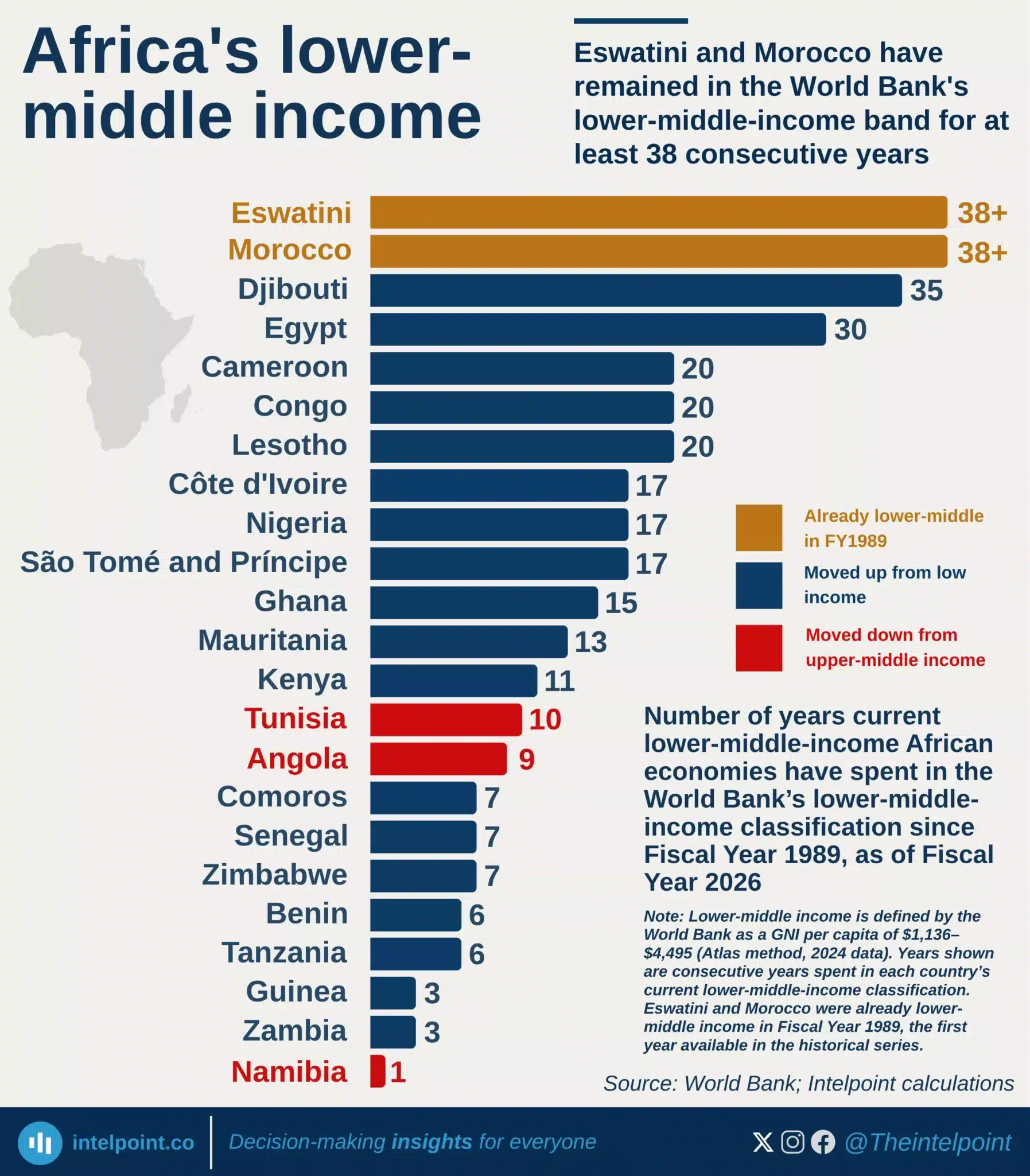
Eswatini and Morocco have remained in the World Bank's lower-middle-income band for at least 38 consecutive years

  • Nigeria has remained in the World Bank’s lower-middle-income category for 17 consecutive years.
  • Eswatini and Morocco have spent at least 38 consecutive years in the category, the longest among African countries.
  • Africa has 23 lower-middle-income economies in the World Bank’s Fiscal Year 2026 classification.
  • Tunisia, Angola, and Namibia entered the category after falling from upper-middle-income status.

Nigeria has spent 17 consecutive years in the World Bank's lower-middle-income band, making it one of the longest-standing economies in the category.

Eswatini and Morocco have remained there for at least 38 consecutive years, while Djibouti and Egypt have spent 35 and 30 years respectively.

Africa has 23 lower-middle-income economies in the World Bank's Fiscal Year 2026 classification. Most entered from low income, but Tunisia, Angola, and Namibia were downgraded from upper-middle income.
Source:

World Bank; Intelpoint calculations

Period:

1989-2026
HTML code to embed chart
Want a bespoke report?
Reach out
Tags
Related Insights

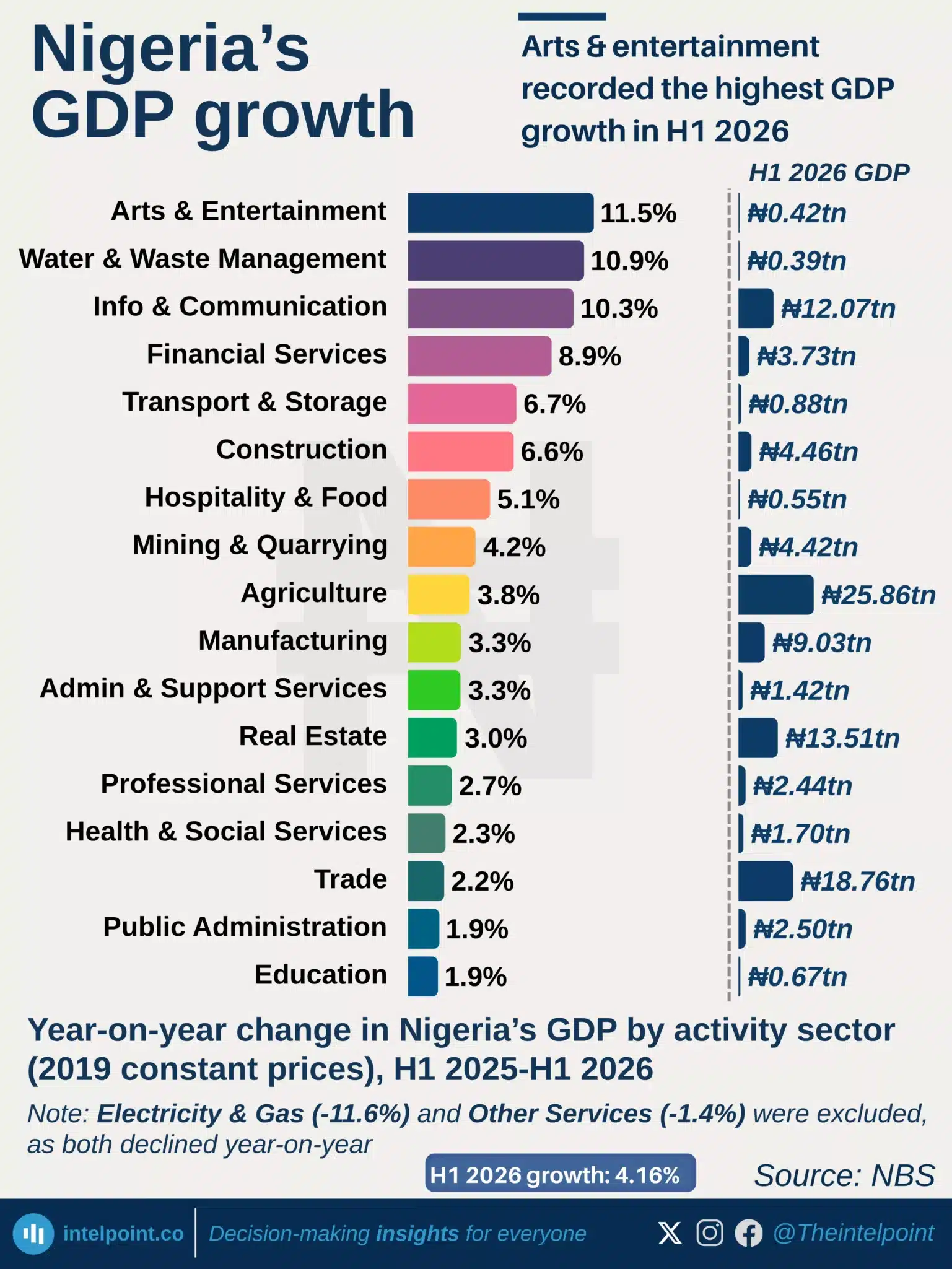
Arts & entertainment recorded the highest GDP growth in H1 2026
  • Nigeria’s economy grew 4.16% in H1 2026, but growth was uneven across sectors.
  • Arts and entertainment grew fastest at 11.5%, followed by water and waste management (10.9%) and information and communication (10.3%).
  • Agriculture, which accounts for about a quarter of GDP, grew 3.8%, below the headline rate.
  • Trade and real estate also lagged, growing 2.2% and 3.0%, respectively.
  • Electricity and gas was the biggest drag, contracting 11.6%, while Other Services fell 1.4%.

Year-on-year change in Nigeria's electricity, gas, steam and air conditioning supply GDP
  • Electricity, gas and related supply was Nigeria’s worst-performing broad economic activity in H1 2026.
  • Sector GDP fell 11.6% year-on-year, from ₦800.2bn to ₦707.1bn.
  • Output fell below H1 2024 levels, when the sector recorded ₦708.5bn.
  • Only one other broad activity contracted: Other Services, which fell 1.4%.
  • The sector contributed just 0.7% of Nigeria’s real GDP on average over the period shown.

Nigeria, Egypt and Madagascar have consistently led Africa’s rice production, with Nigeria recording consistent growth in recent years
  • Nigeria's rice production hit 9.13 million tonnes in 2024, its highest level since 2021.
  • Egypt and Madagascar produced 6.43 and 4.97 million tonnes, respectively, in 2024.
  • Egypt and Madagascar combined produced 11.4 million tonnes, exceeding Nigeria's output.
  • Africa's rice production reached a record 44.8 million tonnes in 2024, up 421% since 1980.

Food inflation has climbed to 20.31% in July, while headline inflation eased to 15.43%
  • Food inflation more than doubled, from 8.89% in January to 20.31% in July.
  • Food inflation overtook headline inflation, moving from 6.21 points below to 4.88 points above it.
  • Headline inflation barely changed, from 15.10% to 15.43%.
  • Food price pressures accelerated, with monthly inflation rising to 5.56% in July.

World Bank Group and Eurobonds alone account for 74% ($38.37b) of Nigeria's $51.9b external debt
  • Nigeria’s external debt stood at $51.90 billion as of March 2026.
  • External debt increased by just 0.09% from December 2025.
  • Multilateral creditors held the largest share at 46.0%.
  • Commercial creditors accounted for 41.3% of external debt.
  • Bilateral creditors accounted for 12.7% of external debt.
  • The World Bank Group accounted for 38.2% of total external debt.
  • Eurobond holders accounted for 35.7% of total external debt.
  • The World Bank Group and Eurobond holders together accounted for 73.9% of Nigeria’s external debt.
  • Bilateral debt fell by $130 million from December 2025 to March 2026.
  • Commercial external debt increased by about $1.1 billion over the same period.

Personal remittance inflows to Nigeria increased 3.0% year-on-year, from $22.1 billion in 2024 to $22.8 billion in 2025
  • Nigeria received $22.8 billion in personal remittances in 2025; a 3% year-on-year increase
  • Inflows remained 6.3% below the 2018 record of $24.3 billion.
  • Remittances have recovered from the $17.2 billion recorded in 2020.
  • Nigeria’s 2025 remittance inflows were 32.6% higher than in 2020.
  • Remittances accounted for 7.8% of GDP in 2025.
  • Remittances’ share of GDP fell from 8.8% in 2024.
  • Remittances’ share of GDP remained above the 4.0% recorded in 2023.

POPULAR TOPICS
SIGN UP TO OUR NEWSLETTER
Get periodic updates about the African startup space, access to our reports, among others.
Subscribe Here
Subscription Form

A product of Techpoint Africa. All rights reserved