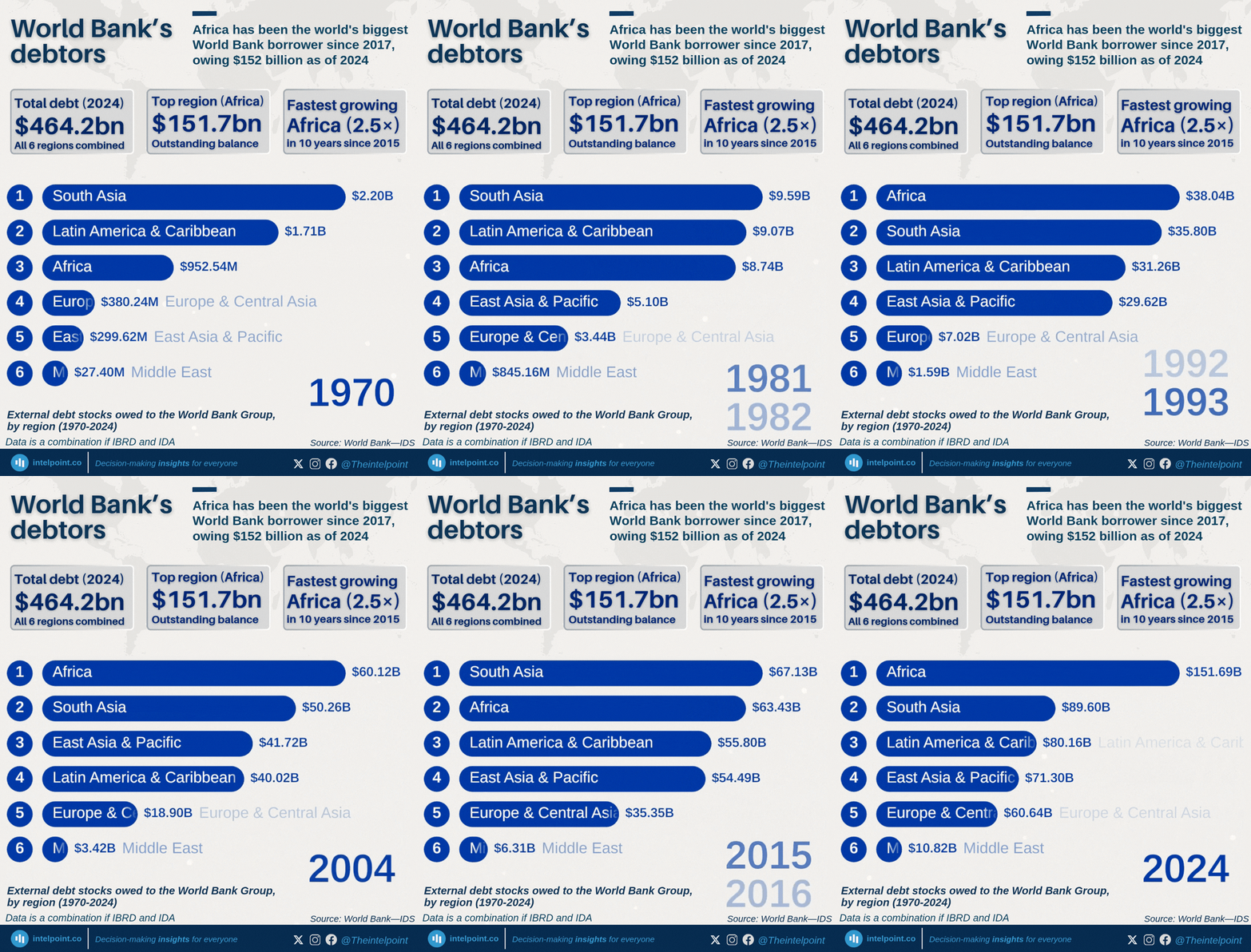
Africa has been the world's biggest World Bank borrower since 2017, owing $152 billion as of 2024

  • Africa has been the world's biggest World Bank borrower since 2017, and the gap is widening.
  • Three crises drove it: an infrastructure gap, the 2014 commodity crash, and COVID-19.
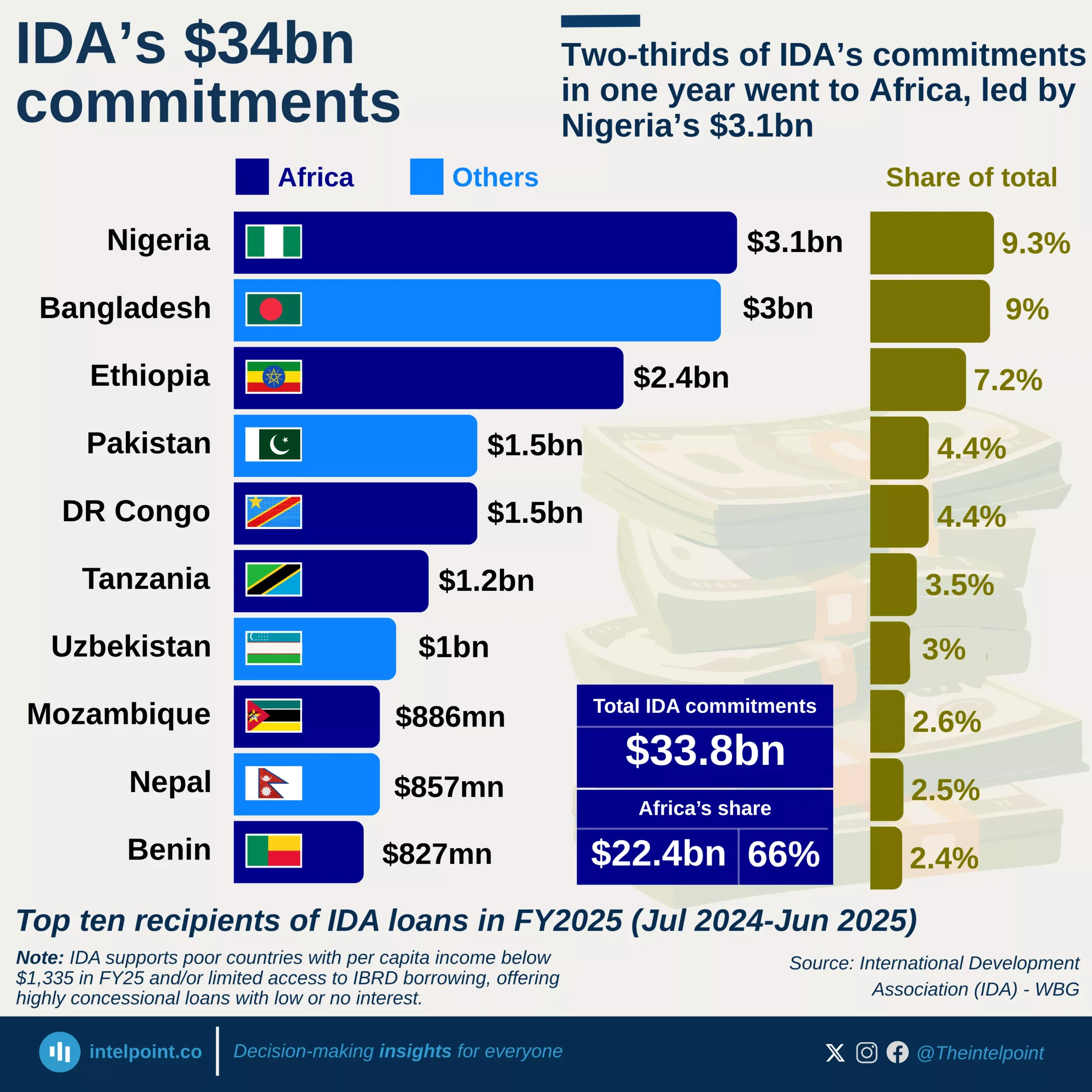
  • The World Bank leaned in deliberately — 66% of all IDA funds went to Africa in 2025 alone.
  • It's not really "Africa's debt" — it's Nigeria's, Kenya's, Ethiopia's, Egypt's, Tanzania's, and Morocco's.
  • Every other region is slowing down, but Africa's curve is still climbing.

Africa's rise to the top of the World Bank borrowing table was not a single event; it was the result of one crisis stacking on top of another.

Before the pandemic, African governments were already borrowing heavily to close an infrastructure gap estimated at up to $108 billion per year in roads, power, and connectivity. Then the commodity price crash of 2014 hit, throwing 10 of the 14 countries that had taken out natural resource-backed loans into serious debt trouble and forcing many to return to multilateral lenders just to cover existing obligations.
COVID-19 made everything worse. With tax revenues collapsing, health budgets stretched, and currencies sliding against the dollar, 21 low-income African countries are now either in debt distress or dangerously close to it.

The World Bank stepped in to fill that vacuum in a big way; since its founding, IDA has disbursed just over $210 billion to Africa, accounting for 73% of its total lifetime disbursements.

By 2024, Africa's outstanding World Bank debt stood at $151.7 billion, more than double East Asia and Pacific's $71.3 billion and clear of every other region by a distance that has only grown since 2017.

But the regional number hides more than it reveals.
Just six countries — Nigeria ($17.8 billion), Kenya ($13.8 billion), Ethiopia ($12.8 billion), Egypt ($12.3 billion), Tanzania ($12.1 billion), and Morocco ($10.2 billion) — account for roughly 52% of Africa's entire World Bank debt stock; this concentration has only deepened over time.

Nigeria alone has gone from $2.27 billion in 2000 to $17.8 billion in 2024, a near-eightfold increase in two decades. In the 2025 fiscal year alone, Africa absorbed 66% of all IDA commitments globally — $22.4 billion in a single year — a concentration that reflects both how acute the financing need has become and how deliberately the World Bank has repositioned itself toward the continent.

Europe and Central Asia sit at $60.64 billion, East Asia and Pacific at $71.3 billion, Latin America and the Caribbean at $80.16 billion, South Asia at $89.60 billion, and the Middle East at just $10.82 billion.

This chart tells you who is borrowing. What it does not tell you is whether that borrowing is building something or simply accumulating.
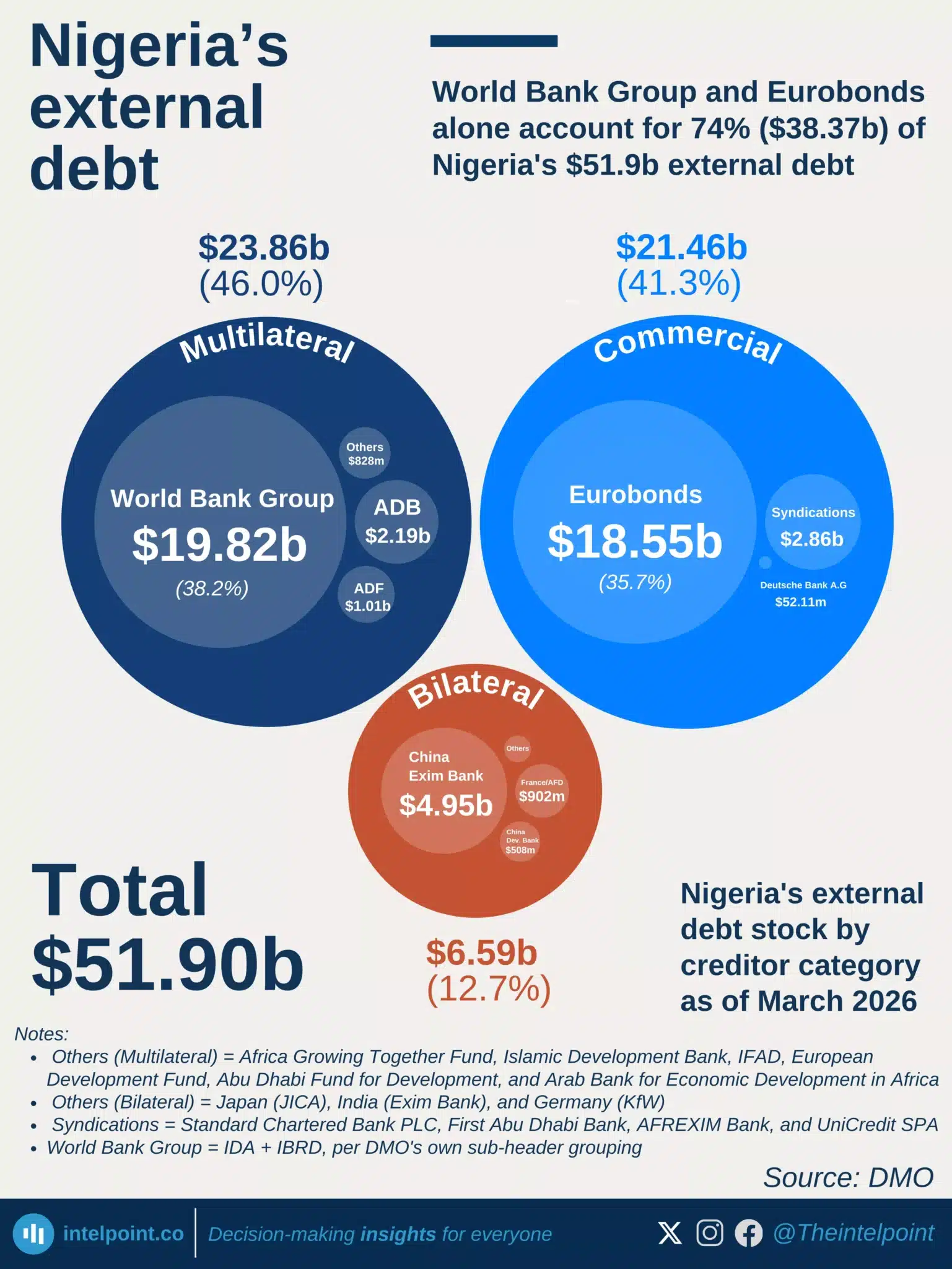
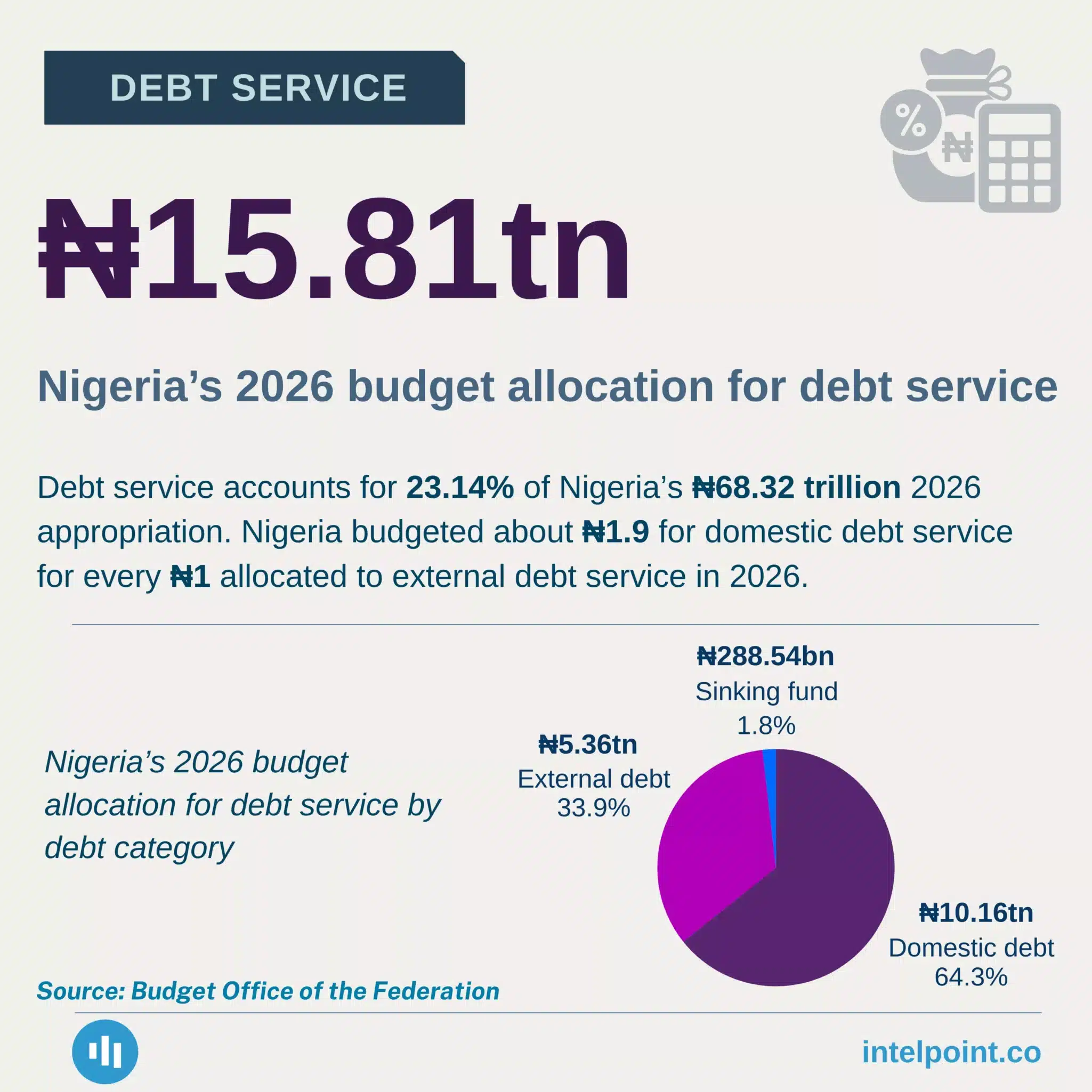
Source:

World Bank - IDS

Period:

1970-2024
HTML code to embed chart
Want a bespoke report?
Reach out
Tags
Related Insights

Two-thirds of IDA’s commitments in one year went to Africa, led by Nigeria’s $3.1bn
  • Africa received 66% of IDA’s FY2025 commitments.
  • Africa’s total IDA allocation was $22.4 billion out of $33.8 billion.
  • Nigeria was the largest borrower from the DA globally, with $3.1 billion in loans.
  • Bangladesh ranked second with $3 billion.
  • Six of the top ten borrowers were African countries.
  • Nigeria accounted for 9.3% of total FY2025 IDA commitments.

Oyo has reduced external debt by 36% and domestic debt by 22% under Makinde
  • Oyo reduced external and domestic debt by the end of 2025.
  • External debt fell faster than domestic debt.
  • External debt declined more consistently over the period.
  • Oyo’s local debt peaked around 2022–2023 before falling back.
  • The state appears to have prioritised reducing FX exposure.

Under Sanwo-Olu, Lagos cut its external debt and more than doubled its domestic debt
  • Lagos cut external debt, but increased domestic debt.
  • The drop in external debt was meaningful, but the rise in domestic debt was much larger.
  • Stronger IGR gave Lagos more room to borrow and repay.
  • The state chose local funding over heavier dollar exposure.

Lagos's external debt has reduced by nearly three times more than the other six states combined
  • Lagos's debt reduction is larger than the other six combined.
  • Oyo posted the fastest reduction rate.
  • The biggest percentage cut did not equal the biggest dollar cut.
  • Debt reduction was concentrated, not broad-based.
  • Higher state revenues likely created room for repayments.
  • Lagos had the strongest fiscal capacity among the states shown.
  • Smaller debt stocks made percentage declines easier for some states.

Northern states have accounted for 12 of the 15 fastest-growing external debts in Nigeria since June 2023
  • All but four states increased their external debt between June 2023 and December 2025.
  • Northern states account for roughly 70% of the $1.34 billion added by states nationally.
  • Katsina recorded the highest growth in both absolute terms ($150 million) and rate (+296%).
  • 12 of the 15 fastest-growing state debts are in the north.
  • Lagos, Nigeria's largest debtor at $1.17 billion outstanding, was one of only four states that reduced its debt.
  • Kaduna carries the second-heaviest debt load at $684 million, despite a relatively modest 20% growth rate.

Alex Otti’s administration reduced Abia's domestic debt by 66%, with external debt rising by 14%
  • Abia’s domestic debt dropped by 66% between 2023 and 2025.
  • The state reduced domestic debt by about ₦94 billion.
  • Debt fell from roughly ₦138 billion to about ₦48.5 billion within two and a half years.
  • About ₦72 billion of inherited debt was cleared early in the administration.
  • External debt increased by 14% (+$12.9 million) over the same period.

POPULAR TOPICS
SIGN UP TO OUR NEWSLETTER
Get periodic updates about the African startup space, access to our reports, among others.
Subscribe Here
Subscription Form

A product of Techpoint Africa. All rights reserved