Bite-sized Insights about
 
Providing you with data-based insights about things happening around you.
Popular Insights
  • In addition to having one of the lowest populations on the continent, Mauritius boasts the greatest broadband penetration rate — 147.39% as of 2022 — of any country in Africa. The eastern African nation's broadband Internet subscribers surpassed its population in 2019.

    See more

    Twelve Nigerian banks listed on the Nigerian Exchange Group (NGX) reported a total profit of ₦3.42 trillion in 2023, with all banks making a profit and seeing increases from 2022. The top four banks — Zenith Bank, Access Holdings, UBA, and GTCO — contributed 71% of this amount. Zenith Bank saw a 202% increase from the previous year and led the way with ₦676.9 billion, while Access Bank recorded the highest increase in profits (307%). Jaiz Bank made the least profit (₦11.2 billion) followed by Sterling Bank (₦21.6 billion) and Wema Bank (₦36 billion).

    See more
  • The 2024 Global Peace Index reveals a decline in peacefulness in 97 countries, the highest since the index began.

    Nigeria is among the nations affected by regional conflicts and rising violence. With a peace index score of 2.91, Nigeria is facing increasing challenges.

    A deteriorating peace score impacts foreign investment and economic stability. Global economic losses due to violence reached $19.1 trillion in 2023.

    See more

    The FAAC's revenue distribution from 2017 to August 2023 highlights the dominance of Delta, Akwa Ibom, Rivers, and Bayelsa states in allocations. Despite Lagos' economic prominence, it ranked fifth. Here is the distribution of revenue among states between 2017 and August 2023.

    See more
  • A Trend of Adult literacy rates of African countries

    Between 2018 and 2021, adult literacy rates across African nations exhibited significant disparities. Seychelles and South Africa led with literacy rates of 96% and 95%, respectively, indicating a high proportion of literate adults. Conversely, Chad had the lowest literacy rate during this period.

    These statistics underscore the uneven progress in educational attainment across Africa, highlighting the need for targeted interventions to improve literacy in lower-performing nations.

    See more
    Countries by Global Innovation Index 2024

    The Global Innovation Index 2024 reveals a striking contrast in innovation performance between countries globally and across Africa. Switzerland leads the global rankings with an impressive score of 67.5, followed by Sweden (64.5) and the USA (62.4), highlighting their sustained investments in research, development, and technological advancement.

    In Africa, Mauritius takes the top spot with a score of 30.5, followed closely by Morocco (28.8) and South Africa (28.3). However, even Africa's most innovative nations achieve less than half the score of global leaders, indicating a significant innovation gap.

    Nigeria ranks 15th in the African ranking and 113th globally, out of 133 countries, with a score of 17.1.

    See more

  • Africa's sanitation crisis is alarming, with 17 of the top 20 countries having the highest open defecation rates.

    Eritrea (67%), Niger (65%), and Chad (63%) lead, putting millions at risk of disease.

    Even Nigeria, the most populous African country, has 18% of its population practising it.

    See more
  • Only 10% of Nigerians earn above ₦100,000, according to the Nigerian Financial Services Market Report. This aligns with most reports about Nigeria, and it's in sharp contrast to the narratives online.
    See more
  • The 2024 Global Peace Index reveals a decline in peacefulness in 97 countries, the highest since the index began.

    Nigeria is among the nations affected by regional conflicts and rising violence. With a peace index score of 2.91, Nigeria is facing increasing challenges.

    A deteriorating peace score impacts foreign investment and economic stability. Global economic losses due to violence reached $19.1 trillion in 2023.
    See more

Other Insights
  • The Federal Ministry of Finance dominates with ₦16.78 trillion, accounting for nearly ₦1 in every ₦3 spent among the top ministries.
  • Combined, the ministries of Finance and Budget & Economic Planning control more than 50% of the listed allocations, underscoring the government’s focus on fiscal strategy and economic agenda.
  • The Works and Defence sectors rank third and fourth, reflecting continuous prioritisation of infrastructure development and national security.
  • Education and Health, while critical, receive smaller shares, signalling potential pressure points in human capital development funding
See more
  • Pastor Jerry Eze ranks 3rd globally, with 105 million hours watched, outperforming most entertainment and music livestream channels.
  • Faith-based livestreaming dominates the top tier, with religious creators accounting for four of the top ten.
  • Nigeria is the only African country represented in the global top ten, signalling a strong international reach.
  • Live spiritual content competes directly with relaxation and music streams, traditionally among YouTube’s most-watched formats.
See more
  • Selar’s payouts grew from ₦807.2 million in 2021 to ₦18 billion in 2025, marking over 22x growth in five years.
  • The number of creators increased from 20,000 to 400,000, indicating rapid adoption of Selar.
  • Creator and payout growth moved in parallel, indicating a balanced, expanding ecosystem.
  • Average earnings per creator are rising, suggesting improved monetisation opportunities.
  • Selar has become a major income channel for digital entrepreneurs in Nigeria and beyond.
See more
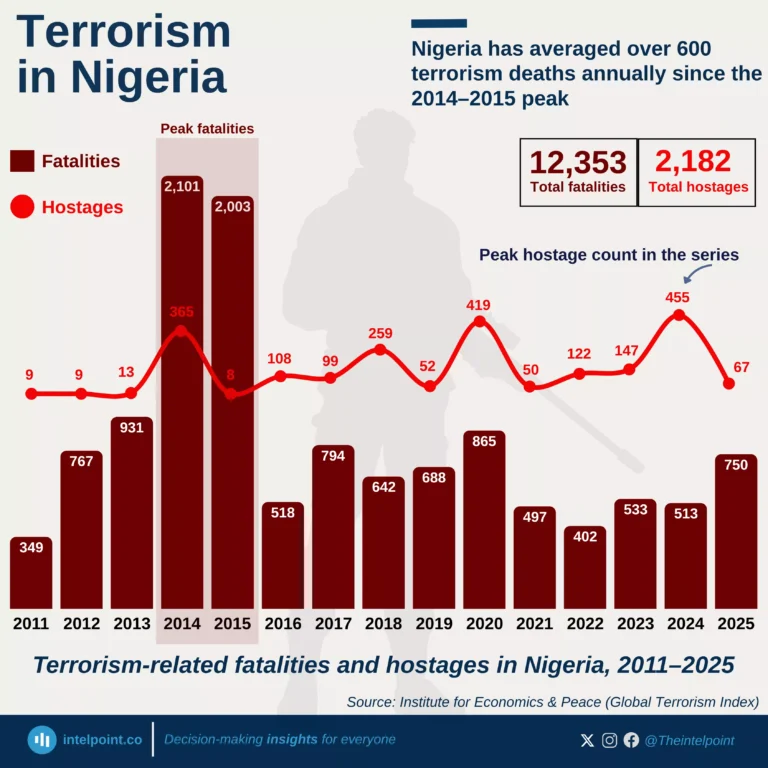
  • Kidnapping for ransom is the largest source of terrorist and bandit funding in Nigeria, accounting for 40%.
  • Resource extraction contributes 25%, highlighting the importance of illegal mining and natural-resource exploitation in sustaining armed groups.
  • Extortion makes up 15% of total funding, demonstrating the broad reach of coercive levies imposed on communities and businesses.
  • Illegal taxation (10%) remains a steady revenue stream.
  • External support accounts for 7%, indicating some level of international or cross-border backing for these groups.
See more
  • West Africa now has 12 AFCON championships, equal to North Africa’s total after Senegal’s latest win.
  • Egypt is AFCON’s most successful nation with 7 titles.
  • Cameroon (5 titles) and Ghana (4) form the second tier of AFCON’s most successful teams.
  • 15 countries feature on the list of champions, reflecting sustained competitiveness.
See more
  • Morocco leads Africa and is ranked 8th globally.
  • Nigeria and Cameroon recorded the biggest jumps, each rising 12 positions.
  • Senegal is Africa’s second-best team at 12th in the world.
  • Algeria and Egypt continue to stay relevant at the top despite slower ranking movement.
  • DR Congo and Mali show strong upward momentum, reflecting growing competitiveness beyond the traditional giants.
  • Ghana’s position outside Africa’s top ten highlights the cost of inconsistent results.
See more
  • Nigeria’s entrepreneurship index increased in 2025 for the first time since 2022.
  • The 2025 score (0.47) represents a reversal of a two-year downward trend.
  • The ecosystem remains weaker than in 2022, when the index peaked at 0.58.
  • The sharpest decline occurred between 2022 and 2023.
  • The improvement from 2024 to 2025 is incremental, not transformative.
  • The index suggests stabilisation rather than full recovery in the entrepreneurial environment.
See more
     
  • Nigeria extends its AFCON bronze medal wins to nine, the highest in men’s AFCON history, with another podium finish.
  • The win over Egypt highlights Nigeria’s resilience, turning late-stage setbacks into tangible success.
  • Bronze medals remain rare for most nations, with the majority appearing only once or twice in AFCON history.
See more
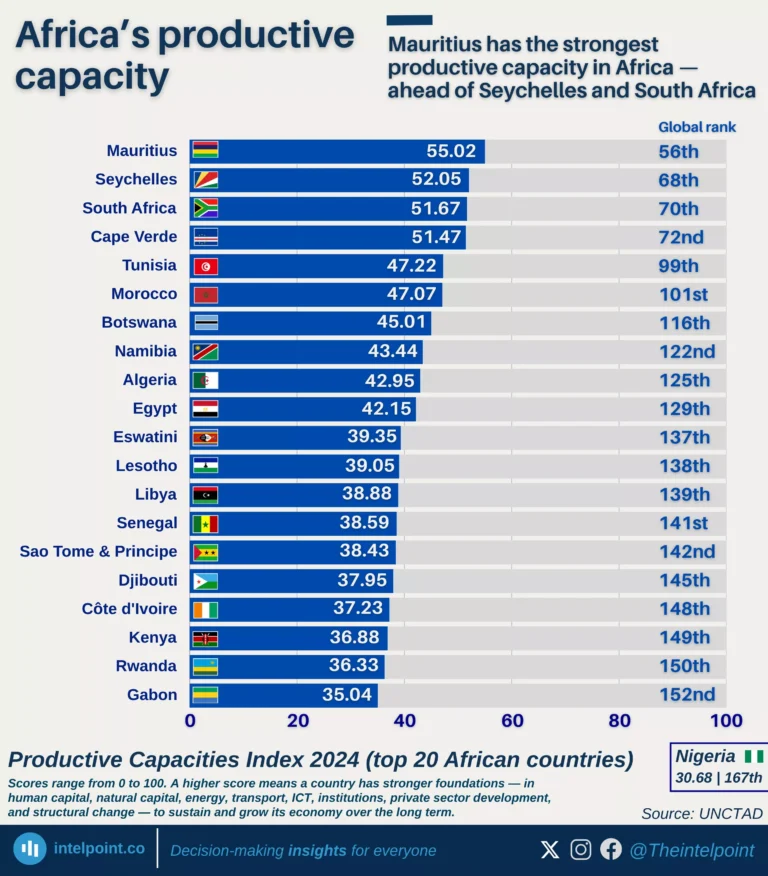
  • Mauritius is the continent’s strongest performer by a wide margin, leading with a score of 75, and ranking 15th globally.
  • Botswana and Cape Verde are the only other African countries with a score close to 70, placing them within the global top 40.
  • Most of Africa’s top 15 countries score between 56 and 60, indicating moderate levels of economic freedom.
  • Even Africa’s highest performers trail global leaders, showing persistent gaps in rule of law, regulatory efficiency, and open-market conditions.
See more
  • Allocation declined by ₦290 m from ₦6.16bn in 2025 to a proposed ₦5.87bn in 2026.
  • The change represents a 4.7% year-on-year reduction in funding.
  • Despite the decline, allocations remain broadly flat, with no major expansion in 2026.
  • The 2026 figure is still a proposal, and actual funding figures may change after legislative review.
See more
  • Firearms were used in about 70%% of all attacks, making them the single most important driver of violent insecurity in Nigeria.
  • 14,782 attacks were recorded between 2018 and 2024, underscoring the scale of sustained armed violence.
  • Explosives accounted for 15% of incidents, showing continued but secondary use of IEDs and bombings.
  • Melee weapons made up 12%, reflecting close-range violence but far lower impact than gun attacks.
See more
     
  • Kogi entrepreneurs have the highest tax policy awareness in Nigeria (96.8%) in 2025.
  • Abia has the lowest awareness nationwide at just 1.4%.
  • Fewer than one-third of Nigerian states have awareness levels above 60%.
  • Major economic hubs like Lagos and Rivers have awareness below 50%.
  • Northern states dominate the top awareness rankings more than southern states.
  • Several states cluster around the 40–50% range, indicating partial reach.
  • States with low awareness risk lower compliance and higher friction during enforcement.
  • The gap between the highest and lowest states exceeds 95 percentage points, showing extreme disparity.
See more
1 7 8 9 10 11 126
  • South Africa leads in headcount, with seven billionaires, more than other African countries.
  • Nigeria leads in wealth, with four billionaires worth $47.5 billion, $4.5 billion more than the combined $43 billion of South Africa's seven billionaires.
  • Nigeria's billionaires are richer individually, with an average net worth of $11.9 billion, compared with South Africa's $6.1 billion.
  • North Africa punches below its weight: Egypt, Morocco, and Algeria have ten billionaires combined but just $31.4 billion in total wealth.
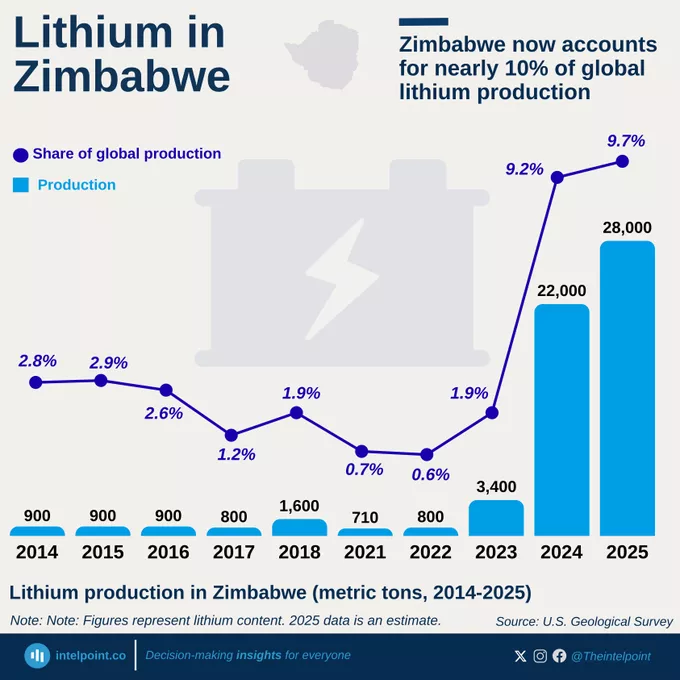
  • East Africa barely registers: Tanzania and Zimbabwe each have just one billionaire, both worth $2.1 billion.
 
Read more
Fuel prices from Dangote Refinery reached an all-time high of ₦1,175 per litre in March 2026. The lowest recorded price in the period was ₦699 per litre in December 2025, showing a wide price swing. The jump from ₦699 to ₦1,175 happened in roughly four months.
  • Prices earlier in the timeline hovered mostly between ₦820 and ₦987 during late 2024 and much of 2025.
  • The December 2025 price cut was aimed at making locally refined fuel more competitive against imports.
  • After the price drop, fuel costs began rising again in early 2026, reaching ₦995 by early March before climbing further.
  • Global geopolitical tensions affecting oil markets contributed to the upward pressure on prices.
Read more
  • Internationally authorised Nigerian banks have raised and injected over ₦3.3 trillion in new capital since March 2024.
  • The recapitalisation exercise is being driven by the Central Bank of Nigeria’s requirements, with the deadline expected in March 2026.
  • Zenith Bank currently has the highest capital among the banks shown, reaching about ₦614 billion.
  • Access Holdings has about ₦602.8 billion in total capital.
  • Fidelity Bank raised the largest single capital injection in the group, about ₦437.85 billion, pushing its total capital to ₦564.5 billion.
  • FCMB has the highest previous capital base among the banks listed (₦266.5 billion) before the recapitalisation injection.
Read more
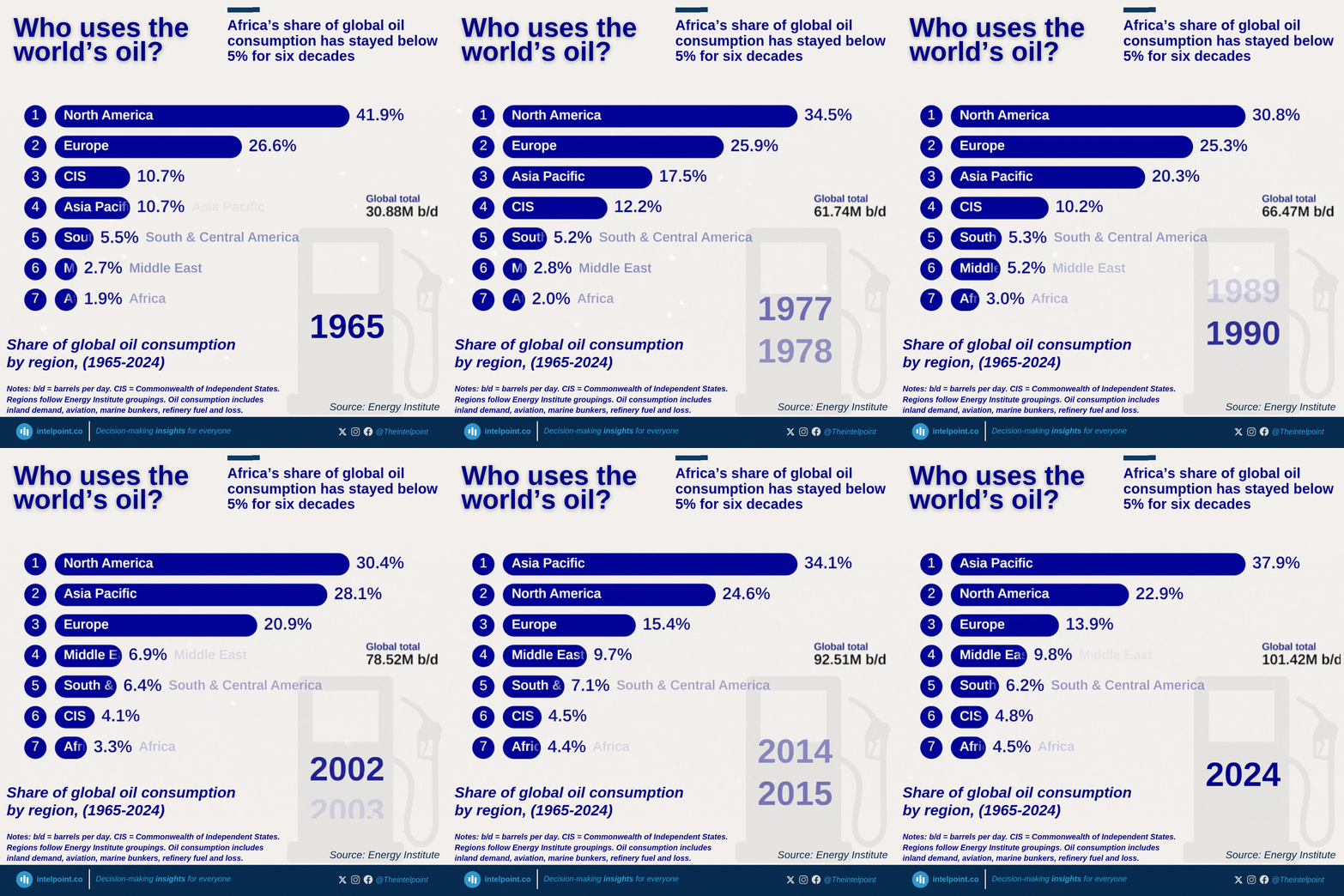
  • The Strait of Malacca is the world’s most important oil chokepoint, carrying about 24–25% of global oil supply in recent years.
  • The Strait of Hormuz moves around 20–23% of global oil supply, making it the second-largest energy transit chokepoint.
  • The Cape of Good Hope carries about 9–10% of global oil flows, and its share tends to increase when other chokepoints face disruptions.
  • The Bab el-Mandeb saw a sharp drop in oil flow share from about 9% in 2023 to around 4% in 2024, reflecting security concerns affecting shipping in the Red Sea corridor.
  • Oil transported through the Suez Canal and the SUMED pipeline system dropped significantly after 2023, falling from about 8.6% to below 5%, showing how quickly routes shift during geopolitical tensions.
  • The Strait of Malacca’s share has remained consistently high and stable, indicating its structural importance to Asian energy demand.
  • Alternative routes like the Cape of Good Hope in South Africa are longer but strategically crucial, especially when Middle Eastern chokepoints become unstable.
Read more
  • Seven of nine exchanges posted positive growth, signalling broad-based expansion across African equity markets in 2025.
  • Ghana Stock Exchange led all exchanges in growth rate, rising 133.86% across the year — the sharpest single-year gain in this dataset.
  • The Johannesburg Stock Exchange closed Q4 at $1.3 trillion, making it by far the largest exchange on the continent by market capitalisation.
  • The Stock Exchange of Mauritius and MERJ Exchange (Seychelles) were the only two exchanges to contract, declining 2.61% and 8.02% respectively.
Read more
  • Life Business was the single largest segment, and its 70.3% jump signals that more Nigerians are thinking seriously about financial protection for their families.
  • Miscellaneous, the smallest segment, posted the biggest growth at 86.7%, suggesting new and unconventional insurance products are gaining serious traction.
  • Aviation & Marine nearly doubled, with 79.9% growth in a sector tied to trade and logistics, reflecting Nigeria's expanding import/export activity and the rising cost of cargo and aircraft risk coverage.
  • Motor (52.5%), Fire (53.3%), and General Accident (49.6%) grew by roughly half, indicating broad-based sector expansion rather than isolated pockets of growth.
Read more
1 7 8 9 10 11 252

Can’t find what you’re looking for? Please fill the form below
Contact Form Demo
SIGN UP TO OUR NEWSLETTER
Get periodic updates about the African startup space, access to our reports, among others.
Subscribe Here
Subscription Form

A product of Techpoint Africa. All rights reserved