Bite-sized Insights about
 
Providing you with data-based insights about things happening around you.
Popular Insights
  • GSM subscribers in Nigeria only recorded three year-on-year drops in the past 11 years

    As of March 2024, there were 219m subscribers in Nigeria's GSM market which is dominated by three players each with over 20% market share. More than 40 mobile virtual network operators (MVNOs) have been licensed to date, all of whom will rely on the infrastructure of the country's four mobile network operators to offer their services.

    See more

    Nigeria ranked 2nd after India in Chainalysis' 2023 Global Crypto Adoption Index. However, it ranked 1st in the peer-to-peer (P2P) exchange trade volume sub-index, which has 6 other African countries in the top 10. Here are the leading countries in P2P crypto trading volume.

    See more
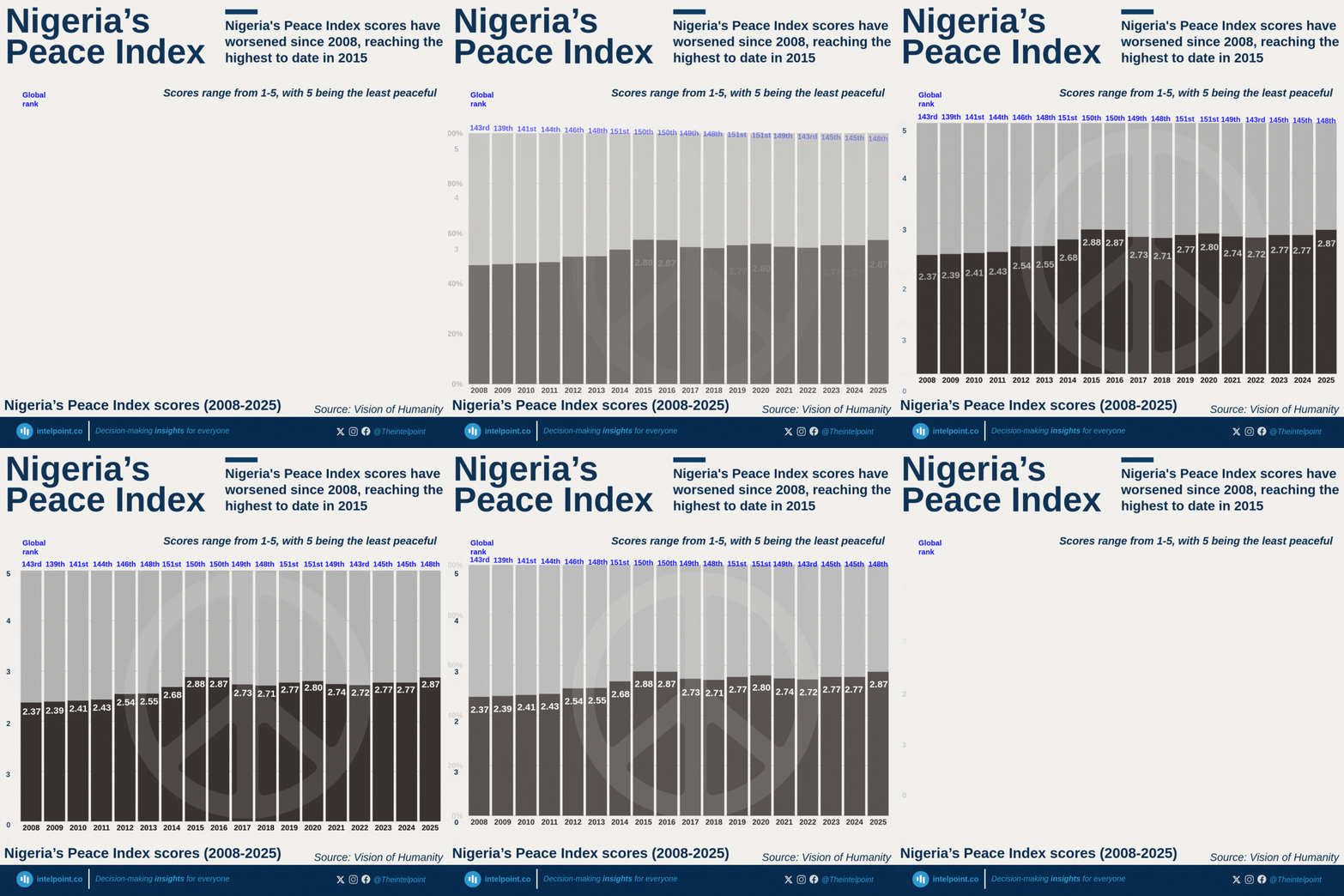
  • The 2024 Global Peace Index reveals a decline in peacefulness in 97 countries, the highest since the index began.

    Nigeria is among the nations affected by regional conflicts and rising violence. With a peace index score of 2.91, Nigeria is facing increasing challenges.

    A deteriorating peace score impacts foreign investment and economic stability. Global economic losses due to violence reached $19.1 trillion in 2023.

    See more

    The FAAC's revenue distribution from 2017 to August 2023 highlights the dominance of Delta, Akwa Ibom, Rivers, and Bayelsa states in allocations. Despite Lagos' economic prominence, it ranked fifth. Here is the distribution of revenue among states between 2017 and August 2023.

    See more
  • A Trend of Adult literacy rates of African countries

    Between 2018 and 2021, adult literacy rates across African nations exhibited significant disparities. Seychelles and South Africa led with literacy rates of 96% and 95%, respectively, indicating a high proportion of literate adults. Conversely, Chad had the lowest literacy rate during this period.

    These statistics underscore the uneven progress in educational attainment across Africa, highlighting the need for targeted interventions to improve literacy in lower-performing nations.

    See more
    Countries by Global Innovation Index 2024

    The Global Innovation Index 2024 reveals a striking contrast in innovation performance between countries globally and across Africa. Switzerland leads the global rankings with an impressive score of 67.5, followed by Sweden (64.5) and the USA (62.4), highlighting their sustained investments in research, development, and technological advancement.

    In Africa, Mauritius takes the top spot with a score of 30.5, followed closely by Morocco (28.8) and South Africa (28.3). However, even Africa's most innovative nations achieve less than half the score of global leaders, indicating a significant innovation gap.

    Nigeria ranks 15th in the African ranking and 113th globally, out of 133 countries, with a score of 17.1.

    See more

  • Argentina, Egypt, and Ukraine were the IMF’s top three debtors as of June 26, 2024, accounting for $51 billion (46%) of the total debt. Egypt, Angola, and Kenya occupy the top three spots in Africa on the IMF’s debtors’ list.

    As of December 2023, Kenya's public debt stood at Ksh11.14 trillion (approximately $76.8 billion). By June 2024, its debt to the IMF had increased by 245% from $744 million in August 2020.

    This increase has coincided with protests in Kenya, where citizens opposed a proposed finance bill aiming to raise additional taxes to reduce the budget deficit and state borrowing.

    See more
  • MTN Nigeria has dominated the country's telecommunications market over the years, accounting for the largest market share. All four operators, apart from 9mobile, recorded a significant increase in their subscriber base between May 2014 and March 2024.

    See more
  • The 2024 Global Peace Index reveals a decline in peacefulness in 97 countries, the highest since the index began.

    Nigeria is among the nations affected by regional conflicts and rising violence. With a peace index score of 2.91, Nigeria is facing increasing challenges.

    A deteriorating peace score impacts foreign investment and economic stability. Global economic losses due to violence reached $19.1 trillion in 2023.
    See more

Other Insights
  • Oil exports continued to dominate, averaging over 88% of total exports in 2024 and remaining above 81% in the first half of 2025.
  • Non-oil exports rose gradually, from a low of 6.9% (February 2024) to a high of 18.1% (January 2025).
  • Peaks in non-oil export contributions occurred in July 2024 (16.4%) and January–April 2025 (13–18%), indicating progress toward diversification.
  • Total exports remained heavily oil-driven, though sustained double-digit non-oil shares in late 2024 and early 2025 show a slow shift.
See more
     
  • Non-oil exports rose to 14.3% of total exports in 2025, up from 8.7% in 2023.
  • Oil exports still represent 85.7% of total exports in 2025.
  • The non-oil share reached 13.1% in 2019 before dipping and rebounding by 2025.
  • Nigeria’s total exports expanded from ₦9.6 trillion in 2015 to ₦43.3 trillion in H1 2025, showing strong value growth.
  • The lowest non-oil share in the decade occurred in 2016 (4%), reflecting heavy oil dependence.
See more
  • Urban electricity access has remained between 80% and 89% since 1990, never crossing to 90%.
  • The inability to achieve universal access suggests that infrastructure expansion has struggled to keep pace with rapid urbanisation and population growth.
  • Periodic dips in access, such as in 2010 and 2015, point to challenges in maintaining consistent electricity supply rather than just extending connections.
  • Insufficient generation, outdated grids, and policy inefficiencies have constrained Nigeria’s ability to deliver reliable and universal electricity access even in its urban centres.
See more
  • Rural electricity access increased from just 4% in 1990 to about 33% in 2023, showing gradual progress over three decades.
  • The data reveals irregular jumps in certain years—such as 2003, 2011, and 2016—likely tied to temporary electrification programmes or revised data estimates. D
  • espite improvements, nearly two-thirds of rural Nigerians still lack electricity, underscoring a wide disparity in energy access across regions.
  • The slow rate of expansion highlights ongoing issues with investment, grid extension, and maintenance that continue to limit rural electrification efforts.
See more
  • Manufacturing records the highest monthly revenue at ₦8.27m, nearly double that of the next sector.
  • Healthcare (₦5.02m) and Transportation (₦3.70m) follow, reflecting essential service demand.
  • Industries like Marketing & Advertising (₦191k), Food & Beverages (₦320k), and Education (₦440k) earn significantly less on average.
  • The difference between top earners (Manufacturing, Healthcare) and bottom sectors highlights a stark inequality in industry.
See more
  • The South West is the only region with MSMEs reporting revenues above ₦100 million, accounting for 100% of that bracket.
  • While high-revenue firms cluster in the South West, the South South leads in the ₦10M–₦99.9M range, with over 50.8% share.
  • The North Central (30.3%) has the highest share of MSMEs earning less than ₦100,000 monthly, followed by the North East (19.6%).
  • The ₦200K–₦999.9K range is more evenly spread across regions, but the South West and South South consistently record stronger representation.
See more
  • Nigerian naturalisations in Canada rose from 5,286 in H1 2022 to 6,831 in H1 2025, a 29% increase overall.
  • H1 2023 marked the highest level with 7,400 new citizens.
  • Numbers declined through 2024, bottoming at 6,057 in H2.
  • The rebound in H1 2025 signals sustained interest in Canadian citizenship among Nigerians.
See more
  • Nigeria accounts for 25.9% of all new Canadian citizens of African origin, more than triple any other African country.
  • Morocco, Algeria, and Tunisia rank next, each contributing over 5% of total new citizens of African origin.
  • Countries like Eritrea, Ethiopia, and DR Congo show steady growth, reflecting widening migration links with Canada.
  • South Africa closes the top ten with 832 citizens (3.2%), indicating smaller but consistent migration flows.
See more
  • India accounts for 23.4% of all new citizens, the largest share by far.
  • Four of the top five source countries (India, Philippines, Iran, China) are in Asia, showing the region’s migration strength.
  • Nigeria ranks third, contributing 4.5% of total new citizens, the highest share from Africa.
  • Traditional migration partners like the U.K. and U.S.A. contribute smaller shares, under 3% each, highlighting a shifting global migration pattern.
See more
  • Flutterwave UK’s turnover rose from £0.93M in 2021 to £6.61M in 2024, showing consistent expansion.
  • Growth cooled from 311% in 2022 to 21% in 2024, reflecting market maturity.
  • The UK unit’s performance is now tied to Flutterwave’s global surge, with over $31 billion in payments processed in 2024.
  • The focus is shifting from rapid scaling to sustainable growth, compliance, and strengthening cross-border infrastructure.
See more
  • The US imported 425 million barrels of crude oil and other petroleum products from Nigeria in 2005, the highest in the past 32 years.
  • The US shale boom reduced America’s reliance on foreign crude.
  • The launch of the Dangote Refinery has increased domestic demand for crude oil, further reducing the amount available for export to the US.
  • Nigeria, which was regularly a top five crude oil supplier to the US in earlier decades, ranked ninth among its suppliers in 2024.
See more
  • Papua New Guinea remains unmatched: With 843 living languages, the Pacific nation continues to hold the title of the world’s most linguistically diverse country.
  • Nigeria tops Africa: Hosting 530 living languages, Nigeria ranks third globally and stands as Africa’s richest linguistic hub.
  • Indonesia (709) and India (454) are also in the top five, showcasing the dense cultural mosaic across Asia.
  • Even large, developed countries like the U.S. (239), Australia (225), and Brazil (222) make the list, proving that language diversity transcends geography and development.
See more
1 19 20 21 22 23 126
  • Ghana first appeared at the World Cup in 2006 after missing all 17 previous editions.
  • They advanced to the second round in 2006, a standout entry for a first-time participant.
  • In 2010, Ghana reached the quarter-finals, marking their strongest performance to date.
  • 2018 was the only missed World Cup since their debut, reflecting consistent qualification success.
  • They have already qualified for the 2026 World Cup.
  • Ghana has made five qualifications within 20 years, showing remarkable frequency for a team that only debuted in 2006.
Read more
  • South Africa did not qualify for any of the first 15 World Cups from 1930 to 1994.
  • They made their World Cup debut in 1998 and were knocked out in the group stage.
  • Their second appearance came in 2002, ending again at the group stage.
  • In 2010, South Africa became the first African country to host the tournament, but still did not progress beyond the group stage.
  • The country failed to qualify for three straight World Cups in 2014, 2018, and 2022.
Read more
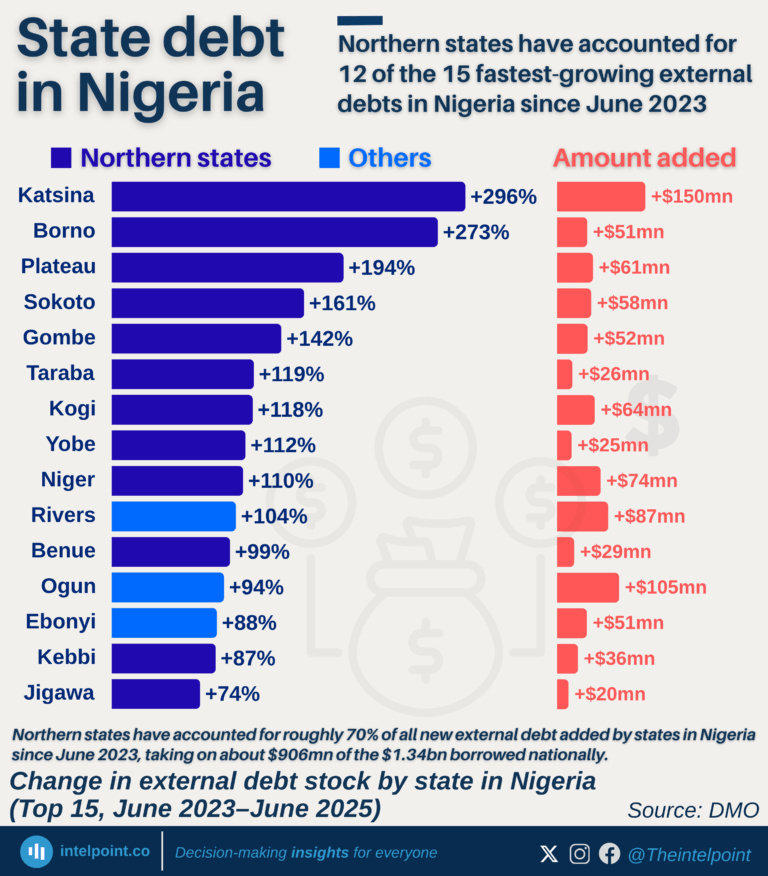
  • Ten states and the FCT collectively reduced their external debt by $227.19 million in H1 2025.
  • Lagos, Edo, and Rivers accounted for most of the reductions, making up more than three-quarters of the total.
  • Several smaller states also trimmed their balances, but by relatively modest amounts.
  • These reductions significantly offset the increases recorded by 26 other states, helping keep nationwide net external debt growth low.
Read more
  • Agriculture dominated Kenya’s exports, with coffee, tea, and spices alone contributing $1.7 billion, the largest single export category.
  • Mineral fuels were a surprisingly strong second, delivering $1.1 billion, and showing Kenya’s growing role in regional fuel distribution.
  • Horticultural exports (flowers, live plants, and trees) contributed $790 million, reinforcing Kenya’s global strength in floriculture.
  • All other export categories fall below $300 million individually, reflecting a long list of small but diverse export segments such as textiles, vegetables, and pharmaceuticals.
Read more
  • Gems and precious metals were the largest single export category, contributing $20.6 billion.
  • Ores and industrial minerals followed closely with $17.2 billion, showing the country’s reliance on mining.
  • Vehicles and machinery were significant non-mineral exports, with a combined $18.3 billion.
  • Agricultural and light industry products like fruits, nuts, and beverages contributed modestly, strengthening mining and manufacturing’s position as the core export drivers.
Read more
  • Nigerian players have won the award seven times from 1992 to 2025.
  • Ivorian players follow with six wins, driven by their strong presence in the 2000s and 2010s.
  • Only four countries have produced four or more individual winners: Nigeria, Côte d’Ivoire, Cameroon, and Senegal.
  • Just 12 African nations account for all winners across the 33 years, showing how concentrated elite talent production has been.
Read more
1 19 20 21 22 23 252

Can’t find what you’re looking for? Please fill the form below
Contact Form Demo
SIGN UP TO OUR NEWSLETTER
Get periodic updates about the African startup space, access to our reports, among others.
Subscribe Here
Subscription Form

A product of Techpoint Africa. All rights reserved