Bite-sized Insights about
 
Providing you with data-based insights about things happening around you.
Popular Insights
  • The African countries with the highest life expectancies as of 2023 are: Algeria - 77 years, Tunisia - 77 years, Cape Verde - 77 years, Mauritius - 76 years.

    The African countries with the lowest life expectancies: Central African Republic - 55 years, Lesotho - 55 years, Nigeria - 54 years, Chad - 54 years.

    See more
  • The 2024 Global Peace Index reveals a decline in peacefulness in 97 countries, the highest since the index began.

    Nigeria is among the nations affected by regional conflicts and rising violence. With a peace index score of 2.91, Nigeria is facing increasing challenges.

    A deteriorating peace score impacts foreign investment and economic stability. Global economic losses due to violence reached $19.1 trillion in 2023.

    See more

    The FAAC's revenue distribution from 2017 to August 2023 highlights the dominance of Delta, Akwa Ibom, Rivers, and Bayelsa states in allocations. Despite Lagos' economic prominence, it ranked fifth. Here is the distribution of revenue among states between 2017 and August 2023.

    See more
  • A Trend of Adult literacy rates of African countries

    Between 2018 and 2021, adult literacy rates across African nations exhibited significant disparities. Seychelles and South Africa led with literacy rates of 96% and 95%, respectively, indicating a high proportion of literate adults. Conversely, Chad had the lowest literacy rate during this period.

    These statistics underscore the uneven progress in educational attainment across Africa, highlighting the need for targeted interventions to improve literacy in lower-performing nations.

    See more
    Countries by Global Innovation Index 2024

    The Global Innovation Index 2024 reveals a striking contrast in innovation performance between countries globally and across Africa. Switzerland leads the global rankings with an impressive score of 67.5, followed by Sweden (64.5) and the USA (62.4), highlighting their sustained investments in research, development, and technological advancement.

    In Africa, Mauritius takes the top spot with a score of 30.5, followed closely by Morocco (28.8) and South Africa (28.3). However, even Africa's most innovative nations achieve less than half the score of global leaders, indicating a significant innovation gap.

    Nigeria ranks 15th in the African ranking and 113th globally, out of 133 countries, with a score of 17.1.

    See more

  • Five of the top tep African countries with the largest gold reserves are North African

    Half of the top 10 African countries with significant gold reserves come from North Africa, with Algeria leading with 174 tonnes. Egypt and South Africa come in second and third with 126 tonnes and 125 tonnes, respectively. Algeria, Egypt, South Africa, and Libya hold the most significant gold reserves.

    See more
  • MTN Nigeria has dominated the country's telecommunications market over the years, accounting for the largest market share. All four operators, apart from 9mobile, recorded a significant increase in their subscriber base between May 2014 and March 2024.

    See more
  • The 2024 Global Peace Index reveals a decline in peacefulness in 97 countries, the highest since the index began.

    Nigeria is among the nations affected by regional conflicts and rising violence. With a peace index score of 2.91, Nigeria is facing increasing challenges.

    A deteriorating peace score impacts foreign investment and economic stability. Global economic losses due to violence reached $19.1 trillion in 2023.
    See more

Other Insights
     
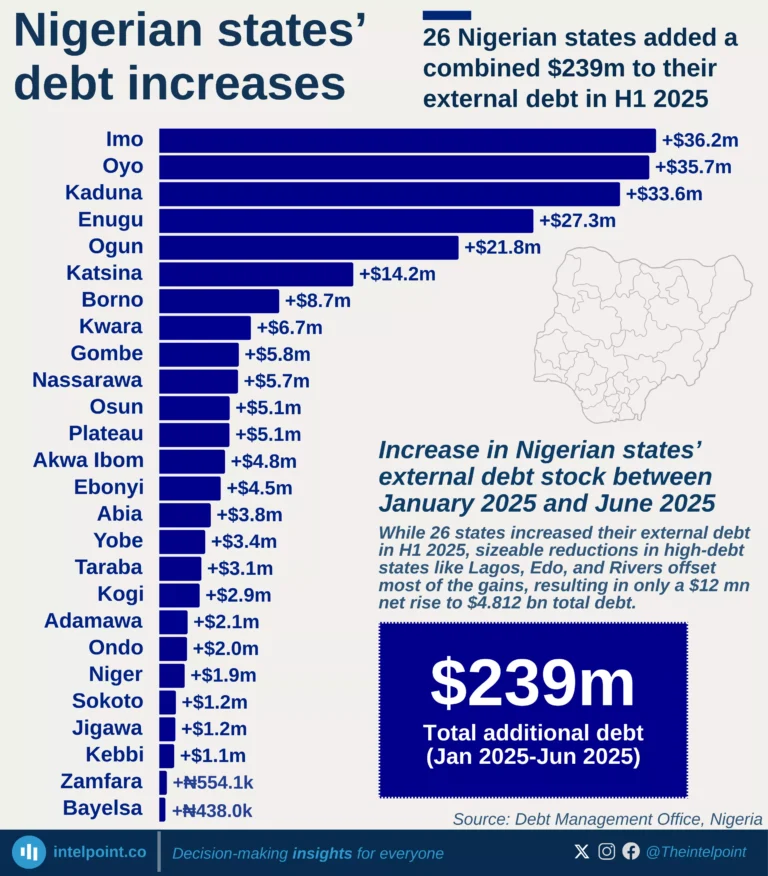
  • The six North Central states collectively hold ₦449.4 billion in domestic debt as of Q2 2025, according to DMO data.
  • Kogi and Nasarawa lead in fiscal control with ₦18.8 billion and ₦23.9 billion, respectively
  • Both states record the lowest debt profiles in the region. Niger State’s ₦141.5 billion debt makes it the region’s most indebted, accounting for nearly one-third of the total.
  • The debt gap between Kogi (lowest) and Niger (highest) stands at over ₦123 billion, highlighting stark differences in fiscal management and borrowing capacity across the zone.
See more
     
  • Lagos dominates regional debt with a domestic debt stock of ₦1.04 trillion, over 70% of the South-West’s total subnational debt.
  • Lagos’s debt is six times larger than that of Ogun (₦162.9 billion), the region’s next most indebted state.
  • At ₦10.6 billion, Ondo maintains the lowest domestic debt profile in the region, reflecting relatively modest borrowing.
  • The combined domestic debt of the six South-West states (Lagos, Ogun, Oyo, Osun, Ekiti, and Ondo) stood at ₦1.43 trillion as of Q2 2025.
See more
  • Nigeria dominates with ₦339.6b, contributing over 70% of GTCO’s total profit after tax in Africa.
  • Ghana (₦61.9b) and Côte d’Ivoire (₦28.2b) followed as the strongest non-Nigerian subsidiaries.
  • Tanzania (₦46m) and Uganda (₦505m) contributed negligible profits compared to peers.
  • GTCO subsidiaries across Africa collectively generated around ₦476b profit after tax in the first half of 2025.
See more
  • Nigeria’s public debt rose to $99.7 billion, up from $91.3 billion in June 2024, marking a return to growth after a dollar-value decline in 2024.
  • The debt in local currency climbed to ₦152.4 trillion, reflecting both borrowing and continued naira depreciation.
  • The increase underscores ongoing domestic financing challenges and vulnerability to exchange-rate fluctuations.
  • The growth in dollar terms points to renewed external borrowing as the government manages debt obligations post-2024 volatility.
See more
 
  • From recession to recovery, Nigeria’s GDP growth journey reveals three decades of economic volatility and slow transformation.
  • Nigeria's economy grew by 14.6% in 2002, which is still the highest in the country's history.
  • The country entered a recession in 2016, with the economy shrinking by -1.6%.
  • Nigeria enjoyed a long period of strong growth between 2003 and 2010: The economy grew between 7% and 11%, powered by high oil prices and booming sectors like telecoms and banking.
See more
     
  • The U.S. consistently leads Nigeria’s imports from the Americas, accounting for 57–73% between 2013 and 2025.
  • Brazil ranks second, with shares ranging between 11% and 24%, highlighting its steady trade ties with Nigeria.
  • During the period, the combined share of the U.S. and Brazil never fell below 76%, even at its lowest point in 2022.
  • Total imports from the Americas surged from ₦0.9 trillion in 2013 to a peak of ₦6.3 trillion in 2024.
  • Canada’s import share peaked at 16.4% in 2022, showing a rare moment of diversification.
See more
  • South Africa dominates with 30 battery storage systems, the largest by far.
  • Egypt is the second-largest market with 7 projects, while Morocco has 4.
  • Nigeria and Senegal have five projects each (operational + pipeline).
  • Several countries, including Ghana, Togo, Angola, Botswana, DR Congo, and Mauritius, each have just one or two projects, indicating an uneven spread across the continent.
  • South Africa also leads in systems under construction (7).
  • Operational projects are still limited continent-wide, with most systems either under construction or in the planning pipeline.
See more
     
  • Imports from ECOWAS countries peaked at 39.9% in H1 2024, up from just 12.0% in H1 2021.
  • The share declined to 32.4% in H1 2025, showing a reversal after the 2024 peak.
  • Total import values grew sharply, from ₦209.6B in H1 2020 to ₦1.8T in H1 2025.
  • In H1 2019, ECOWAS already had a decent share of 19.6%, showing long-standing but fluctuating trade ties.
See more
     
  • ECOWAS’ share of Nigerian exports rose from 34.2% in H1 2019 to 62.1% in H1 2025.
  • The most significant share came in H1 2022, when ECOWAS accounted for 75.8% of exports.
  • Exports to other African countries dropped significantly in 2022, to just 24.2%.
  • Nigeria’s total exports to Africa grew from ₦0.9T in H1 2022 to ₦4.8T in H1 2025.
  • ECOWAS consistently maintained a majority share from H1 2022 onwards, with a share above 60%.
See more
 
  • FDI inflows in Nigeria peaked at $8.8 billion in 2011, marking the highest point in the Fourth Republic.
  • From 2011 to 2024, FDI inflows dropped, settling at $1.1 billion in 2024.
  • The early Fourth Republic (1999–2011) showed growth in FDI inflows.
  • FDI outflows rose from $0.2 billion in 1999 to $1.5 billion in 2009, reflecting gradual international expansion by Nigerian investors.
  • From 2015 onward, both inflows and outflows showed significant volatility, with no clear recovery trend.
See more
  • Debt service costs in South Africa overtook government health spending in 2020/21.
  • In South Africa's 2025 budget, debt service costs stand at R426.3B, compared to R296.1B for health.
  • Debt service costs grew at 11.3% CAGR (2017–2025), more than double the 5.0% CAGR of government health expenditure.
  • The gap between debt and health spending widened sharply after 2020/21, with debt consistently pulling ahead.
See more
  • The young-to-old dependency ratio stands at 14:1, showing that youth dependency overwhelmingly drives the total ratio.
  • The total dependency ratio declined from 88.2% in 1976 to 78.8% in 2024, showing slow but steady improvement.
  • The youth dependency ratio has dropped from 82.2% to 73.3% over the same period.
  • The old-age dependency ratio remained almost flat, averaging around 5–6% for nearly 50 years.
  • The highest total dependency ratio was 95.0% in 1988.
  • The ratio’s slight downward trend after 2012 reflects a growing working-age population entering the labour market.
See more
1 18 19 20 21 22 126
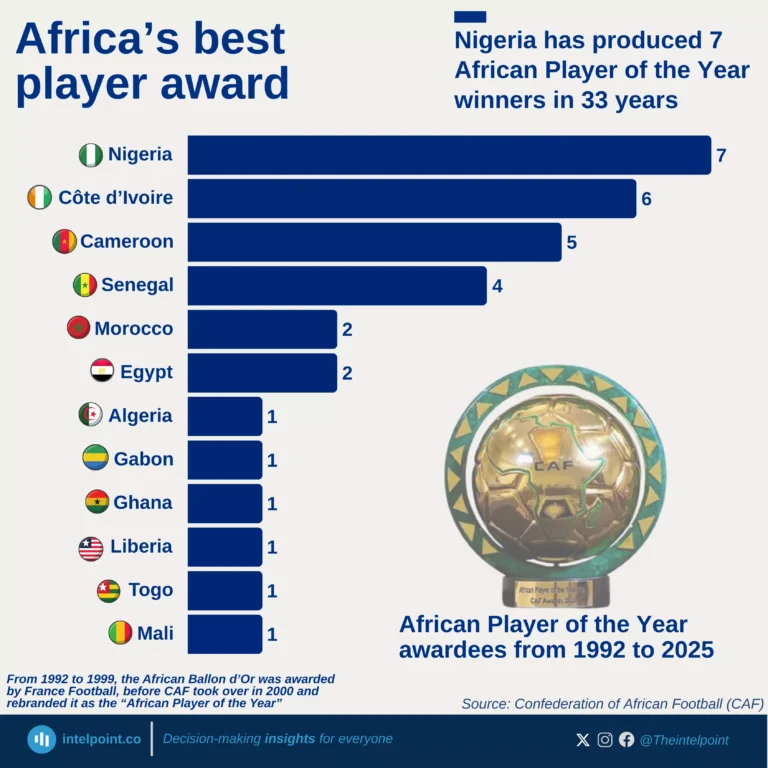
  • Nigeria remains the country with the most overall winners.
  • Three Nigerian players — Asisat Oshoala (6), Perpetua Nkwocha (4), and Cynthia Uwak (2) — have won the award more than once.
  • Outside Nigeria, only Ghana, South Africa, Equatorial Guinea, and Cameroon have produced winners, showing limited spread beyond Nigeria in the first two decades.
  • In recent years, the award has become more competitive, with new winners emerging from Morocco, Zambia, and South Africa, signaling a noticeable shift away from long-standing Nigerian dominance.
Read more
  • Nigeria remains the leader at U-17 level with five titles, more than any other nation.
  • Brazil follows closely with four wins, making the two countries the dominant forces in youth football history.
  • Only Mexico and Ghana have won the tournament more than once, highlighting how rare repeated success is at this level.
  • The remaining winners — Germany, England, Switzerland, France, Saudi Arabia, Portugal, and the former Soviet Union — show that victory is widely distributed but rarely sustained.
Read more
  • APC increased its number of sitting governors from 19 in 2019 to 26 in 2025.
  • PDP saw a significant decline, dropping from 16 governors in 2019 to 6 by 2025.
  • APC’s share of governors rose from 52.8% in 2019 to 72.2% in 2025.
  • As of May 2023, after the 2023 general elections, 13 sitting governors were still members of the PDP, but by 2025, five of these governors had defected to the APC, one had defected to
  • Accord, and one lost an election in 2024 to the APC.
  • Smaller parties (APGA, NNPP, LP, and Accord) appeared intermittently, each holding a single governorship.
  • By 2025, Nigeria’s governorship landscape was the most one-sided in recent years, heavily dominated by the APC.
Read more
  • The U.S Department of Homeland Security specifies that the data reflects the “worst of the worst” criminal aliens arrested by ICE, not general immigration arrests.
  • Nigeria leads the list with 40 arrests, the highest among all African nationals reported.
  • Somalia (27) and Liberia (21) follow, forming a concentrated top tier.
  • Most countries report fewer than 10 arrests, showing a sharp decline beyond the top group.
Read more
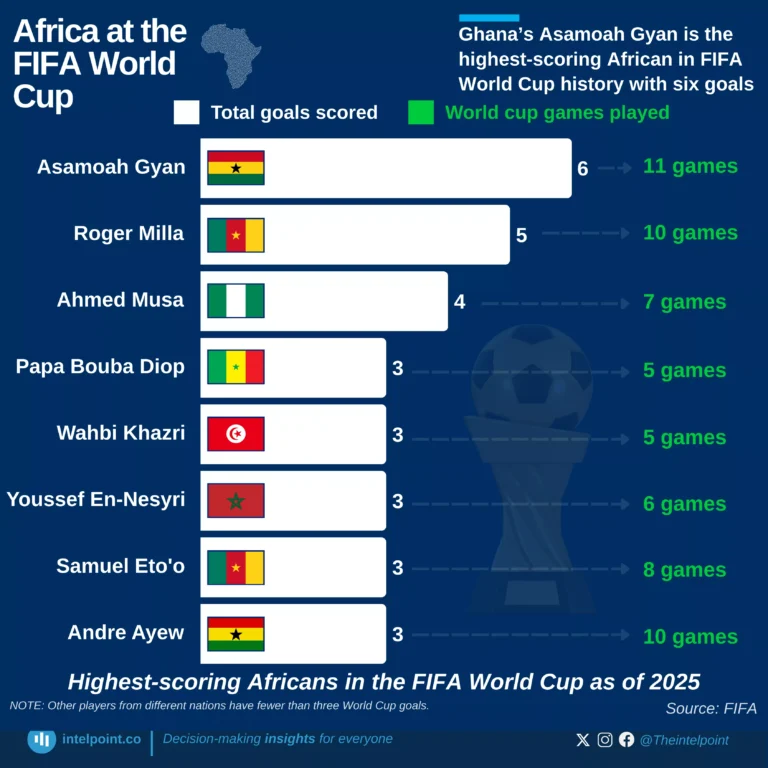
  • Asamoah Gyan leads Africa’s all-time World Cup scoring chart with six goals in eleven games, making him the most prolific African player in World Cup history.
  • Roger Milla follows closely with five goals in ten matches.
  • Nigeria’s Ahmed Musa is Africa’s highest-scoring active World Cup player with four goals in just seven matches.
  • Despite a legendary club career, Samuel Eto'o scored only three goals in eight matches.
Read more
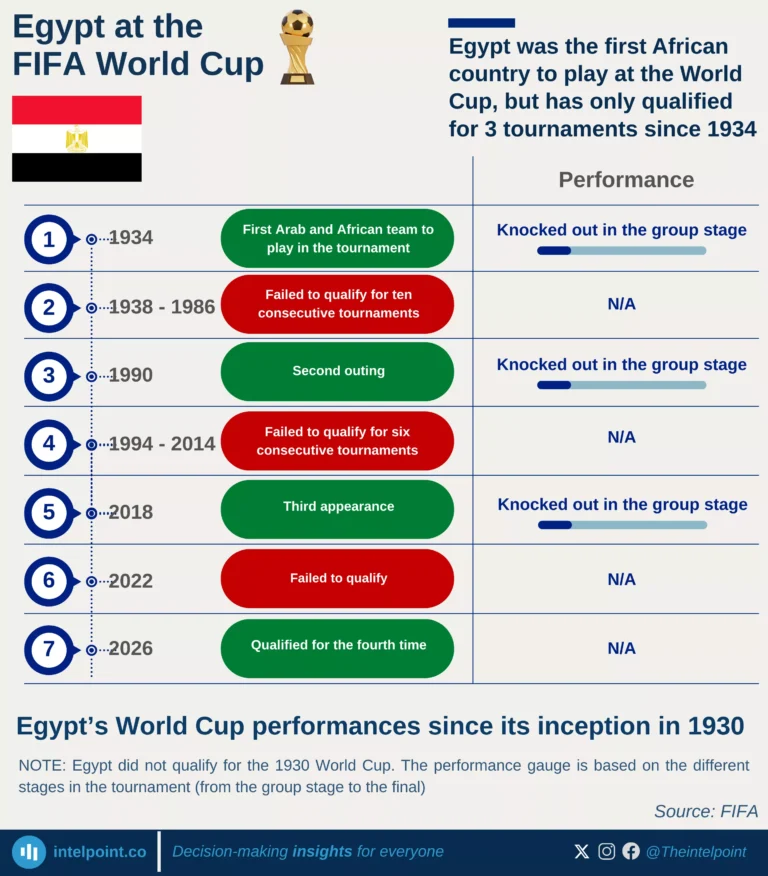
  • Egypt was the first African and Arab nation to play at the FIFA World Cup, debuting in 1934.
  • Despite this early start, Egypt has qualified for only three tournaments since: 1990, 2018, and 2026.
  • Egypt failed to qualify for ten consecutive World Cups from 1938 to 1986.
  • Another long drought followed, with the team missing every World Cup tournament between 1994 and 2014.
  • Each of Egypt’s three World Cup appearances to date (1934, 1990, and 2018) ended in group-stage elimination.
Read more
1 18 19 20 21 22 252

Can’t find what you’re looking for? Please fill the form below
Contact Form Demo
SIGN UP TO OUR NEWSLETTER
Get periodic updates about the African startup space, access to our reports, among others.
Subscribe Here
Subscription Form

A product of Techpoint Africa. All rights reserved