Bite-sized Insights about
 
Providing you with data-based insights about things happening around you.
Popular Insights
  • In June 2023, Nigeria exported goods worth ₦3.026 trillion and imported goods worth ₦1.285 trillion, resulting in a trade surplus of ₦1.74 trillion. This came after a trade deficit of ₦653 billion in May 2023. Here is Nigeria's trade balance since July 2022.
    See more

    India has been the World Bank's largest debtor for over 50 years, with a debt of $38.3 billion as of 2022.

    Five Asian nations — India, Indonesia, Bangladesh, Pakistan, and China — owe a combined $111.2 billion, or 27% of the World Bank’s total debt.

    Nigeria, Africa's largest World Bank debtor, ranks 10th, with nearly #14 billion in debt.

    See more
  • The 2024 Global Peace Index reveals a decline in peacefulness in 97 countries, the highest since the index began.

    Nigeria is among the nations affected by regional conflicts and rising violence. With a peace index score of 2.91, Nigeria is facing increasing challenges.

    A deteriorating peace score impacts foreign investment and economic stability. Global economic losses due to violence reached $19.1 trillion in 2023.

    See more

    The FAAC's revenue distribution from 2017 to August 2023 highlights the dominance of Delta, Akwa Ibom, Rivers, and Bayelsa states in allocations. Despite Lagos' economic prominence, it ranked fifth. Here is the distribution of revenue among states between 2017 and August 2023.

    See more
  • A Trend of Adult literacy rates of African countries

    Between 2018 and 2021, adult literacy rates across African nations exhibited significant disparities. Seychelles and South Africa led with literacy rates of 96% and 95%, respectively, indicating a high proportion of literate adults. Conversely, Chad had the lowest literacy rate during this period.

    These statistics underscore the uneven progress in educational attainment across Africa, highlighting the need for targeted interventions to improve literacy in lower-performing nations.

    See more
    Countries by Global Innovation Index 2024

    The Global Innovation Index 2024 reveals a striking contrast in innovation performance between countries globally and across Africa. Switzerland leads the global rankings with an impressive score of 67.5, followed by Sweden (64.5) and the USA (62.4), highlighting their sustained investments in research, development, and technological advancement.

    In Africa, Mauritius takes the top spot with a score of 30.5, followed closely by Morocco (28.8) and South Africa (28.3). However, even Africa's most innovative nations achieve less than half the score of global leaders, indicating a significant innovation gap.

    Nigeria ranks 15th in the African ranking and 113th globally, out of 133 countries, with a score of 17.1.

    See more

  • As of February 2023, Airtel had the fastest Internet speed of all mobile operators in Nigeria at 22.42Mbps, followed by MTN with 21.71Mbps, and Glo with 8.70Mbps. 9mobile comes last with a speed of 8.32Mbps. Airtel's speed of 22.42Mbps was about 26% of Starlink's speed.

    See more
  • MTN Nigeria has dominated the country's telecommunications market over the years, accounting for the largest market share. All four operators, apart from 9mobile, recorded a significant increase in their subscriber base between May 2014 and March 2024.

    See more
  • The 2024 Global Peace Index reveals a decline in peacefulness in 97 countries, the highest since the index began.

    Nigeria is among the nations affected by regional conflicts and rising violence. With a peace index score of 2.91, Nigeria is facing increasing challenges.

    A deteriorating peace score impacts foreign investment and economic stability. Global economic losses due to violence reached $19.1 trillion in 2023.
    See more

Other Insights
  • Lafarge Africa's revenue hit a decade-high of ₦697bn in 2024, reflecting a strong 71.7% year-on-year growth.
  • With ₦517bn in H1 2025 alone, Lafarge Africa has already achieved nearly 74% of 2024’s full-year revenue, signalling potential to surpass last year’s record if momentum continues.
  • The company has experienced sharp swings, including steep drops in 2016 (-17.8%) and 2019 (-30.9%).
  • Despite volatility, Lafarge has grown from ₦260bn in 2014 to ₦697bn in 2024, showing long-term expansion.
See more
 
  • South Africa’s share of Africa’s GDP has averaged around 20% since 1960.
  • The country’s relative dominance peaked in the early 1990s at nearly 28% of continental GDP.
  • Nominal GDP grew steadily from $8.7 billion in 1960 to over $400 billion in 2024.
  • South Africa’s share of Africa’s GDP has generally declined in recent decades as other African economies expanded faster.
  • Despite the relative decline, South Africa remains one of Africa’s largest and most influential economies.
See more
  • Microfinance deposits in Kenya grew at only 1.66% CAGR between 2014 and 2024.
  • The peak occurred in 2021 at KSh 50.2B, after which deposits began a steady decline.
  • 2015 (+13.2%) and 2020 (+12.3%) posted the strongest year-on-year growth rates.
  • The sector saw consecutive contractions from 2022 (-7.3%), 2023 (-5.7%), to 2024 (-2.0%).
  • Despite small rebounds in 2018 (+7.3%) and 2019 (+12.3%), the long-term trend is weak.
See more
  • Microfinance banks in Kenya recorded their last profit in 2015 (KSh 0.6B) before sliding into losses.
  • The sector’s losses deepened from KSh -0.4B in 2016 to KSh -3.5B in 2024.
  • The steepest single-year decline occurred in 2020, when losses increased by 560.8% to KSh -2.2B.
  • Even in recovery years like 2019 (KSh -0.3B) and 2021 (KSh -0.7B), the sector remained in losses.
  • Over the 10 years, profitability fell at a -212.1% CAGR, reflecting a structural collapse.
  • Since 2016, there has been no single year of profit, highlighting sustained weakness.
  • The worsening losses mirror other sector struggles, such as stagnant deposits, weak asset growth, and rising NPLs.
See more
 
  • At independence in 1960, Nigeria contributed about 10% of Africa’s GDP, establishing itself early as one of the continent’s largest economies.
  • Nigeria’s share peaked at 31% in 1981 during the oil boom, highlighting the dramatic impact of natural resources on the economy.
  • Between the mid-1980s and 2000s, Nigeria’s share fluctuated significantly, dropping to 9.2% in 1999 due to political instability, economic mismanagement, and external shocks.
  • By 2024, Nigeria’s share fell to 7.1%, despite a GDP of $187.8 billion, showing slower relative growth compared to other African economies and the ongoing need for economic diversification.
  • This share reflects Nigeria’s relative position in Africa’s economy over time, showing how it moved in relation to the growth of the rest of the continent.
See more
     
  • From 2013 to 2024, the services sector has consistently dominated Ghana’s GDP, while agriculture has remained the smallest sector.
  • A weak agriculture sector can make Ghana more dependent on food imports.
  • Agriculture’s stagnation reduces its role as a labour buffer.
See more
  • Nearly half (48.9%) of Nigerian businesses identify inflation as their greatest economic challenge in 2025.
  • The foreign exchange rate (17.1%) is the second most pressing concern, reflecting ongoing naira volatility.
  • Insecurity (15.6%) and government policies (10.0%) remain significant worries for business operations.
  • Inadequate infrastructure (8.4%), while the least mentioned, continues to constrain growth.
See more
  • Just 25.1% of MSMEs report receiving any form of government support, while 74.9% remain untouched by initiatives.
  • Among those who benefitted, 41.1% accessed grants, making it the most common form of support.
  • 22.1% of MSMEs participated in government training programmes, showing recognition of capacity-building needs.
  • Only 16% received loans and 13.8% got tax breaks, underscoring limited financial and fiscal support penetration.
  • A mere 6.9% of businesses report accessing subsidies, reflecting minimal impact of such schemes.
See more
  • The South West (₦8.3m) far surpasses all regions in monthly revenue, reflecting Lagos’ dominance as Nigeria’s commercial hub.
  • The South South (₦831k) and South East (₦605k) trail far behind but still outperform the northern regions.
  • The North East (₦562k) and North West (₦479k) show significantly lower average revenues.
  • The North Central (₦241k) records the weakest average, underlining stark regional disparities.
See more
  • Only 12.1% of entrepreneurs are aged 18–25, showing limited entry among very young adults.
  • The largest groups are 26–35 (33.3%) and 36–45 (33.8%), together accounting for two-thirds of entrepreneurs.
  • Mid-life representation: 14.6% are aged 46–55.
  • Just 6.2% are 56 and above, indicating fewer older adults start or run MSMEs.
See more
  • 48.8% of MSMEs earn less than ₦100,000 monthly.
  • 19.5% report revenues between ₦100,000 and ₦199,900.
  • The share of businesses decreases steadily in the ₦200,000–₦999,900 bands, ranging from 9.3% to 6%.
  • Only 8.8% of MSMEs earn above ₦1 million monthly, with just 0.4% exceeding ₦100 million.
See more
  • Mauritius leads Africa with the highest GII score (32.5), ranking 53rd globally out of 139 countries.
  • North Africa dominates the top 5, with Morocco and Tunisia both strong performers.
  • Sub-Saharan Africa’s bright spots include South Africa, Seychelles, Botswana, and Senegal.
  • Nigeria is 105th globally (21.1), highlighting Africa’s uneven innovation capacity.
See more
1 20 21 22 23 24 126
  • Mineral fuels (including crude oil) accounted for $49.3 billion, or 86.8% of total exports in 2024.
  • Non-oil exports remained marginal, with the second-largest item, cocoa, contributing only 4.6%.
  • Fertilisers, ores, slag, ash, and oilseeds collectively made up less than 5%, indicating limited diversification.
  • All other export categories each contributed 1% or less, underscoring Nigeria’s narrow export base.
Read more
  • Nigeria has qualified for six World Cups since its first appearance in 1994.
  • Three second-round finishes in 1994, 1998, and 2014 represent the country's best performances at the tournament.
  • Nigeria ended three of its World Cup appearances at the group stage (2002, 2010, and 2018).
  • Nigeria failed to qualify for the 2006, 2022, and 2026 tournaments.
  • Nigeria did not qualify for any World Cup before 1994, making its debut year a significant milestone.
  • Qualification challenges are increasing, as shown by more failures in recent cycles.
Read more
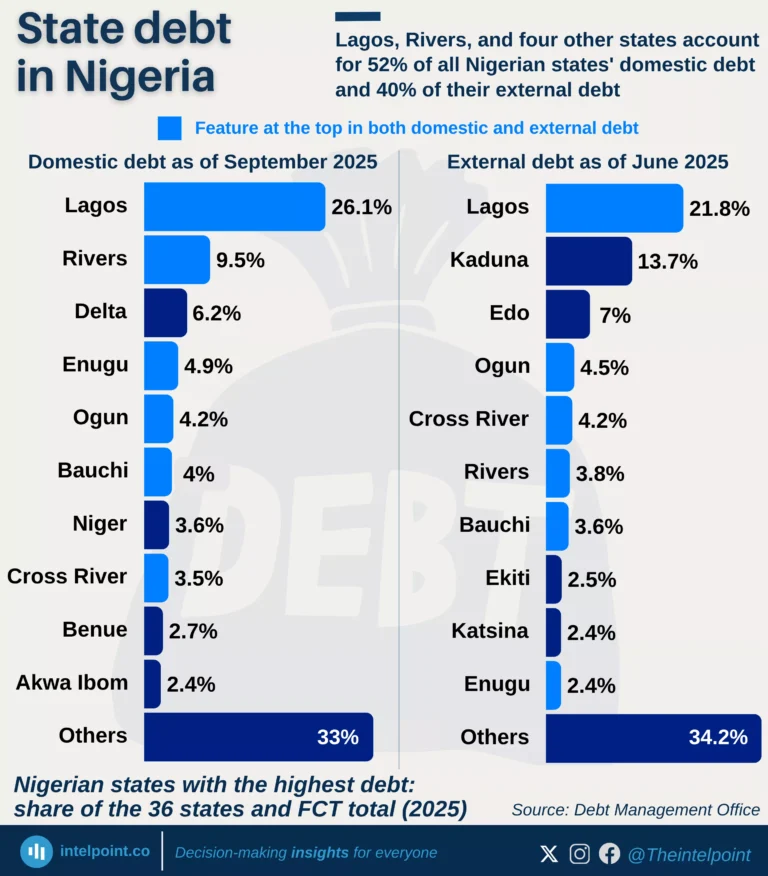
  • 26 states increased their external debt by a combined $239 million in H1 2025.
  • Imo, Oyo, Kaduna, Enugu, and Ogun recorded the biggest increases.
  • 11 states, including the FCT, reduced their debt through higher repayments.
  • Lagos, Edo, Rivers, and Bauchi accounted for most of the $227 million in reductions.
  • Total state external debt rose only slightly, from $4.8 billion to $4.812 billion.
Read more
  • The Debt Management Office (DMO) Nigeria took the lion’s share, with ₦14.3 trillion (92.23%) of the Ministry of Finance's total allocation.
  • The Nigerian Bulk Electricity Trading Plc. received ₦858.7 billion (5.53%), making it the second-highest allocation.
  • The Federal Ministry of Finance (Headquarters) got ₦289.4 billion (1.86%).
  • The Office of the Accountant General of the Federation was allocated ₦50.7 billion (0.33%).
  • The figures reveal how debt servicing priorities overshadow operational and policy-related financial allocations.
Read more
  • Cards were the most involved in fraud, with ₦14.3 billion representing the most significant exposure among all transaction channels
  • Card transactions also had the highest number of cases (11,972), indicating widespread and frequent attacks
  • Actual losses on cards were 11.5% (₦1.6 billion) of the amount involved, showing that significant financial damage still occurs despite preventive systems
  • Cash fraud accounted for ₦6.8 bn in exposure, nearly half of the card channel’s total
  • Cash also recorded 12.3% (₦800 million) in actual losses
  • Cheques had the lowest fraud involvement (₦1.2 billion) and only 46 cases, but the highest actual loss rate (72.7%)
Read more
  • Nigeria has 371,800 police personnel as of 2025
  • 100,000 officers, 26.9% of the NPF, are dedicated to VIP and politician protection
  • Only 73.1% of personnel (271,800 officers) remain available for general public policing
  • Nearly one-third of the police workforce is focused on elite protection rather than community safety
  • The heavy VIP-protection allocation reduces manpower available for daily security operations
Read more
1 20 21 22 23 24 252

Can’t find what you’re looking for? Please fill the form below
Contact Form Demo
SIGN UP TO OUR NEWSLETTER
Get periodic updates about the African startup space, access to our reports, among others.
Subscribe Here
Subscription Form

A product of Techpoint Africa. All rights reserved