Bite-sized Insights about
 
Providing you with data-based insights about things happening around you.
Popular Insights
  • Nigeria’s electricity distribution companies (DISCOs) generated ₦1.07 trillion revenue in 2023 — double 2020's amount and 3.8x that of 2015. From 2015 to 2023, revenue has grown from ₦279b to ₦1.07t, while customer base has increased by over 5m, from 7m to 12.1m.

    See more

    Nigeria collected nearly ₦5 trillion income tax from companies in 2023. The amount collected in 2023 is 3.5x the collections in 2015 and 73% more than in 2022. Here are Nigeria's company income tax collections since 2015.

    See more
  • The 2024 Global Peace Index reveals a decline in peacefulness in 97 countries, the highest since the index began.

    Nigeria is among the nations affected by regional conflicts and rising violence. With a peace index score of 2.91, Nigeria is facing increasing challenges.

    A deteriorating peace score impacts foreign investment and economic stability. Global economic losses due to violence reached $19.1 trillion in 2023.

    See more

    The FAAC's revenue distribution from 2017 to August 2023 highlights the dominance of Delta, Akwa Ibom, Rivers, and Bayelsa states in allocations. Despite Lagos' economic prominence, it ranked fifth. Here is the distribution of revenue among states between 2017 and August 2023.

    See more
  • A Trend of Adult literacy rates of African countries

    Between 2018 and 2021, adult literacy rates across African nations exhibited significant disparities. Seychelles and South Africa led with literacy rates of 96% and 95%, respectively, indicating a high proportion of literate adults. Conversely, Chad had the lowest literacy rate during this period.

    These statistics underscore the uneven progress in educational attainment across Africa, highlighting the need for targeted interventions to improve literacy in lower-performing nations.
    See more
    Countries by Global Innovation Index 2024

    The Global Innovation Index 2024 reveals a striking contrast in innovation performance between countries globally and across Africa. Switzerland leads the global rankings with an impressive score of 67.5, followed by Sweden (64.5) and the USA (62.4), highlighting their sustained investments in research, development, and technological advancement.

    In Africa, Mauritius takes the top spot with a score of 30.5, followed closely by Morocco (28.8) and South Africa (28.3). However, even Africa's most innovative nations achieve less than half the score of global leaders, indicating a significant innovation gap.

    Nigeria ranks 15th in the African ranking and 113th globally, out of 133 countries, with a score of 17.1.

    See more

  • Twelve Nigerian banks listed on the Nigerian Exchange Group (NGX) reported a total profit of ₦3.42 trillion in 2023, with all banks making a profit and seeing increases from 2022. The top four banks — Zenith Bank, Access Holdings, UBA, and GTCO — contributed 71% of this amount. Zenith Bank saw a 202% increase from the previous year and led the way with ₦676.9 billion, while Access Bank recorded the highest increase in profits (307%). Jaiz Bank made the least profit (₦11.2 billion) followed by Sterling Bank (₦21.6 billion) and Wema Bank (₦36 billion).

    See more
  • MTN Nigeria has dominated the country's telecommunications market over the years, accounting for the largest market share. All four operators, apart from 9mobile, recorded a significant increase in their subscriber base between May 2014 and March 2024.

    See more
  • The 2024 Global Peace Index reveals a decline in peacefulness in 97 countries, the highest since the index began.

    Nigeria is among the nations affected by regional conflicts and rising violence. With a peace index score of 2.91, Nigeria is facing increasing challenges.

    A deteriorating peace score impacts foreign investment and economic stability. Global economic losses due to violence reached $19.1 trillion in 2023.
    See more

Other Insights
  • For every $1 Ghana earns from pharmaceutical exports, it spends about $22 on imports, underscoring the country’s overwhelming dependence on foreign pharmaceutical products.
  • Ghana is a net importer of medicine and has been for nearly two decades.
  • By 2015, Ghana’s pharmaceutical imports reached its peak with $348.12m while exports were $3.10m, meaning imports were nearly 100 times larger.
  • In 2016, Ghana recorded its highest-ever export performance at $78.33 million, but even then, imports stood at $154.96m, almost two times higher.
See more
  • In 2023, Ghana recorded $91.9m in ceramic exports, amassing $19.9m profit, after 17 years of consistent trade losses and heavy dependence on imported ceramic products.
  • For 17 years, Ghana’s ceramic market was largely import-driven, with local industries struggling to compete against foreign products.
  • Ghana's ceramic products trade recorded $1.397 billion in trade deficit in almost two decades.
  • Ghana's ceramic industry has finally moved from dependency to a driver of profit and progress.
See more
  • Over the past two decades, Egypt exported roughly twice as much ceramic products as it imported, positioning itself as a key player in regional and global ceramic products trade.
  • In 2012, exports peaked at $488.51 million, more than double imports at $178.23 million, setting a clear demonstration of strong industrial and commodity output.
  • In 2008, exports soared to $325.86 million, more than doubling imports at $126.21 million.
  • Between 2017 and 2021, the export sector showed stable performance, averaging $327 million annually.
  • The year 2021 was a standout, with exports reaching $401.12 million, reflecting a strong rebound that reaffirmed Egypt’s export capacity post-pandemic.
See more
     
  • The South-West recorded the highest domestic debt stock of approximately ₦1.43 trillion, largely powered by Lagos State’s ₦1.04 trillion debt.
  • The South-South ranks second with ₦968 billion, led by Rivers State’s ₦364.4 billion, reflecting major infrastructure and fiscal commitments.
  • The North-Central (₦520 billion) and North-East (₦450 billion) show moderate borrowing compared to their southern counterparts.
  • The North-West records the smallest combined debt stock at ₦223 billion, indicating a relatively conservative borrowing posture.
See more
     
  • Enugu State holds the highest domestic debt in the South-East at ₦180.5 billion.
  • Imo ranks second with ₦97.9 billion, about 54% lower than Enugu’s figure.
  • At ₦15.8 billion, Ebonyi remains the least indebted in the region, maintaining a conservative borrowing stance.
  • Combined, the five South-East states (Enugu, Imo, Abia, Anambra, and Ebonyi) owe roughly ₦371 billion domestically as of Q2 2025.
See more
     
  • Bayelsa holds the lowest debt with ₦65.9 billion.
  • Rivers’ ₦364.4 billion domestic debt is almost six times Bayelsa’s total, highlighting major fiscal disparities.
  • Delta (₦204.7 billion) and Cross River (₦147.3 billion) remain among the region’s more indebted states
  • Regional debt approaches ₦1 trillion: The six South-South states collectively hold an estimated ₦968 billion in domestic debt as of Q2 2025.
See more
  • Naturalisations rose consistently from 577 in H1 2022 to 717 in H1 2024, marking a 24% rise over two years.
  • The 11.5% increase recorded that period was the strongest half-year growth across the timeline.
  • Numbers fell 25.5% in H1 2025, the steepest half-on-half drop since tracking began.
  • Despite the recent fall, total naturalisations remain above early 2022 levels, signalling sustained long-term growth.
See more
  • The number of new Canadian citizens born in Egypt fell 9.8% in H1 2025, reaching 1,158, down from 1,284 in late 2024.
  • The steepest half-on-half fall came in H2 2024 (-37.3%), signalling the start of a more sustained slowdown.
  • Compared with the 2022 peak of 2,566, current levels are down 55%, marking a continuous decline since mid-2022.
  • Despite the multi-year decline, the smaller 9.8% decrease in H1 2025 suggests the rate of decline may be easing.
See more
  • H1 2025 recorded 832 new Canadian citizens of South African origin, down 23.7% from H2 2024 (1,091).
  • The first half of 2024 marked the highest level of approvals (1,514) in the past four years.
  • H1 2025 is 24% below H1 2022’s 1,089, the second lowest number in the period.
  • The data shows average half-on-half change of ±19%, reflecting strong fluctuations in migration and processing patterns.
See more
  • Algeria’s naturalisation figures in Canada showed major volatility, swinging between sharp increases and declines across half-year periods.
  • The number of new citizens peaked at 3,429 in H2 2023, representing a 69.1% surge from the preceding half year.
  • Following the 2023 peak, figures fell by 18.8% in H1 2024 and another 8.3% in H1 2025, showing a sustained downward correction.
  • Between H1 2022 (2,559) and H1 2025 (1,831), naturalisations dropped by roughly 28%, suggesting reduced inflow or slower application approvals among Algerian residents.
See more
  • Nigeria dominates with ₦339.6b, contributing over 70% of GTCO’s total profit after tax in Africa.
  • Ghana (₦61.9b) and Côte d’Ivoire (₦28.2b) followed as the strongest non-Nigerian subsidiaries.
  • Tanzania (₦46m) and Uganda (₦505m) contributed negligible profits compared to peers.
  • GTCO subsidiaries across Africa collectively generated around ₦476b profit after tax in the first half of 2025.
See more
     
  • The seven North-Western states collectively owed about ₦223.4 billion in domestic debt as of Q2 2025, according to DMO data.
  • Kano State ranked highest with ₦56.9 billion, accounting for roughly 25% of the zone’s total debt.
  • Jigawa remains the least indebted in the region and in the entire country, with only ₦852 million.
  • Moderate debt spread: While Kano, Zamfara, and Sokoto carried the largest debt loads, the remaining states maintained relatively conservative borrowing patterns.
See more
1 17 18 19 20 21 126
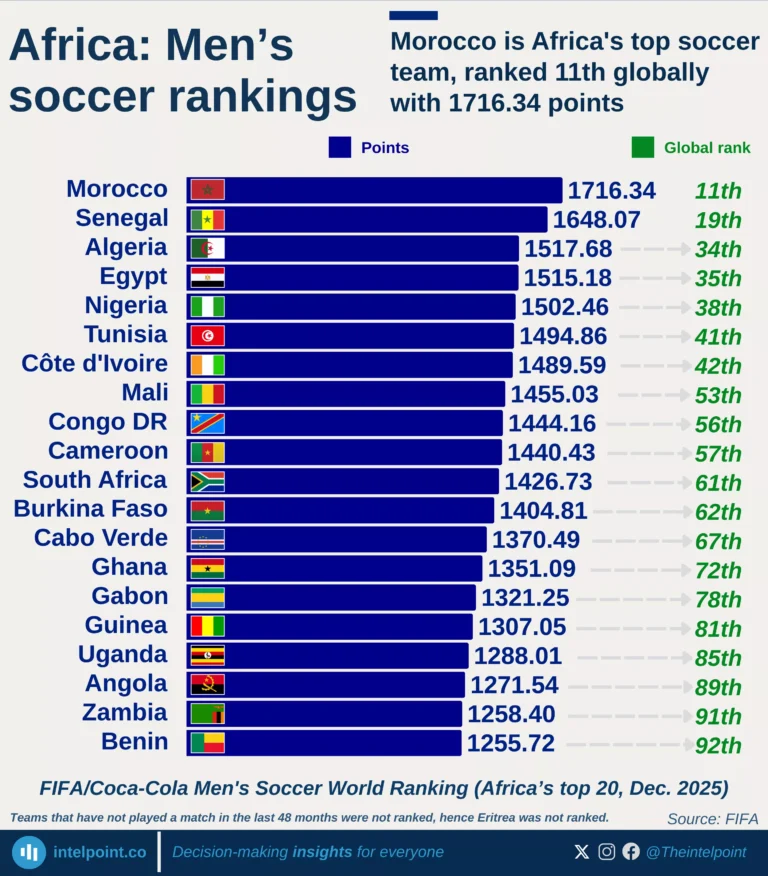
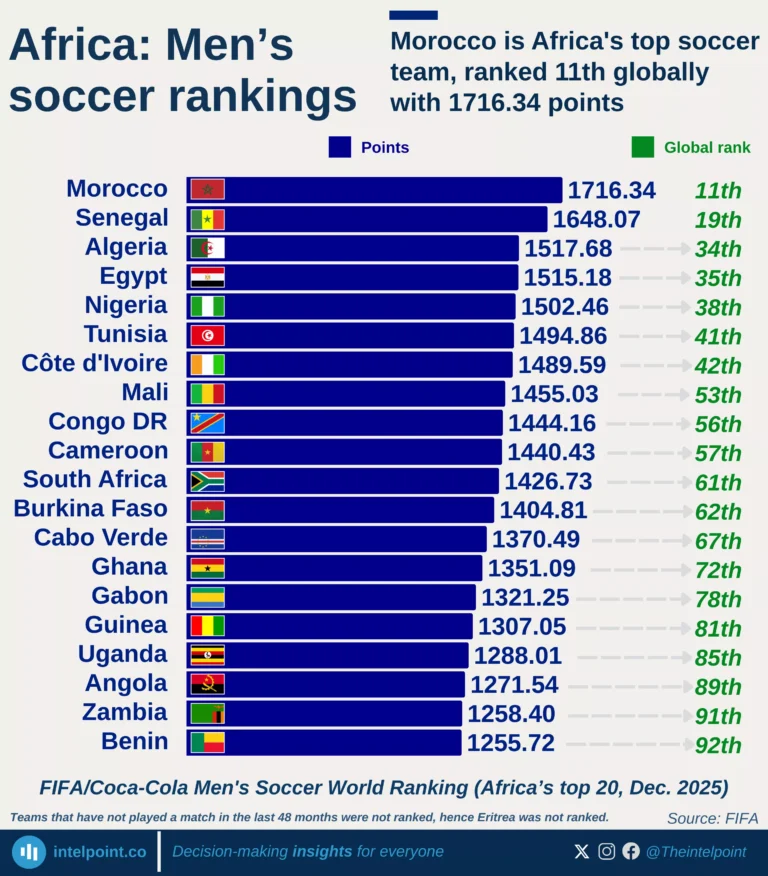
  • Morocco’s male football team ranks 1st in Africa and 11th globally with 1713.12 points.
  • Senegal ranks 2nd and 19th in the world, confirming its strong international presence.
  • Egypt, Algeria, and Nigeria complete Africa’s top five, all within the global top 40.
  • The top 20 list includes teams from all major African regions.
  • Africa has 2 teams in the global top 20, 7 in the top 50, and 13 in the top 70.
Read more
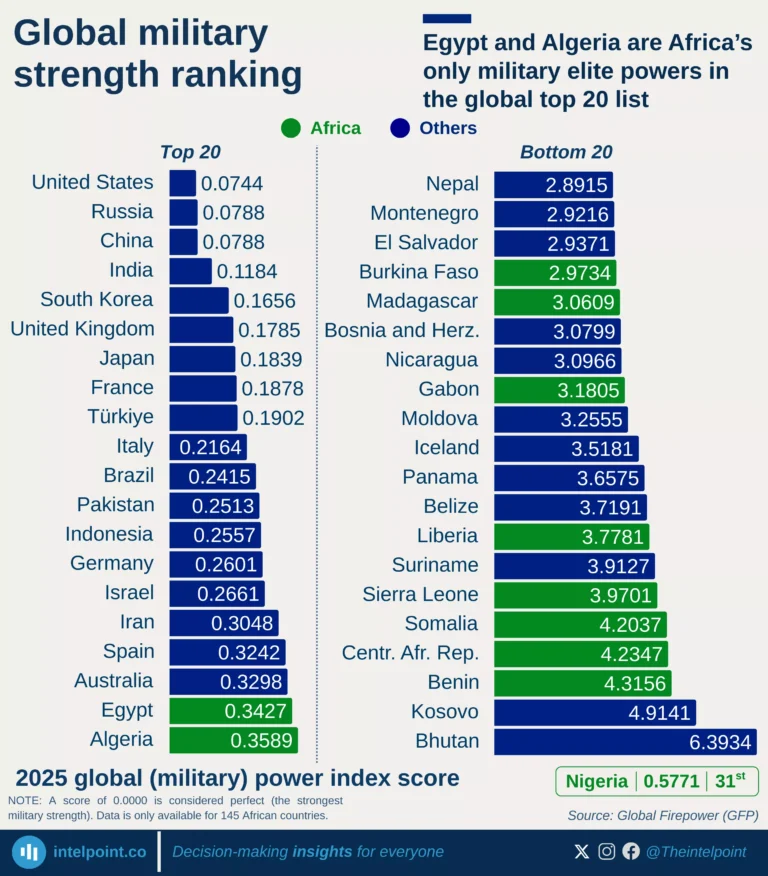
  • Egypt and Algeria are Africa’s only countries in the global top 20 military strength ranking.
  • The United States remains the world’s strongest military, with a near-perfect power index score.
  • Africa’s global military influence is highly concentrated in just two countries.
  • No Sub-Saharan African country appears in the global top 20.
  • Several African countries cluster in the global bottom 10, highlighting weak military capacity.
  • The gap between Africa’s strongest and weakest militaries is significant.
Read more
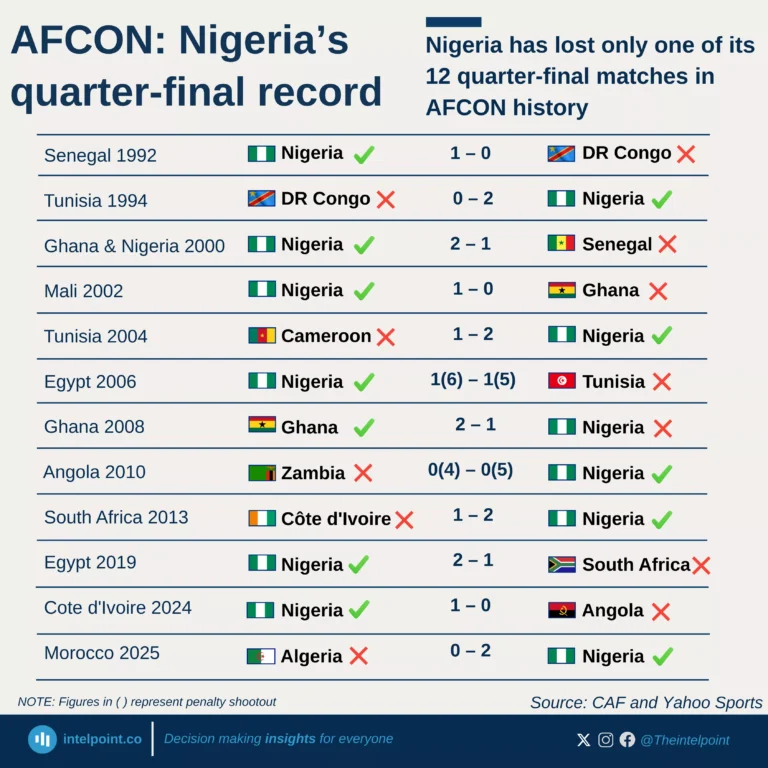
  • Nigeria has won 11 of its 12 AFCON quarter-final matches, losing only once (2008).
  • The only quarter-final defeat came against Ghana, highlighting the intensity of historic rivalries.
  • Most Nigerian wins were by narrow margins.
  • Nigeria has beaten a wide range of opponents at this stage, including Algeria, Senegal, Ghana, Côte d’Ivoire, and South Africa.
  • Penalty shootouts feature twice, reflecting composure under extreme pressure.
  • Nigeria’s quarter-final success spans over 30 years, cutting across different generations of players.
Read more
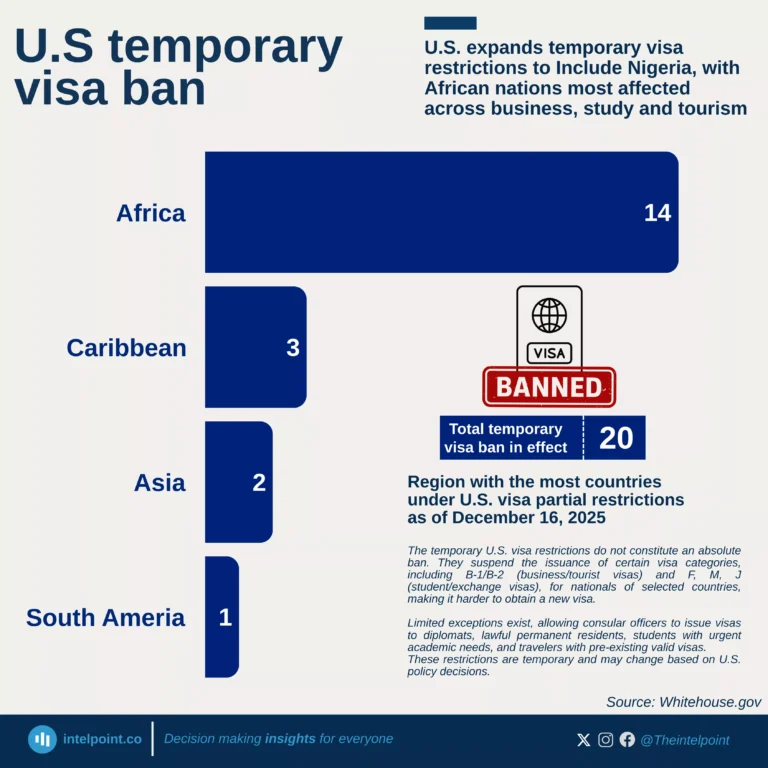
  • Africa is the hardest-hit region, with 14 countries under partial visa restrictions, including Nigeria, limiting travel for business, tourism, and study.
  • Temporary bans target B‑1/B‑2 visas for business and tourism, and may also affect F‑1 student, M‑1 vocational, and J exchange visitor visas, impacting students, trainees, and cultural exchange participants.
  • Other affected regions include the Caribbean, Asia, and South America, showing the temporary restrictions span multiple continents.
  • Exemptions exist for lawful permanent residents, diplomats, and travellers with valid pre-existing visas, so not all citizens from these countries are blocked from entering the US.
 
Read more
  • Morocco’s male football team ranks 1st in Africa and 11th globally with 1713.12 points.
  • Senegal ranks 2nd and 19th in the world, confirming its strong international presence.
  • Egypt, Algeria, and Nigeria complete Africa’s top five, all within the global top 40.
  • The top 20 list includes teams from all major African regions.
  • Africa has 2 teams in the global top 20, 7 in the top 50, and 13 in the top 70.
Read more
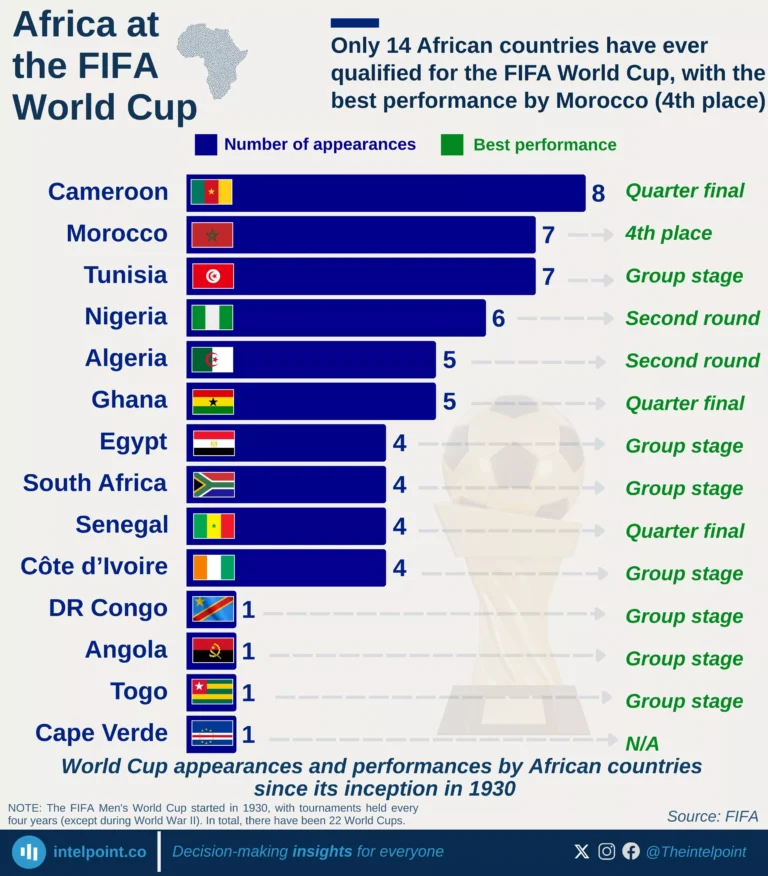
  • Cameroon has the highest World Cup appearances (8).
  • Morocco holds Africa’s best-ever performance (4th place), a historic milestone for African football.
  • Tunisia and Morocco both have seven appearances.
  • Nigeria remains one of Africa’s most successful qualifiers (six appearances), with multiple second-round finishes.
  • Algeria and Ghana (five appearances each) show strong track records, with Ghana also reaching the quarterfinals.
  • Egypt, South Africa, Senegal, and Côte d’Ivoire each have four appearances, but Senegal stands out for reaching the quarterfinals.
Read more
1 17 18 19 20 21 252

Can’t find what you’re looking for? Please fill the form below
Contact Form Demo
SIGN UP TO OUR NEWSLETTER
Get periodic updates about the African startup space, access to our reports, among others.
Subscribe Here
Subscription Form

A product of Techpoint Africa. All rights reserved