Bite-sized Insights about
 
Providing you with data-based insights about things happening around you.
Popular Insights
  • Key takeaways:

    • Throughout the decade, Nigeria saw a consistent decline in education funding as a percentage of GDP.
    • The most substantial allocation occurred in 2012 at 0.55% of GDP.
    • The lowest allocation was noted in 2022 at 0.35% of GDP.
    • There was a brief recovery from 2017 to 2018 before the downward trend resumed in 2019.
    • Over the decade, the overall reduction in education spending relative to GDP was approximately 36.5%.
    • Nigeria's education spending as a percentage of GDP is significantly lower than the UNESCO recommendation of 4-6% for developing nations.
    See more

    Canada granted permanent residency to 471.8k individuals in 2023, with Indian citizens leading with nearly 30% of the total.

    Nigeria (3.7%), Cameroon (2.5%), and Eritrea (2.3%) were in the top ten recipients.


    See more
  • The 2024 Global Peace Index reveals a decline in peacefulness in 97 countries, the highest since the index began.

    Nigeria is among the nations affected by regional conflicts and rising violence. With a peace index score of 2.91, Nigeria is facing increasing challenges.

    A deteriorating peace score impacts foreign investment and economic stability. Global economic losses due to violence reached $19.1 trillion in 2023.

    See more

    The FAAC's revenue distribution from 2017 to August 2023 highlights the dominance of Delta, Akwa Ibom, Rivers, and Bayelsa states in allocations. Despite Lagos' economic prominence, it ranked fifth. Here is the distribution of revenue among states between 2017 and August 2023.

    See more
  • A Trend of Adult literacy rates of African countries

    Between 2018 and 2021, adult literacy rates across African nations exhibited significant disparities. Seychelles and South Africa led with literacy rates of 96% and 95%, respectively, indicating a high proportion of literate adults. Conversely, Chad had the lowest literacy rate during this period.

    These statistics underscore the uneven progress in educational attainment across Africa, highlighting the need for targeted interventions to improve literacy in lower-performing nations.

    See more

    Nigeria was the seventh most populous nation in the world in 2020, with 206.1 million people. Projected to reach a population of 401.3 million by 2050, Nigeria will rank third after India (1st) and China (2nd). According to Institut national d'études démographiques' projections, Nigeria, Ethiopia, DR Congo, Egypt, Tanzania, and Kenya will be among the world’s top 20 most populous countries by 2050.
    See more

  • Nigeria produced 1.4 million tons of palm oil in 2022, 2% of the global production in the 2022/2023 market year, making the country the fifth largest producer of the commodity. Indonesia dominated global production with 59%, followed by Malaysia and Thailand.
    See more
  • MTN Nigeria has dominated the country's telecommunications market over the years, accounting for the largest market share. All four operators, apart from 9mobile, recorded a significant increase in their subscriber base between May 2014 and March 2024.

    See more
  • The 2024 Global Peace Index reveals a decline in peacefulness in 97 countries, the highest since the index began.

    Nigeria is among the nations affected by regional conflicts and rising violence. With a peace index score of 2.91, Nigeria is facing increasing challenges.

    A deteriorating peace score impacts foreign investment and economic stability. Global economic losses due to violence reached $19.1 trillion in 2023.
    See more

Other Insights
 

Local company income tax in Nigeria surged threefold quarter-on-quarter in Q2 2024, reaching ₦1.35t. Agriculture, Forestry, and Fishing led with a growth of 474.5%, while Household Employment and Own-Use Production experienced the steepest decline at -30.22%

See more
Total number of products registered with NAFDAC from 2020 to 2022

Food and packaged water dominate NAFDAC registration, as close to 50% of all products registered between 2020 and 2022 were either food or packaged water. This suggests a significant focus on ensuring the safety and quality of these essential commodities. Human drugs also make up a substantial portion of registered products, reflecting the importance of regulating medications to protect public health. Cosmetics and herbal drugs follow closely with 13.2% and 6.5%, respectively.

See more
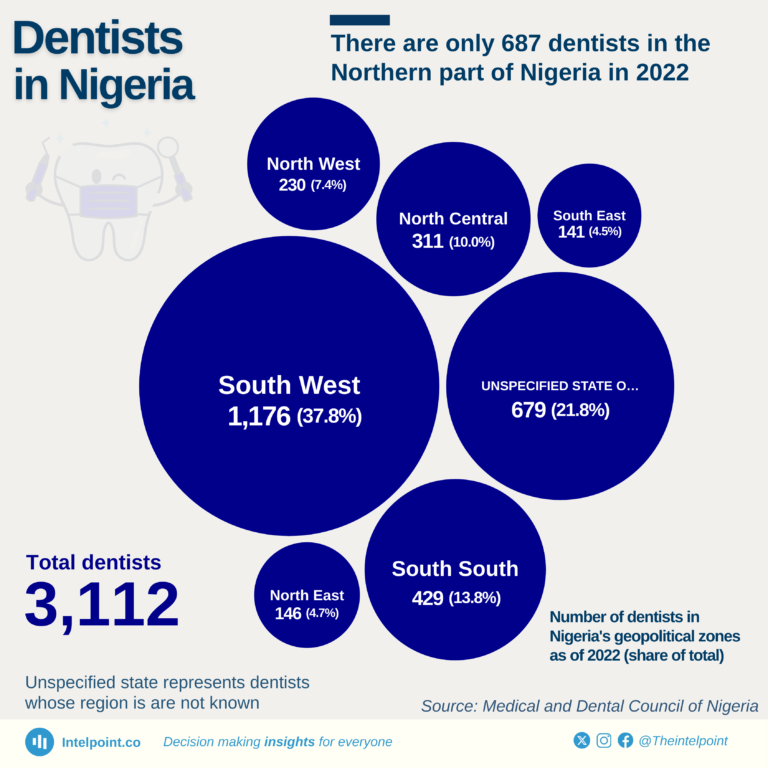
Top & bottom ten states by number of dentists (2022)

Lagos State leads the dental healthcare workforce in Nigeria with an impressive 713 dentists, a figure over three times higher than any other state. This dominance shows Lagos' position as a hub for healthcare professionals. Trailing far behind are the FCT (Abuja) with 208 dentists and Oyo with 185.

The gap becomes even more glaring when examining the bottom states like Taraba, with only eight dentists, and others such as Jigawa and Abia, with just nine each. These numbers paint a concerning picture for residents of these regions, who may face long travel distances or extended waiting times to access basic dental care. Interestingly, Borno State, which faces security challenges, has 53 dentists, surpassing several other states.

See more

Nigeria's import value increased by 8.7% quarter-on-quarter and 63% year-on-year, reaching ₦14.67 trillion in Q3 2024. China led as the top trading partner with imports valued at ₦3.57 trillion (24%), while Malta rounded out the top five with ₦767 billion (5%).

See more
Countries by Global Innovation Index 2024

The Global Innovation Index 2024 reveals a striking contrast in innovation performance between countries globally and across Africa. Switzerland leads the global rankings with an impressive score of 67.5, followed by Sweden (64.5) and the USA (62.4), highlighting their sustained investments in research, development, and technological advancement.

In Africa, Mauritius takes the top spot with a score of 30.5, followed closely by Morocco (28.8) and South Africa (28.3). However, even Africa's most innovative nations achieve less than half the score of global leaders, indicating a significant innovation gap.

Nigeria ranks 15th in the African ranking and 113th globally, out of 133 countries, with a score of 17.1.

See more
Nigeria's national grid has collapsed 12 times in 2024

Nigeria's national grid has experienced 12 collapses so far in 2024, a troubling trend that reveals the fragility of the country's energy infrastructure. The timeline highlights intervals ranging from as short as one day to as long as 82 days between incidents. Notably, two consecutive collapses occurred on October 14 and October 15, while a total of 9 collapses occurred in the second half of the year.

Yesterday's collapse came 35 days after November 7, when the grid went down for the 11th time.

See more

In 2024, the top ten universities in Nigeria graduated 3,047 first-class students. Seventeen per cent of private university students in Nigeria earned first-class degrees, compared to 3% in federal/state universities.

The University of Benin convocated the most first-class students (385), while the Federal University of Agriculture, Abeokuta (FUNAAB) had the least, with 122.

Covenant University had the highest proportion, with one in five students graduating with a first class.

See more

Ogun State is the top location for private universities, with 16 universities, while the top eight states collectively account for 50% of Nigeria's 149 private universities. Bauchi and Yobe are the only states with no private universities.

See more

As of 2024, 149 private universities are accredited by the National Universities Commission. Southern Nigeria houses 62%, with the South West leading at 47 universities, while the North East has the fewest, with just 5 (3%).

See more

Bayelsa, Gombe, and Katsina States have the fewest accredited universities — five each — of the 274 in Nigeria in 2024. Ogun leads with 19, followed closely by Abuja (17) and Delta (15).

See more
Participants of the National Open Apprenticeship Scheme by gender (2021 - 2023)

Participation in Nigeria’s National Open Apprenticeship Scheme has dropped by over 50% since 2021, with male and female enrolments declining significantly; over the years, there have been more female participants. The declining participation rates raise questions about awareness, funding, and programme efficiency.

For many Nigerian youths, apprenticeship programmes are a gateway to self-reliance and stable income. The National Open Apprenticeship Scheme is a National Directorate of Employment (NDE) programme that upskills unskilled and unemployed people and equips them with relevant demand-driven skills.

See more
1 91 92 93 94 95 132
  • Algeria leads Africa with 41 active oil rigs, making up nearly 29% of the continent's total count.
  • Nigeria follows with 31 rigs, confirming its strong position in West Africa’s upstream oil activity.
  • Egypt ranks third with 23 rigs, while Libya maintains 18 rigs despite its fluctuating political climate.
  • The top seven countries host 122 of Africa’s 144 rigs, showing drilling operations are concentrated in just a handful of nations.
Read more
  • July 2025 saw the ASI rise by 8.6%, the largest monthly jump in over a year.
  • The index grew steadily for four straight months from April to July 2025.
  • ASI climbed from 99.5K in June 2024 to 126.7K in July 2025, a 27.3% increase overall.
  • August 2024 recorded the sharpest monthly drop at -2.9%.
  • December 2024 and January 2025 posted back-to-back strong gains of 2.5% and 3.8% respectively.
  • May and June 2025 saw healthy gains of 4.2% and 6.6%, paving the way for July’s surge.
Read more
  • Manufacturing hit a record $64.90b in 2022, after steady growth from 2016.
  • Output fell 55% to $25.36b in 2024, the worst one-year drop since 1999.
  • Military-era lows: Slumped from $33.33b (1981) to $8.08b (1989).
  • Democratic rebounds: Output grew from $9.62b (1999) to $55.33b (2014), and from $35.12b (2016) to $64.90b (2022).
Read more
  • Ronaldo leads the UEFA Champions League scoring chart with 141 goals, ahead of Messi's 129.
  • Salah and Drogba are the only two African players in the top 20 scorers list.
  • Just 8 goals separate the 10th and 20th-ranked scorers, showing how tight competition is outside the top ranks.
  • Haaland and Mbappé are the only two players under 30 in the top 15.
  • Legendary players like Neymar and Ibrahimović never broke into the top 10 despite long careers at top clubs.
Read more
  • Starlink is cheaper than traditional ISPs in five out of the twelve African countries analysed.
  • Zimbabwe has the widest price gap, with traditional ISPs costing over 21 times more than Starlink.
  • Nigeria currently offers the cheapest traditional ISP plan at $9.59, undercutting Starlink’s price by a wide margin.
  • In Ghana and Kenya, Starlink’s monthly subscription is less than half the cost of the leading ISPs.
  • Only slight differences exist between Starlink and traditional ISP prices in Zambia and Botswana, indicating near-parity.
  • Mozambique and Cape Verde have moderate Starlink price advantages, suggesting potential for market competition.
Read more
  • Sudan recorded the steepest GDP decline in Africa in 2024 at -13.49%.
  • Botswana’s economy contracted by -2.99%, the second-worst on the continent.
  • Libya was the only other country in the bottom 10 with negative growth at -0.61%.
  • South Africa, with 0.58% growth, continues to struggle with low economic momentum.
  • Sao Tome & Principe and Equatorial Guinea both recorded growth below 1%.
  • Despite being Africa’s largest economy, Nigeria’s 3.43% growth places it closer to underperforming countries than to the continent’s fastest risers.
Read more
1 91 92 93 94 95 263

Can’t find what you’re looking for? Please fill the form below
Contact Form Demo
SIGN UP TO OUR NEWSLETTER
Get periodic updates about the African startup space, access to our reports, among others.
Subscribe Here
Subscription Form

A product of Techpoint Africa. All rights reserved