Bite-sized Insights about
 
Providing you with data-based insights about things happening around you.
Popular Insights
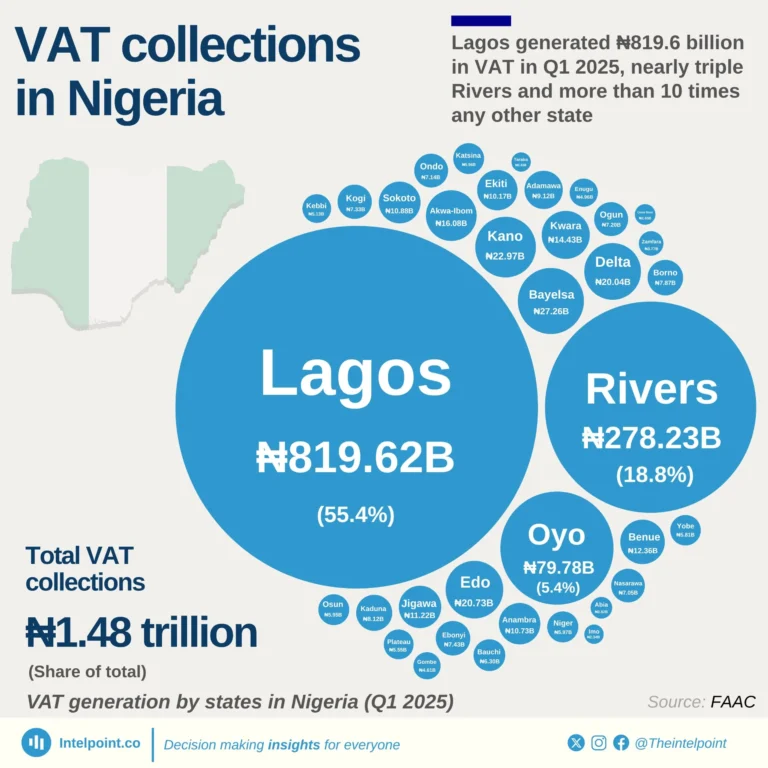
    • South-West drives Nigeria’s VAT but gets little back. The region remitted ₦341.38B (53%) but received only ₦99.85B (29% return).
    • South-South remitted ₦121.84B but got ₦52.49B (43% return); Rivers alone gave ₦90.21B but got just ₦11.01B.
    • The North enjoyed the highest VAT gains, remitting ₦66.18B and receiving ₦161.11B (240% return); the North-West got ₦66.75B from ₦28.31B (235% return).
    • South-East and North-East got the biggest VAT boost. South-East: ₦10.94B remitted, ₦39.13B received (357.6% return); North-East: ₦14.94B remitted, ₦46.68B received (312.5% return).
    See more

    While several African nations have state-controlled telcos, some private operators have extended their presence across the continent. Notably, none operates in all countries on the continent.

    MTN Group and Orange are present in 17 countries, with MTN having a stronger presence in Southern Africa than Orange. Francophone West Africa and North Africa are Orange's primary markets.

    See more
  • The 2024 Global Peace Index reveals a decline in peacefulness in 97 countries, the highest since the index began.

    Nigeria is among the nations affected by regional conflicts and rising violence. With a peace index score of 2.91, Nigeria is facing increasing challenges.

    A deteriorating peace score impacts foreign investment and economic stability. Global economic losses due to violence reached $19.1 trillion in 2023.

    See more

    The FAAC's revenue distribution from 2017 to August 2023 highlights the dominance of Delta, Akwa Ibom, Rivers, and Bayelsa states in allocations. Despite Lagos' economic prominence, it ranked fifth. Here is the distribution of revenue among states between 2017 and August 2023.

    See more
  • A Trend of Adult literacy rates of African countries

    Between 2018 and 2021, adult literacy rates across African nations exhibited significant disparities. Seychelles and South Africa led with literacy rates of 96% and 95%, respectively, indicating a high proportion of literate adults. Conversely, Chad had the lowest literacy rate during this period.

    These statistics underscore the uneven progress in educational attainment across Africa, highlighting the need for targeted interventions to improve literacy in lower-performing nations.

    See more

    Nigeria was the seventh most populous nation in the world in 2020, with 206.1 million people. Projected to reach a population of 401.3 million by 2050, Nigeria will rank third after India (1st) and China (2nd). According to Institut national d'études démographiques' projections, Nigeria, Ethiopia, DR Congo, Egypt, Tanzania, and Kenya will be among the world’s top 20 most populous countries by 2050.

    See more

    • Nigeria’s agricultural GDP reached ₦19.3 billion in 2023, showing minimal growth.
    • From 2013 to 2023, agriculture played a key role in Nigeria’s economic growth, averaging 24.43% of the total annual GDP.
    • Agriculture's share in the total GDP in 2020 (25.90%) dropped to 24.76% in 2023.
    • Post-pandemic recovery in the agricultural sector has been robust, with consistent growth from ₦18.3 billion in 2020 to ₦19.3 billion in 2023.
    • Agriculture remains a critical driver of Nigeria’s economy, ensuring food security and supporting livelihoods across the country.
    See more
  • MTN Nigeria has dominated the country's telecommunications market over the years, accounting for the largest market share. All four operators, apart from 9mobile, recorded a significant increase in their subscriber base between May 2014 and March 2024.

    See more
  • The 2024 Global Peace Index reveals a decline in peacefulness in 97 countries, the highest since the index began.

    Nigeria is among the nations affected by regional conflicts and rising violence. With a peace index score of 2.91, Nigeria is facing increasing challenges.

    A deteriorating peace score impacts foreign investment and economic stability. Global economic losses due to violence reached $19.1 trillion in 2023.

    See more

Other Insights
Since 2011, Unity Bank Plc has seen more losses than profits over a 12-year period. Despite a consistent growth in gross earnings from 2011 to 2017, profits were overshadowed by losses, exceeding profits by over ₦9 billion.
See more
top-15-african-countries-by-number-of-medical-doctors-per-10000-people-as-of-2022

As of 2022, only seven African countries met the WHO's recommended doctor-to-population ratio of 10 doctors per 10,000 people.

Cape Verde, Seychelles, Libya, Eswatini, Tunisia, Mauritius, and Algeria are leading the way in healthcare accessibility in Africa. However, the continent still averages only 2.6 doctors per 10,000 people.

See more

As of 2023, the global labour force has expanded to an estimated 3.63 billion, driven by population booms in key regions.

China and India lead with a combined 1.37 billion people 15+ active in the workforce.

Nigeria ranks 7th with 76 million, following the US, Indonesia, Brazil, and Pakistan.

See more

In 2023, South Africa led Africa's exports with a value of $110.7 billion, nearly double Nigeria's $60.7 billion. Key exports include gems, vehicles, and mineral fuels.

The top 15 African exporters contribute 84% to the continent's trade, with South Africa, Nigeria, Algeria, Morocco, and Egypt leading with a combined 52%.

See more

The cumulative number of asylum applications to the UK has exceeded one million, with Iran, Afghanistan, Iraq, Pakistan, and Albania being major contributors.

African countries such as Eritrea, Somalia, Zimbabwe, the DR Congo, and Nigeria have also been in the top ten.

These are the top ten nationalities in the past 23 years.

See more
     

The average price of cooking gas in Nigeria has increased significantly, from ₦370 per kg in early 2016 to ₦1,390 per kg in June 2024.

After prices peaked at nearly ₦1,500 in May 2024, they fell by 6.1% in June.

The contributing factors to the increase include global energy fluctuations, naira depreciation, supply chain disruptions, and changes in domestic policies.

Here are the average prices of cooking gas in Nigeria since 2016.

See more

Prices of food items like tomatoes, yams, Irish potatoes, and brown beans have witnessed more than a 250% increase over the past 12 months in Nigeria. The country's headline inflation rate went from 24.08% in July 2023 to 34.19% in June 2024.

See more

WhatsApp Business generated an estimated $39.5 million from Africa in 2023, representing 10.3% of its global revenue.

Estimates from Statista show that Asia was the leading contributor to WhatsApp Business' revenue, with $155.2 million.

Here is a breakdown of WhatsApp Business' revenue by region in 2023.

See more
     

As of December 2023, 28.6 million internally displaced people affected by conflict were under the age of 18, accounting for 38% of the global IDP population.

Conflict-ravaged Sudan has the most internally displaced children globally, with 4.25 million under the age of 18.

DR Congo and Syria follow with 3.57 million and 2.65 million displaced children, respectively. Nigeria's 1.65 million displaced children make it the 7th highest globally for child displacement due to conflict.

See more

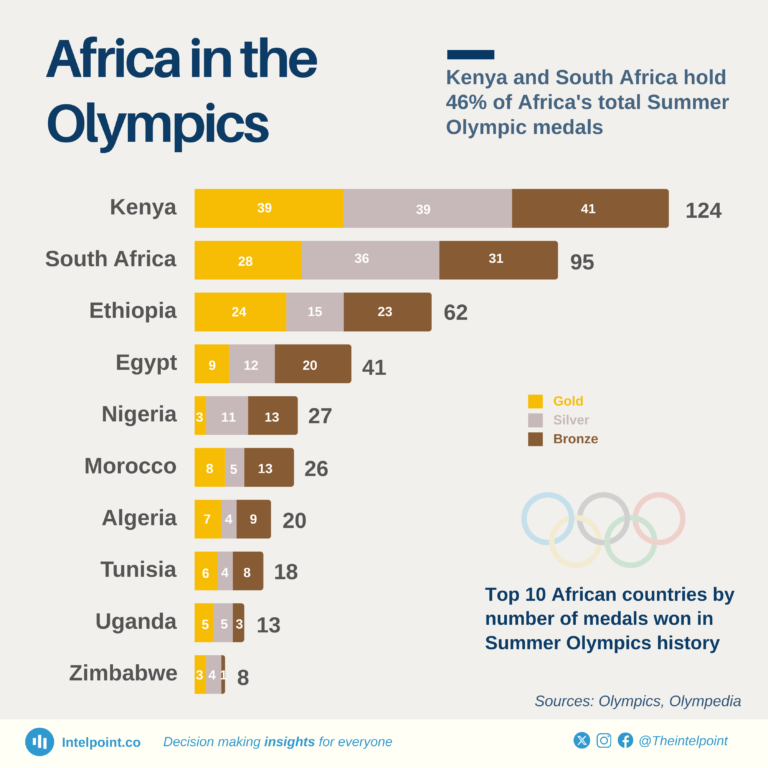
Nigeria's first Olympics appearance was at Helsinki 1952 but it wasn't until its fourth appearance at Tokyo 1964 that it won its first medal — a bronze. The country’s best medals haul (6) was at Atlanta 1996, where it won 2 gold, 1 silver, and 3 bronze.

See more
Between 2005 and 2022, Cote d'Ivoire's natural rubber production grew at an average of 12% yearly, maintaining its continental dominance. With an estimated population of nearly 29 million, the West African country produced 1.286 million tonnes in 2022, 73% of the continent's output, and placed fourth globally.
 
Meanwhile, Nigeria's production has grown 158% since 1961, peaking at 155 thousand tonnes in 1991.
Ghana's production has grown steadily, peaking at 117 thousand tonnes in 2022. Liberia and Cameroon complete the top five in Africa as of 2022.
See more

Since 2011, over ₦32.8 trillion has gone to Nigeria’s state governors from the Federation Account Allocation Committee (FAAC). States from the South East have received ₦3.3 trillion combined, the least nationwide.


This fund allocation is to ensure that all levels of government have the necessary funds to meet their financial obligations and to provide public services.

See more
1 … 107 108 109 110 111 … 134
  • In 2024, nearly 138 million children globally are still involved in child labour.
  • Africa accounts for 94.5 million (68.7%) of these children — the largest regional share.
  • Four in 5 child labourers under age 12 are based in Africa.
  • The global goal to end child labour by 2025 was not achieved.
  • Child labour has fallen by over 100 million since 2000, despite global child population growth.
Read more
  • Lagos has grown from 325,200 in 1950 to a an estimated 17.2 million in 2025
  • The State’s fastest 5-year growth came between 1955–1960 at 62.7%.
  • Since 2000, growth has steadied around 18–20% every 5 years.
  • More than 10 million people added between 2000 and 2025 alone.
  • Growth continues to outstrip investments in housing, transport, and basic services.
Read more
Key Takeaways:
  • India is projected to remain the world’s most populous country in 2054, reaching 1.69 billion, an increase of 246 million from 2024.
  • China’s population is expected to decline to 1.22 billion by 2054, marking a 14.1% decrease.
  • Nigeria is projected to rise to 5th place globally, with a population of 374 million, a 62% increase from 2024.
  • The United States remains the only high-income country in the top five, with a projected population of 384 million.
  • Pakistan is expected to climb from 5th to 3rd place, adding 138 million people by 2054.
  • Three African countries (Nigeria, Ethiopia, and the Democratic Republic of the Congo) are expected to rank among the top 10 most populous nations.
  • Russia is projected to see a population decline of 6.9%.
Read more
Key Takeaways:
  • India is projected to remain the world’s most populous country in 2100, with 1.5 billion people, a 4.5% increase from 2024.
  • China’s population is expected to fall sharply by 55.1% to 638.7 million, less than half of its 2024 population.
  • Pakistan's population is expected to nearly double by 2100.
  • Nigeria is projected to become the world’s fourth most populous country by 2100, with a population of more than 470 million.
  • Seven of the 15 most populous countries in 2100 are expected to be in Africa.
  • The United States is projected to rank sixth globally by 2100 from its current third position, despite a 22.2% expected population increase from 2024.
  • Together, the top 15 countries are expected to account for 57.9% of the global population by 2100.
  • The total world population is projected to reach 10.19 billion by the end of the century.
Read more
All-time Premier League top scorers from Nigeria as of 2025
  • Yakubu Aiyegbeni leads all Nigerian scorers in Premier League history with 95 goals.
  • Kanu (54) and Efan Ekoku (52) round out the top three, with a combined total of 201 goals among them.
  • Kelechi Iheanacho (42 goals) is the highest active Nigerian scorer.
  • Shola Ameobi had a consistent career with 43 goals, mostly with Newcastle United.
  • Alex Iwobi (31 goals) continues to be a key attacking presence in midfield roles.
Read more
  • Gabon led Africa in GDP per person employed for 21 years, the most of any country, thanks largely to its oil wealth and smaller labour force.
  • Equatorial Guinea was a close second, topping the list for 12 straight years, particularly during its oil boom.
  • Libya never came first but held second place in 18 different years, showing long-term stability in productivity.
  • Algeria and Egypt frequently ranked in the top three but never led.
  • Nigeria, despite being Africa’s most populous country and once its largest economy, never made it into the top 3 and has consistently ranked around 23rd to 26th.
  • The leading countries tend to share a pattern: resource-driven economies with relatively smaller workforces, while lower-ranked ones often struggle.
Read more
1 … 107 108 109 110 111 … 267

Can’t find what you’re looking for? Please fill the form below
Contact Form Demo
SIGN UP TO OUR NEWSLETTER
Get periodic updates about the African startup space, access to our reports, among others.
Subscribe Here
Subscription Form

A product of Techpoint Africa. All rights reserved