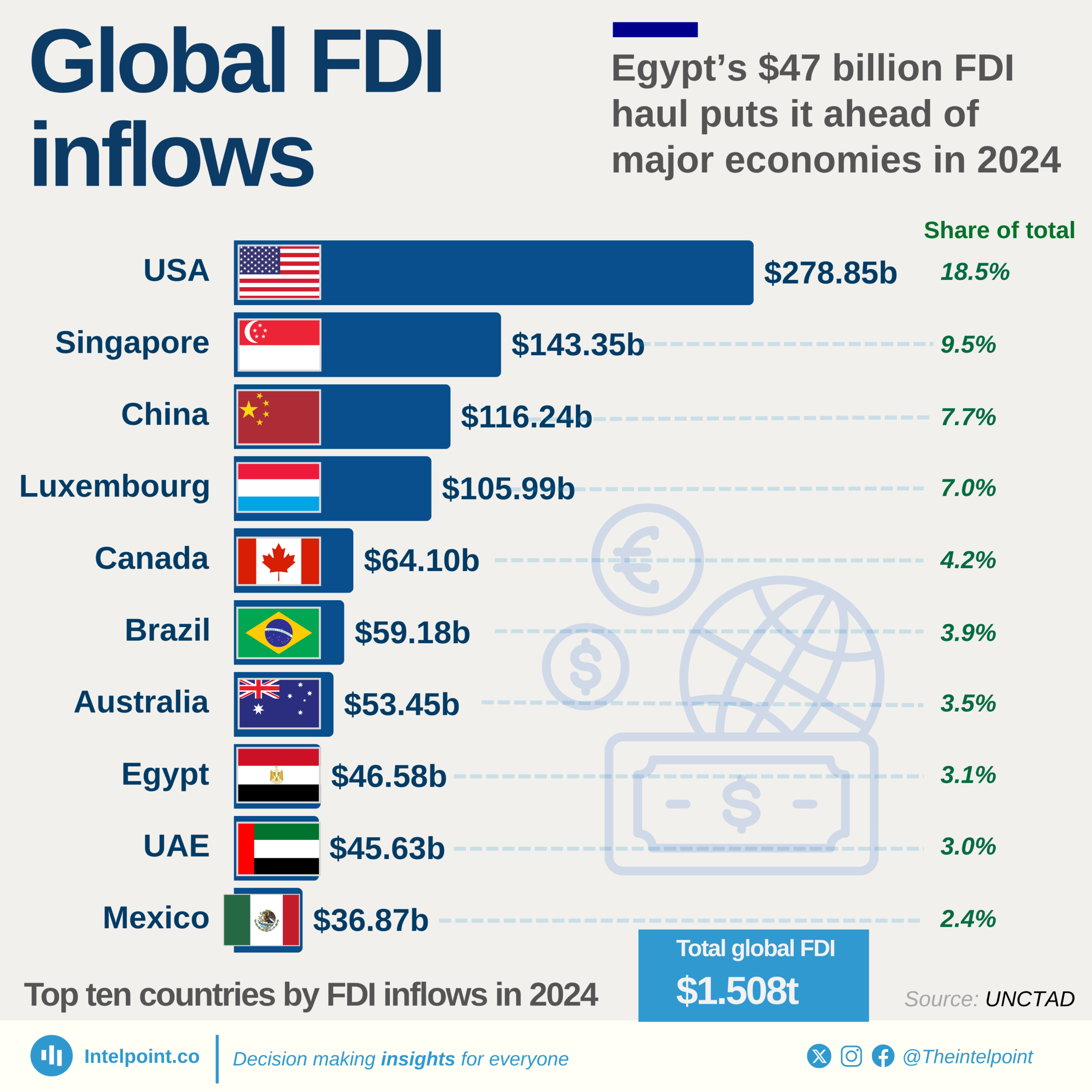
Egypt’s $47 billion FDI haul puts it ahead of major economies in 2024

  • Global FDI rose to $1.51 trillion, still below its 2015 peak.
  • The top 10 countries accounted for 65% of total inflows.
  • Egypt ranked 8th globally with $46.6 billion, ahead of UAE and Mexico.
  • A $35 billion Ras El-Hekma deal drove much of Egypt’s surge.
  • Egypt’s FDI grew over 370%, the fastest among top recipients.

In 2024, global foreign direct investment (FDI) rose modestly to $1.51 trillion, continuing a gradual post-pandemic recovery but still far below the $2.2 trillion peak of 2015, with Egypt’s inflows growing more than 370% year-on-year.

The United States, Singapore, and China remained the top destinations, drawing over $538 billion combined. Capital flows continued to concentrate, with just 10 countries accounting for 63% of global FDI. Among them, the standout was Egypt, which climbed to 8th place globally with $46.6 billion, outperforming larger economies like the United Arab Emirates and Mexico.

This dramatic leap, driven by a $35 billion UAE-backed megaproject in Ras El-Hekma and sweeping domestic reforms, marks a rare moment where an African country disrupts the global investment hierarchy.
Source:

UN Trade and Development (UNCTAD)

Period:

2024
HTML code to embed chart
Want a bespoke report?
Reach out
Tags
Related Insights

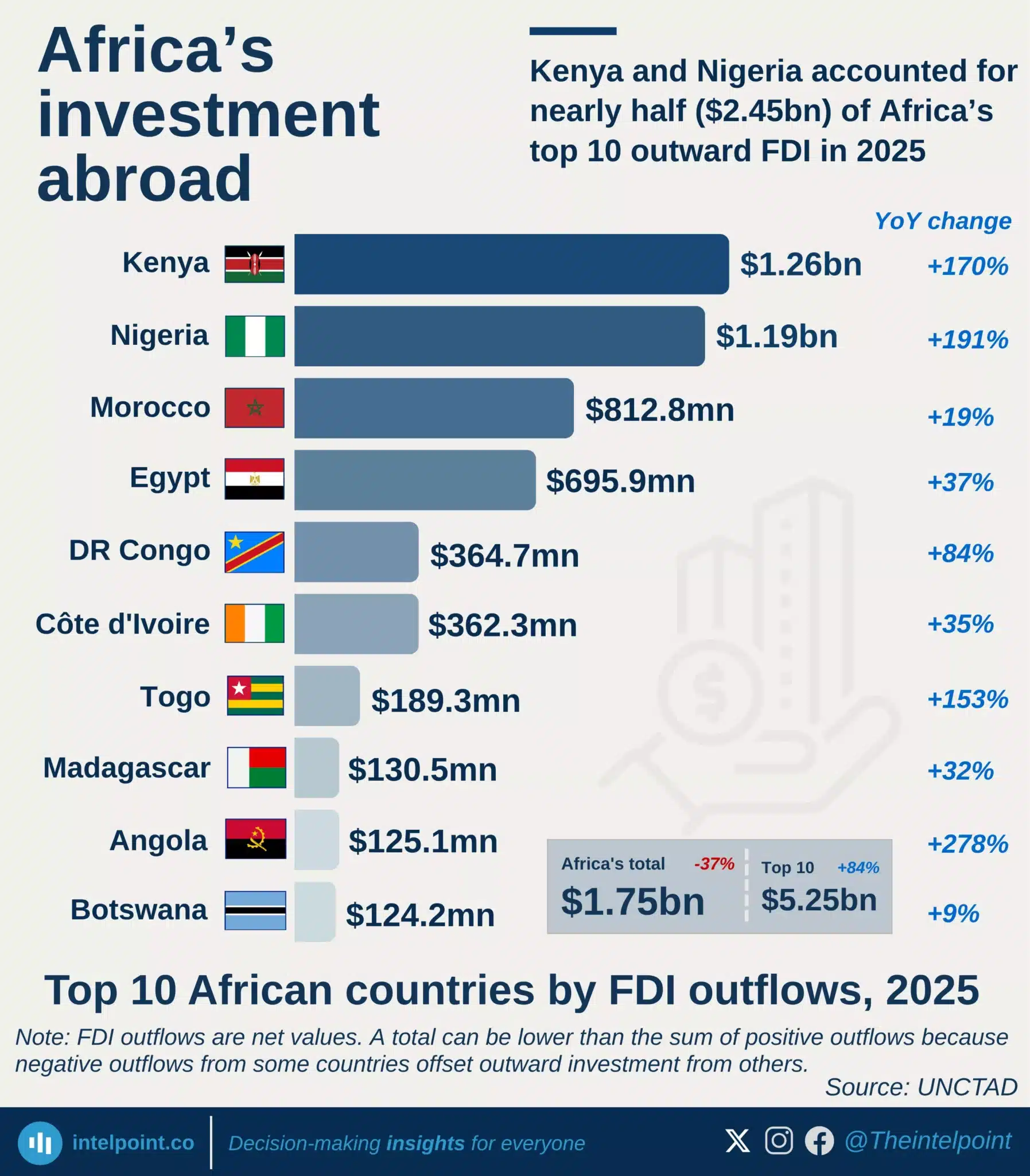
Kenya and Nigeria accounted for nearly half ($2.45bn) of Africa’s top 10 outward FDI in 2025
  • Kenya led Africa’s outward FDI in 2025, recording $1.26bn.
  • Nigeria followed closely with $1.19bn, after a 191% increase.
  • Together, Kenya and Nigeria accounted for $2.45bn of the top 10 total.
  • Morocco and Egypt completed the top four, with $812.8m and $695.9m.
  • Angola recorded the fastest growth among the top 10, rising 278%.
  • Africa’s total outflow was lower because negative outflows offset gains elsewhere.

Nigeria’s FDI inflow crossed $4bn for the first time since 2014
  • Nigeria’s FDI inflows rose to $4.01 billion in 2025, the highest level since 2014.
  • The 2025 figure represents a 148% increase from the revised $1.61 billion recorded in 2024.
  • Despite the rebound, Nigeria remains far below its 2011 peak of $8.91 billion.
  • Nigeria’s strongest FDI period was 2005 to 2014, when inflows stayed above $4 billion every year.

Nigeria’s FDI inflows rose to 4th in Africa after a 148% increase, while Egypt remained the continent’s top destination
Egypt remained Africa’s top FDI destination with $15.45bn. Nigeria ranked 4th after FDI inflows rose 148% to $4.01bn. Guinea had the biggest top-10 jump, rising 454% to $7.76bn. Africa’s top 10 accounted for 73% of total FDI inflows.

Europe, Asia, and the Americas have attracted a combined 94% of global foreign investment since 1990, leaving Africa and Oceania with just 6%
  • Europe ($12.58 trillion), Asia ($11.88 trillion), and the Americas ($11.49 trillion) are nearly tied after 35 years, each capturing roughly a third of global FDI
  • Asia grew from just $25 billion annually in 1990 to consistently attracting $600-700 billion per year, showing the most stable growth pattern
  • Major crises (2001, 2008-09, 2020, and 2022) caused dramatic swings, with Europe even recording negative flows in 2022
  • Africa and Oceania combined received just 6% of total FDI, remaining far behind despite Africa's recent acceleration to $97 billion in 2024

North Africa was the primary destination for FDI in 2024, attracting 52% of Africa's total FDI inflow
  • Africa attracted $97 billion in total FDI inflows in 2024.
  • North Africa dominated with $51 billion (52%), remaining the continent’s top foreign investment hub.
  • West Africa ranked second with $15 billion (15.3%).
  • East Africa secured $13 billion (13.3%).
  • Central Africa remained the least favoured, with only $8 billion (8.2%) in FDI inflows.

Nigeria’s share of Africa’s FDI collapsed from ~38% in 1994 to barely 1.1% in 2024
  • Nigeria’s FDI share plunged from 35% in 1990 to 1.1% in 2024.
  • Africa’s FDI surged over the same period, leaving Nigeria behind.
  • Q1 2025 inflow was only $126.3 million, showing persistent weakness.
  • Decline mirrors structural hurdles — unstable policies, forex issues, and weak infrastructure.

POPULAR TOPICS
SIGN UP TO OUR NEWSLETTER
Get periodic updates about the African startup space, access to our reports, among others.
Subscribe Here
Subscription Form

A product of Techpoint Africa. All rights reserved