Bite-sized Insights about
 
Providing you with data-based insights about things happening around you.
Popular Insights
  • Just like Nigeria, Tanzania has more mobile subscriptions than its population. As of December 2023, Nigeria had a teledensity of 103.66%. With a population of 67.4 million as of 2023, the East African country had 70.3m telecom subscriptions, up from 32 million in 2014.

    See more

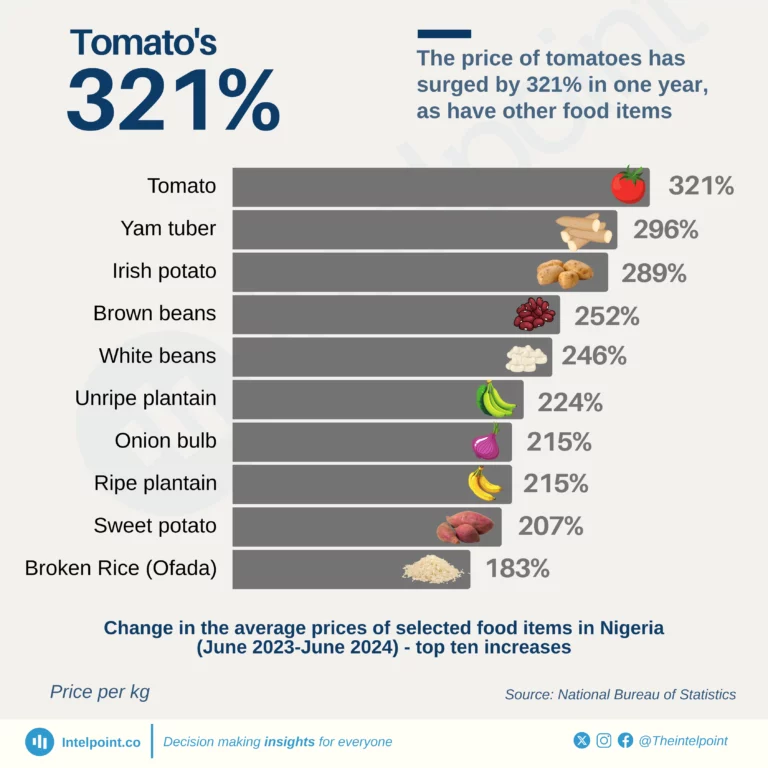
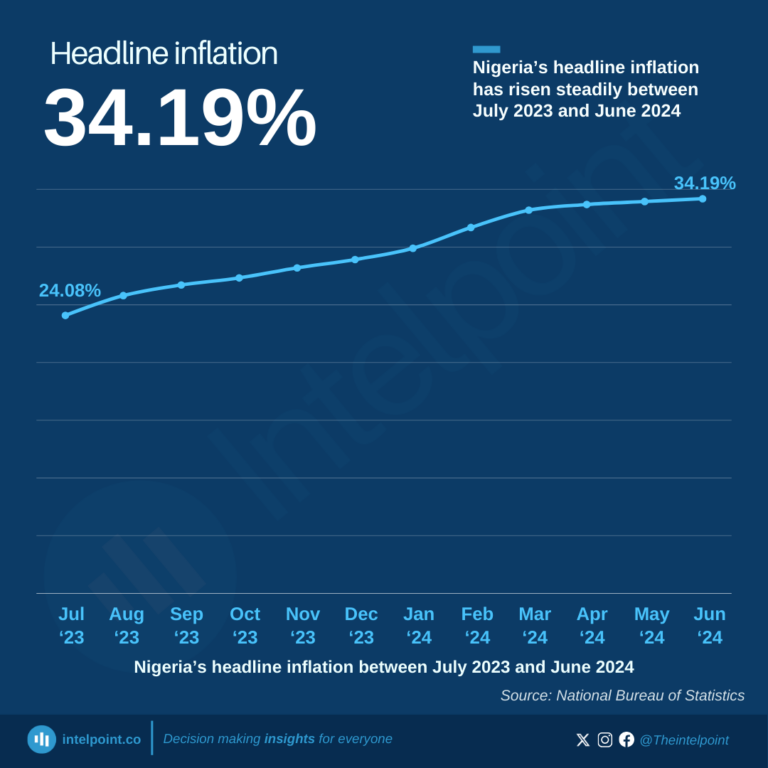
    Food prices have continued to increase as Nigeria's headline inflation hit 34.19% in June 2024, one of the highest globally.

    NBS's monthly survey for the average prices of selected food items in Nigeria as of June 2024 shows that tomatoes have gone up by 321%, yam by 296%, and staples — beans, rice, and plantain — have also seen significant increases. These are the top ten food items most hit by inflation in Nigeria in the past twelve months.
    See more
  • Only 10% of Nigerians earn above ₦100,000, according to the Nigerian Financial Services Market Report. This aligns with most reports about Nigeria, and it's in sharp contrast to the narratives online.
    See more

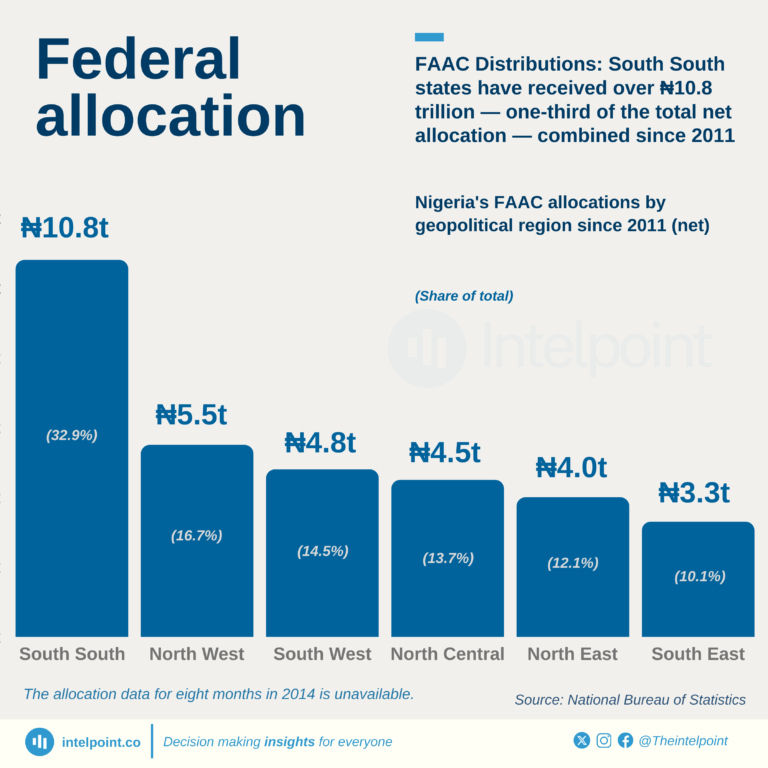
    The FAAC's revenue distribution from 2017 to August 2023 highlights the dominance of Delta, Akwa Ibom, Rivers, and Bayelsa states in allocations. Despite Lagos' economic prominence, it ranked fifth. Here is the distribution of revenue among states between 2017 and August 2023.

    See more
  • A Trend of Adult literacy rates of African countries

    Between 2018 and 2021, adult literacy rates across African nations exhibited significant disparities. Seychelles and South Africa led with literacy rates of 96% and 95%, respectively, indicating a high proportion of literate adults. Conversely, Chad had the lowest literacy rate during this period.

    These statistics underscore the uneven progress in educational attainment across Africa, highlighting the need for targeted interventions to improve literacy in lower-performing nations.

    See more
    Countries by Global Innovation Index 2024

    The Global Innovation Index 2024 reveals a striking contrast in innovation performance between countries globally and across Africa. Switzerland leads the global rankings with an impressive score of 67.5, followed by Sweden (64.5) and the USA (62.4), highlighting their sustained investments in research, development, and technological advancement.

    In Africa, Mauritius takes the top spot with a score of 30.5, followed closely by Morocco (28.8) and South Africa (28.3). However, even Africa's most innovative nations achieve less than half the score of global leaders, indicating a significant innovation gap.

    Nigeria ranks 15th in the African ranking and 113th globally, out of 133 countries, with a score of 17.1.

    See more

    • Crude oil prices peaked at $93.12 in April, marking the highest point of the year before experiencing fluctuations in the following months.
    • A steady decline in the last quarter saw prices drop to $74.72 in December, the lowest recorded price of 2024.
    • The decline in prices from September onward raised concerns about potential revenue shortfalls, impacting government budgets and foreign exchange earnings.
    • Oil prices remained unstable throughout the year, with significant fluctuations driven by geopolitical factors, global demand shifts, and production adjustments.
    See more
  • The 2024 Global Peace Index reveals a decline in peacefulness in 97 countries, the highest since the index began.

    Nigeria is among the nations affected by regional conflicts and rising violence. With a peace index score of 2.91, Nigeria is facing increasing challenges.

    A deteriorating peace score impacts foreign investment and economic stability. Global economic losses due to violence reached $19.1 trillion in 2023.

    See more
  • Only 10% of Nigerians earn above ₦100,000, according to the Nigerian Financial Services Market Report. This aligns with most reports about Nigeria, and it's in sharp contrast to the narratives online.
    See more

Other Insights

Mobile App transfers increased by 174% to ₦53.21 trillion 20 2021, it also increased by 108% to ₦111.12 trillion in 2022. There was also a charge increase in the volume of funds transfers done on mobile apps. The Central Bank of Nigeria, in its figures, separated Mobile App transfers from those of Mobile Money Operators (MMOs).

See more

The value of transactions conducted over Unstructured Supplementary Service Data (USSD) in Nigeria in 2021 was ₦5.2 trillion, 73% higher than 2020 figures. The total transaction value dropped by ₦685 billion in 2022, a 13.3% decline. The transaction volume also witnessed a 6% decline.

See more
As of 2021, 6 in every 10 males aged 15 and above in sub-Saharan Africa had an account with a financial institution, compared to almost half of all females of the same age in the region. Check out the share of sub-Saharan Africans with bank/mobile money accounts.
See more

Nigeria was the seventh most populous nation in the world in 2020, with 206.1 million people. Projected to reach a population of 401.3 million by 2050, Nigeria will rank third after India (1st) and China (2nd). According to Institut national d'études démographiques' projections, Nigeria, Ethiopia, DR Congo, Egypt, Tanzania, and Kenya will be among the world’s top 20 most populous countries by 2050.

See more

Nigeria was the seventh most populous nation in the world in 2020, with 206.1 million people. Projected to reach a population of 401.3 million by 2050, Nigeria will rank third after India (1st) and China (2nd). According to Institut national d'études démographiques' projections, Nigeria, Ethiopia, DR Congo, Egypt, Tanzania, and Kenya will be among the world’s top 20 most populous countries by 2050.

See more
With Chinese platforms like Alibaba and AliExpress serving customers across the globe, China's eCommerce sales in 2021 ($2.78 trillion) are larger than the sales in the USA, the UK, and other countries of the top 10 eCommerce markets globally combined.
See more

Since launching in 2007, the iPhone has been a key part of Apple's revenue stream. Apple's 2021 annual report shows that net sales for iPhones accounted for over half of the company's total net sales for the year.

See more
Apple recorded $191b in net sales from iPhones in 2021, a 39% increase from its 2020 figures. Apple attributed the increase to new iPhone models launched in Q1 and Q4 2021 and a favourable mix of iPhone sales. Here are Apple's iPhone net sales over the years:
See more

African startups raised $831 million in Q1 2023, about half of what was raised in the same quarter of the previous year. Financial Services startups accounted for 70% of the total amount raised in the quarter.

See more

African startups raised $831 million in Q1 2023, about half of what was raised in the same quarter of the previous year.

See more

As of March 2022, South Africa was still MultiChoice Group's biggest market, with 41.28% of its customer base, while its other African markets accounted for 58.72%. Here’s the share of MultiChoice’s subscriber base.

See more
Alibaba made $1.17 trillion in sales in 2020, larger than what Amazon and Walmart did in the same period, making the Chinese company the biggest eCommerce in the world.
See more
1 109 110 111 112 113 126
Strongest African currencies by annual average official exchange rate (LCU per US$) in 2024
  • Tunisia held the top spot with the strongest African currency, trading at 3.11 TND per USD in 2024.
  • Libya followed as the second-strongest, with an exchange rate of 4.83 LYD per USD.
  • Morocco maintained a strong regional position, with its dirham trading at 9.94 MAD per USD.
  • Botswana’s pula was relatively stable, exchanging at 13.56 per USD, highlighting Southern Africa’s economic steadiness.
  • Ghana and Seychelles had closely matched exchange rates, trading at 14.48 and 14.53 to the dollar, respectively.
  • South Africa, Lesotho, Namibia, and Eswatini all shared almost identical exchange rates of around 18.32–18.33 per USD, showing tight regional monetary coordination.
Read more
Africa's regional economic performance (2024), regional averages
  • Eastern Africa is the continent's fastest-growing region in 2024 with a GDP growth rate of 5.39%, but it also faces the highest inflation at 17.76%.
  • Southern Africa has the lowest inflation (3.48%) but also the highest unemployment by far, at 28.64%.
  • Western Africa combines growth (3.57%) with low unemployment (4.53%), positioning it as a relatively stable economic zone.
  • Central Africa and Northern Africa both lag in GDP growth, at 1.40% and 2.90% respectively, with Central Africa also experiencing moderate inflation and interest rates.
  • Interest rates are highest in Western (10.84%) and Eastern Africa (10.12%), reflecting tighter monetary policies likely aimed at controlling inflation.
  • Northern Africa’s 11.15% unemployment rate suggests underlying labour market issues despite moderate inflation and interest rates.
  • Southern Africa's low interest rate (6.29%) hasn't translated into job creation, indicating that monetary easing alone isn't resolving unemployment challenges.
Read more
Share of internet users by type of app usage (worldwide) as of 2024 Q3
  • Chat and Messaging apps lead globally, engaging 94.5% of internet users as of Q3 2024.
  • Social Networks follow closely behind at 94.4%, nearly matching messaging apps in global user engagement.
  • Search Engines and Web Portals still see high use, engaging 82.3% of users.
  • Email services remain highly relevant, used by 75% of internet users globally.
  • Shopping, Auctions, and Classifieds apps are also prominent, used by 74.9% of users.
  • Location-based services like maps and ride-sharing apps engage 55.3%, indicating a strong but more practical use case.
  • Games remain a niche category, with only 32.6% of users engaging with gaming apps compared to much higher engagement with communication or shopping platforms.
Read more
Key takeaways:
  • The United States holds the largest national gold reserves in 2024, totalling 8,133.46 tonnes.
  • Western European countries in the top ten list collectively hold 9,892.76 tonnes of gold reserves.
  • China, India, and Japan are the only Asian countries in the top 10, together holding 4,001.71 tonnes.
  • The Russian Federation is the leading gold reserve holder in Central and Eastern Europe, with 2,332.74 tonnes.
  • All countries in the top ten list maintain at least 600 tonnes of gold reserves.
  • The total gold reserve held by the top ten countries amounted to 24,360.67 tonnes.
Read more
Key takeaways:
  • China leads all nations with total reserves of $3.46 trillion while holding 5.53% of its share in gold reserves.
  • The top 15 countries collectively hold a total reserve of $10.78 trillion.
  • Despite being the global leader in gold reserves, the United States ranks third in total reserves.
  • The largest share of the United States' total reserves is from its gold reserve holdings of 74.97%.
  • Countries in the top fifteen list hold at least $236.9 billion each in total reserves.
  • The United States, France, and Italy have more than 70% of their total reserve holdings in gold.
Read more
Key Takeaways:
  • Ghana led the continent in gold production in 2023, producing 135.11 tonnes, 13.5% of Africa’s total.
  • Four countries (Ghana, Mali, South Africa, and Burkina Faso) each produced over 95 tonnes, together accounting for 443 tonnes or 44.1% of the continent’s output.
  • West African countries dominated the rankings, with eight nations from the region among the top 15 producers.
  • The West African countries in the top 15 combined contributed 525.55 tonnes, more than half (52.3%) of Africa's total gold production.
  • South Africa ranked third in Africa with 104.29 tonnes.
  • Burkina Faso ranked fourth while contributing almost 10% of Africa’s gold production.
Read more
1 109 110 111 112 113 251

Can’t find what you’re looking for? Please fill the form below
Contact Form Demo
SIGN UP TO OUR NEWSLETTER
Get periodic updates about the African startup space, access to our reports, among others.
Subscribe Here
Subscription Form

A product of Techpoint Africa. All rights reserved