Bite-sized Insights about
 
Providing you with data-based insights about things happening around you.
Popular Insights
  • Argentina, Egypt, and Ukraine were the IMF’s top three debtors as of June 26, 2024, accounting for $51 billion (46%) of the total debt. Egypt, Angola, and Kenya occupy the top three spots in Africa on the IMF’s debtors’ list.

    As of December 2023, Kenya's public debt stood at Ksh11.14 trillion (approximately $76.8 billion). By June 2024, its debt to the IMF had increased by 245% from $744 million in August 2020.

    This increase has coincided with protests in Kenya, where citizens opposed a proposed finance bill aiming to raise additional taxes to reduce the budget deficit and state borrowing.

    See more

    Every Nigerian president since 1999 left office with a higher dollar to naira exchange rate than when they took office. Will President Tinubu's tenure be the exception?

    See more
  • The 2024 Global Peace Index reveals a decline in peacefulness in 97 countries, the highest since the index began.

    Nigeria is among the nations affected by regional conflicts and rising violence. With a peace index score of 2.91, Nigeria is facing increasing challenges.

    A deteriorating peace score impacts foreign investment and economic stability. Global economic losses due to violence reached $19.1 trillion in 2023.

    See more

    The FAAC's revenue distribution from 2017 to August 2023 highlights the dominance of Delta, Akwa Ibom, Rivers, and Bayelsa states in allocations. Despite Lagos' economic prominence, it ranked fifth. Here is the distribution of revenue among states between 2017 and August 2023.

    See more
  • A Trend of Adult literacy rates of African countries

    Between 2018 and 2021, adult literacy rates across African nations exhibited significant disparities. Seychelles and South Africa led with literacy rates of 96% and 95%, respectively, indicating a high proportion of literate adults. Conversely, Chad had the lowest literacy rate during this period.

    These statistics underscore the uneven progress in educational attainment across Africa, highlighting the need for targeted interventions to improve literacy in lower-performing nations.

    See more
    Countries by Global Innovation Index 2024

    The Global Innovation Index 2024 reveals a striking contrast in innovation performance between countries globally and across Africa. Switzerland leads the global rankings with an impressive score of 67.5, followed by Sweden (64.5) and the USA (62.4), highlighting their sustained investments in research, development, and technological advancement.

    In Africa, Mauritius takes the top spot with a score of 30.5, followed closely by Morocco (28.8) and South Africa (28.3). However, even Africa's most innovative nations achieve less than half the score of global leaders, indicating a significant innovation gap.

    Nigeria ranks 15th in the African ranking and 113th globally, out of 133 countries, with a score of 17.1.

    See more

  • Over the past ten years, there has been a rising trend of fraud and forgery cases in Nigerian banks. Although there was an 88% increase in reported cases in 2021, there was a 27% decrease in 2022, resulting in a 221% increase in financial losses of ₦9.5 billion.
    See more
  • MTN Nigeria has dominated the country's telecommunications market over the years, accounting for the largest market share. All four operators, apart from 9mobile, recorded a significant increase in their subscriber base between May 2014 and March 2024.

    See more
  • The 2024 Global Peace Index reveals a decline in peacefulness in 97 countries, the highest since the index began.

    Nigeria is among the nations affected by regional conflicts and rising violence. With a peace index score of 2.91, Nigeria is facing increasing challenges.

    A deteriorating peace score impacts foreign investment and economic stability. Global economic losses due to violence reached $19.1 trillion in 2023.
    See more

Other Insights
  • Ghana first appeared at the World Cup in 2006 after missing all 17 previous editions.
  • They advanced to the second round in 2006, a standout entry for a first-time participant.
  • In 2010, Ghana reached the quarter-finals, marking their strongest performance to date.
  • 2018 was the only missed World Cup since their debut, reflecting consistent qualification success.
  • They have already qualified for the 2026 World Cup.
  • Ghana has made five qualifications within 20 years, showing remarkable frequency for a team that only debuted in 2006.
See more
  • South Africa did not qualify for any of the first 15 World Cups from 1930 to 1994.
  • They made their World Cup debut in 1998 and were knocked out in the group stage.
  • Their second appearance came in 2002, ending again at the group stage.
  • In 2010, South Africa became the first African country to host the tournament, but still did not progress beyond the group stage.
  • The country failed to qualify for three straight World Cups in 2014, 2018, and 2022.
See more
  • Ten states and the FCT collectively reduced their external debt by $227.19 million in H1 2025.
  • Lagos, Edo, and Rivers accounted for most of the reductions, making up more than three-quarters of the total.
  • Several smaller states also trimmed their balances, but by relatively modest amounts.
  • These reductions significantly offset the increases recorded by 26 other states, helping keep nationwide net external debt growth low.
See more
     
  • Agriculture dominated Kenya’s exports, with coffee, tea, and spices alone contributing $1.7 billion, the largest single export category.
  • Mineral fuels were a surprisingly strong second, delivering $1.1 billion, and showing Kenya’s growing role in regional fuel distribution.
  • Horticultural exports (flowers, live plants, and trees) contributed $790 million, reinforcing Kenya’s global strength in floriculture.
  • All other export categories fall below $300 million individually, reflecting a long list of small but diverse export segments such as textiles, vegetables, and pharmaceuticals.
See more
     
  • Gems and precious metals were the largest single export category, contributing $20.6 billion.
  • Ores and industrial minerals followed closely with $17.2 billion, showing the country’s reliance on mining.
  • Vehicles and machinery were significant non-mineral exports, with a combined $18.3 billion.
  • Agricultural and light industry products like fruits, nuts, and beverages contributed modestly, strengthening mining and manufacturing’s position as the core export drivers.
See more
  • Nigerian players have won the award seven times from 1992 to 2025.
  • Ivorian players follow with six wins, driven by their strong presence in the 2000s and 2010s.
  • Only four countries have produced four or more individual winners: Nigeria, Côte d’Ivoire, Cameroon, and Senegal.
  • Just 12 African nations account for all winners across the 33 years, showing how concentrated elite talent production has been.
See more
     
  • Mineral fuels (including crude oil) accounted for $49.3 billion, or 86.8% of total exports in 2024.
  • Non-oil exports remained marginal, with the second-largest item, cocoa, contributing only 4.6%.
  • Fertilisers, ores, slag, ash, and oilseeds collectively made up less than 5%, indicating limited diversification.
  • All other export categories each contributed 1% or less, underscoring Nigeria’s narrow export base.
See more
  • Nigeria has qualified for six World Cups since its first appearance in 1994.
  • Three second-round finishes in 1994, 1998, and 2014 represent the country's best performances at the tournament.
  • Nigeria ended three of its World Cup appearances at the group stage (2002, 2010, and 2018).
  • Nigeria failed to qualify for the 2006, 2022, and 2026 tournaments.
  • Nigeria did not qualify for any World Cup before 1994, making its debut year a significant milestone.
  • Qualification challenges are increasing, as shown by more failures in recent cycles.
See more
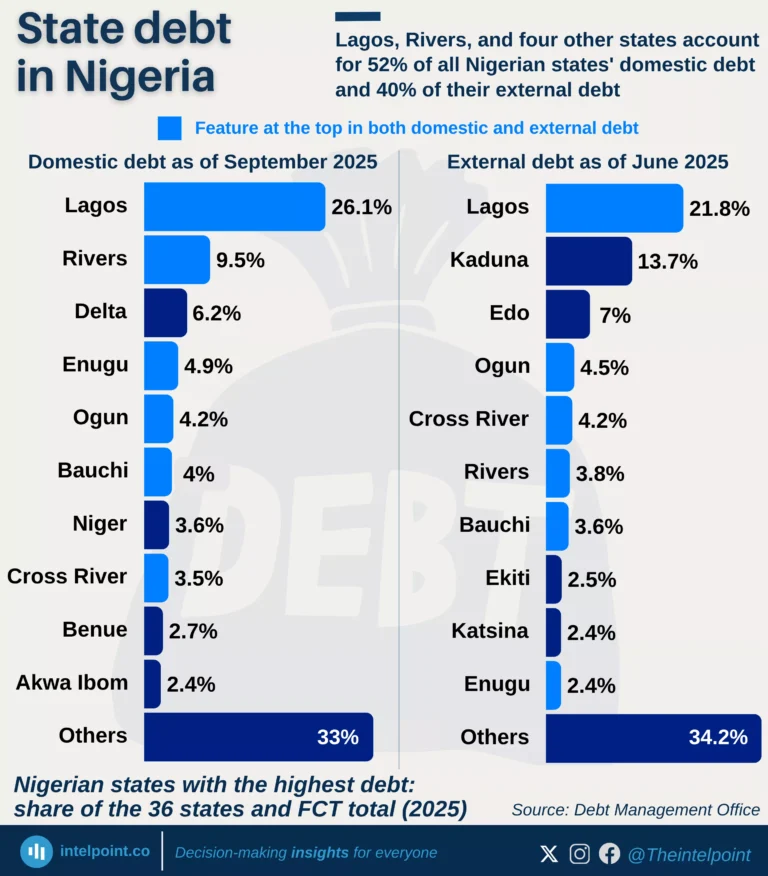
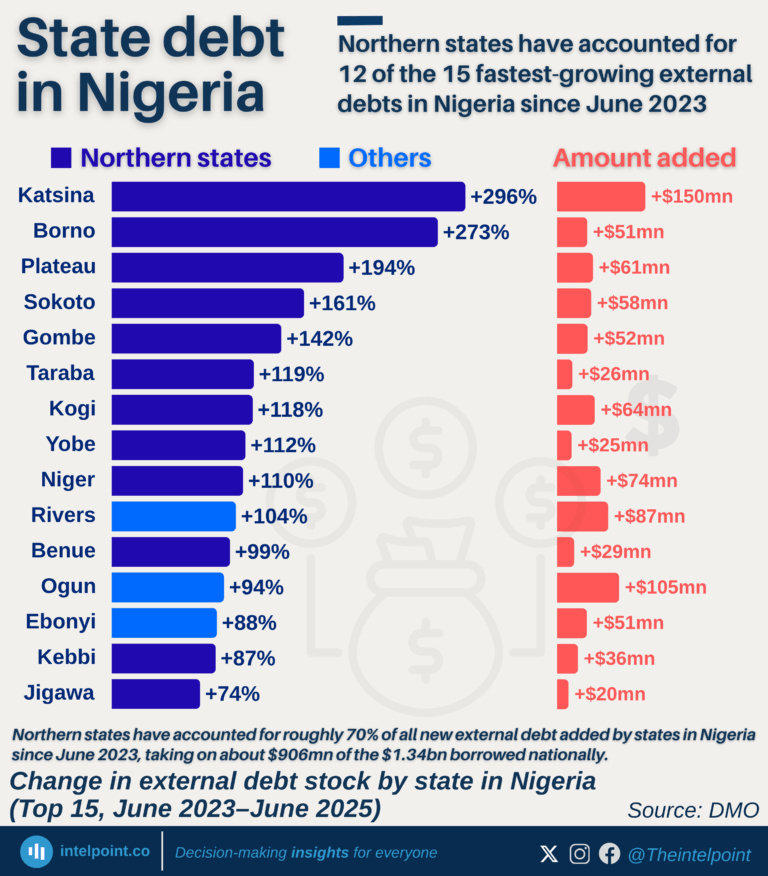
  • 26 states increased their external debt by a combined $239 million in H1 2025.
  • Imo, Oyo, Kaduna, Enugu, and Ogun recorded the biggest increases.
  • 11 states, including the FCT, reduced their debt through higher repayments.
  • Lagos, Edo, Rivers, and Bauchi accounted for most of the $227 million in reductions.
  • Total state external debt rose only slightly, from $4.8 billion to $4.812 billion.
See more
  • The Debt Management Office (DMO) Nigeria took the lion’s share, with ₦14.3 trillion (92.23%) of the Ministry of Finance's total allocation.
  • The Nigerian Bulk Electricity Trading Plc. received ₦858.7 billion (5.53%), making it the second-highest allocation.
  • The Federal Ministry of Finance (Headquarters) got ₦289.4 billion (1.86%).
  • The Office of the Accountant General of the Federation was allocated ₦50.7 billion (0.33%).
  • The figures reveal how debt servicing priorities overshadow operational and policy-related financial allocations.
See more
  • Cards were the most involved in fraud, with ₦14.3 billion representing the most significant exposure among all transaction channels
  • Card transactions also had the highest number of cases (11,972), indicating widespread and frequent attacks
  • Actual losses on cards were 11.5% (₦1.6 billion) of the amount involved, showing that significant financial damage still occurs despite preventive systems
  • Cash fraud accounted for ₦6.8 bn in exposure, nearly half of the card channel’s total
  • Cash also recorded 12.3% (₦800 million) in actual losses
  • Cheques had the lowest fraud involvement (₦1.2 billion) and only 46 cases, but the highest actual loss rate (72.7%)
See more
  • Nigeria has 371,800 police personnel as of 2025
  • 100,000 officers, 26.9% of the NPF, are dedicated to VIP and politician protection
  • Only 73.1% of personnel (271,800 officers) remain available for general public policing
  • Nearly one-third of the police workforce is focused on elite protection rather than community safety
  • The heavy VIP-protection allocation reduces manpower available for daily security operations
See more
1 9 10 11 12 13 126
  • Local companies dominated CIT contributions in most years, accounting for over 50% of payments in 9 of 11 periods between 2015 and 2025 (Q1–Q3).
  • Foreign companies briefly closed the gap in 2023, contributing 49%, the closest they have come to matching local firms.p
  • Local companies recorded their strongest share in 2021 at 65%, marking the widest gap between local and foreign contributors.
  • “Other payments” peaked during the pandemic, rising to 17% in 2020 before dropping to 0% from 2022 onward.
Read more
  • Niger (76%), the Central African Republic (61%), and Chad (61%) top the global list, meaning the majority of women in these countries marry as children.
  • Seven of the top ten countries by prevalence are African, showing that child marriage is most entrenched relative to population on the continent.
  • Countries in South Asia — Bangladesh (51%) and Nepal (35%) — and Latin America — Suriname (36%) and Belize (34%) — also feature, highlighting the global nature of the challenge.
  • While some countries have larger populations, this list ranks the share of girls affected, not the absolute number, meaning even smaller populations can show extreme societal impact if the prevalence is high.
Read more
  1. Nigeria ranks first with 7.3 million estimated users — over 2.8 million more than Egypt.
  2. Egypt (4.5 million) and South Africa (3.1 million) follow, forming the top three markets.
  3. The top three countries account for nearly 60% of the total users across the ten listed countries.
  4. The gap between first (7.3 million) and tenth (Tunisia, 322,000) is more than 6.9 million users, highlighting wide market disparities.
Read more
  • Since its 2019 IPO, Jumia Group has accumulated over $1 billion in total losses, with 2019 marking its highest annual loss at $254.2 million.
  • Losses remained elevated between 2020 and 2022, consistently exceeding $180 million annually despite post-IPO restructuring efforts.
  • From 2023 onwards, annual losses dropped sharply — falling below $105 million for the first time since listing — following the shutdown of underperforming business units across African markets.
  • By 2025, losses declined further to $60.1 million, representing the company’s lowest annual loss in nine years and signalling the sustained impact of its cost-reduction strategy.
Read more
  • With revenue per screen of ₦ 271.6 million, EbonyLife Cinemas outperforms other top cinemas in West Africa.
  • Several Genesis and FilmHouse branches fall within the strong mid-tier cluster, with revenue per screen ranging from ₦100 million to ₦160 million.
  • Lower-tier cinemas still generate ₦40 million to ₦70 million per screen
  • Revenue per-screen metric reveals the operational efficiency of the cinemas
Read more
  • Nigeria is the fastest to reach $100B — 34 years, achieving the milestone in 1994.
  • Ethiopia took the longest — 81 years, reaching the mark in 2022 after decades of gradual expansion.
  • Resource-driven economies reached the threshold faster, including Angola (36 years) and Algeria (43 years).
  • North African economies crossed earlier, with Egypt (1989) and Morocco (2008) benefiting from diversified economic bases.
  • South Africa reached $100B as early as 1988, reflecting its long-standing industrial and financial depth.
  • Ghana is among the slowest climbers (68 years), but its recent 2025 milestone shows the impact of sustained reforms and growth.
  • Speed varies widely (34 to 81 years), showing that growth paths across Africa are shaped by very different economic realities.
Read more
1 9 10 11 12 13 252

Can’t find what you’re looking for? Please fill the form below
Contact Form Demo
SIGN UP TO OUR NEWSLETTER
Get periodic updates about the African startup space, access to our reports, among others.
Subscribe Here
Subscription Form

A product of Techpoint Africa. All rights reserved