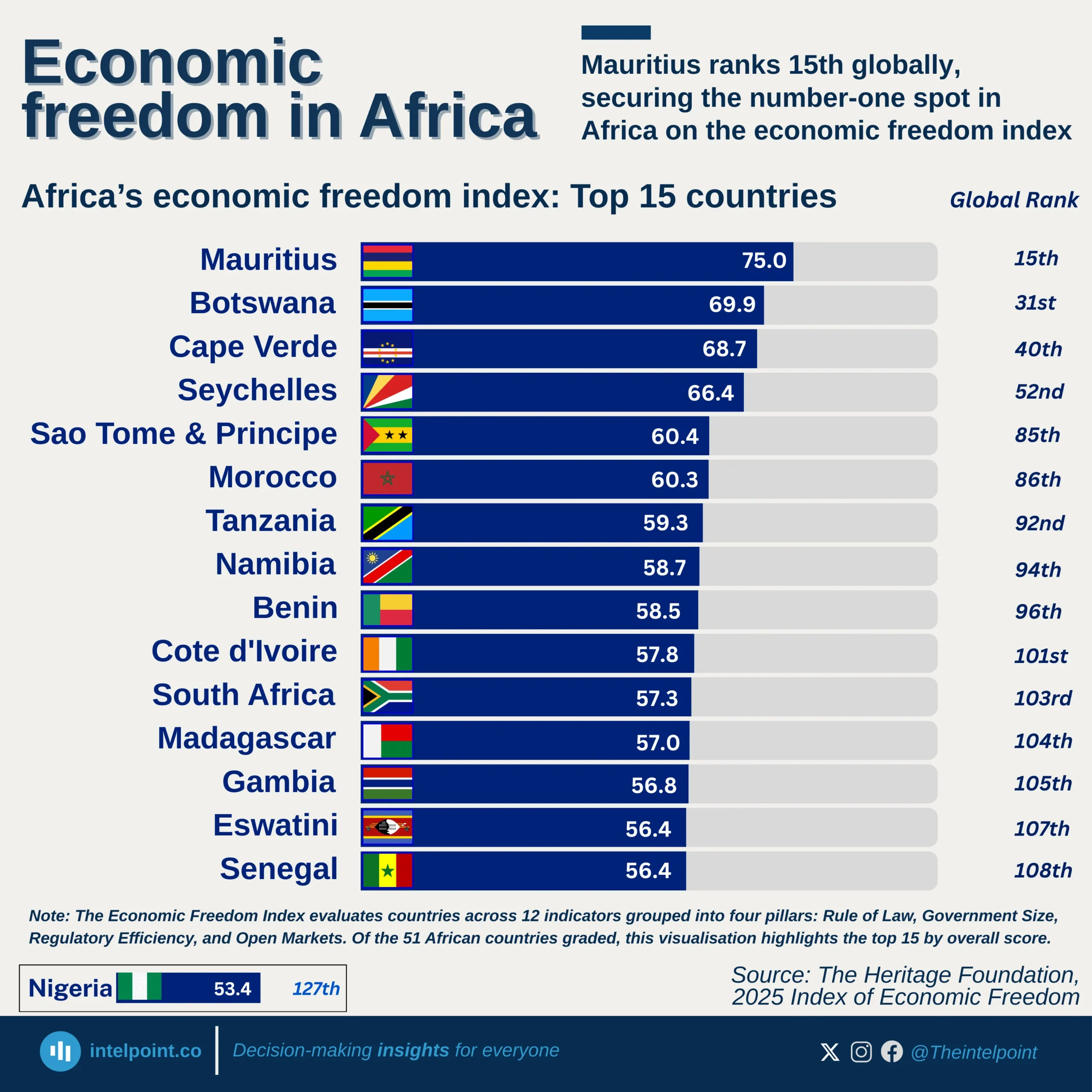
Mauritius ranks 15th globally, securing the number-one spot in Africa on the economic freedom index

Key Takeaways

  • Mauritius is the continent’s strongest performer by a wide margin, leading with a score of 75, and ranking 15th globally.
  • Botswana and Cape Verde are the only other African countries with a score close to 70, placing them within the global top 40.
  • Most of Africa’s top 15 countries score between 56 and 60, indicating moderate levels of economic freedom.
  • Even Africa’s highest performers trail global leaders, showing persistent gaps in rule of law, regulatory efficiency, and open-market conditions.

Mauritius has the most economic freedom in Africa, and, thus, offers its people and businesses the greatest ability to make their economic choices with minimal government interference.

Among 51 African countries assessed by the Heritage Foundation’s Economic Freedom Index, Mauritius ranks 15th globally with a score of 75, reflecting strong property rights, effective courts, low corruption, sound fiscal management, efficient regulation, and open markets.

Only Botswana, Cape Verde, and Seychelles come close, while most of the top 15 cluster in the high-50s to low-60s, showing that economic freedom remains concentrated in a small group of African economies.
Source:

heritage.org

Period:

2024
HTML code to embed chart
Want a bespoke report?
Reach out
Tags
Related Insights

Nigeria’s FDI inflows rose to 4th in Africa after a 148% increase, while Egypt remained the continent’s top destination
Egypt remained Africa’s top FDI destination with $15.45bn. Nigeria ranked 4th after FDI inflows rose 148% to $4.01bn. Guinea had the biggest top-10 jump, rising 454% to $7.76bn. Africa’s top 10 accounted for 73% of total FDI inflows.

Nigeria’s external debt service crossed $5bn in 2025 after payments in 2018–2025 dwarfed the previous decade
  • Nigeria’s external debt service entered a heavier phase in 2018.
  • External debt service crossed $5bn in 2025.
  • Nigeria paid about $22.2bn from 2018 to 2025.
  • That was about 6x the $3.7bn paid from 2008 to 2017.
  • The 2006 spike reflects one-off debt settlement payments.

Nigeria collected ₦34.6 trillion in company income tax over 11 years
  • Nigeria collected ₦34.62 trillion in company income tax across 45 quarters from Q1 2015 to Q1 2026.
  • Average quarterly collection stood at about ₦769 billion over the period.
  • CIT collections stayed below ₦1 trillion in every quarter until Q2 2023.
  • Since Q2 2024, collections have remained above ₦1 trillion for eight straight quarters.
  • The highest quarterly collection was ₦2.96 trillion in Q3 2025.
  • Annual CIT collections rose sharply from ₦2.82 trillion in 2022 to ₦9.21 trillion in 2025.
  • The recent surge is nominal and likely reflects stronger collections, inflation, naira depreciation, and higher naira-value foreign CIT receipts.

Nigeria’s food inflation has risen every month since January 2026, climbing 8.07 percentage points to 16.96% in May
  • Nigeria’s year-on-year food inflation rose for the fourth consecutive month, from 8.89% in January 2026 to 16.96% in May.
  • The rate increased by 8.07 percentage points within the first five months of 2026.
  • May’s 16.96% rate means food prices were, on average, 16.96% higher than they were in May 2025.
  • Food inflation rose from 12.12% in February to 14.31% in March and 16.06% in April before reaching 16.96% in May.
  • Food inflation exceeded Nigeria’s 15.93% headline inflation rate in May, showing that food was a major source of renewed pressure on household expenses.

Among 44 African countries, Nigeria's 16.96% food inflation in May 2026 was lower only than that of Libya and Malawi
  • Nigeria recorded the third-highest food inflation rate among 44 African countries in May 2026.
  • At 16.96%, Nigeria’s rate was lower only than Libya and Malawi, both at 17.6%.
  • Nigeria’s food inflation was nearly 3.5 times the 4.88% average across the countries covered.
  • Eight of the ten countries with the highest food inflation recorded rates above 10%.

Company income tax collections declined across 13 sectors in Q1 2026
  • Thirteen of Nigeria’s 21 sectors recorded year-on-year declines in CIT collections.
  • Extraterritorial organisations recorded the steepest fall at 53.9%.
  • Construction collections fell by 52.4%, the second-largest decline.
  • Mining and agriculture declined by 39.4% and 40.8%, respectively.
  • Manufacturing still generated ₦74.5 billion despite a 31.0% decline.

POPULAR TOPICS
SIGN UP TO OUR NEWSLETTER
Get periodic updates about the African startup space, access to our reports, among others.
Subscribe Here
Subscription Form

A product of Techpoint Africa. All rights reserved