Bite-sized Insights about
 
Providing you with data-based insights about things happening around you.
Popular Insights
  • Top ten natural rubber-producing countries (1990-2022)
    Côte d'Ivoire emerged as the world's fourth-largest producer of natural rubber in 2022. Cote d'Ivoire, Nigeria, and Liberia are the only African countries in the top ten between 1990 and 2022.
    Nigeria was among the top ten until 2010, but as of 2022, Côte d'Ivoire was the only African country in the top ten producers. 
    Asian countries have historically led the world's natural rubber production, with the top seven countries — Thailand, Indonesia, Malaysia, India, Vietnam, China, and Philippines — producing 87% of the global output between 1990 and 2022.
    See more
    Nigeria produced 1.4 million tons of palm oil in 2022, 2% of the global production in the 2022/2023 market year, making the country the fifth largest producer of the commodity. Indonesia dominated global production with 59%, followed by Malaysia and Thailand.
    See more
  • The 2024 Global Peace Index reveals a decline in peacefulness in 97 countries, the highest since the index began.

    Nigeria is among the nations affected by regional conflicts and rising violence. With a peace index score of 2.91, Nigeria is facing increasing challenges.

    A deteriorating peace score impacts foreign investment and economic stability. Global economic losses due to violence reached $19.1 trillion in 2023.

    See more

    The FAAC's revenue distribution from 2017 to August 2023 highlights the dominance of Delta, Akwa Ibom, Rivers, and Bayelsa states in allocations. Despite Lagos' economic prominence, it ranked fifth. Here is the distribution of revenue among states between 2017 and August 2023.

    See more
  • A Trend of Adult literacy rates of African countries

    Between 2018 and 2021, adult literacy rates across African nations exhibited significant disparities. Seychelles and South Africa led with literacy rates of 96% and 95%, respectively, indicating a high proportion of literate adults. Conversely, Chad had the lowest literacy rate during this period.

    These statistics underscore the uneven progress in educational attainment across Africa, highlighting the need for targeted interventions to improve literacy in lower-performing nations.

    See more
    Countries by Global Innovation Index 2024

    The Global Innovation Index 2024 reveals a striking contrast in innovation performance between countries globally and across Africa. Switzerland leads the global rankings with an impressive score of 67.5, followed by Sweden (64.5) and the USA (62.4), highlighting their sustained investments in research, development, and technological advancement.

    In Africa, Mauritius takes the top spot with a score of 30.5, followed closely by Morocco (28.8) and South Africa (28.3). However, even Africa's most innovative nations achieve less than half the score of global leaders, indicating a significant innovation gap.

    Nigeria ranks 15th in the African ranking and 113th globally, out of 133 countries, with a score of 17.1.

    See more

  • The African countries with the highest life expectancies as of 2023 are: Algeria - 77 years, Tunisia - 77 years, Cape Verde - 77 years, Mauritius - 76 years.

    The African countries with the lowest life expectancies: Central African Republic - 55 years, Lesotho - 55 years, Nigeria - 54 years, Chad - 54 years.

    See more
  • MTN Nigeria has dominated the country's telecommunications market over the years, accounting for the largest market share. All four operators, apart from 9mobile, recorded a significant increase in their subscriber base between May 2014 and March 2024.

    See more
  • The 2024 Global Peace Index reveals a decline in peacefulness in 97 countries, the highest since the index began.

    Nigeria is among the nations affected by regional conflicts and rising violence. With a peace index score of 2.91, Nigeria is facing increasing challenges.

    A deteriorating peace score impacts foreign investment and economic stability. Global economic losses due to violence reached $19.1 trillion in 2023.
    See more

Other Insights
  • Electricity distribution in South Africa reached its peak in 2018, a record high of 231 TWh.

  • The lowest electricity distribution was recorded in 2023, dropping to 206 TWh.

  • Load shedding has become a persistent challenge, with 2023 experiencing the highest number of load shedding days — 332 days in total.

  • Eskom accounts for about 80% of electricity distributed in South Africa.
See more
  • Just 16 out of 54 African countries have launched a national AI strategy.
  • Over 30 countries remain at the early or inactive stage with no clear roadmap.
  • Nigeria, Africa’s most populous nation, is still drafting its AI policy.
  • Leaders include Kenya, Egypt, Ghana, Algeria, Rwanda, and Senegal.
  • Most low-income and post-conflict states like Chad, Somalia, and South Sudan are far behind.
See more
  • Access Bank paid the highest total salaries in 2024, amounting to ₦357.6 billion.
  • Stanbic IBTC devoted the largest share of its revenue to salaries at 9.96%, despite a much lower total salary bill than Access or FirstHoldCo.
  • Zenith Bank had one of the highest salary bills (₦137.7 billion) but spent the smallest portion of its revenue on staff at just 3.47%.
  • Wema Bank, though paying the lowest in total salaries (₦33.8 billion), had one of the highest salary-to-revenue ratios at 7.81%.
  • FirstHoldCo, with ₦229.1 billion in staff costs, maintained a moderate salary-to-revenue ratio of 7.14%.
  • The gap between total salary spend and salary-to-revenue ratios reveals more about each bank’s internal cost structure.
See more
  • Access Bank led all Nigerian banks with ₦4.9T in gross earnings in 2024, nearly doubling its 2023 performance.
  • FirstHoldCo saw a sharp rise in earnings to ₦3.2T in 2024
  • Zenith Bank grew consistently, crossing the ₦4T mark in 2024 from ₦1T in 2022, showing strong operational expansion.
  • Wema Bank, despite being the smallest, quadrupled its earnings over two years, from ₦0.1T to ₦0.4T.
  • Fidelity and FCMB nearly tripled their gross earnings between 2022 and 2024, showing rising momentum among mid-tier banks.
See more
 
  • Real GDP grew from ₦205.1 trillion in 2019 to ₦217.8 trillion in 2024, a modest 6% rise.
  • Nominal GDP jumped from ₦205.1 trillion to ₦372.8 trillion over the same period, an 82% increase.
  • The gap between nominal and real GDP widened sharply after 2021, reaching ₦155 trillion in 2024.
  • Nominal GDP has grown year-on-year, with the steepest jump between 2023 (₦314.0 trillion) and 2024 (₦372.8 trillion).
  • Inflationary pressures have driven nominal gains, masking subdued real economic expansion.
See more
  • FirstBank's planned headquarters will have 43 floors, nearly double UBA‌'s HQ.
  • Among the five FUGAZ banks, three currently have headquarters with 15 floors or fewer.
  • FirstBank’s existing HQ has only 15 floors, showing how big the planned leap is.
  • UBA’s HQ in Marina leads the pack among existing HQs, with 23 floors, followed by Access Bank with 16 floors.
  • The new FirstBank property in Eko Atlantic will be the tallest bank HQ in Nigeria by a wide margin when completed.
See more
  • Eskom’s average electricity tariff increased by approximately 162% between 2013/14 and 2023/24.
  • Tariffs are categorized into two groups based on distribution: Local Authority Tariffs and Non-Local Authority Tariffs.
  • Landlight Tariff (Non-Local Authority category) is the highest rate and in 2023/24 it stood at 608.61 c/kWh.
  • Homelight 20A (Block 1) is the lowest tariff also in the non-local authority category, at 168.78 c/kWh in 2023/24.
  • Eskom applies Time-of-Use (ToU) pricing, where tariffs vary by Time of day (peak, standard, off-peak periods) and Demand season (high-demand season: June to August and Low-demand season: September to May)

See more
  • Jewellery demand made up 81.35% of Egypt’s total gold demand between 2010 and 2024.
  • The highest jewellery demand was recorded in 2010 at 53 tonnes, and no year since has reached that level.
  • Jewellery demand declined by 50.75% between 2010 and 2024.
  • Bar and coin demand saw a sharp 700% increase between 2021 and 2022.
  • In 2023, bar and coin demand hit a record high of 30.3 tonnes and, for the first time, exceeded jewellery demand.
  • Overall, bar and coin demand rose by 943.48% between 2010 and 2024.
See more
  • The North Central zone accounts for the highest share of road accidents in Nigeria, contributing 34.55% of the national total.
  • Within the North Central zone, Abuja (FCT) recorded the most accidents, with a cumulative total of 8,133 cases.
  • The South West zone ranks second, responsible for 25.78% of all accidents nationwide, with Ogun State leading the zone at 6,418 accidents.
  • The South East zone has the lowest share, contributing just 5.38% of total accidents from Q2 2020 to Q2 2024.
  • Enugu State, the highest contributor within the South East, accounts for only 1.59% of the national total.
See more
  • Venezuela and Iran offer diesel at nearly free prices, charging just $0.004 and $0.006 per litre respectively, the lowest globally.
  • Libya leads Africa with diesel priced at only $0.028 per litre, making it the third cheapest worldwide.
  • Six African countries—Libya, Algeria, Egypt, Angola, Nigeria and Sudan—feature in the global top 20 for the lowest diesel prices.
  • Nigeria ranks 17th globally, with diesel priced at $0.658 per litre, despite recent subsidy removals and price hikes.
See more
  • Over six MPC meetings from February to November 2024, the MPR rose cumulatively by 875 basis points, ending the year at 27.5%.
  • The pace of increases slowed after March: from 200 bps (Feb–Mar) to just 25 bps (Sept–Nov), reflecting a tapering hike strategy.
  • Since November 2024, the CBN has maintained the rate at 27.5% across four consecutive MPC meetings into July 2025.
  • The 2024 cycle was dominated by aggressive rate hikes aimed at stabilising inflation and exchange rate volatility.
  • The CBN’s interest rate strategy appears more restrained in 2025, indicating a possible pause phase in the monetary policy cycle.
See more
 
  • Anambra’s IGR grew sevenfold in 16 years, reaching ₦42 billion in 2024.
  • A ₦26B to ₦42B jump in just six years (2018–2024) indicates accelerating growth.
  • The most dramatic jumps occurred post-2018, pointing to possibly new fiscal reforms or policies.
  • Between 2014 and 2024, revenue grew by over 300%, from ₦10B to ₦42B.
See more
1 37 38 39 40 41 126
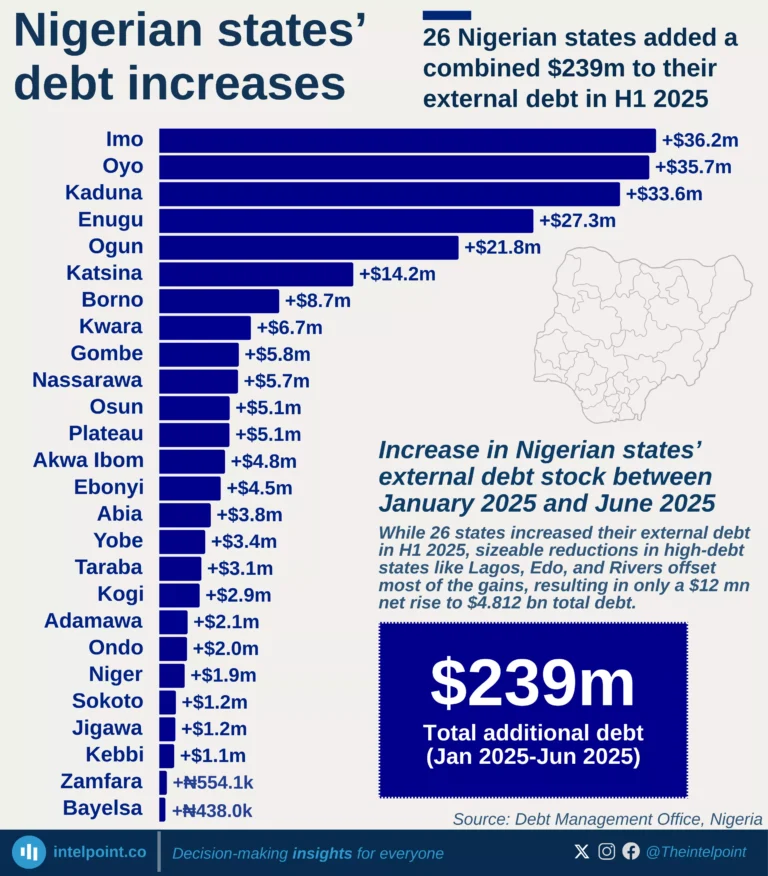
  • The six North Central states collectively hold ₦449.4 billion in domestic debt as of Q2 2025, according to DMO data.
  • Kogi and Nasarawa lead in fiscal control with ₦18.8 billion and ₦23.9 billion, respectively
  • Both states record the lowest debt profiles in the region. Niger State’s ₦141.5 billion debt makes it the region’s most indebted, accounting for nearly one-third of the total.
  • The debt gap between Kogi (lowest) and Niger (highest) stands at over ₦123 billion, highlighting stark differences in fiscal management and borrowing capacity across the zone.
Read more
  • Lagos dominates regional debt with a domestic debt stock of ₦1.04 trillion, over 70% of the South-West’s total subnational debt.
  • Lagos’s debt is six times larger than that of Ogun (₦162.9 billion), the region’s next most indebted state.
  • At ₦10.6 billion, Ondo maintains the lowest domestic debt profile in the region, reflecting relatively modest borrowing.
  • The combined domestic debt of the six South-West states (Lagos, Ogun, Oyo, Osun, Ekiti, and Ondo) stood at ₦1.43 trillion as of Q2 2025.
Read more
  • Nigeria dominates with ₦339.6b, contributing over 70% of GTCO’s total profit after tax in Africa.
  • Ghana (₦61.9b) and Côte d’Ivoire (₦28.2b) followed as the strongest non-Nigerian subsidiaries.
  • Tanzania (₦46m) and Uganda (₦505m) contributed negligible profits compared to peers.
  • GTCO subsidiaries across Africa collectively generated around ₦476b profit after tax in the first half of 2025.
Read more
  • Nigeria’s public debt rose to $99.7 billion, up from $91.3 billion in June 2024, marking a return to growth after a dollar-value decline in 2024.
  • The debt in local currency climbed to ₦152.4 trillion, reflecting both borrowing and continued naira depreciation.
  • The increase underscores ongoing domestic financing challenges and vulnerability to exchange-rate fluctuations.
  • The growth in dollar terms points to renewed external borrowing as the government manages debt obligations post-2024 volatility.
Read more
  • From recession to recovery, Nigeria’s GDP growth journey reveals three decades of economic volatility and slow transformation.
  • Nigeria's economy grew by 14.6% in 2002, which is still the highest in the country's history.
  • The country entered a recession in 2016, with the economy shrinking by -1.6%.
  • Nigeria enjoyed a long period of strong growth between 2003 and 2010: The economy grew between 7% and 11%, powered by high oil prices and booming sectors like telecoms and banking.
Read more
  • The U.S. consistently leads Nigeria’s imports from the Americas, accounting for 57–73% between 2013 and 2025.
  • Brazil ranks second, with shares ranging between 11% and 24%, highlighting its steady trade ties with Nigeria.
  • During the period, the combined share of the U.S. and Brazil never fell below 76%, even at its lowest point in 2022.
  • Total imports from the Americas surged from ₦0.9 trillion in 2013 to a peak of ₦6.3 trillion in 2024.
  • Canada’s import share peaked at 16.4% in 2022, showing a rare moment of diversification.
Read more
1 37 38 39 40 41 252

Can’t find what you’re looking for? Please fill the form below
Contact Form Demo
SIGN UP TO OUR NEWSLETTER
Get periodic updates about the African startup space, access to our reports, among others.
Subscribe Here
Subscription Form

A product of Techpoint Africa. All rights reserved