Bite-sized Insights about
 
Providing you with data-based insights about things happening around you.
Popular Insights
  • In 2023, South Africa led Africa's exports with a value of $110.7 billion, nearly double Nigeria's $60.7 billion. Key exports include gems, vehicles, and mineral fuels.

    The top 15 African exporters contribute 84% to the continent's trade, with South Africa, Nigeria, Algeria, Morocco, and Egypt leading with a combined 52%.

    See more

    In 2022, the US hosted a diverse African immigrant community, totaling over 2.75 million. ​​ ​Nigerians make up the largest group at 448,405 (16.3%), followed by Ethiopians (10.6%), Egyptians (8.3%), and Ghanaians (7.8%).

    See more
  • The 2024 Global Peace Index reveals a decline in peacefulness in 97 countries, the highest since the index began.

    Nigeria is among the nations affected by regional conflicts and rising violence. With a peace index score of 2.91, Nigeria is facing increasing challenges.

    A deteriorating peace score impacts foreign investment and economic stability. Global economic losses due to violence reached $19.1 trillion in 2023.

    See more

    The FAAC's revenue distribution from 2017 to August 2023 highlights the dominance of Delta, Akwa Ibom, Rivers, and Bayelsa states in allocations. Despite Lagos' economic prominence, it ranked fifth. Here is the distribution of revenue among states between 2017 and August 2023.

    See more
  • A Trend of Adult literacy rates of African countries

    Between 2018 and 2021, adult literacy rates across African nations exhibited significant disparities. Seychelles and South Africa led with literacy rates of 96% and 95%, respectively, indicating a high proportion of literate adults. Conversely, Chad had the lowest literacy rate during this period.

    These statistics underscore the uneven progress in educational attainment across Africa, highlighting the need for targeted interventions to improve literacy in lower-performing nations.

    See more
    Countries by Global Innovation Index 2024

    The Global Innovation Index 2024 reveals a striking contrast in innovation performance between countries globally and across Africa. Switzerland leads the global rankings with an impressive score of 67.5, followed by Sweden (64.5) and the USA (62.4), highlighting their sustained investments in research, development, and technological advancement.

    In Africa, Mauritius takes the top spot with a score of 30.5, followed closely by Morocco (28.8) and South Africa (28.3). However, even Africa's most innovative nations achieve less than half the score of global leaders, indicating a significant innovation gap.

    Nigeria ranks 15th in the African ranking and 113th globally, out of 133 countries, with a score of 17.1.

    See more

  • GSM subscribers in Nigeria only recorded three year-on-year drops in the past 11 years

    As of March 2024, there were 219m subscribers in Nigeria's GSM market which is dominated by three players each with over 20% market share. More than 40 mobile virtual network operators (MVNOs) have been licensed to date, all of whom will rely on the infrastructure of the country's four mobile network operators to offer their services.

    See more
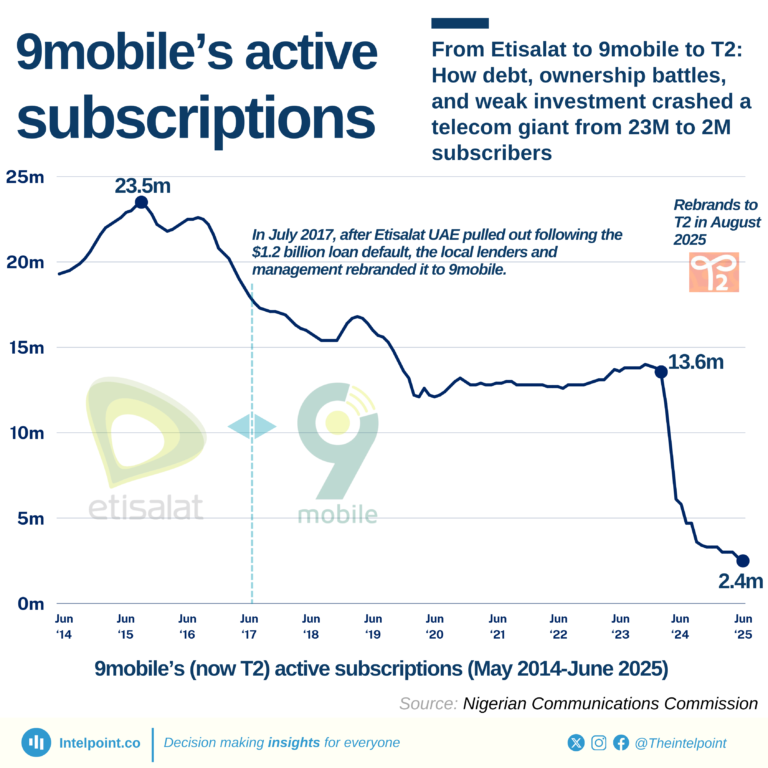
  • MTN Nigeria has dominated the country's telecommunications market over the years, accounting for the largest market share. All four operators, apart from 9mobile, recorded a significant increase in their subscriber base between May 2014 and March 2024.

    See more
  • The 2024 Global Peace Index reveals a decline in peacefulness in 97 countries, the highest since the index began.

    Nigeria is among the nations affected by regional conflicts and rising violence. With a peace index score of 2.91, Nigeria is facing increasing challenges.

    A deteriorating peace score impacts foreign investment and economic stability. Global economic losses due to violence reached $19.1 trillion in 2023.
    See more

Other Insights
  • Lagos alone holds more domestic debt than the bottom 25 states combined.
  • Jigawa’s domestic debt of ₦1.06 billion is less than 0.15% of Lagos’s debt, showing the widest disparity.
  • The 10 highest-indebted states account for nearly 70% of the total domestic debts across Nigerian states.
  • The Federal Capital Territory (FCT) carries more debt than 17 other states.
See more
  • Inflation jumped by 13.4 percentage points, from 9.0% pre-Buhari to 22.4% post-Buhari.
  • The value of the naira] depreciated by over 235% during Buhari’s tenure, ending at ₦645.2/$.
  • Total public debt increased nearly 7x, from ₦12.6 trillion in 2015 to ₦87.4 trillion in 2023.
  • Nigeria’s GDP growth rate averaged just 1.24% annually between 2015 and 2023.
  • Foreign reserves peaked at $44.5 billion in 2018 but dropped to $38.3 billion by 2023.
  • FDI inflows showed volatility, with the highest being $3.5 billion in 2021 and the lowest at $0.8 billion.
  • Nigeria's GDP growth rate was modest, with the country experiencing a recession in 2016.
See more
  • Guinea-Bissau showed the highest agricultural contribution to its GDP at 36.8% in 2024.
  • Contributions range widely, with high reliance seen in Comoros (36.6%) and Ethiopia (34.9%), contrasting with lower percentages in DR Congo (17.1%) and Angola (16.4%).
  • Agriculture, forestry, and fishing contributed a notable 20.4% to Nigeria's GDP in 2024.
  • Countries with high agricultural GDP contributions are predominantly located in West and East Africa.
See more
  • Nigeria is the world’s top yam producer since the 1980s.
  • West Africa supplies over 95% of global yam output.
  • Ghana and Côte d’Ivoire have grown steadily in the rankings.
  • Non-African countries play a very small role today.
  • Nigeria exports very little yam despite massive production.
See more
  • Libya leads Africa with 48.4 billion barrels of recoverable oil, the continent’s highest.
  • Nigeria ranks second with 37.3 billion barrels, accounting for about 27% of reserves among top holders.
  • Algeria holds 12.2 billion barrels, rounding out the top three and far ahead of other nations.
  • Sudan, Egypt, and Angola each contribute between 2.5 and 5 billion barrels, showing smaller but notable reserves.
See more
  • South Africa leads the continent with a vast 20,986km rail network, nearly triple the size of Sudan’s, the second-largest.
  • Nigeria’s rail infrastructure measures 3,798km, ranking it behind Kenya (3,819km) and DR Congo (4,007km).
  • North African countries like Egypt and Algeria maintain significant rail mileage, exceeding 4,000km each.
  • Southern Africa dominates the top five, with Mozambique and Zimbabwe also featuring prominently.
See more
 
  • Zambia recorded its highest-ever FDI inflow in 2013 at $2.10 billion.
  • After dipping to a negative inflow of -$0.07 billion in 2022, Zambia recovered to $1.24 billion in 2024.
  • The country experienced its first billion-dollar inflow in 2007, marking a turning point in foreign investment.
  • FDI inflow was consistently below $0.5 billion throughout the 1990s, indicating limited investor confidence during that period.
See more
  • Algeria leads Africa with 41 active oil rigs, making up nearly 29% of the continent's total count.
  • Nigeria follows with 31 rigs, confirming its strong position in West Africa’s upstream oil activity.
  • Egypt ranks third with 23 rigs, while Libya maintains 18 rigs despite its fluctuating political climate.
  • The top seven countries host 122 of Africa’s 144 rigs, showing drilling operations are concentrated in just a handful of nations.
See more
  • July 2025 saw the ASI rise by 8.6%, the largest monthly jump in over a year.
  • The index grew steadily for four straight months from April to July 2025.
  • ASI climbed from 99.5K in June 2024 to 126.7K in July 2025, a 27.3% increase overall.
  • August 2024 recorded the sharpest monthly drop at -2.9%.
  • December 2024 and January 2025 posted back-to-back strong gains of 2.5% and 3.8% respectively.
  • May and June 2025 saw healthy gains of 4.2% and 6.6%, paving the way for July’s surge.
See more
  • Manufacturing hit a record $64.90b in 2022, after steady growth from 2016.
  • Output fell 55% to $25.36b in 2024, the worst one-year drop since 1999.
  • Military-era lows: Slumped from $33.33b (1981) to $8.08b (1989).
  • Democratic rebounds: Output grew from $9.62b (1999) to $55.33b (2014), and from $35.12b (2016) to $64.90b (2022).
See more
  • Ronaldo leads the UEFA Champions League scoring chart with 141 goals, ahead of Messi's 129.
  • Salah and Drogba are the only two African players in the top 20 scorers list.
  • Just 8 goals separate the 10th and 20th-ranked scorers, showing how tight competition is outside the top ranks.
  • Haaland and Mbappé are the only two players under 30 in the top 15.
  • Legendary players like Neymar and Ibrahimović never broke into the top 10 despite long careers at top clubs.
See more
  • Starlink is cheaper than traditional ISPs in five out of the twelve African countries analysed.
  • Zimbabwe has the widest price gap, with traditional ISPs costing over 21 times more than Starlink.
  • Nigeria currently offers the cheapest traditional ISP plan at $9.59, undercutting Starlink’s price by a wide margin.
  • In Ghana and Kenya, Starlink’s monthly subscription is less than half the cost of the leading ISPs.
  • Only slight differences exist between Starlink and traditional ISP prices in Zambia and Botswana, indicating near-parity.
  • Mozambique and Cape Verde have moderate Starlink price advantages, suggesting potential for market competition.
See more
1 39 40 41 42 43 126
  • Oil exports continued to dominate, averaging over 88% of total exports in 2024 and remaining above 81% in the first half of 2025.
  • Non-oil exports rose gradually, from a low of 6.9% (February 2024) to a high of 18.1% (January 2025).
  • Peaks in non-oil export contributions occurred in July 2024 (16.4%) and January–April 2025 (13–18%), indicating progress toward diversification.
  • Total exports remained heavily oil-driven, though sustained double-digit non-oil shares in late 2024 and early 2025 show a slow shift.
Read more
  • Non-oil exports rose to 14.3% of total exports in 2025, up from 8.7% in 2023.
  • Oil exports still represent 85.7% of total exports in 2025.
  • The non-oil share reached 13.1% in 2019 before dipping and rebounding by 2025.
  • Nigeria’s total exports expanded from ₦9.6 trillion in 2015 to ₦43.3 trillion in H1 2025, showing strong value growth.
  • The lowest non-oil share in the decade occurred in 2016 (4%), reflecting heavy oil dependence.
Read more
  • Urban electricity access has remained between 80% and 89% since 1990, never crossing to 90%.
  • The inability to achieve universal access suggests that infrastructure expansion has struggled to keep pace with rapid urbanisation and population growth.
  • Periodic dips in access, such as in 2010 and 2015, point to challenges in maintaining consistent electricity supply rather than just extending connections.
  • Insufficient generation, outdated grids, and policy inefficiencies have constrained Nigeria’s ability to deliver reliable and universal electricity access even in its urban centres.
Read more
  • Rural electricity access increased from just 4% in 1990 to about 33% in 2023, showing gradual progress over three decades.
  • The data reveals irregular jumps in certain years—such as 2003, 2011, and 2016—likely tied to temporary electrification programmes or revised data estimates. D
  • espite improvements, nearly two-thirds of rural Nigerians still lack electricity, underscoring a wide disparity in energy access across regions.
  • The slow rate of expansion highlights ongoing issues with investment, grid extension, and maintenance that continue to limit rural electrification efforts.
Read more
  • Manufacturing records the highest monthly revenue at ₦8.27m, nearly double that of the next sector.
  • Healthcare (₦5.02m) and Transportation (₦3.70m) follow, reflecting essential service demand.
  • Industries like Marketing & Advertising (₦191k), Food & Beverages (₦320k), and Education (₦440k) earn significantly less on average.
  • The difference between top earners (Manufacturing, Healthcare) and bottom sectors highlights a stark inequality in industry.
Read more
  • The South West is the only region with MSMEs reporting revenues above ₦100 million, accounting for 100% of that bracket.
  • While high-revenue firms cluster in the South West, the South South leads in the ₦10M–₦99.9M range, with over 50.8% share.
  • The North Central (30.3%) has the highest share of MSMEs earning less than ₦100,000 monthly, followed by the North East (19.6%).
  • The ₦200K–₦999.9K range is more evenly spread across regions, but the South West and South South consistently record stronger representation.
Read more
1 39 40 41 42 43 252

Can’t find what you’re looking for? Please fill the form below
Contact Form Demo
SIGN UP TO OUR NEWSLETTER
Get periodic updates about the African startup space, access to our reports, among others.
Subscribe Here
Subscription Form

A product of Techpoint Africa. All rights reserved