Bite-sized Insights about
 
Providing you with data-based insights about things happening around you.
Popular Insights
  • Nigerian academic IELTS test takers scored an average of 6.7 out of 9 in 2022, placing the country joint 5th globally with Ghana, Hong Kong, and Indonesia. Spanish academic IELTS test takers topped the list with an overall score of 7.1.

    See more

    Lagos State led Nigeria’s 2022 PAYE tax collections, surpassing the total of 32 other states combined.

    PAYE, a tax on employees’ income, saw Lagos contributing 36%, far ahead of Rivers State (11%) and the FCT (∼9%).
    This highlights the economic disparity across states.

    See more
  • The 2024 Global Peace Index reveals a decline in peacefulness in 97 countries, the highest since the index began.

    Nigeria is among the nations affected by regional conflicts and rising violence. With a peace index score of 2.91, Nigeria is facing increasing challenges.

    A deteriorating peace score impacts foreign investment and economic stability. Global economic losses due to violence reached $19.1 trillion in 2023.

    See more

    The FAAC's revenue distribution from 2017 to August 2023 highlights the dominance of Delta, Akwa Ibom, Rivers, and Bayelsa states in allocations. Despite Lagos' economic prominence, it ranked fifth. Here is the distribution of revenue among states between 2017 and August 2023.

    See more
  • A Trend of Adult literacy rates of African countries

    Between 2018 and 2021, adult literacy rates across African nations exhibited significant disparities. Seychelles and South Africa led with literacy rates of 96% and 95%, respectively, indicating a high proportion of literate adults. Conversely, Chad had the lowest literacy rate during this period.

    These statistics underscore the uneven progress in educational attainment across Africa, highlighting the need for targeted interventions to improve literacy in lower-performing nations.

    See more
    Countries by Global Innovation Index 2024

    The Global Innovation Index 2024 reveals a striking contrast in innovation performance between countries globally and across Africa. Switzerland leads the global rankings with an impressive score of 67.5, followed by Sweden (64.5) and the USA (62.4), highlighting their sustained investments in research, development, and technological advancement.

    In Africa, Mauritius takes the top spot with a score of 30.5, followed closely by Morocco (28.8) and South Africa (28.3). However, even Africa's most innovative nations achieve less than half the score of global leaders, indicating a significant innovation gap.

    Nigeria ranks 15th in the African ranking and 113th globally, out of 133 countries, with a score of 17.1.

    See more

  • Nigeria collected nearly ₦5 trillion income tax from companies in 2023. The amount collected in 2023 is 3.5x the collections in 2015 and 73% more than in 2022. Here are Nigeria's company income tax collections since 2015.

    See more
  • MTN Nigeria has dominated the country's telecommunications market over the years, accounting for the largest market share. All four operators, apart from 9mobile, recorded a significant increase in their subscriber base between May 2014 and March 2024.

    See more
  • The 2024 Global Peace Index reveals a decline in peacefulness in 97 countries, the highest since the index began.

    Nigeria is among the nations affected by regional conflicts and rising violence. With a peace index score of 2.91, Nigeria is facing increasing challenges.

    A deteriorating peace score impacts foreign investment and economic stability. Global economic losses due to violence reached $19.1 trillion in 2023.
    See more

Other Insights
  • Per-user data usage more than doubled in 29 months.
  • The surge [was] driven by heavier usage, not more users.
  • February dips and year-end spikes show seasonal habits.
  • 2024 marked a lasting shift to higher monthly data use.


See more
  • In 1970, about 76.7% of Nigerian women of reproductive age were married, compared to 66.4% in 2024.
  • The trend shows a consistent decline in marriage rates among women of reproductive age over the past five decades.
  • Marriage among reproductive-age women in Nigeria is projected to drop further to 64.5% by 2030.
  • Between 1985 and 2005, the marriage rate among women in this group declined more sharply than in previous decades.
  • The data indicates a gradual but steady societal shift away from early or widespread marriage.
  • Modern factors such as education, urbanisation, and career options likely contribute to this ongoing decline.
  • This decline in marriage rates may have ripple effects on fertility trends, family size, and national planning.
See more
  • South Sudan and Zimbabwe have crossed 100% food inflation.
  • Three of the top five countries with the highest food inflation in Africa are in East Africa, showing a regional pattern of vulnerability.
  • Nigeria ranks 7th in Africa for food inflation at 21.3%, underlining persistent cost-of-living pressures despite being a major economy.
  • Liberia and Zambia round out the top 10 with double-digit food inflation.
  • Djibouti, Somalia, and Senegal are experiencing food price deflation, setting them apart from most African countries.
See more
  • Apapa Port accounted for 71.6% of Nigeria’s total trade value in Q1 2025 and 82.12% of total exports
  • Apapa Port handled ₦25.79 trillion worth of goods in Q1 2025, representing 71.6% of total trade. It remains the country’s primary trade hub, far surpassing all other ports combined.
  •  Apapa alone facilitated ₦17.74 trillion or 86.1% of Nigeria’s total exports, showing a high dependency on a single location for outbound goods.
  • Tin Can Island is the only meaningful secondary hub With ₦3.44 trillion (9.5%) in total trade, ranking a distant second. It’s the only other port contributing more than ₦1 trillion each to imports and exports.
  • Lekki has limited export impact, despite handling ₦1.70 trillion in imports. Lekki contributed only ₦0.30 trillion (1.5%) in exports, indicating underutilization for outbound trade.
  • Murtala Muhammed International Airport processed just ₦647.91 billion (1.8%) of total trade, reinforcing that Nigeria’s international trade remains heavily maritime-focused.
See more
         
  • From just $190 million in 2006, Lagos State's year-end external debt rose significantly to over $1.1 billion by 2024, a more than 500% increase over 19 years.
  • The highest year-end debt was recorded in 2017 at $1.47 billion, with a gradual decline afterwards, except for a brief rise again in 2022–2023.
  • By 2024, Lagos State's external debt dipped slightly to $1.17 billion, suggesting some debt service or currency gain effects.
  • If Lagos State paid off or borrowed funds in a given year, only the remaining unpaid amount by year-end is shown in the data.
See more
  • The Super Falcons have won 10 out of 13 WAFCON tournaments, a 77% win rate.
  • They have never failed to reach the semi final stage, finishing in second place once and fourth place twice.
  • The Super Eagles, by contrast, have won only 3 out of 34 AFCON tournaments.
  • The men's team has placed second 5 times and third 8 times, but failed to earn a medal in 18 editions.
  • WAFCON results show more consistency and dominance by Nigeria’s women’s team than the men’s team.
See more
  • Liberia leads with an ENPP of 6.44, showing the strongest balance of party influence in Africa.
  • Morocco (5.68) and Tanzania (5.64) follow closely, reflecting vibrant multiparty political systems.
  • East Africa is well represented, with both Tanzania and Kenya among the top five.
  • Malawi’s ENPP of 5.19 highlights its robust political competition despite its smaller size.
  • Countries such as Gambia, Benin, and Comoros maintain a healthy level of party competitiveness, underscoring diversity beyond larger nations.
See more
  • Ethiopia leads Africa’s hydropower projects with the massive 6,450 MW Grand Ethiopian Renaissance Dam.
  • Three of Africa’s top ten hydroelectric plants are located in Ethiopia, signalling major investment in renewable energy.
  • The Kariba Dam, shared by Zambia and Zimbabwe, is the largest cross-border project on the list.
  • Nigeria’s Kainji Dam ranks tenth with 760 MW, highlighting a relatively lower capacity compared to continental leaders.
See more
  • Life insurance dominates the market with ₦276.8 billion in gross premiums, more than any other sector.
  • Oil and Gas insurance follows as the second-largest segment, generating ₦188.7 billion in Q1.
  • Fire and Motor insurance sectors contributed ₦91.9 billion and ₦77.7 billion respectively, reflecting strong demand.
  • Aviation insurance recorded the least income at ₦16.6 billion, likely due to the limited scope of operations.
  • The top three segments (Life, Oil & Gas, and Fire) jointly account for over 75% of the total GPI in the quarter.
See more
  • Dangote Cement reported the highest H1 2025 profit at ₦436.6 billion, up 50% from ₦291.7 billion in H1 2024.
  • BUA Cement’s profit more than doubled to ₦149.1 billion, a 164% rise from ₦56.5 billion in the same period last year.
  • BUA Cement had the fastest profit growth rate among the three major players, despite starting from a lower base.
  • Combined, the three firms posted over ₦720 billion in half-year profit, with Dangote alone accounting for over 60% of the total.
  • The sharp profit rises may reflect improved pricing, cost management, or benefits from forex gains after naira devaluation.
See more
  • Seychelles holds Africa’s strongest passport, granting visa-free or visa-on-arrival access to 156 destinations, and ranks 24th worldwide.
  • Mauritius follows closely, with a passport index score of 149 and a strong global rank of 27th.
  • South Africa leads mainland Africa, ranking 48th globally with access to 103 countries.
  • Southern African countries dominate Africa’s top 10, with Botswana, Namibia, and Lesotho all securing higher index scores than East and North African nations.
  • Africa’s passport strength varies widely, but island nations lead the way.
See more
  • Landlight tariffs (20A and 60A), offered primarily in rural areas, are Eskom’s highest tariff rates and are exclusive to direct (non-local authority) customers.
  • The Homelight 20A Block 1 tariff, which applies to consumption between 0–350 kWh, is the lowest among Eskom’s tariffs.
  • Landlight tariffs carry higher rates because they exclude other fixed charges such as: Ancillary service charge (c/kWh), Network demand charge (c/kWh), Network capacity charge (R/POD/day), and Service charge (R/POD/day). This structure makes Landlight more suitable for rural or low-income areas, where simplifying cost recovery is necessary.
  • Eskom classifies its tariffs into the following categories:
    • Residential Tariffs (for household electricity supply): Homelight 20A, Homelight 60A, Homepower, and Homeflex
    • Urban Tariffs (for large industrial and commercial users): Megaflex, Miniflex, Nightsave Urban (Large and Small), Business Rate, Public Lighting, Transflex (rail), and Gen-Wheeling/Offset tariffs
    • Rural Tariffs (for agricultural, business, and residential customers in rural areas): Ruraflex, Nightsave Rural, Landrate, and Landlight
    • Municipal Tariffs (for municipalities purchasing in bulk and for municipal services like water pumps or offices): Municrate, Municflex, and Public Lighting.
  • Customers with rooftop solar PV systems are required to be on the Homeflex tariff plan, which is based on Time-of-Use (ToU) pricing.
  • Several Eskom tariffs are Time-of-Use-based, where charges vary depending on peak, standard, and off-peak periods. These include: Nightsave Urban Large, Nightsave Urban Small, Megaflex, Miniflex, Homeflex, Nightsave Rural, Ruraflex, and Ruraflex Gen
See more
1 36 37 38 39 40 126
  • Naturalisations rose consistently from 577 in H1 2022 to 717 in H1 2024, marking a 24% rise over two years.
  • The 11.5% increase recorded that period was the strongest half-year growth across the timeline.
  • Numbers fell 25.5% in H1 2025, the steepest half-on-half drop since tracking began.
  • Despite the recent fall, total naturalisations remain above early 2022 levels, signalling sustained long-term growth.
Read more
  • The number of new Canadian citizens born in Egypt fell 9.8% in H1 2025, reaching 1,158, down from 1,284 in late 2024.
  • The steepest half-on-half fall came in H2 2024 (-37.3%), signalling the start of a more sustained slowdown.
  • Compared with the 2022 peak of 2,566, current levels are down 55%, marking a continuous decline since mid-2022.
  • Despite the multi-year decline, the smaller 9.8% decrease in H1 2025 suggests the rate of decline may be easing.
Read more
  • H1 2025 recorded 832 new Canadian citizens of South African origin, down 23.7% from H2 2024 (1,091).
  • The first half of 2024 marked the highest level of approvals (1,514) in the past four years.
  • H1 2025 is 24% below H1 2022’s 1,089, the second lowest number in the period.
  • The data shows average half-on-half change of ±19%, reflecting strong fluctuations in migration and processing patterns.
Read more
  • Algeria’s naturalisation figures in Canada showed major volatility, swinging between sharp increases and declines across half-year periods.
  • The number of new citizens peaked at 3,429 in H2 2023, representing a 69.1% surge from the preceding half year.
  • Following the 2023 peak, figures fell by 18.8% in H1 2024 and another 8.3% in H1 2025, showing a sustained downward correction.
  • Between H1 2022 (2,559) and H1 2025 (1,831), naturalisations dropped by roughly 28%, suggesting reduced inflow or slower application approvals among Algerian residents.
Read more
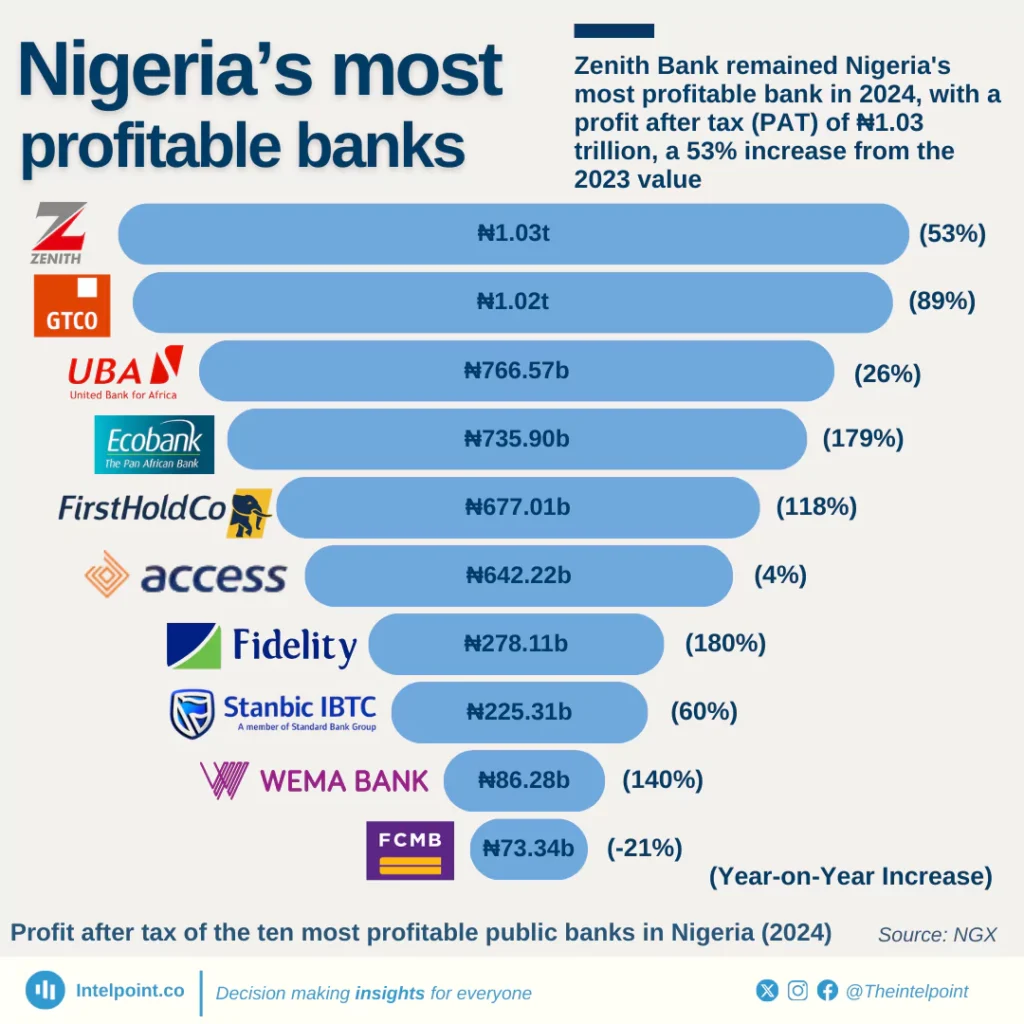
  • Nigeria dominates with ₦339.6b, contributing over 70% of GTCO’s total profit after tax in Africa.
  • Ghana (₦61.9b) and Côte d’Ivoire (₦28.2b) followed as the strongest non-Nigerian subsidiaries.
  • Tanzania (₦46m) and Uganda (₦505m) contributed negligible profits compared to peers.
  • GTCO subsidiaries across Africa collectively generated around ₦476b profit after tax in the first half of 2025.
Read more
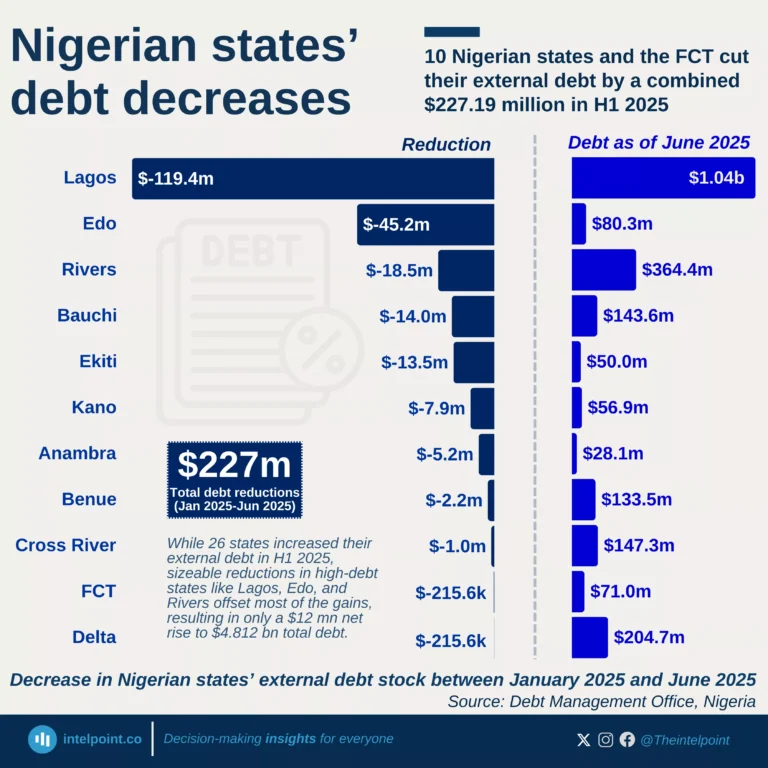
  • The seven North-Western states collectively owed about ₦223.4 billion in domestic debt as of Q2 2025, according to DMO data.
  • Kano State ranked highest with ₦56.9 billion, accounting for roughly 25% of the zone’s total debt.
  • Jigawa remains the least indebted in the region and in the entire country, with only ₦852 million.
  • Moderate debt spread: While Kano, Zamfara, and Sokoto carried the largest debt loads, the remaining states maintained relatively conservative borrowing patterns.
Read more
1 36 37 38 39 40 252

Can’t find what you’re looking for? Please fill the form below
Contact Form Demo
SIGN UP TO OUR NEWSLETTER
Get periodic updates about the African startup space, access to our reports, among others.
Subscribe Here
Subscription Form

A product of Techpoint Africa. All rights reserved