Bite-sized Insights about
 
Providing you with data-based insights about things happening around you.
Popular Insights
  • Nigeria's Federal Account Allocation Committee shared ₦1.85 trillion among 36 states between January and June 2023. Here is the revenue allocation by geopolitical zone in H1 2023.
    See more

    How much more debt did Nigerian states add to their existing domestic debt in 2023?

    Nigerian states' domestic debt increased by 9.8% in 2023, with 20 states and the FCT contributing to this increase. Lagos State recorded the biggest jump in domestic debt with ₦241.5b added.

    See more
  • The 2024 Global Peace Index reveals a decline in peacefulness in 97 countries, the highest since the index began.

    Nigeria is among the nations affected by regional conflicts and rising violence. With a peace index score of 2.91, Nigeria is facing increasing challenges.

    A deteriorating peace score impacts foreign investment and economic stability. Global economic losses due to violence reached $19.1 trillion in 2023.

    See more

    The FAAC's revenue distribution from 2017 to August 2023 highlights the dominance of Delta, Akwa Ibom, Rivers, and Bayelsa states in allocations. Despite Lagos' economic prominence, it ranked fifth. Here is the distribution of revenue among states between 2017 and August 2023.

    See more
  • A Trend of Adult literacy rates of African countries

    Between 2018 and 2021, adult literacy rates across African nations exhibited significant disparities. Seychelles and South Africa led with literacy rates of 96% and 95%, respectively, indicating a high proportion of literate adults. Conversely, Chad had the lowest literacy rate during this period.

    These statistics underscore the uneven progress in educational attainment across Africa, highlighting the need for targeted interventions to improve literacy in lower-performing nations.

    See more
    Countries by Global Innovation Index 2024

    The Global Innovation Index 2024 reveals a striking contrast in innovation performance between countries globally and across Africa. Switzerland leads the global rankings with an impressive score of 67.5, followed by Sweden (64.5) and the USA (62.4), highlighting their sustained investments in research, development, and technological advancement.

    In Africa, Mauritius takes the top spot with a score of 30.5, followed closely by Morocco (28.8) and South Africa (28.3). However, even Africa's most innovative nations achieve less than half the score of global leaders, indicating a significant innovation gap.

    Nigeria ranks 15th in the African ranking and 113th globally, out of 133 countries, with a score of 17.1.

    See more

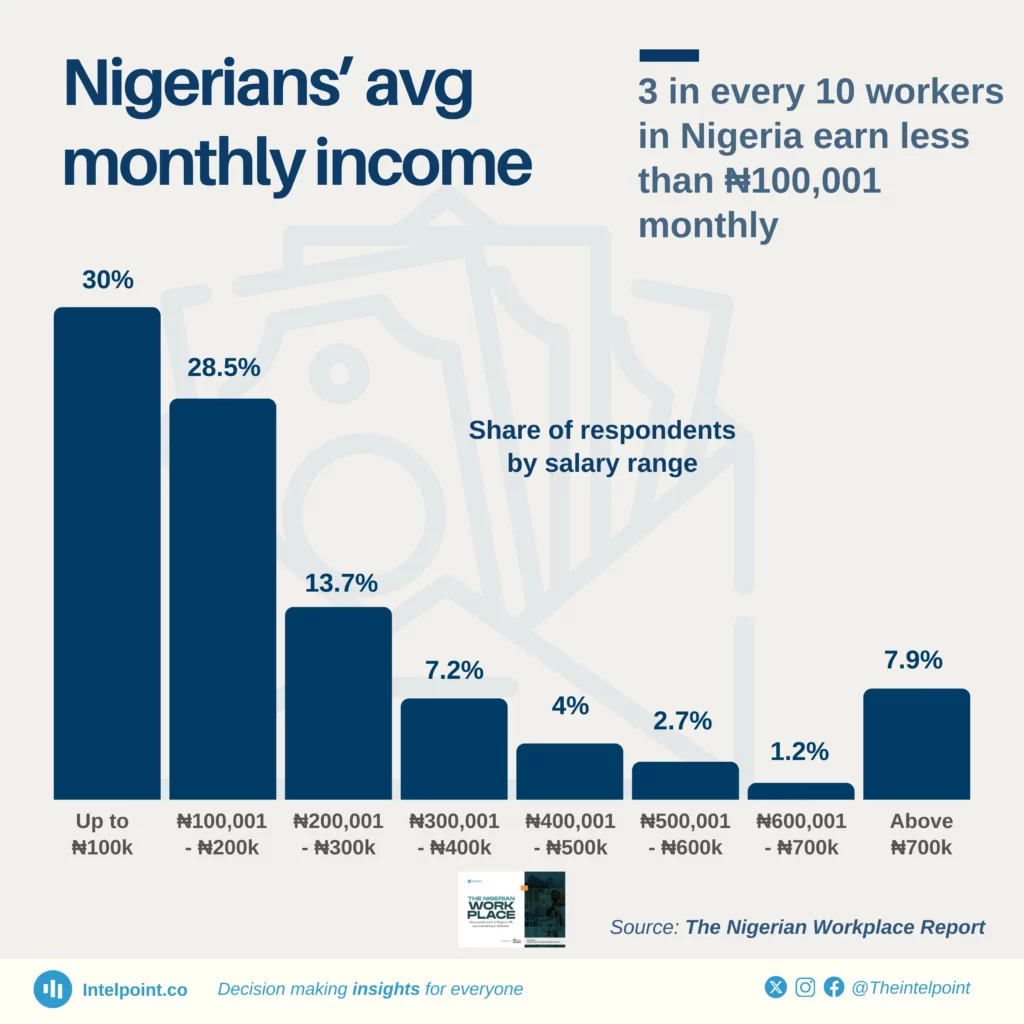
  • The Nigerian Workplace Report indicates that over 50% of Nigeria’s working population earns less than ₦200,001 monthly. It further highlights that individuals earning above ₦600k are among the top 10% earners.

    See more
  • MTN Nigeria has dominated the country's telecommunications market over the years, accounting for the largest market share. All four operators, apart from 9mobile, recorded a significant increase in their subscriber base between May 2014 and March 2024.

    See more
  • The 2024 Global Peace Index reveals a decline in peacefulness in 97 countries, the highest since the index began.

    Nigeria is among the nations affected by regional conflicts and rising violence. With a peace index score of 2.91, Nigeria is facing increasing challenges.

    A deteriorating peace score impacts foreign investment and economic stability. Global economic losses due to violence reached $19.1 trillion in 2023.
    See more

Other Insights
  • Lagos receives the highest average monthly grid supply at 1,051 MW, accounting for 26% of national distribution.
  • The South West (excluding Lagos) comes second with 569 MW.
  • Abuja alone receives 435 MW, higher than the North Central zone at 396 MW.
  • The North East receives the least electricity from the grid, with only 199 MW monthly on average.
  • The combined total for Lagos and the rest of the South West is 1,620 MW, roughly 40% of national grid supply.
See more
  • Between 2013 and 2025, Nigeria has dominated the Africa Magic Viewers’ Choice Awards (AMVCA), winning 8 out of 11 awards for Best Overall Movie.
  • Kenya, South Africa, and Ghana have each won the top prize once, highlighting Nigeria’s influence on African cinema.
  • This trend reflects both the scale and consistency of Nigeria’s film industry, Nollywood, which has outpaced its regional peers in terms of production volume, distribution, and local audience engagement.
  • While other countries show occasional excellence, Nigeria remains the cultural and commercial centre of African filmmaking.
See more
  • Union Bank began as Colonial Bank, later Barclays Bank DCO, before indigenisation in 1979.
  • Nigerian investors took majority control, renaming it Union Bank of Nigeria.
  • The 2009 banking crisis weakened the bank; AMCON stabilised it, while Union Global Partners Ltd injected $500m for 65% control.
  • Titan Trust Bank acquired up to 100% ownership, and Union Bank was delisted from the Nigerian Exchange.
  • A court-approved scheme merged Titan Trust into Union Bank; Union Bank survived, retaining its century-old name and legacy under Titan’s ownership.
See more
  • Fibre cuts were responsible for 51.7% of mobile network disruptions between April and July 2025.
  • Power outages followed at 28.1%, making infrastructure issues the dominant cause overall.
  • Together, fibre cuts and power outages accounted for nearly 80% of service disruptions.
  • The “Others” category, which includes congestion, equipment theft, and natural disasters, accounted for 13.9% of disruptions.
  • Infrastructure and environmental factors remain the leading threats to mobile network reliability.
See more
  • From 1970 through the early 2000s, Egypt’s debt interest payments hovered mostly under $1.5 billion, with fluctuations tied to global oil shocks and debt rescheduling.
  • Payments remained relatively moderate, ranging between $0.7–$1.0 billion annually.
  • Following Egypt’s 2016 IMF programme and rising external borrowing, payments jumped dramatically, climbing from $1.53 billion in 2016 to $6.13 billion in 2022.
  • Interest payments hit an all-time high of $9.47 billion in 2023, underscoring the heavy burden of Egypt’s rapid debt accumulation and exposure to global financing costs.
See more
  • Mauritius leads Africa’s Peace Index with the lowest (best) score of 1.586, showing its stability and strong governance.
  • Southern Africa is well represented in the rankings with Mauritius, Botswana, Namibia, Madagascar, and Zambia in the top 10.
  • West Africa also performs strongly, represented by The Gambia, Sierra Leone, Ghana, Senegal, and Liberia.
  • The scores are tightly clustered (1.586–1.939), showing that Africa’s most peaceful states are relatively close in performance despite regional differences.
See more
  • Nigeria maintained a positive trade balance, with exports accounting for 57.7% against imports at 42.3%.
  • Oil and gas remain the backbone of Nigeria’s export dominance, shaping the overall surplus.
  • The import share reflects the country’s reliance on foreign goods, particularly refined petroleum, machinery, and food products.
  • Sustaining export strength while reducing import dependency remains key to Nigeria’s long-term economic resilience.
See more
  • Ghana’s debt interest payments remained below $200 million for nearly three decades, reflecting relatively low external borrowing.
  • From 2000 to 2010, payments rose moderately, reaching $300 million by 2010 as Ghana’s borrowing needs expanded.
  • Interest payments accelerated sharply, surpassing $1 billion in 2017 and peaking at $1.49 billion in 2022.
  • After years of growth, payments plunged to $780 million in 2023, suggesting debt restructuring, payment relief, or reduced new borrowing.
See more
  • Financial services dominate Nigeria’s digitally delivered exports, contributing $1.15bn (over 74%).
  • Telecommunications ($184m) and insurance & pension services ($147m) follow, though far smaller.
  • Computer, information, and IP services registered almost no exports, highlighting untapped digital potential.
  • Nigeria’s digital exports remain highly concentrated in finance, leaving other sub-sectors underdeveloped.
See more
  • Africa’s renewable energy capacity more than doubled between 2015 (34.6 GW) and 2024 (70 GW).
  • Despite this growth, Africa’s global share fell from 1.87% in 2015 to 1.57% in 2024.
  • The decline in global share highlights that other regions are expanding renewable energy capacity much faster than Africa.
  • Between 2020 and 2024 alone, Africa added 18.5 GW of renewable energy capacity.
  • The sharpest annual increase occurred between 2022 and 2023, with capacity rising by 6.4 GW.
  • The percentage share of global renewable energy for Africa has consistently trended downward since 2018.
  • Africa’s renewable energy growth, while positive, is not yet keeping pace with the global energy transition.
See more
  • The cost of a 64-page Nigerian passport increased from ₦70,000 before September 2024 to ₦200,000 by September 2025.
  • A 32-page passport rose from ₦35,000 before September 2024 to ₦100,000 by September 2025.
  • The minimum wage only rose once within this period—from ₦30,000 to ₦70,000 in September 2024.
  • In 2025, the 64-page passport costs nearly three times the minimum wage.
  • Affording a passport now requires significantly higher financial sacrifice, particularly for low-income earners.
See more
1 27 28 29 30 31 126
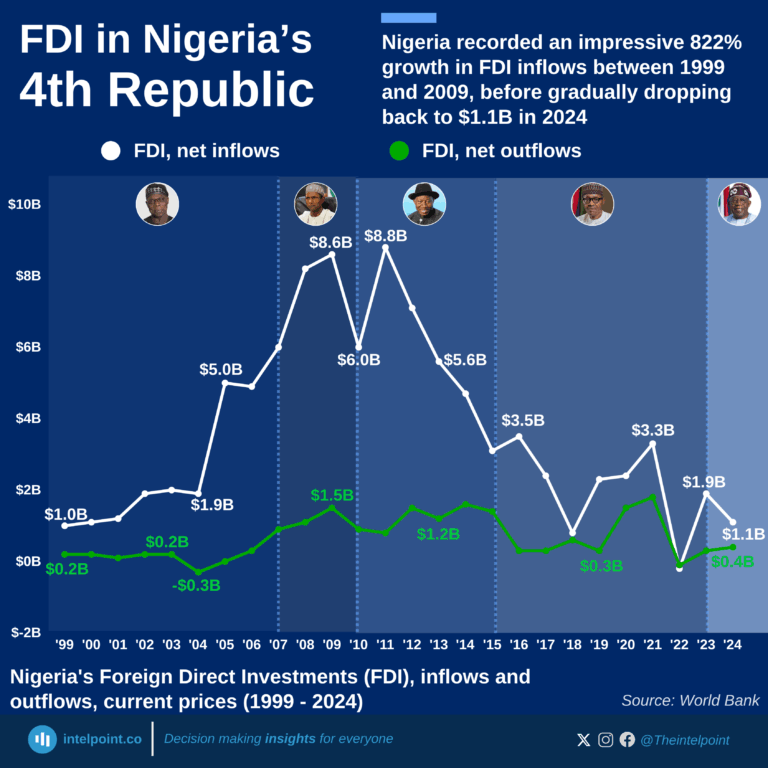
  • Nigeria’s FDI share plunged from 35% in 1990 to 1.1% in 2024.
  • Africa’s FDI surged over the same period, leaving Nigeria behind.
  • Q1 2025 inflow was only $126.3 million, showing persistent weakness.
  • Decline mirrors structural hurdles — unstable policies, forex issues, and weak infrastructure.
Read more
  • Nigeria recorded 971 protests and violent demonstrations in 2024.
  • Protest numbers have grown 50-fold since 2000, signalling a consistent rise in public mobilisation.
  • The most significant surge occurred between 2011 and 2015, under Goodluck Jonathan’s administration.
  • Muhammadu Buhari’s tenure saw the highest number of recorded protests — peaking at 1,008 in 2020.
  • Despite a change in leadership, protest activity remains elevated under Bola Tinubu.
Read more
  • Kenya recorded 2,008 protests in 2024, the highest in its modern history.
  • The number of protest events increased seven-fold between 2022 and 2024.
  • Social media has become a major mobilisation tool for civic expression.
  • Rising cost of living, taxation, and unemployment remain the top drivers of unrest.
Read more
  • Africa recorded 12,581 protests and violent demonstrations in 2024.
  • Morocco led the continent with 3,654 protests, far ahead of others.
  • Kenya ranked second with 2,008 protests.
  • South Africa (1,715) and Nigeria (971) followed, driven by economic and political frustrations.
  • North African countries, such as Morocco, Tunisia, and Libya, accounted for a significant share of protests.
  • The bottom 10 countries, including Lesotho, Gambia, and Seychelles, recorded fewer than 10 protests each.
  • Djibouti and Eritrea reported zero protests.
Read more
  • India recorded the highest number of protests and demonstration events globally in 2024 (22.1K).
  • The United States followed with 10.5K protest events.
  • Yemen (8.2K) ranked third, reflecting the instability and ongoing conflict-driven unrest.
  • Pakistan (7.3K) and France (6.9K) rounded out the top five, underscoring the diverse sources of civic agitation.
  • Morocco (3.7K) was Africa’s leading country for protest activity, placing 12th globally.
  • The global total of protest and violent demonstration events reached 153,573 in 2024.
Read more
1 27 28 29 30 31 252

Can’t find what you’re looking for? Please fill the form below
Contact Form Demo
SIGN UP TO OUR NEWSLETTER
Get periodic updates about the African startup space, access to our reports, among others.
Subscribe Here
Subscription Form

A product of Techpoint Africa. All rights reserved