Bite-sized Insights about
 
Providing you with data-based insights about things happening around you.
Popular Insights
  • Nigeria's VAT revenue has grown every year since 2013, reaching ₦3.6 trillion in 2023. The amount collected in 2023 exceeded 2022’s by ₦1.13 trillion — a 45% increase.

    See more

    Since 2011, over ₦32.8 trillion has gone to Nigeria’s state governors from the Federation Account Allocation Committee (FAAC). States from the South East have received ₦3.3 trillion combined, the least nationwide.


    This fund allocation is to ensure that all levels of government have the necessary funds to meet their financial obligations and to provide public services.

    See more
  • The 2024 Global Peace Index reveals a decline in peacefulness in 97 countries, the highest since the index began.

    Nigeria is among the nations affected by regional conflicts and rising violence. With a peace index score of 2.91, Nigeria is facing increasing challenges.

    A deteriorating peace score impacts foreign investment and economic stability. Global economic losses due to violence reached $19.1 trillion in 2023.

    See more

    The FAAC's revenue distribution from 2017 to August 2023 highlights the dominance of Delta, Akwa Ibom, Rivers, and Bayelsa states in allocations. Despite Lagos' economic prominence, it ranked fifth. Here is the distribution of revenue among states between 2017 and August 2023.

    See more
  • A Trend of Adult literacy rates of African countries

    Between 2018 and 2021, adult literacy rates across African nations exhibited significant disparities. Seychelles and South Africa led with literacy rates of 96% and 95%, respectively, indicating a high proportion of literate adults. Conversely, Chad had the lowest literacy rate during this period.

    These statistics underscore the uneven progress in educational attainment across Africa, highlighting the need for targeted interventions to improve literacy in lower-performing nations.
    See more
    Countries by Global Innovation Index 2024

    The Global Innovation Index 2024 reveals a striking contrast in innovation performance between countries globally and across Africa. Switzerland leads the global rankings with an impressive score of 67.5, followed by Sweden (64.5) and the USA (62.4), highlighting their sustained investments in research, development, and technological advancement.

    In Africa, Mauritius takes the top spot with a score of 30.5, followed closely by Morocco (28.8) and South Africa (28.3). However, even Africa's most innovative nations achieve less than half the score of global leaders, indicating a significant innovation gap.

    Nigeria ranks 15th in the African ranking and 113th globally, out of 133 countries, with a score of 17.1.

    See more

  • In addition to having one of the lowest populations on the continent, Mauritius boasts the greatest broadband penetration rate — 147.39% as of 2022 — of any country in Africa. The eastern African nation's broadband Internet subscribers surpassed its population in 2019.

    See more
  • MTN Nigeria has dominated the country's telecommunications market over the years, accounting for the largest market share. All four operators, apart from 9mobile, recorded a significant increase in their subscriber base between May 2014 and March 2024.

    See more
  • The 2024 Global Peace Index reveals a decline in peacefulness in 97 countries, the highest since the index began.

    Nigeria is among the nations affected by regional conflicts and rising violence. With a peace index score of 2.91, Nigeria is facing increasing challenges.

    A deteriorating peace score impacts foreign investment and economic stability. Global economic losses due to violence reached $19.1 trillion in 2023.
    See more

Other Insights
     
  • Nigeria paid $816.3 million to the International Monetary Fund, accounting for over 35% of total external debt service payments.
  • Eurobond payments followed closely, with $687.8 million paid, reflecting Nigeria’s heavy reliance on commercial debt instruments.
  • Multilateral lenders like IDA and AfDB collectively received about $463 million, signalling continued exposure to concessional financing.
  • China’s share shrinking: Payments to Chinese lenders (EXIM + CDB) totalled $235.6 million, less than 11% of total outflows, suggesting reduced Chinese debt servicing in H1 2025.
See more
     
  • FGN bonds dominated: ₦1.07 trillion went to Federal Government Bonds, accounting for about 63% of total domestic debt servicing.
  • Treasury bills followed: Payments on NTBs reached ₦537.9 billion, making up roughly 31% of the total.
  • Sukuk and promissory notes together cost ₦90.8 billion, reflecting Nigeria’s mix of infrastructure and settlement instruments.
  • Green and savings bonds remained minimal, together below ₦5 billion, showing limited traction for retail and sustainability-focused debt.
See more
  • China (773M) and India (607M) together make up for about 40% of the world’s total labour force.
  • Nigeria ranks 5th globally with 113 million workers, the largest in Africa and only African country in the top 10.
  • Asia dominates, accounting for over 47% of global workers, highlighting the region’s population and production strength.
  • The U.S.A. (174M) ranks third, representing just about 5% of global labour but producing almost a quarter of global GDP, proving productivity, not size, drives wealth.
See more
     
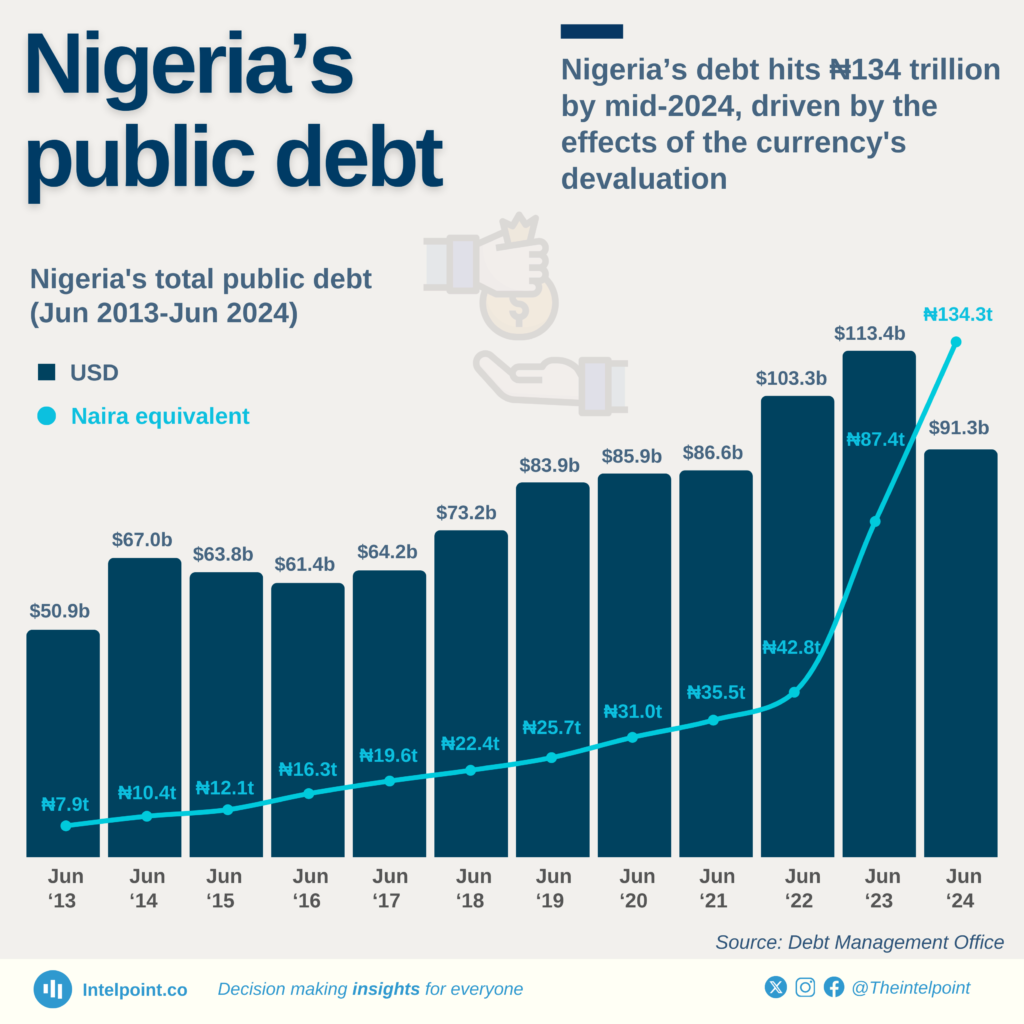
  • The Federal Government’s share of total public debt rose from 79.5% in 2019 to 92.6% in 2025.
  • States’ share has more than halved, from 20.5% to 7.4% in six years.
  • Total public debt grew from $83.9 billion to $99.7 billion, peaking at $113.4 billion in 2023.
  • Nigeria’s debt burden is increasingly concentrated at the centre, amplifying federal repayment risks and reducing fiscal independence for states.
See more
  • Wealth-building dominates motivation: 45.4% cite “active wealth building” as their primary motive, and an additional 21.8% cite “long-term financial security”.
  • Payments and utility are minor drivers: Only 3.3% report “daily utility” and 2.2% “digital commerce” as their chief motive for using crypto.
  • Hedging and cross-border flows matter: 8.7% use crypto for currency hedging, and 4.1% for cross-border payments, showing a dual role of investment plus international value flows.
  • Nigerian retail users treat crypto like a conventional financial instrument rather than only as a means of payment or speculation.
See more
  • Nearly two-thirds (67%) of all crypto transactions in Nigeria are below ₦50,000, reflecting widespread use among everyday retail users.
  • The ₦15,000–₦25,000 band (28.2%) is the single largest group, showing consistent, small-scale engagement rather than high-value speculation.
  • Around 25% of users transact between ₦50,000 and ₦250,000, suggesting a growing middle class of more confident, mid-level investors.
  • Less than 3% of users transact above ₦1 million, confirming that Nigeria’s crypto market remains primarily retail-driven, not institutional or high-net-worth.
See more
  • A majority (67.2%) of Nigerian crypto users (17.7 million people) use digital assets mainly for investment and long-term financial growth.
  • Overall, 26.34 million Nigerians—over one in eight adults—actively use or hold cryptocurrency, giving the country the highest adoption rate globally.
  • About 18.4% (4.8 million) use crypto for everyday needs such as remittances, payments, and inflation protection.
  • 14.4% (3.8 million) identify as active traders, providing liquidity and earning income through market participation.
See more
     
  • Total public debt hits ₦152.4 trillion, marking another milestone in Nigeria’s expanding debt profile.
  • Domestic debt leads at ₦80.5 trillion, making up about 53% of total obligations.
  • External debt stands at ₦71.8 trillion, equivalent to roughly 47%, reflecting Nigeria’s ongoing exposure to foreign lenders.
  • The data signals growing fiscal dependence on local markets, as authorities seek to limit exchange rate risks while still financing deficits.
See more
  • Power supply remains the biggest challenge affecting Nigerian businesses, affecting 82.5% of firms nationwide.
  • Poor transport infrastructure limits operations for over a quarter of businesses.
  • Internet disruptions affect more than one in five firms, highlighting connectivity gaps.
  • Climate and water issues are emerging risks, with some firms reporting weather damage and supply shortages.
  • The survey covered 1,043 firms across Nigeria and reflects responses from business owners and top managers.
See more
 
  • The IMF’s new 2019 GDP base year added between $20 billion and $235 billion annually to Nigeria’s GDP from 1990–2025.
  • 2014 saw the biggest jump — an upward revision of $235.1 billion, raising GDP to $811.1 billion from $576.0 billion under the old base.
  • The rebased data consistently show 40–45% higher GDP values through the 2000s and 2010s, revealing a larger economy than earlier estimates.
  • The impact was strongest during Nigeria’s oil boom years (2007–2014), when rebasing captured fast-growing sectors like digital services, informal trade, and modular refining.
See more
  • Sudan ranks highest in Africa with 18 coup attempts, the most in the continent since 1950.
  • Burkina Faso, Burundi, and Sierra Leone follow closely with 11 attempts each.
  • Ghana and Guinea-Bissau have each experienced 10 coup attempts, ranking among the top six.
  • West Africa remains the most coup-prone subregion, accounting for 9 of the top 15 coups in the region.
  • Africa has witnessed 226 coup attempts between 1950 and 2025.
  • Most coup-prone countries share traits like weak institutions, governance failures, and economic hardship.
See more
 
  • Nigeria’s GDP has been rebased to a 2019 base year, raising its nominal value by about 40.8%, according to the IMF’s October 2025 update.
  • The revision includes new data on digital, informal, and service sectors, giving a fuller picture of the economy.
  • Nigeria ranked among the world’s top 20 economies in 1998, 2013, 2014, and 2015, peaking in 2014 at $811 billion.
  • Despite later declines from currency depreciation and slower growth, the revision reaffirms Nigeria’s position as Africa’s largest economy.
See more
1 16 17 18 19 20 126
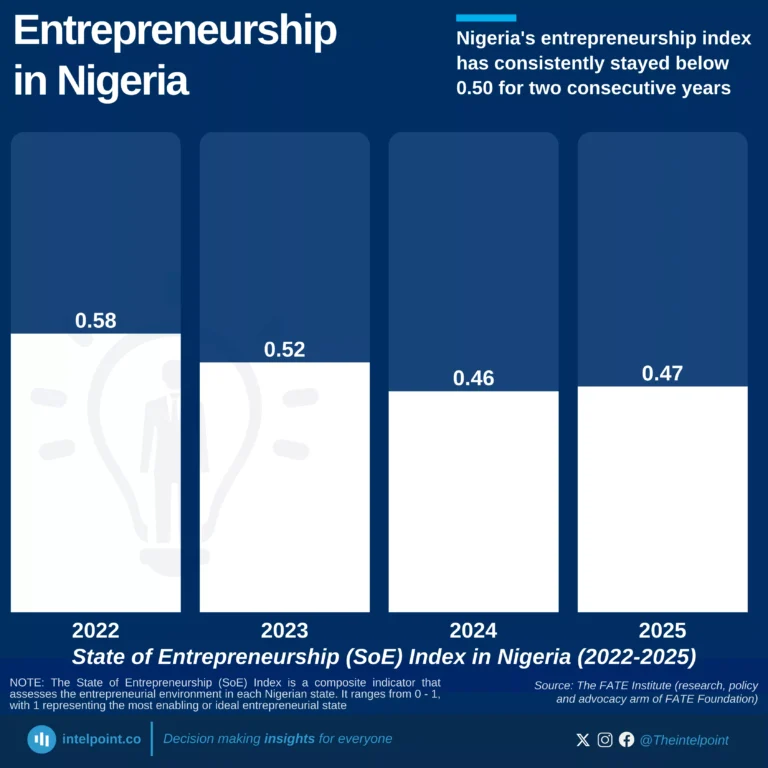
  • Nigeria’s entrepreneurship index increased in 2025 for the first time since 2022.
  • The 2025 score (0.47) represents a reversal of a two-year downward trend.
  • The ecosystem remains weaker than in 2022, when the index peaked at 0.58.
  • The sharpest decline occurred between 2022 and 2023.
  • The improvement from 2024 to 2025 is incremental, not transformative.
  • The index suggests stabilisation rather than full recovery in the entrepreneurial environment.
Read more
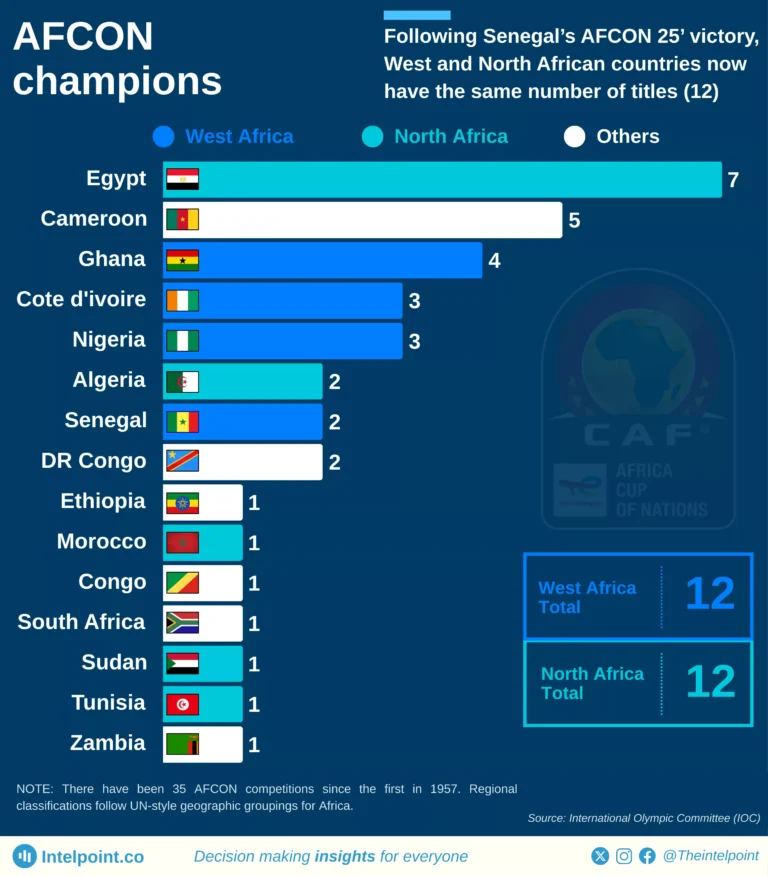
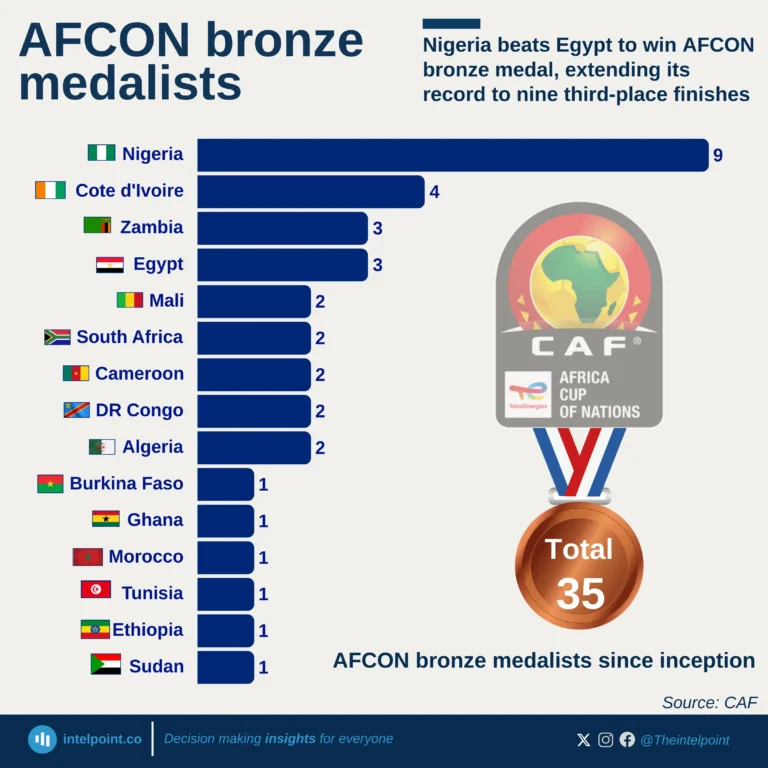
  • Nigeria extends its AFCON bronze medal wins to nine, the highest in men’s AFCON history, with another podium finish.
  • The win over Egypt highlights Nigeria’s resilience, turning late-stage setbacks into tangible success.
  • Bronze medals remain rare for most nations, with the majority appearing only once or twice in AFCON history.
Read more
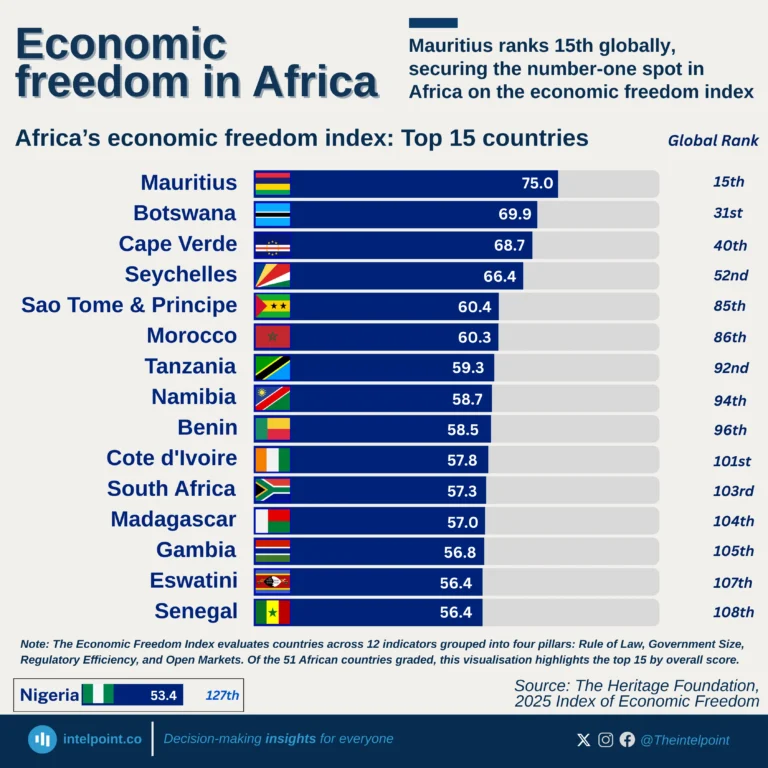
  • Mauritius is the continent’s strongest performer by a wide margin, leading with a score of 75, and ranking 15th globally.
  • Botswana and Cape Verde are the only other African countries with a score close to 70, placing them within the global top 40.
  • Most of Africa’s top 15 countries score between 56 and 60, indicating moderate levels of economic freedom.
  • Even Africa’s highest performers trail global leaders, showing persistent gaps in rule of law, regulatory efficiency, and open-market conditions.
Read more
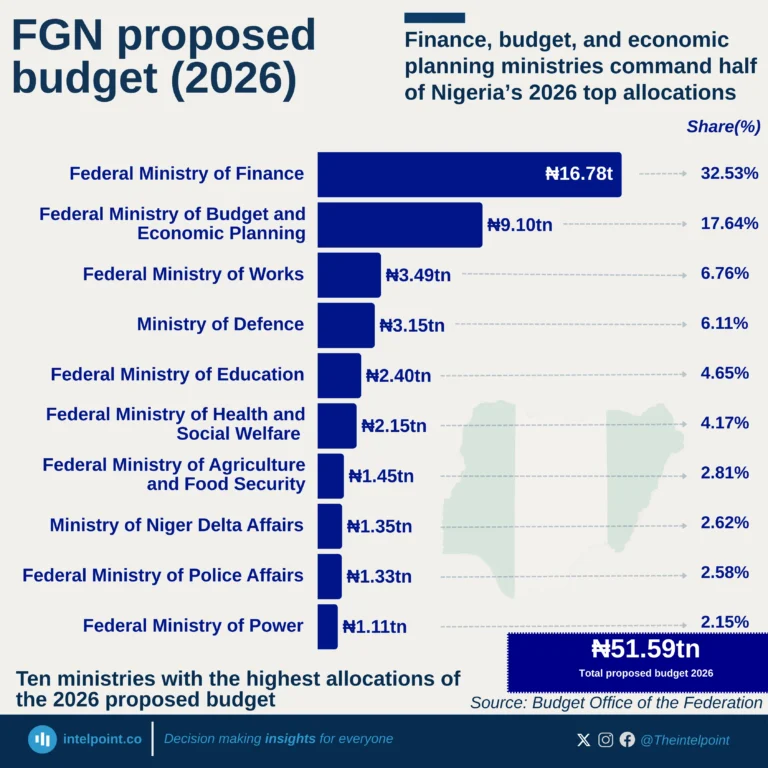
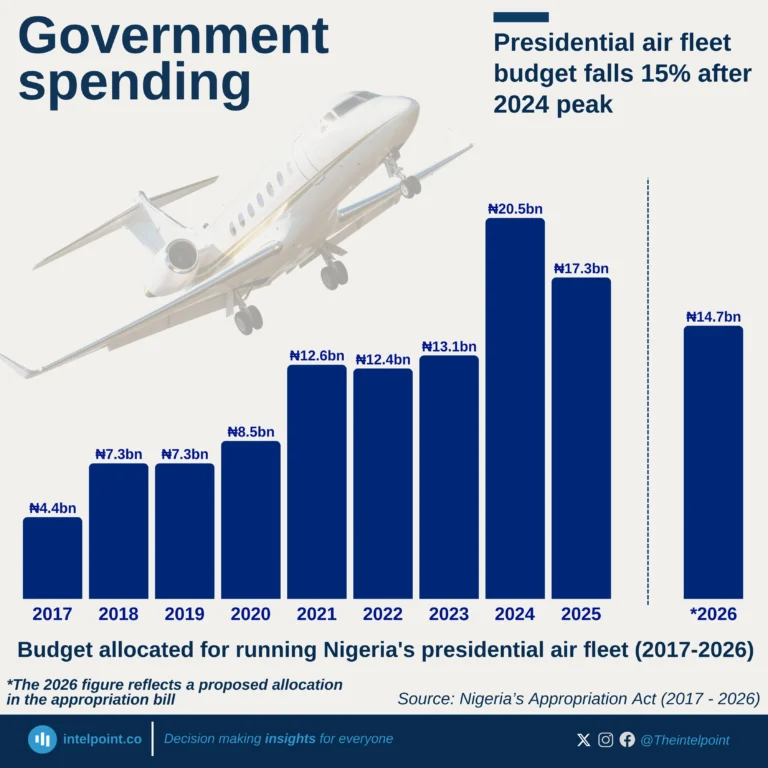
  • Allocation declined by ₦290 m from ₦6.16bn in 2025 to a proposed ₦5.87bn in 2026.
  • The change represents a 4.7% year-on-year reduction in funding.
  • Despite the decline, allocations remain broadly flat, with no major expansion in 2026.
  • The 2026 figure is still a proposal, and actual funding figures may change after legislative review.
Read more
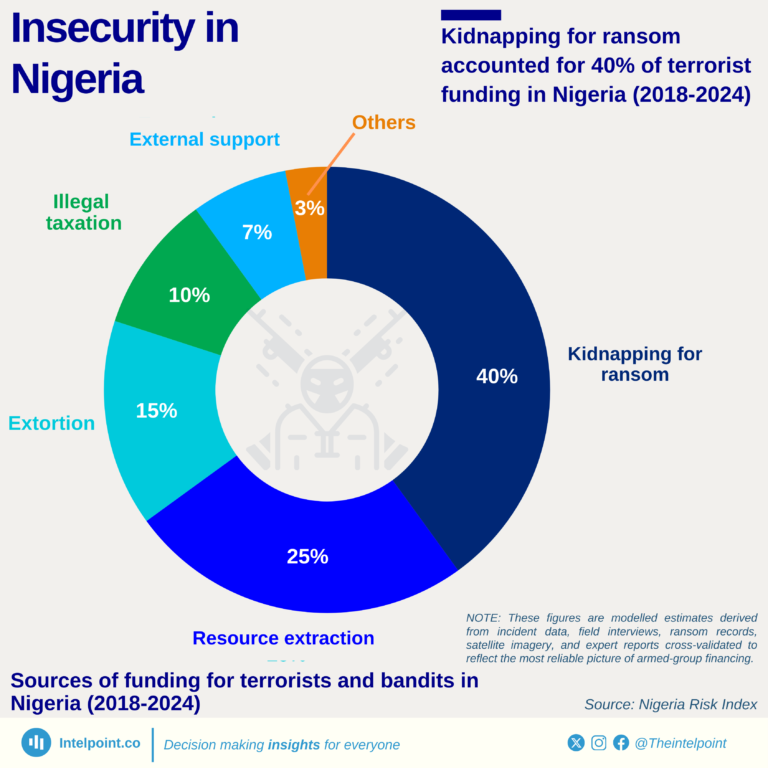
  • Firearms were used in about 70%% of all attacks, making them the single most important driver of violent insecurity in Nigeria.
  • 14,782 attacks were recorded between 2018 and 2024, underscoring the scale of sustained armed violence.
  • Explosives accounted for 15% of incidents, showing continued but secondary use of IEDs and bombings.
  • Melee weapons made up 12%, reflecting close-range violence but far lower impact than gun attacks.
Read more
  • Kogi entrepreneurs have the highest tax policy awareness in Nigeria (96.8%) in 2025.
  • Abia has the lowest awareness nationwide at just 1.4%.
  • Fewer than one-third of Nigerian states have awareness levels above 60%.
  • Major economic hubs like Lagos and Rivers have awareness below 50%.
  • Northern states dominate the top awareness rankings more than southern states.
  • Several states cluster around the 40–50% range, indicating partial reach.
  • States with low awareness risk lower compliance and higher friction during enforcement.
  • The gap between the highest and lowest states exceeds 95 percentage points, showing extreme disparity.
Read more
1 16 17 18 19 20 252

Can’t find what you’re looking for? Please fill the form below
Contact Form Demo
SIGN UP TO OUR NEWSLETTER
Get periodic updates about the African startup space, access to our reports, among others.
Subscribe Here
Subscription Form

A product of Techpoint Africa. All rights reserved