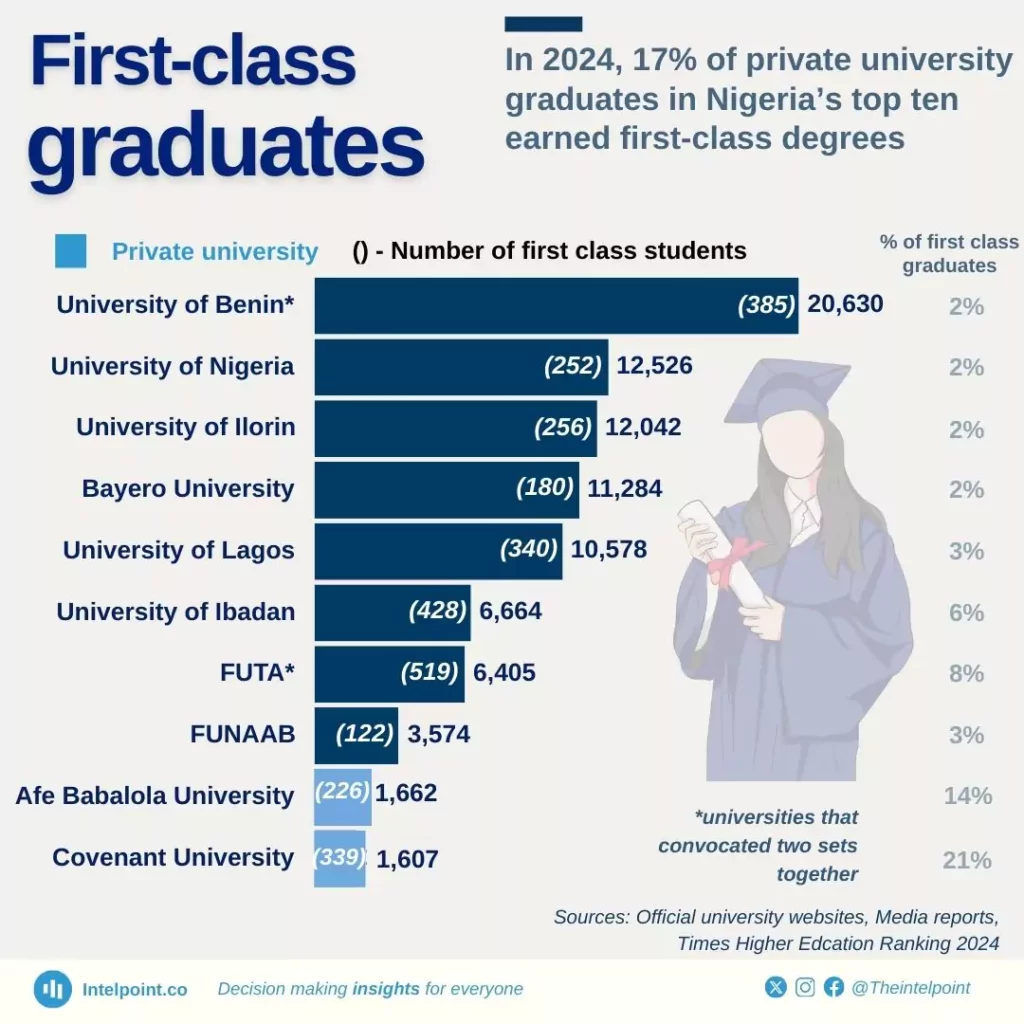
In 2024, the top ten universities in Nigeria graduated 3,047 first-class students. Seventeen per cent of private university students in Nigeria earned first-class degrees, compared to 3% in federal/state universities.
The University of Benin convocated the most first-class students (385), while the Federal University of Agriculture, Abeokuta (FUNAAB) had the least, with 122.
Covenant University had the highest proportion, with one in five students graduating with a first class.

The 2024 Global Peace Index reveals a decline in peacefulness in 97 countries, the highest since the index began.
Nigeria is among the nations affected by regional conflicts and rising violence. With a peace index score of 2.91, Nigeria is facing increasing challenges.
A deteriorating peace score impacts foreign investment and economic stability. Global economic losses due to violence reached $19.1 trillion in 2023.

Between 2018 and 2021, adult literacy rates across African nations exhibited significant disparities. Seychelles and South Africa led with literacy rates of 96% and 95%, respectively, indicating a high proportion of literate adults. Conversely, Chad had the lowest literacy rate during this period.
These statistics underscore the uneven progress in educational attainment across Africa, highlighting the need for targeted interventions to improve literacy in lower-performing nations.

Nigeria was the seventh most populous nation in the world in 2020, with 206.1 million people. Projected to reach a population of 401.3 million by 2050, Nigeria will rank third after India (1st) and China (2nd). According to Institut national d'études démographiques' projections, Nigeria, Ethiopia, DR Congo, Egypt, Tanzania, and Kenya will be among the world’s top 20 most populous countries by 2050.
The 2024 Global Peace Index reveals a decline in peacefulness in 97 countries, the highest since the index began.
Nigeria is among the nations affected by regional conflicts and rising violence. With a peace index score of 2.91, Nigeria is facing increasing challenges.
A deteriorating peace score impacts foreign investment and economic stability. Global economic losses due to violence reached $19.1 trillion in 2023.
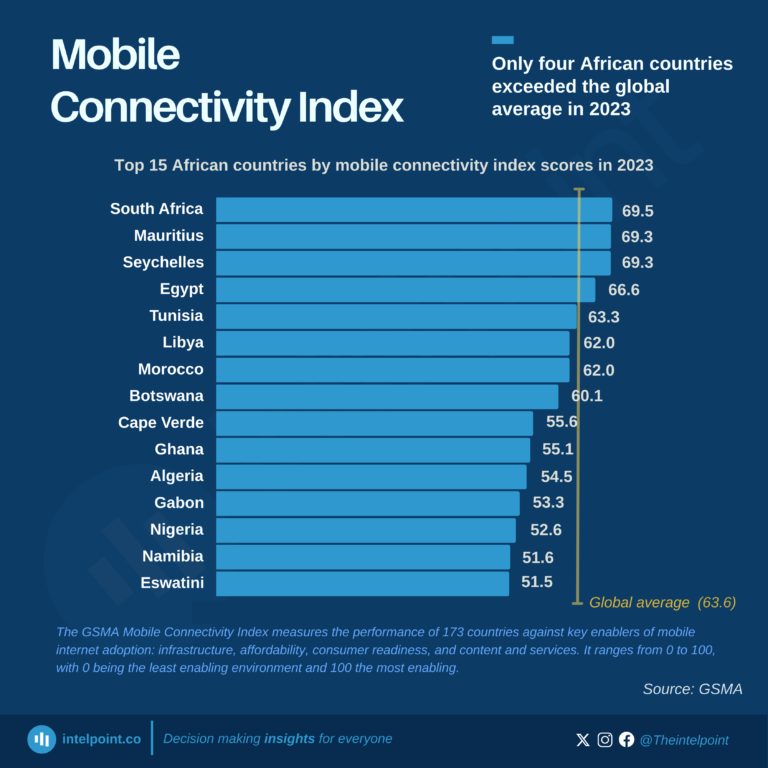
A country with strong infrastructure, affordable services, and high digital literacy, enabling everyone to use fast and reliable mobile internet will have a perfect score (100) on the GSMA's Mobile Connectivity Index 2023. South Africa leads in Africa with 69.53.
Globally, Singapore is first, with a score of 93.7, setting the benchmark for mobile internet adoption. Only four African countries — South Africa, Mauritius, Seychelles, and Egypt — surpassed the global average score.

Nigeria's foreign portfolio investment surged by 570% in Q1 2024, hitting $2.1 billion and making up 61% of total capital imports. This boost ends a 15-quarter slump, surpassing Q4 2019‘s levels.
Overall capital imports for Q1 2024 reached $3.4 billion, with $119.2 million from foreign direct investments and $1.2 billion from other investments.

Argentina, Egypt, and Ukraine were the IMF’s top three debtors as of June 26, 2024, accounting for $51 billion (46%) of the total debt. Egypt, Angola, and Kenya occupy the top three spots in Africa on the IMF’s debtors’ list.
As of December 2023, Kenya's public debt stood at Ksh11.14 trillion (approximately $76.8 billion). By June 2024, its debt to the IMF had increased by 245% from $744 million in August 2020.
This increase has coincided with protests in Kenya, where citizens opposed a proposed finance bill aiming to raise additional taxes to reduce the budget deficit and state borrowing.

Surfshark's data reveals that 17.2b online accounts have been compromised globally since 2004, with African countries accounting for 250.7m (1.45%).
South Sudan has the highest number of breached online accounts in Africa, with over 89 million compromised accounts.
South Africa and Egypt follow with 0.2% and 0.13% of the global figure, respectively. Nigeria ranks fourth with 19.3 million breaches.
Although Africa's share of global breaches is relatively low, the potential harm is significant. Recently, unauthorised websites reportedly sold Nigerians' data, including NIN, BVN, and driver's licenses, for as little as ₦100.
These breaches pose serious privacy, financial security, and national safety risks, calling our attention to the urgent need for robust data protection measures.

With over ten million registered Retirement Savings Accounts as of Dec 2023, Nigerian workers' pension contributions have grown steadily, despite fluctuations in recent years, to reach ₦1.32t in 2023.
In 2023 alone, 13.3% of the total savings since inception was contributed.
Total contributions since 2004 reached ₦9.9 trillion by 2023, with 52% coming from the public sector. The public sector grows at an average annual rate of 15.8%, while the private sector averages 16.2% yearly growth.

In 2023, the UK issued nearly 350k skilled health and care visas, representing 57% of the total work visas (616k) issued, with Indian and Nigerian nationals receiving a combined 50% of the visas issued. Nigeria received 82.8k, approximately 13% of the total work visas issued.

The number of study and work visa applications from Nigeria to the UK has significantly increased, particularly following the COVID-19 pandemic. Although study visa applications dropped by 24% in 2023, they peaked at 124.8k in 2022.
Work visa applications reached a high of 92.7k in 2023, increasing three consecutive years from 2021.
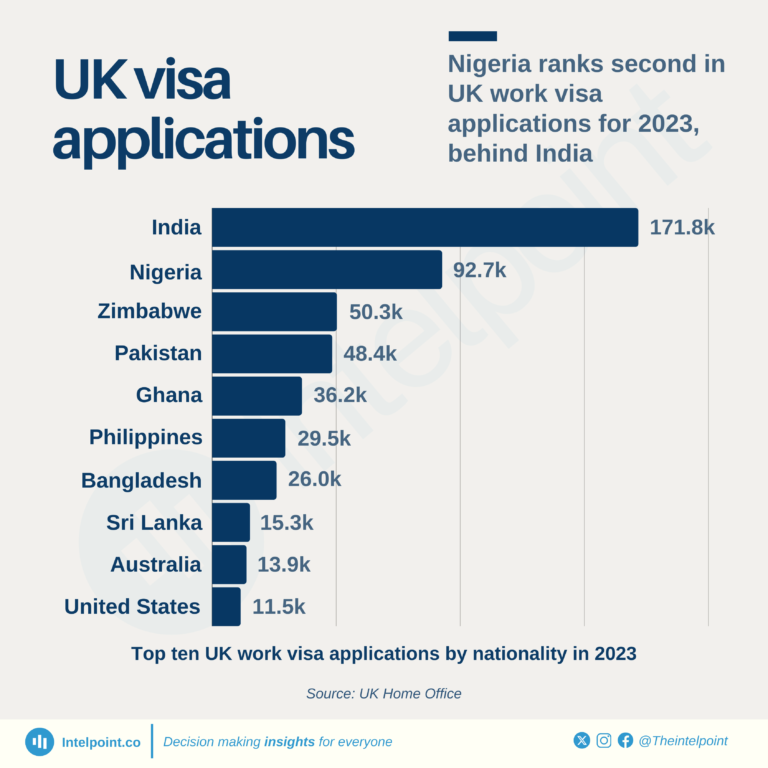
In 2023, Nigeria emerged as the second-largest source of UK work visa applications, with 92.7k applications, trailing only India (171.8k). This places Nigeria ahead of other countries like the Philippines (29.5k), Ghana (36.2k), Pakistan (48.4k), and Zimbabwe (50.3k).
Nigeria, Zimbabwe, and Ghana were the top African countries seeking work in the UK in 2023.
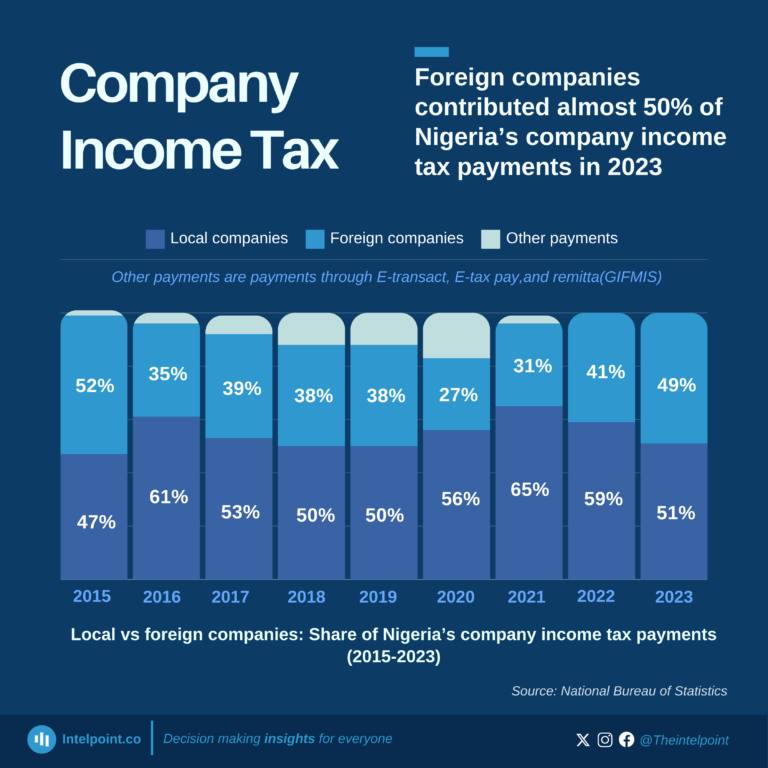
Over the years, local companies have contributed more than foreign companies to Nigeria’s total company income tax revenue. In 2023, local CIT payments accounted for 51% of the total, with foreign payments at 49%.
Local CIT payments saw the highest share in 2021 (65%), while foreign CIT's highest was in 2015 at 52%.
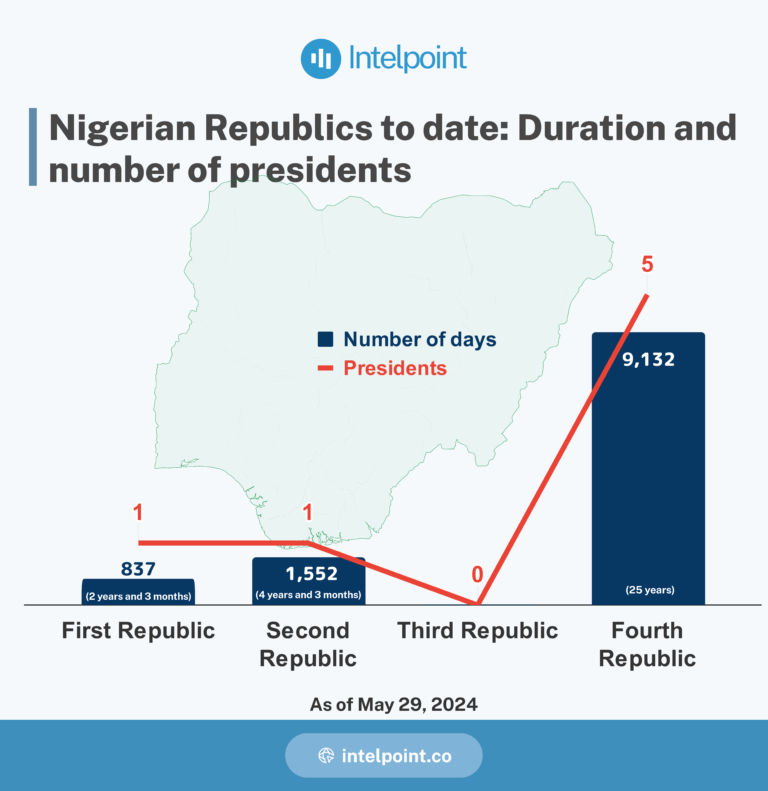
In almost 61 years since Nigeria's First Republic, there have been 16 Presidents and Heads of State either by seizure, democratic election, or handing over by an interim government.
The unsuccessful attempt to restore Nigeria to democracy between 1992 and 1993 gave rise to the aborted Third Republic.