Bite-sized Insights about
 
Providing you with data-based insights about things happening around you.
Popular Insights
  • In 2024, the top ten universities in Nigeria graduated 3,047 first-class students. Seventeen per cent of private university students in Nigeria earned first-class degrees, compared to 3% in federal/state universities.

    The University of Benin convocated the most first-class students (385), while the Federal University of Agriculture, Abeokuta (FUNAAB) had the least, with 122.

    Covenant University had the highest proportion, with one in five students graduating with a first class.

    See more

    In 2022, Africa accounted for only 3.9% (1.4b tonnes) of the world's CO2 emissions from fossil fuels, with Asia being the primary contributor at 19.1b tonnes. This chart shows the variations in regional contributions to global Carbon (CO2) emissions over the past ten years.

    See more
  • The 2024 Global Peace Index reveals a decline in peacefulness in 97 countries, the highest since the index began.

    Nigeria is among the nations affected by regional conflicts and rising violence. With a peace index score of 2.91, Nigeria is facing increasing challenges.

    A deteriorating peace score impacts foreign investment and economic stability. Global economic losses due to violence reached $19.1 trillion in 2023.

    See more

    The FAAC's revenue distribution from 2017 to August 2023 highlights the dominance of Delta, Akwa Ibom, Rivers, and Bayelsa states in allocations. Despite Lagos' economic prominence, it ranked fifth. Here is the distribution of revenue among states between 2017 and August 2023.

    See more
  • A Trend of Adult literacy rates of African countries

    Between 2018 and 2021, adult literacy rates across African nations exhibited significant disparities. Seychelles and South Africa led with literacy rates of 96% and 95%, respectively, indicating a high proportion of literate adults. Conversely, Chad had the lowest literacy rate during this period.

    These statistics underscore the uneven progress in educational attainment across Africa, highlighting the need for targeted interventions to improve literacy in lower-performing nations.

    See more

    Nigeria was the seventh most populous nation in the world in 2020, with 206.1 million people. Projected to reach a population of 401.3 million by 2050, Nigeria will rank third after India (1st) and China (2nd). According to Institut national d'études démographiques' projections, Nigeria, Ethiopia, DR Congo, Egypt, Tanzania, and Kenya will be among the world’s top 20 most populous countries by 2050.
    See more

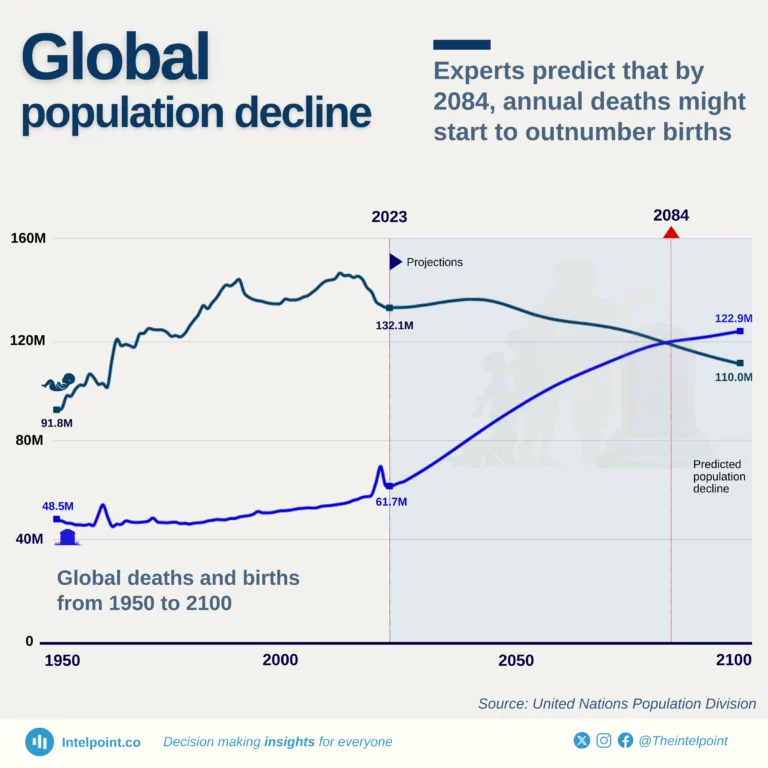
  • In 2023, an estimated 132.1 million newborns were welcomed worldwide, averaging 361.9 thousand births per day.

    India, China, and Nigeria accounted for nearly 30% of daily births; India had the highest contribution with 63,600.

    See more
  • MTN Nigeria has dominated the country's telecommunications market over the years, accounting for the largest market share. All four operators, apart from 9mobile, recorded a significant increase in their subscriber base between May 2014 and March 2024.

    See more
  • The 2024 Global Peace Index reveals a decline in peacefulness in 97 countries, the highest since the index began.

    Nigeria is among the nations affected by regional conflicts and rising violence. With a peace index score of 2.91, Nigeria is facing increasing challenges.

    A deteriorating peace score impacts foreign investment and economic stability. Global economic losses due to violence reached $19.1 trillion in 2023.

    See more

Other Insights

Unity Bank's gross earnings nearly doubled between 2011 and 2017 before sharply declining in 2018. The bank never hit its 2017 gross earnings record of ₦57.1b after 2018.

See more
Since 2011, Unity Bank Plc has seen more losses than profits over a 12-year period. Despite a consistent growth in gross earnings from 2011 to 2017, profits were overshadowed by losses, exceeding profits by over ₦9 billion.
See more
top-15-african-countries-by-number-of-medical-doctors-per-10000-people-as-of-2022

As of 2022, only seven African countries met the WHO's recommended doctor-to-population ratio of 10 doctors per 10,000 people.

Cape Verde, Seychelles, Libya, Eswatini, Tunisia, Mauritius, and Algeria are leading the way in healthcare accessibility in Africa. However, the continent still averages only 2.6 doctors per 10,000 people.

See more

As of 2023, the global labour force has expanded to an estimated 3.63 billion, driven by population booms in key regions.

China and India lead with a combined 1.37 billion people 15+ active in the workforce.

Nigeria ranks 7th with 76 million, following the US, Indonesia, Brazil, and Pakistan.

See more

In 2023, South Africa led Africa's exports with a value of $110.7 billion, nearly double Nigeria's $60.7 billion. Key exports include gems, vehicles, and mineral fuels.

The top 15 African exporters contribute 84% to the continent's trade, with South Africa, Nigeria, Algeria, Morocco, and Egypt leading with a combined 52%.

See more

The cumulative number of asylum applications to the UK has exceeded one million, with Iran, Afghanistan, Iraq, Pakistan, and Albania being major contributors.

African countries such as Eritrea, Somalia, Zimbabwe, the DR Congo, and Nigeria have also been in the top ten.

These are the top ten nationalities in the past 23 years.

See more
     

The average price of cooking gas in Nigeria has increased significantly, from ₦370 per kg in early 2016 to ₦1,390 per kg in June 2024.

After prices peaked at nearly ₦1,500 in May 2024, they fell by 6.1% in June.

The contributing factors to the increase include global energy fluctuations, naira depreciation, supply chain disruptions, and changes in domestic policies.

Here are the average prices of cooking gas in Nigeria since 2016.

See more

Prices of food items like tomatoes, yams, Irish potatoes, and brown beans have witnessed more than a 250% increase over the past 12 months in Nigeria. The country's headline inflation rate went from 24.08% in July 2023 to 34.19% in June 2024.

See more

WhatsApp Business generated an estimated $39.5 million from Africa in 2023, representing 10.3% of its global revenue.

Estimates from Statista show that Asia was the leading contributor to WhatsApp Business' revenue, with $155.2 million.

Here is a breakdown of WhatsApp Business' revenue by region in 2023.

See more
     

As of December 2023, 28.6 million internally displaced people affected by conflict were under the age of 18, accounting for 38% of the global IDP population.

Conflict-ravaged Sudan has the most internally displaced children globally, with 4.25 million under the age of 18.

DR Congo and Syria follow with 3.57 million and 2.65 million displaced children, respectively. Nigeria's 1.65 million displaced children make it the 7th highest globally for child displacement due to conflict.

See more

Nigeria's first Olympics appearance was at Helsinki 1952 but it wasn't until its fourth appearance at Tokyo 1964 that it won its first medal — a bronze. The country’s best medals haul (6) was at Atlanta 1996, where it won 2 gold, 1 silver, and 3 bronze.

See more
Between 2005 and 2022, Cote d'Ivoire's natural rubber production grew at an average of 12% yearly, maintaining its continental dominance. With an estimated population of nearly 29 million, the West African country produced 1.286 million tonnes in 2022, 73% of the continent's output, and placed fourth globally.
 
Meanwhile, Nigeria's production has grown 158% since 1961, peaking at 155 thousand tonnes in 1991.
Ghana's production has grown steadily, peaking at 117 thousand tonnes in 2022. Liberia and Cameroon complete the top five in Africa as of 2022.
See more
1 102 103 104 105 106 129
  • Microsoft’s revenue has grown steadily from $26.8B in Q1 2018 to $70.1B in Q1 2025, marking a 161% increase over the seven-year period.
  • Its net income more than tripled from $7.4B in Q1 2018 to $25.8B in Q1 2025, with consistent year-on-year growth, especially sharp increases between 2020 and 2023.
  • The company crossed the $50B quarterly revenue mark for the first time in Q4 2021, and hasn’t dropped below that threshold since Q1 2022.
  • From Q1 2023 to Q1 2025 alone, Microsoft’s net income surged by over $7.5B, signalling an era of record profitability, with each quarter surpassing $20B in profit since Q2 2023.
Read more
Share of global active Messenger users by continent (Jan. 2025)
  • Asia leads the world in Messenger usage with 471.8M users, representing 49.9% of the global total.
  • Asia has 2.2 times more users than the Americas, which is the next largest region.
  • The Americas account for 210.7M users, or 22.3% of the global audience.
  • Europe contributes 154.3M users, making up 16.3% of all Messenger users worldwide.
  • Africa stands at 104.6M users, showing growth potential and already accounting for 11.1% of global usage.
  • Oceania has the smallest user base at just 4.8M users, contributing 0.5%.
Read more
Number of Nigerians who use each (selected) social media platform (Jan. 2025)
  • Facebook has the highest number of users in Nigeria at 38.7 million, reaching 16.4% of the population.
  • TikTok follows closely with 37.4 million users, accounting for 15.8% of Nigerians.
  • YouTube attracts 27 million users, showing its continued relevance for content consumption.
  • Snapchat boasts 19.6 million users, with 8.3% penetration across the country.
  • LinkedIn is used by 11 million Nigerians, reflecting rising interest in professional networking.
  • Instagram has 9.9 million users, slightly below LinkedIn in total reach.
  • X (formerly Twitter) has 7.57 million users, capturing 3.2% of the population.
  • Messenger is the least used among the listed platforms, with 5.65 million users in Nigeria.
Read more
  • University students filed 497,000 loan applications, accounting for a staggering 90.1% of all institutional submissions.
  • College of education students submitted just 34,000 applications, making up only 6.2% of the total pool.
  • Polytechnics trailed with 21,000 applications, contributing 3.7% to the national tally.
  • Out of every 10 students applying for a loan, 9 are university students, underscoring their dominance in demand.
Read more
  • The United States holds the largest IMF quota by far, with 82,994.2 billion SDRs, accounting for 17.42%, more than double the quota of any other country.
  • Japan, China, and Germany follow as the next largest contributors, each holding between 5.5% and 6.5% of total quota shares.
  • European countries (Germany, France, the U.K., Italy) collectively maintain a strong presence, together accounting for nearly 17.21%, almost equal to the U.S. alone.
  • Emerging economies like India and Russia have relatively modest shares (2.75% and 2.71%, respectively) despite their growing roles in global economic affairs, indicating an imbalance between global influence and IMF voting power.
Read more
  • The number of female central bank governors rose from 21 in 2014 to 29 in 2024, a 38% increase over the decade.
  • The lowest point was in 2018, with just 14 female governors, marking a 33% drop from the 2014 figure.
  • A rebound began after 2018, with consistent annual growth from 2020 onwards, peaking in 2024.
  • The number remained under 20 for six consecutive years (2015–2021) before breaking past that mark again in 2022.
Read more
1 102 103 104 105 106 257

Can’t find what you’re looking for? Please fill the form below
Contact Form Demo
SIGN UP TO OUR NEWSLETTER
Get periodic updates about the African startup space, access to our reports, among others.
Subscribe Here
Subscription Form

A product of Techpoint Africa. All rights reserved