Bite-sized Insights about
 
Providing you with data-based insights about things happening around you.
Popular Insights
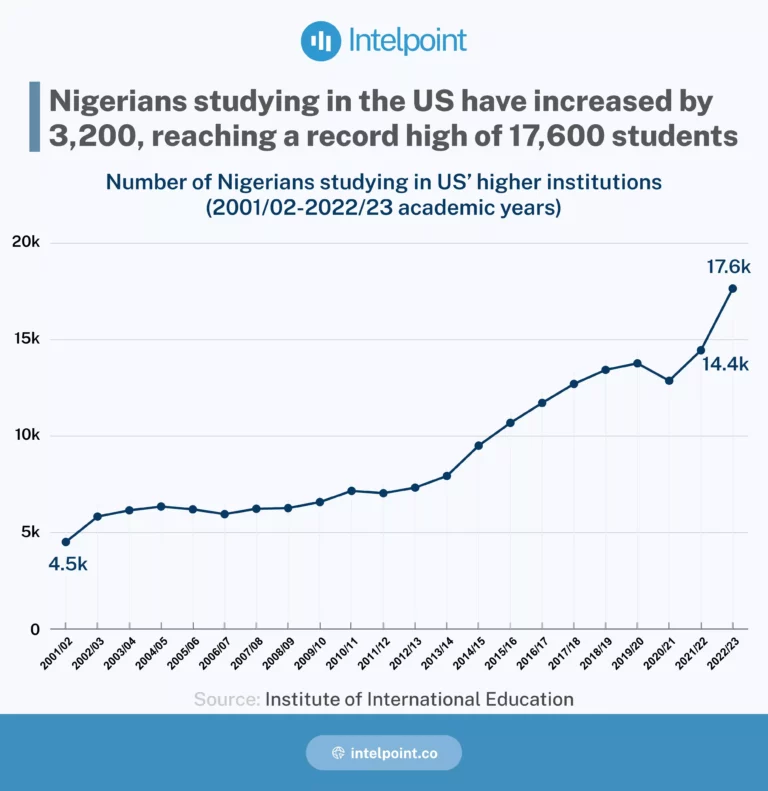
  • Compared to 2022, there was a remarkable surge of 133.7% in the issuance of Canadian study permits to Nigerians in 2023. After experiencing a decline in 2020 (-22%), the number of Nigerian study permit recipients rebounded strongly.

    Globally, the issuance of Canadian study permits witnessed an increase of 24.6%, climbing from 548,610 in 2022 to 683,585 in 2023.

    See more

    Kenya received $377.8 million (Sh50 billion) from a consortium of European agencies to build a Bus Rapid Transport (BRT) lane in Nairobi in 2023 which is also the first electric bus lane in the East Africa region. The European Union will provide $48.9 million (Sh6.47 billion) in grants, the European Investment Bank (EIB) and Agence Française de Développement (AFD) will jointly support the project with $256.8 million (Sh33.9 billion), and Kenya will bring $72.0 million (Sh9.5 billion).

    See more
  • The 2024 Global Peace Index reveals a decline in peacefulness in 97 countries, the highest since the index began.

    Nigeria is among the nations affected by regional conflicts and rising violence. With a peace index score of 2.91, Nigeria is facing increasing challenges.

    A deteriorating peace score impacts foreign investment and economic stability. Global economic losses due to violence reached $19.1 trillion in 2023.

    See more

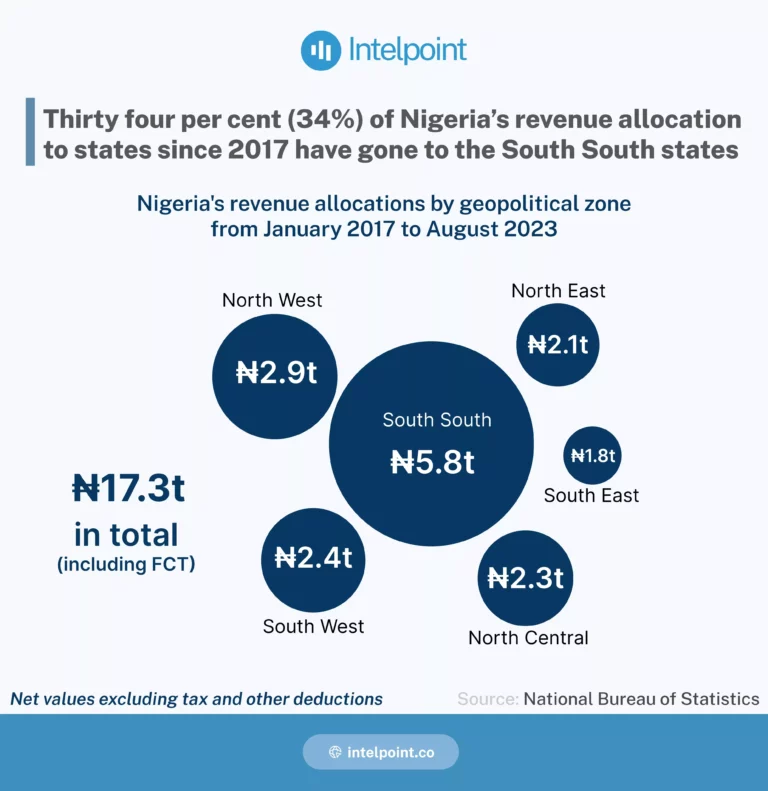
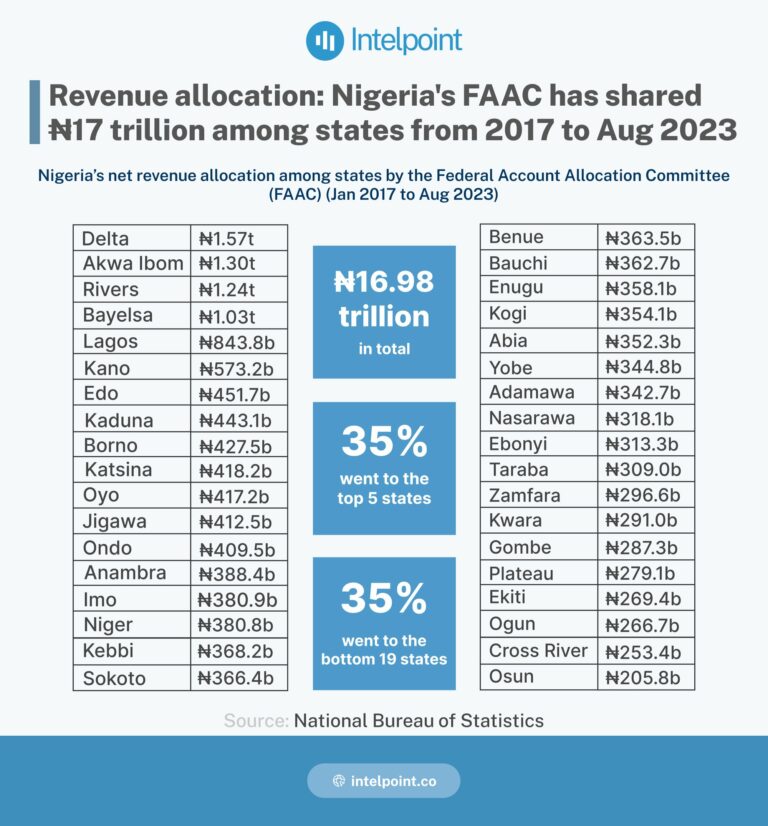
    The FAAC's revenue distribution from 2017 to August 2023 highlights the dominance of Delta, Akwa Ibom, Rivers, and Bayelsa states in allocations. Despite Lagos' economic prominence, it ranked fifth. Here is the distribution of revenue among states between 2017 and August 2023.

    See more
  • A Trend of Adult literacy rates of African countries

    Between 2018 and 2021, adult literacy rates across African nations exhibited significant disparities. Seychelles and South Africa led with literacy rates of 96% and 95%, respectively, indicating a high proportion of literate adults. Conversely, Chad had the lowest literacy rate during this period.

    These statistics underscore the uneven progress in educational attainment across Africa, highlighting the need for targeted interventions to improve literacy in lower-performing nations.

    See more
    Countries by Global Innovation Index 2024

    The Global Innovation Index 2024 reveals a striking contrast in innovation performance between countries globally and across Africa. Switzerland leads the global rankings with an impressive score of 67.5, followed by Sweden (64.5) and the USA (62.4), highlighting their sustained investments in research, development, and technological advancement.

    In Africa, Mauritius takes the top spot with a score of 30.5, followed closely by Morocco (28.8) and South Africa (28.3). However, even Africa's most innovative nations achieve less than half the score of global leaders, indicating a significant innovation gap.

    Nigeria ranks 15th in the African ranking and 113th globally, out of 133 countries, with a score of 17.1.

    See more

  • Nigeria's debt burden has been a growing concern, with data revealing that for every $1 billion external loan repaid in the past decade, approximately $3 billion was borrowed. Here, we look at how the country has managed its external debt in the past ten years.
    See more
  • MTN Nigeria has dominated the country's telecommunications market over the years, accounting for the largest market share. All four operators, apart from 9mobile, recorded a significant increase in their subscriber base between May 2014 and March 2024.

    See more
  • The 2024 Global Peace Index reveals a decline in peacefulness in 97 countries, the highest since the index began.

    Nigeria is among the nations affected by regional conflicts and rising violence. With a peace index score of 2.91, Nigeria is facing increasing challenges.

    A deteriorating peace score impacts foreign investment and economic stability. Global economic losses due to violence reached $19.1 trillion in 2023.
    See more

Other Insights
Key takeaways:
  • In 2024, BUA Foods hit new heights, with gross profit for Q4 surpassing ₦189 billion.
  • A remarkable surge occurred in 2024, with quarterly gross profits regularly exceeding ₦100 billion.
  • The fourth quarter of 2024 marked a significant peak, illustrating a 200% increase from Q4 2023.
  • BUA Foods' gross profit dramatically climbed from approximately ₦25 billion in 2021 to nearly ₦190 billion in Q4 2024.
Read more
Share of people living in Africa by region as of January 2025
  • Eastern Africa is the most populous region, making up 33.09% of Africa’s total population, with over 507 million people.
  • Together, Eastern and Western Africa house over 63% of Africa’s total population, indicating where much of the continent’s human capital and economic activity will be concentrated.
  • Northern Africa has 274.1 million people (17.89%), while Central Africa has 216.3 million (14.11%), placing them in the mid-range of Africa’s population distribution.
  • Southern Africa is by far the least populous region, contributing just 4.8% (73.6 million people) to Africa’s 1.5 billion total.
  • The population contrast across regions highlights key differences in urbanisation, economic opportunities, and development needs.
  • Understanding Africa’s population distribution is crucial for businesses, policymakers, and investors, as future economic growth, consumer markets, and labour forces will be heavily influenced by these demographic trends.
Read more
The number of people living in each region globally as of January 2025
  • Asia remains the world's population giant, housing nearly 59% of the global population.
  • Africa’s population boom is accelerating, contributing 18.7% of the world’s people.
  • Europe is shrinking in global demographic weight, making up only 9.09% of the world’s people.
  • Oceania remains sparsely populated, with just 0.57% of the global population.
  • Demographic trends will shape economic power, as nations with younger populations could become economic engines if properly harnessed.
  • Urbanisation and resource allocation will become critical, especially in Asia and Africa, where rising populations will put pressure on housing, food, and infrastructure.
Read more
Share of individuals globally in each age group (January 2025)
  • Nearly half of the global population is aged between 20 and 54, making this group the primary driver of economic activities worldwide.
  • Individuals under 19 years old make up 32.9% of the total global population, highlighting the need for sustained investments in education and child welfare.
  • Over 19% of the population is aged 55 and above, emphasising the need for healthcare, retirement planning, and age-friendly policies.
  • With 2.10 billion people, the 35-54 group represents the backbone of global leadership, corporate decision-making, and financial stability.
Read more
Key Takeaways:
  • In 2007/08, personal income tax (PIT) contributed 29.46% of total tax revenue, while corporate income tax (CIT) added a substantial 24.46%.
  • The share of personal income tax in tax revenue rose by 27% from 2007/08 to 2023/24.
  • Corporate income tax contribution declined by 26% from 2007/08 to 2023/24.
  • In 2019/20, personal income tax made the largest contribution to tax revenue (38.9%), a 32% rise from the 2007/08 contribution.
  • Other taxes showed minor variations, averaging around 19% of total tax revenue.
  • Personal income tax reached its peak contribution at 38.92% in 2019/20 before dropping by 4% in 2023/24.
Read more
Key Takeaways:
  • Nestlé’s dividends increase year after year was highest in 2018 and 2019 at ₦17.83 billion and ₦12.68 billion, respectively.
  • The declared dividends reached a peak of ₦55.49 billion in 2020, while the lowest was recorded at ₦15.06 billion in 2016.
  • In recent years, Nestlé Nigeria Plc has shown a declining trend in declared dividends.
  • Dividends decreased by nearly 14%, 17%, and 28% in 2021, 2022, and 2023, respectively, compared to the previous years.
Read more
1 131 132 133 134 135 254

Can’t find what you’re looking for? Please fill the form below
Contact Form Demo
SIGN UP TO OUR NEWSLETTER
Get periodic updates about the African startup space, access to our reports, among others.
Subscribe Here
Subscription Form

A product of Techpoint Africa. All rights reserved