Bite-sized Insights about
 
Providing you with data-based insights about things happening around you.
Popular Insights
  • As of 2022, the US had 948,519 international students, 14,438 (1.5%) of whom were Nigerian. Nigeria was ranked tenth among contributing countries to the international student community in the US.
    See more
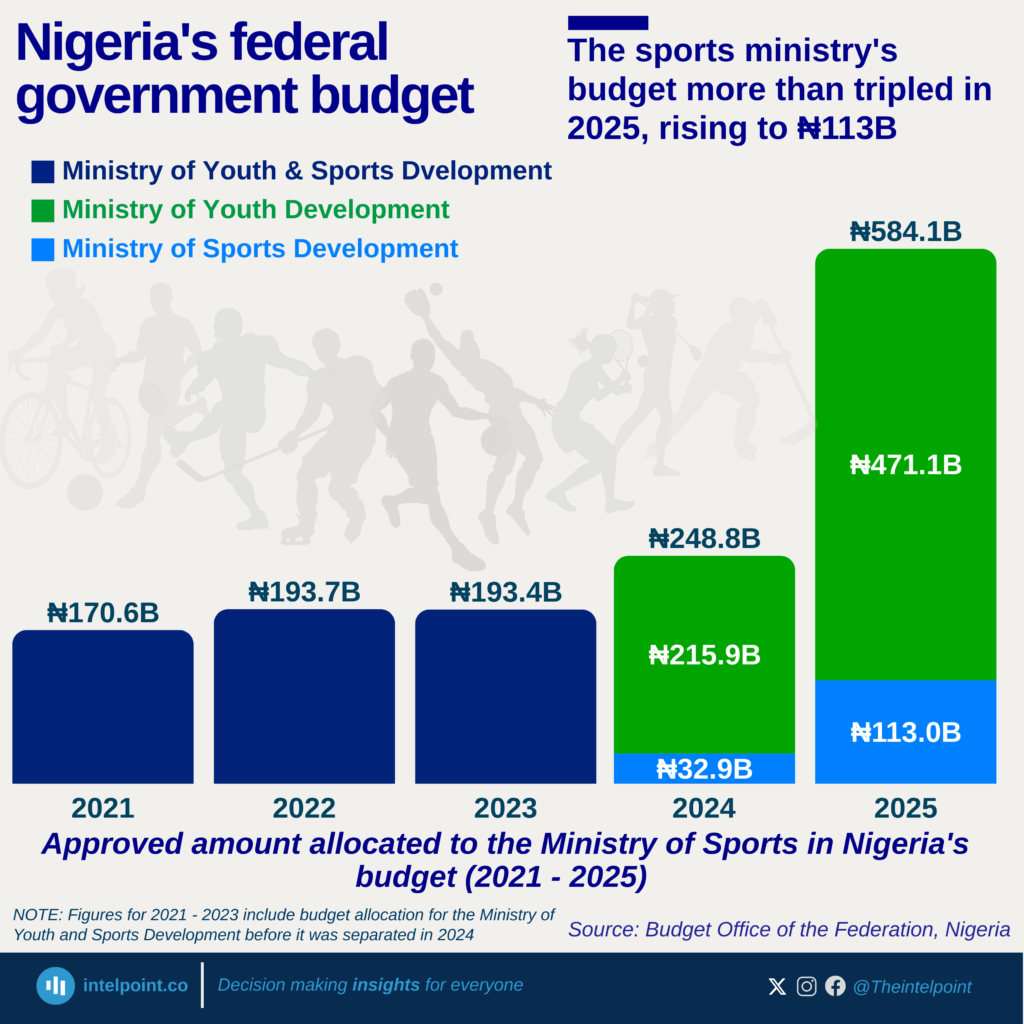
    • Nigeria’s sports budget rose sharply to ₦113 billion in 2025, tripling from the 2024 figure.
    • The 2025 allocation represents a 243.8% increase compared to the previous year.
    • Youth and Sports budget allocations were relatively stable between 2021 and 2023, averaging about ₦186 billion.
    • The splitting of the Ministry of Youth and Sports budgets in 2024 likely contributed to the steep dip that year.
    • The rebound in the sports development budget in 2025 signals government re-prioritisation of sports development.
    See more
  • The 2024 Global Peace Index reveals a decline in peacefulness in 97 countries, the highest since the index began.

    Nigeria is among the nations affected by regional conflicts and rising violence. With a peace index score of 2.91, Nigeria is facing increasing challenges.

    A deteriorating peace score impacts foreign investment and economic stability. Global economic losses due to violence reached $19.1 trillion in 2023.

    See more

    The FAAC's revenue distribution from 2017 to August 2023 highlights the dominance of Delta, Akwa Ibom, Rivers, and Bayelsa states in allocations. Despite Lagos' economic prominence, it ranked fifth. Here is the distribution of revenue among states between 2017 and August 2023.

    See more
  • A Trend of Adult literacy rates of African countries

    Between 2018 and 2021, adult literacy rates across African nations exhibited significant disparities. Seychelles and South Africa led with literacy rates of 96% and 95%, respectively, indicating a high proportion of literate adults. Conversely, Chad had the lowest literacy rate during this period.

    These statistics underscore the uneven progress in educational attainment across Africa, highlighting the need for targeted interventions to improve literacy in lower-performing nations.

    See more

    Nigeria was the seventh most populous nation in the world in 2020, with 206.1 million people. Projected to reach a population of 401.3 million by 2050, Nigeria will rank third after India (1st) and China (2nd). According to Institut national d'études démographiques' projections, Nigeria, Ethiopia, DR Congo, Egypt, Tanzania, and Kenya will be among the world’s top 20 most populous countries by 2050.
    See more

  • Share of individuals in each generation (January 2025)
    • Generation Alpha is the largest generation, making up 24.4% of the global population.
    • Gen Z and Millennials still hold strong influence, comprising 22.9% and 21.2% of the global population.
    • The Baby Boomer generation (12.8%) is gradually declining, which will impact industries like retirement services, healthcare, and wealth distribution.
    • The Silent Generation is now just 2% of the population, highlighting the demographic shift away from the older generations.
    • Generation X, at 16.7%, remains a crucial but often overlooked group, balancing leadership roles in business and governance while supporting both older and younger generations.
    • The rise of Generation Alpha signals the dawn of an even more digital-native world, shaping the future of education, marketing, and work environments.
    • With Millennials, Gen Z, and Gen Alpha making up nearly 70% of the population, the global workforce, economy, and social dynamics will see rapid transformation in the coming years.
    See more
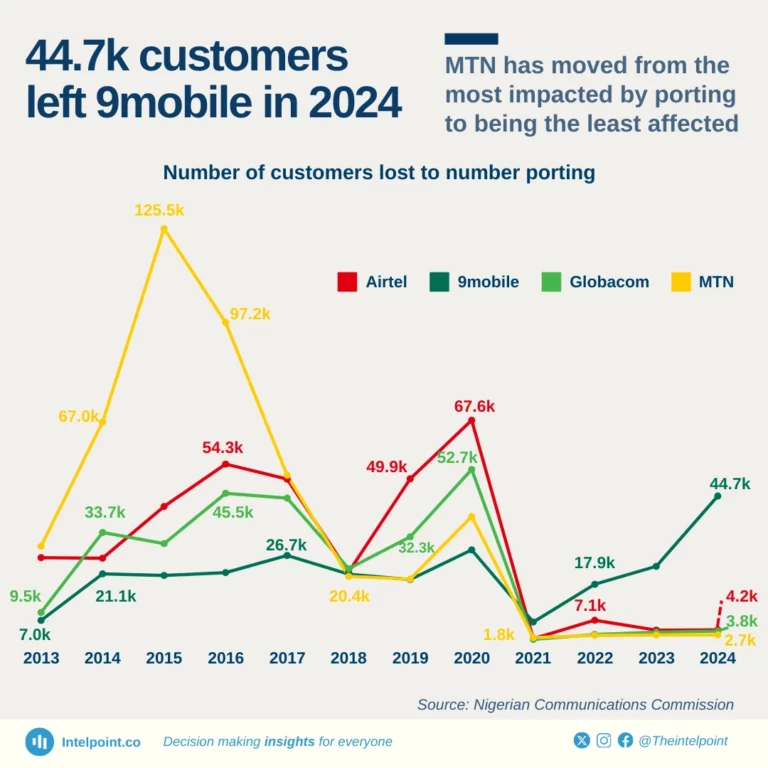
  • MTN Nigeria has dominated the country's telecommunications market over the years, accounting for the largest market share. All four operators, apart from 9mobile, recorded a significant increase in their subscriber base between May 2014 and March 2024.

    See more
  • The 2024 Global Peace Index reveals a decline in peacefulness in 97 countries, the highest since the index began.

    Nigeria is among the nations affected by regional conflicts and rising violence. With a peace index score of 2.91, Nigeria is facing increasing challenges.

    A deteriorating peace score impacts foreign investment and economic stability. Global economic losses due to violence reached $19.1 trillion in 2023.
    See more

Other Insights
 

Local company income tax in Nigeria surged threefold quarter-on-quarter in Q2 2024, reaching ₦1.35t. Agriculture, Forestry, and Fishing led with a growth of 474.5%, while Household Employment and Own-Use Production experienced the steepest decline at -30.22%

See more
Total number of products registered with NAFDAC from 2020 to 2022

Food and packaged water dominate NAFDAC registration, as close to 50% of all products registered between 2020 and 2022 were either food or packaged water. This suggests a significant focus on ensuring the safety and quality of these essential commodities. Human drugs also make up a substantial portion of registered products, reflecting the importance of regulating medications to protect public health. Cosmetics and herbal drugs follow closely with 13.2% and 6.5%, respectively.

See more
Top & bottom ten states by number of dentists (2022)

Lagos State leads the dental healthcare workforce in Nigeria with an impressive 713 dentists, a figure over three times higher than any other state. This dominance shows Lagos' position as a hub for healthcare professionals. Trailing far behind are the FCT (Abuja) with 208 dentists and Oyo with 185.

The gap becomes even more glaring when examining the bottom states like Taraba, with only eight dentists, and others such as Jigawa and Abia, with just nine each. These numbers paint a concerning picture for residents of these regions, who may face long travel distances or extended waiting times to access basic dental care. Interestingly, Borno State, which faces security challenges, has 53 dentists, surpassing several other states.

See more

Nigeria's import value increased by 8.7% quarter-on-quarter and 63% year-on-year, reaching ₦14.67 trillion in Q3 2024. China led as the top trading partner with imports valued at ₦3.57 trillion (24%), while Malta rounded out the top five with ₦767 billion (5%).

See more
Countries by Global Innovation Index 2024

The Global Innovation Index 2024 reveals a striking contrast in innovation performance between countries globally and across Africa. Switzerland leads the global rankings with an impressive score of 67.5, followed by Sweden (64.5) and the USA (62.4), highlighting their sustained investments in research, development, and technological advancement.

In Africa, Mauritius takes the top spot with a score of 30.5, followed closely by Morocco (28.8) and South Africa (28.3). However, even Africa's most innovative nations achieve less than half the score of global leaders, indicating a significant innovation gap.

Nigeria ranks 15th in the African ranking and 113th globally, out of 133 countries, with a score of 17.1.

See more
Nigeria's national grid has collapsed 12 times in 2024

Nigeria's national grid has experienced 12 collapses so far in 2024, a troubling trend that reveals the fragility of the country's energy infrastructure. The timeline highlights intervals ranging from as short as one day to as long as 82 days between incidents. Notably, two consecutive collapses occurred on October 14 and October 15, while a total of 9 collapses occurred in the second half of the year.

Yesterday's collapse came 35 days after November 7, when the grid went down for the 11th time.

See more

In 2024, the top ten universities in Nigeria graduated 3,047 first-class students. Seventeen per cent of private university students in Nigeria earned first-class degrees, compared to 3% in federal/state universities.

The University of Benin convocated the most first-class students (385), while the Federal University of Agriculture, Abeokuta (FUNAAB) had the least, with 122.

Covenant University had the highest proportion, with one in five students graduating with a first class.

See more

Ogun State is the top location for private universities, with 16 universities, while the top eight states collectively account for 50% of Nigeria's 149 private universities. Bauchi and Yobe are the only states with no private universities.

See more

As of 2024, 149 private universities are accredited by the National Universities Commission. Southern Nigeria houses 62%, with the South West leading at 47 universities, while the North East has the fewest, with just 5 (3%).

See more

Bayelsa, Gombe, and Katsina States have the fewest accredited universities — five each — of the 274 in Nigeria in 2024. Ogun leads with 19, followed closely by Abuja (17) and Delta (15).

See more
Participants of the National Open Apprenticeship Scheme by gender (2021 - 2023)

Participation in Nigeria’s National Open Apprenticeship Scheme has dropped by over 50% since 2021, with male and female enrolments declining significantly; over the years, there have been more female participants. The declining participation rates raise questions about awareness, funding, and programme efficiency.

For many Nigerian youths, apprenticeship programmes are a gateway to self-reliance and stable income. The National Open Apprenticeship Scheme is a National Directorate of Employment (NDE) programme that upskills unskilled and unemployed people and equips them with relevant demand-driven skills.

See more
Nomadic primary school enrolment in Nigeria by regions

Nomadic primary school enrolment in Nigeria remains most prevalent in the North West, with over 503,000 children enroled in 2021, significantly higher than any other region. Enrolment numbers have shown gradual improvement across most regions.

See more
1 87 88 89 90 91 128
  • Tesla led global EV deliveries in Q1 2025 with 336,681 vehicles, maintaining its top position despite a year-over-year decline.
  • Tesla and Rivian reported significant drops in deliveries —12.92% and 38.46% respectively, while other EV manufacturers saw increases.
  • Tesla's decline has been partially attributed to public backlash against CEO Elon Musk’s controversial political involvement.
  • Rivian's drop was linked to reduced demand, particularly in its core Los Angeles market, which was affected by recent wildfires.
  • VinFast saw a 300% surge in deliveries, growing from 9,689 to 36,330 vehicles, driven largely by strong performance in Vietnam.
  • Tesla, Rivian, and Lucid are U.S.-based EV manufacturers; NIO is Chinese, VinFast is Vietnamese, and Polestar is Swedish.
Read more
  • Tesla recorded its highest automotive revenue in 2023, reaching an impressive $82.4 billion.
  • In 2024, Tesla’s automotive revenue declined for the first time, with a 6.49% drop compared to the previous year.
  • Despite the decline in automotive revenue, Tesla’s total revenue grew by 0.95%, indicating resilience in other business segments
Read more
  • FCT, Ogun, and Nasarawa consistently rank as the top three states with the highest number of road accidents.

  • The FCT recorded its peak accident figures in 2022, particularly in Q2 (842 cases) and Q4 (864 cases).

  • In Q2 and Q3 of 2024, Ogun State surpassed the FCT in the number of reported accidents.

  • Across these three states, there has been a notable decline in accident numbers, with an average decrease of approximately 37.6% between Q2 and Q3 2024.

Read more
  • In 2024, Tesla delivered a total of 1,789,226 vehicles, marking its first year-over-year delivery decline (1.11%) since 2015.
  • Tesla’s highest annual deliveries occurred in 2023, with 1,808,581 vehicles delivered.
  • Of the total vehicles delivered in 2024, 1,704,093 were Model 3 and Model Y, while 85,133 were other models, including the Cybertruck.
  • The Cybertruck officially launched in late 2023, with production ramping up through 2024.
  • Both Model Y and Model 3 received notable upgrades in 2024, enhancing performance and interior features.
Read more
  • Private universities in Nigeria outnumber federal and state institutions combined.
  • Nigeria has 159 private universities, more than double the number of federal universities.
  • Federal universities stand at 72, showing steady federal government investment in tertiary education.
  • State-owned universities number 66, slightly fewer than federal universities but forming a significant part of public education.
Read more
  • The 1990s saw multiple years of flat or negative FDI, including -$0.02B in 1995 and -$0.04B in 1997.
  • FDI surged to $1.81B in 2007 and $2.94B in 2010, marking a turning point.
  • The all-time high was $3.31B in 2012, with 2024 following closely at $3.11B.
  • From 2015 to 2024, annual FDI remained steadily above $1B, signalling sustained investor confidence.
Read more
1 87 88 89 90 91 255

Can’t find what you’re looking for? Please fill the form below
Contact Form Demo
SIGN UP TO OUR NEWSLETTER
Get periodic updates about the African startup space, access to our reports, among others.
Subscribe Here
Subscription Form

A product of Techpoint Africa. All rights reserved