Bite-sized Insights about
 
Providing you with data-based insights about things happening around you.
Popular Insights
  • MTN Group: The share of revenue for data almost doubled in a decade while share of voice almost halved

    MTN Group's share of voice revenue has steadily declined since 2014, falling from 71% to 36.6% in 2023. On the other hand, data services' share went from 18.6% to 37% in the same period.

    See more

    According to UNESCO, low-budget movies from Nigeria and other African countries account for most of the films produced annually in Africa. Here is a breakdown of the estimated number of films produced annually, private television channels, and cinema screens by African region.

    See more
  • Only 10% of Nigerians earn above ₦100,000, according to the Nigerian Financial Services Market Report. This aligns with most reports about Nigeria, and it's in sharp contrast to the narratives online.
    See more

    The FAAC's revenue distribution from 2017 to August 2023 highlights the dominance of Delta, Akwa Ibom, Rivers, and Bayelsa states in allocations. Despite Lagos' economic prominence, it ranked fifth. Here is the distribution of revenue among states between 2017 and August 2023.

    See more
  • A Trend of Adult literacy rates of African countries

    Between 2018 and 2021, adult literacy rates across African nations exhibited significant disparities. Seychelles and South Africa led with literacy rates of 96% and 95%, respectively, indicating a high proportion of literate adults. Conversely, Chad had the lowest literacy rate during this period.

    These statistics underscore the uneven progress in educational attainment across Africa, highlighting the need for targeted interventions to improve literacy in lower-performing nations.

    See more
    Countries by Global Innovation Index 2024

    The Global Innovation Index 2024 reveals a striking contrast in innovation performance between countries globally and across Africa. Switzerland leads the global rankings with an impressive score of 67.5, followed by Sweden (64.5) and the USA (62.4), highlighting their sustained investments in research, development, and technological advancement.

    In Africa, Mauritius takes the top spot with a score of 30.5, followed closely by Morocco (28.8) and South Africa (28.3). However, even Africa's most innovative nations achieve less than half the score of global leaders, indicating a significant innovation gap.

    Nigeria ranks 15th in the African ranking and 113th globally, out of 133 countries, with a score of 17.1.

    See more

  • Newzoo, a provider of video game and gamer data, reported that in 2023, Nigerian mobile gamers spent approximately $229.7m — the highest expenditure in Africa — boasting a sizable 14.7m spenders.

    Egypt's gamers spent an estimated $212.6m and occupied second place in Africa's mobile gaming expenditure ranking.

    See more
  • The 2024 Global Peace Index reveals a decline in peacefulness in 97 countries, the highest since the index began.

    Nigeria is among the nations affected by regional conflicts and rising violence. With a peace index score of 2.91, Nigeria is facing increasing challenges.

    A deteriorating peace score impacts foreign investment and economic stability. Global economic losses due to violence reached $19.1 trillion in 2023.

    See more
  • Only 10% of Nigerians earn above ₦100,000, according to the Nigerian Financial Services Market Report. This aligns with most reports about Nigeria, and it's in sharp contrast to the narratives online.
    See more

Other Insights
Top 31 countries based on the 2024 English Proficiency Index

Nigeria occupies the 30th spot globally in the English Proficiency Index, achieving a score of 557, just behind Kenya (581) and South Africa (594). As one of Africa's linguistic leaders, this ranking highlights Nigeria’s strength in English proficiency, a vital skill driving communication, business, and education across the continent.

This data comes from the EF English Proficiency Index, which aggregated the test results of 2.2m adults from 113 countries and regions. Countries where English is the primary native spoken language are not included in this ranking. Ranks are determined by each country’s average score in the EF Standard English Test (EF SET).

See more
GDP per capita Nigeria and Africa (2010-2029)
 

Over the years, many African countries, including Nigeria, have experienced economic turbulence caused by fluctuating global markets and domestic challenges. However, amidst these challenges, there’s hope as IMF economic forecasts point toward growth.

According to the IMF, GDP per capita in Nigeria and Africa is projected to increase from 2025 after years of stagnation and decline. Nigeria’s GDP per capita fell sharply from $2,197 in 2022 to $877 in 2024. Encouragingly, growth is expected with projections of $1,047 for Nigeria by 2029, signaling a slow but steady improvement in living standards.

See more
Fatalities caused by the 50 worst terrorist attacks in 2022

In 2022, the top 50 terrorist attacks claimed 2,088 lives across 11 countries, with African nations significantly affected. Seven of these nations are African, and together they account for over half of the fatalities. Mali alone recorded 421 deaths, Burkina Faso recorded 317 deaths, while Nigeria and Somalia saw 212 and 200 lives lost, respectively.

See more
71% of households in Nigeria’s North East lack access to electricity

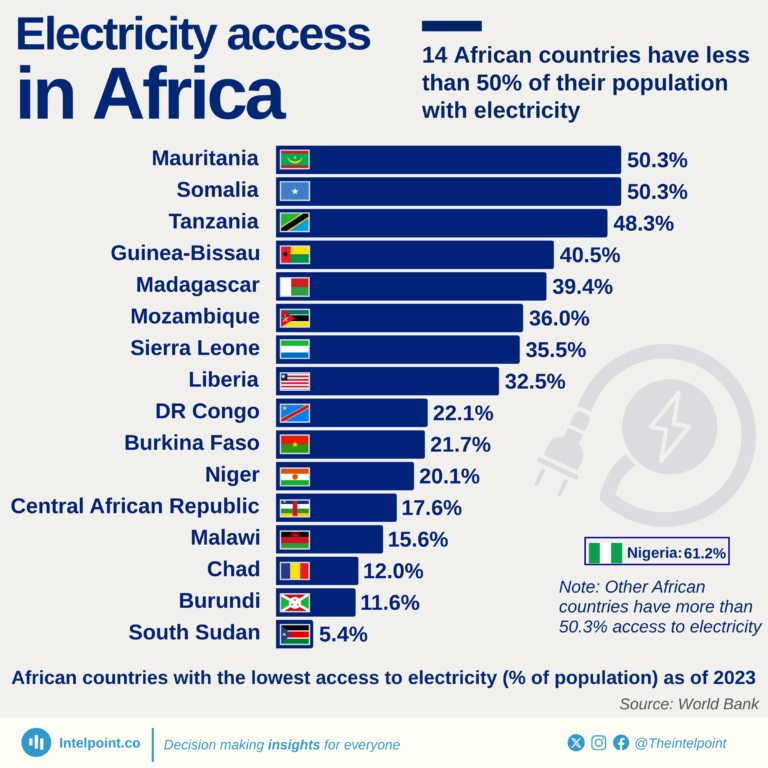
Nearly half (46%) of Nigerian households struggle with electricity access, with the Northern region facing the most significant challenges. The three Northern geopolitical zones have access rates below the national average, whereas South East Nigeria has the highest access, with only 25.4% of households lacking electricity.

See more
8.4 bribes were paid per bribe-payer in Nigeria's North West

The average number of bribes paid per person in Nigeria marginally reduced from 5.4 to 5.1. However, this decrease had no impact in the North East, where bribe-payers nearly doubled the amount paid in 2019, increasing from 4.5 to 8.4. In contrast, other regions recorded slight declines in bribes paid.

See more
Modern slavery by regions (2022)

On this International Day for the Abolition of Slavery, it’s important to face the harsh realities of modern slavery worldwide. As of 2022, 22 million people globally were forced into marriages, and 27.6 million were subjected to forced labour. Africa alone accounted for 3.8 million in forced labour and 3.2 million in forced marriages, making up a significant number of this global issue.

Africa’s numbers were lower than Asia & the Pacific’s, with a total of 29.3m modern slaves. In Africa, people face daily struggles in exploitative labour conditions, from children forced to work on farms to women coerced into early or abusive marriages. These realities explain the broader statistics and call for efforts to address modern slavery in all its forms.

See more

First Class Honours at the Nigerian Law School have been a rarity, but 2023 saw a notable rise. At 251, it is the highest number of First Class candidates in a decade, 2x the number in 2022.

See more

While several African nations have state-controlled telcos, some private operators have extended their presence across the continent. Notably, none operates in all countries on the continent.

MTN Group and Orange are present in 17 countries, with MTN having a stronger presence in Southern Africa than Orange. Francophone West Africa and North Africa are Orange's primary markets.

See more

Fail rates at the Nigerian Law School have declined from 33% in 2014 to 11% in 2023. Over the same period, second-class lower has overtaken the pass grade as the most common outcome.

See more

Many African countries can't grow apples naturally due to unfavourable climate and the required chilling hours.

Despite this, Africa's share of global apple output has grown from 0.66% (1962) to nearly 4% in 2022, averaging 2.3% over 60+ years. South Africa has been the biggest contributor, but Egypt, Morocco, and Algeria also play key roles, with the top four countries making up 96% of Africa's total production in 2022.

Since 1961, South Africa has led Africa in apple production, consistently topping the charts.

See more

In 1961, China produced just 167,000 tonnes of apples, accounting for a mere 1% of global production.

Over the next six decades, this figure surged by 28,300%, reaching 47.5 million tonnes by 2022 and capturing 50% of global production — growing at an average rate of around 7.5% per year.

China's rise began with agricultural reforms in the late 1970s and gained momentum in the 1980s and 1990s.

These are the top ten apple-producing countries over the years.

See more
 

Nigeria’s GDP for 2024 is up by 3.2% so far, with key sectors driving the growth. In the first nine months of 2024, Finance and Insurance took the lead with a 30.3% increase, followed by Water Supply & Waste Management at 8.3%, and Mining and Quarrying with 5.7% growth.

These are the sectors leading Nigeria’s real GDP growth.

See more
1 88 89 90 91 92 126
  • Total trade rose from ₦12.7 trillion (Q2 2023) to over ₦36 trillion (Q1 2025).
  • Exports grew from ₦6.4 trillion (Q2 2023) to ₦20.6 trillion (Q1 2025).
  • Sustained trade surpluses started from Q2 2023, peaking at ₦5.2 trillion in Q1 2025.
  • Imports also rose from ₦6.3 trillion (Q2 2023) to ₦15.4 trillion (Q1 2025), but slower than exports.
  • Pre-2023 was deficit-heavy: Most quarters from 2020–2022 recorded trade deficits or very small surpluses.
  • Q1 2021 had the worst deficit: -₦1.89 trillion, driven by high imports and weak exports.
  • Naira devaluation is the turning point: Starting around Q2 2023, it inflated export values in naira terms.
  • Export growth may not reflect volume; gains are likely due to FX effects, not necessarily more goods shipped.
Read more
  • South Africa ranked highest in Africa; it’s easy to move goods in and out.
  • It beat others on customs speed, delivery time, and tracking.
  • Nigeria, Ghana, and DR Congo scored low. Goods faced more delays and hassles.
  • Countries with high scores attract more trade and business.
  • A low score means slower shipments, higher costs, and weaker logistics.
Read more
  • Lagos led the nation with ₦819.62B VAT, over 45% of the total generated by all 36 states combined.
  • Rivers followed distantly with ₦278.23B, around 34% of Lagos’s VAT haul.
  • Only five states (Lagos, Rivers, Oyo, Bayelsa, Kano) generated over ₦21B in Q1 2025.
  • 22 states generated below ₦10B, with 13 of them earning less than ₦6B in VAT.
  • Northern states like Katsina (₦5.96B), Yobe (₦5.81B), and Kebbi (₦5.13B) trail significantly in VAT contributions.
  • Abia, Cross River, Imo, and Taraba sit at the bottom, each with under ₦3B in VAT returns.
Read more
  • No candidate scored above 300 until 2015, with just 40 high scorers that year out of over 1.46 million candidates.
  • 2025 marked the highest ever with 17,025 candidates scoring above 300, nearly double the count in 2024 and more than triple 2023.
  • From 2022 to 2025, above-300 scorers consistently remained over 5,000 each year, showing a steady rise in top scores.
  • Despite the growth in numbers of JAMB candidates, high scorers still make up less than 1% annually.
Read more
  • Burkina Faso tops the 2025 GTI ranking with a score of 8.581, the highest globally.
  • African nations make up 6 of the 10 most terrorism-impacted countries in 2025.
  • Pakistan (8.374) and Syria (8.006) are the top-ranking Asian countries on the list.
  • Nigeria ranks 6th globally with a GTI score of 7.658, just behind Niger (7.776)
Read more
  • Europe leads with 12 clubs, including giants like Real Madrid, Manchester City, and Bayern Munich, solidifying its global dominance.
  • South America contributes 6 teams, such as Palmeiras, Flamengo, and River Plate, reflecting its strong continental performance.
  • Africa's 4 clubs, Al Ahly (Egypt), Wydad AC (Morocco), Espérance Sportive de Tunis (Tunisia), and Mamelodi Sundowns (South Africa), represent CAF’s top tier.
  • Asia also fields 4 clubs, including Al Hilal (Saudi Arabia), Urawa Red Diamonds (Japan), Al Ain (UAE), and Ulsan HD (South Korea).
  • Oceania and North America are modestly represented with one club from New Zealand and four from the CONCACAF region, including Inter Miami as host.
Read more
1 88 89 90 91 92 251

Can’t find what you’re looking for? Please fill the form below
Contact Form Demo
SIGN UP TO OUR NEWSLETTER
Get periodic updates about the African startup space, access to our reports, among others.
Subscribe Here
Subscription Form

A product of Techpoint Africa. All rights reserved