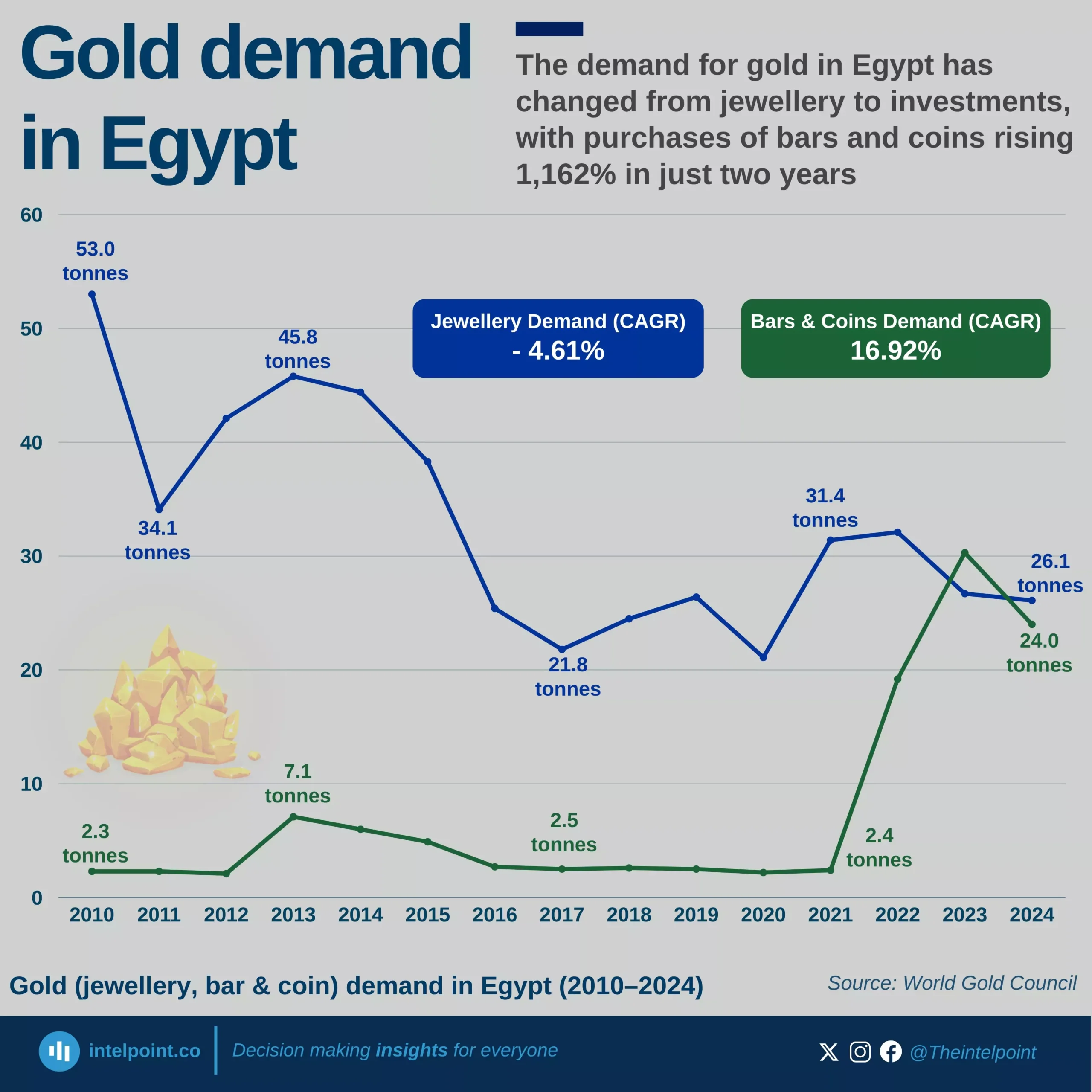
Gold (jewellery, bar & coin) demand in Egypt (2010–2024)

Key Takeaways

  • Jewellery demand made up 81.35% of Egypt’s total gold demand between 2010 and 2024.
  • The highest jewellery demand was recorded in 2010 at 53 tonnes, and no year since has reached that level.
  • Jewellery demand declined by 50.75% between 2010 and 2024.
  • Bar and coin demand saw a sharp 700% increase between 2021 and 2022.
  • In 2023, bar and coin demand hit a record high of 30.3 tonnes and, for the first time, exceeded jewellery demand.
  • Overall, bar and coin demand rose by 943.48% between 2010 and 2024.

Egypt's long-standing passion for gold is changing drastically. Although the allure of conventional gold wedding jewellery has diminished, with demand dropping by 50.75% since 2010, a new gold rush is underway. The demand for gold bars and coins has exploded by almost 1,100% between 2021 and 2023 alone, as Egyptians are increasingly grabbing them for financial protection. This signifies the transformation of gold from a treasured cultural icon to a vital financial resource.
Source:

World Gold Council

Period:

2010-2024
HTML code to embed chart
Want a bespoke report?
Reach out
Tags
Related Insights

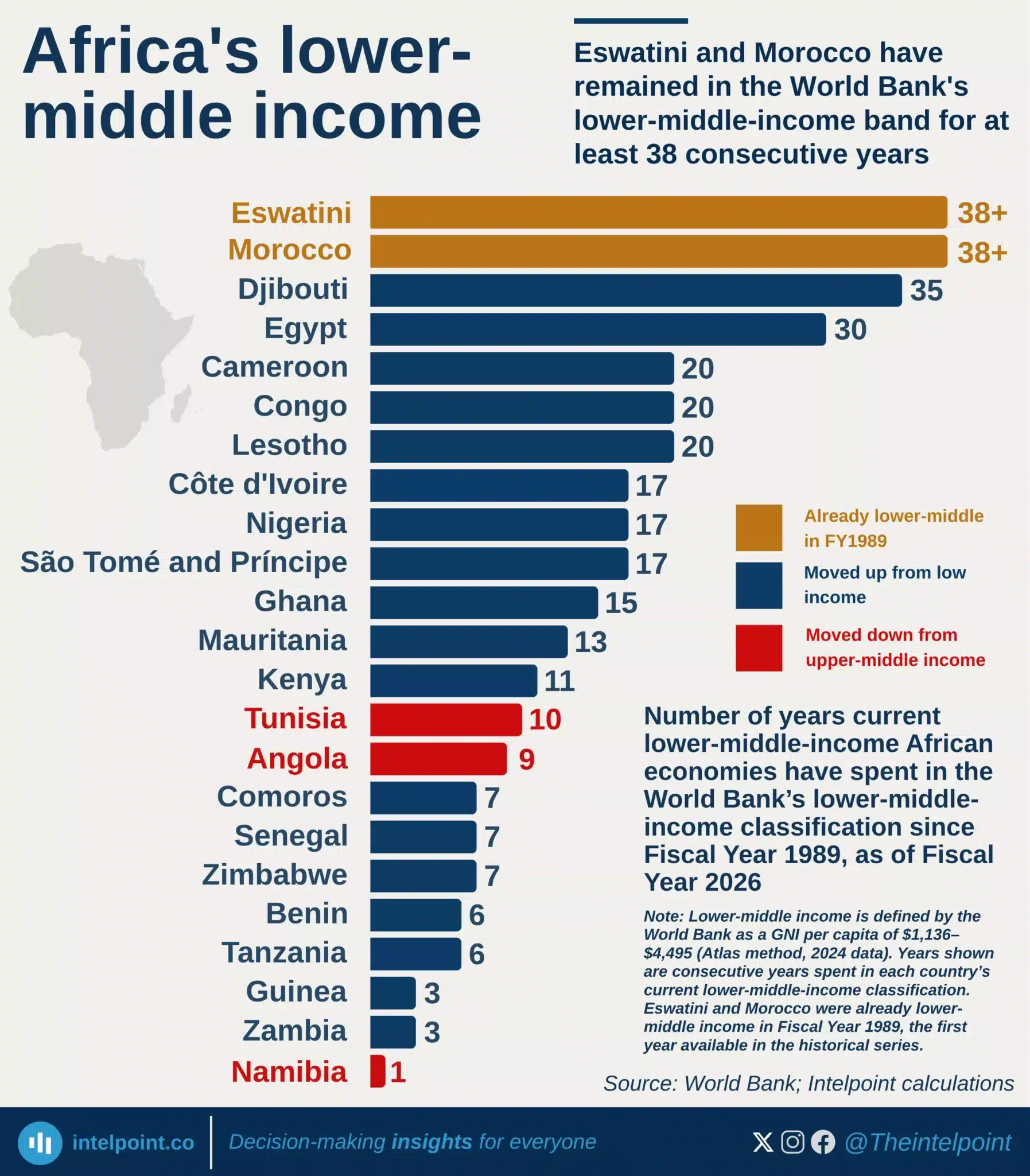
Eswatini and Morocco have remained in the World Bank's lower-middle-income band for at least 38 consecutive years
  • Nigeria has remained in the World Bank’s lower-middle-income category for 17 consecutive years.
  • Eswatini and Morocco have spent at least 38 consecutive years in the category, the longest among African countries.
  • Africa has 23 lower-middle-income economies in the World Bank’s Fiscal Year 2026 classification.
  • Tunisia, Angola, and Namibia entered the category after falling from upper-middle-income status.

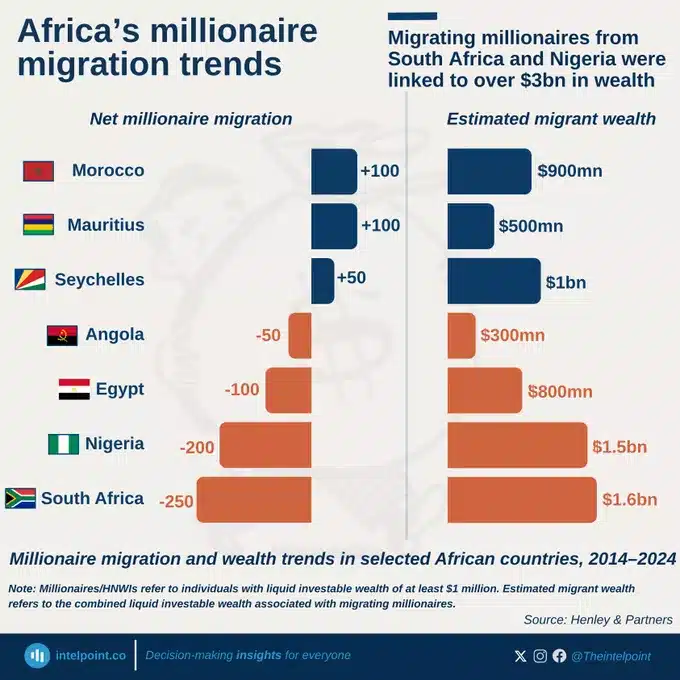
Migrating millionaires from South Africa and Nigeria were linked o over $3 billion in wealth
  • Nigeria lost 200 more millionaires than it gained between 2014 and 2024.
  • Migrating Nigerian millionaires were linked to an estimated $1.5 billion in wealth.
  • South Africa had Africa’s biggest net millionaire outflow among the selected countries.
  • Mauritius and Seychelles stood out as millionaire wealth magnets.
  • Seychelles attracted the highest migrant wealth per net millionaire gained.
 

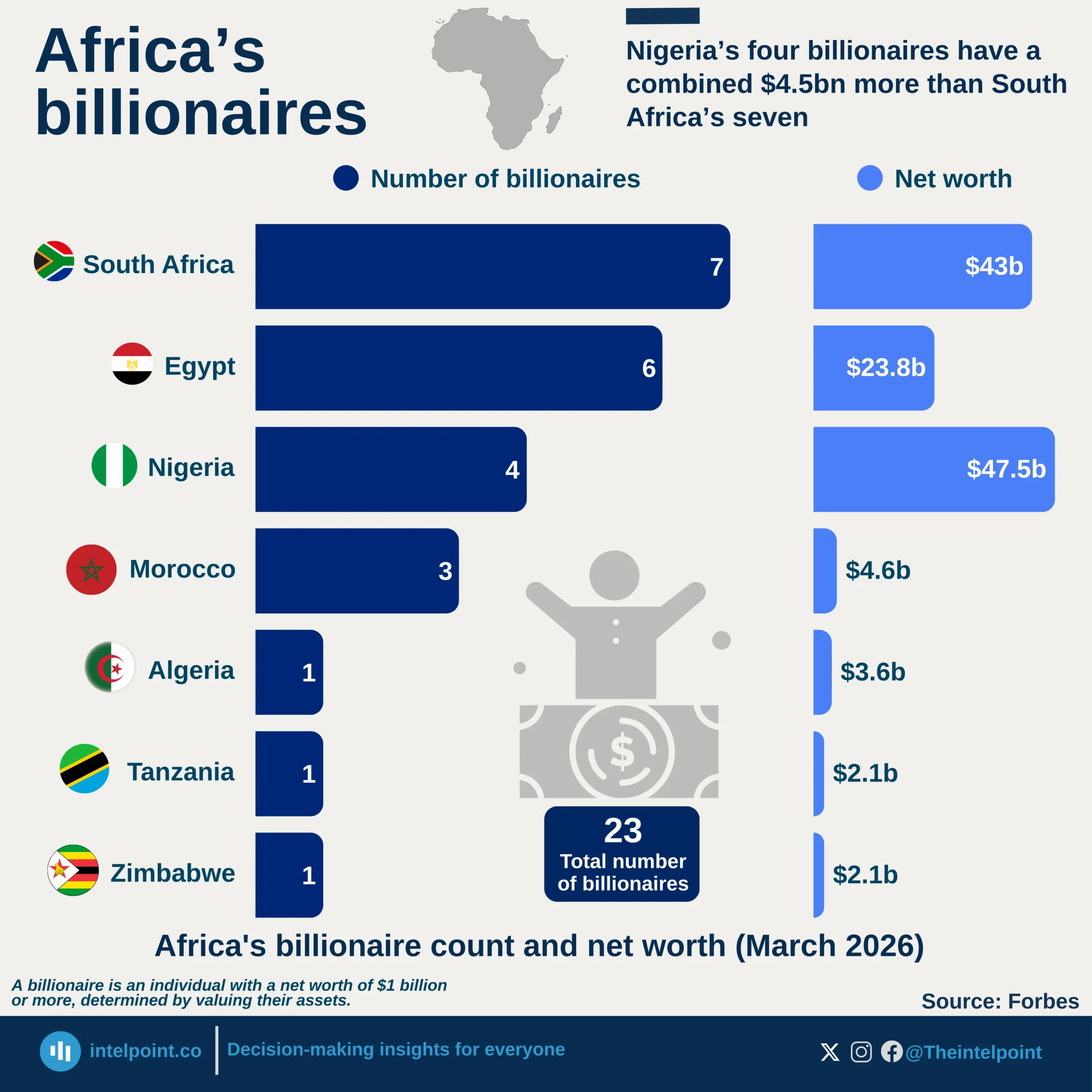
Nigeria’s four billionaires have a combined $4.5bn more than South Africa’s seven
  • South Africa leads in headcount, with seven billionaires, more than other African countries.
  • Nigeria leads in wealth, with four billionaires worth $47.5 billion, $4.5 billion more than the combined $43 billion of South Africa's seven billionaires.
  • Nigeria's billionaires are richer individually, with an average net worth of $11.9 billion, compared with South Africa's $6.1 billion.
  • North Africa punches below its weight: Egypt, Morocco, and Algeria have ten billionaires combined but just $31.4 billion in total wealth.
  • East Africa barely registers: Tanzania and Zimbabwe each have just one billionaire, both worth $2.1 billion.
 

South Africa has 1 in every 3 millionaires in Africa
  • South Africa dominates with 41,100 millionaires, accounting for more than 1 in 3 African millionaires, far ahead of any other nation.
  • Egypt (14,800) and Morocco (7,500) round out the top three, highlighting North Africa’s wealth concentration.
  • Nigeria (7,200) and Kenya (6,800) confirm West and East Africa’s growing wealth hubs, though still far below South Africa.
  • Mauritius (4,800) and Seychelles (500) rank surprisingly high relative to population size, showing their role as finance and wealth management hubs.

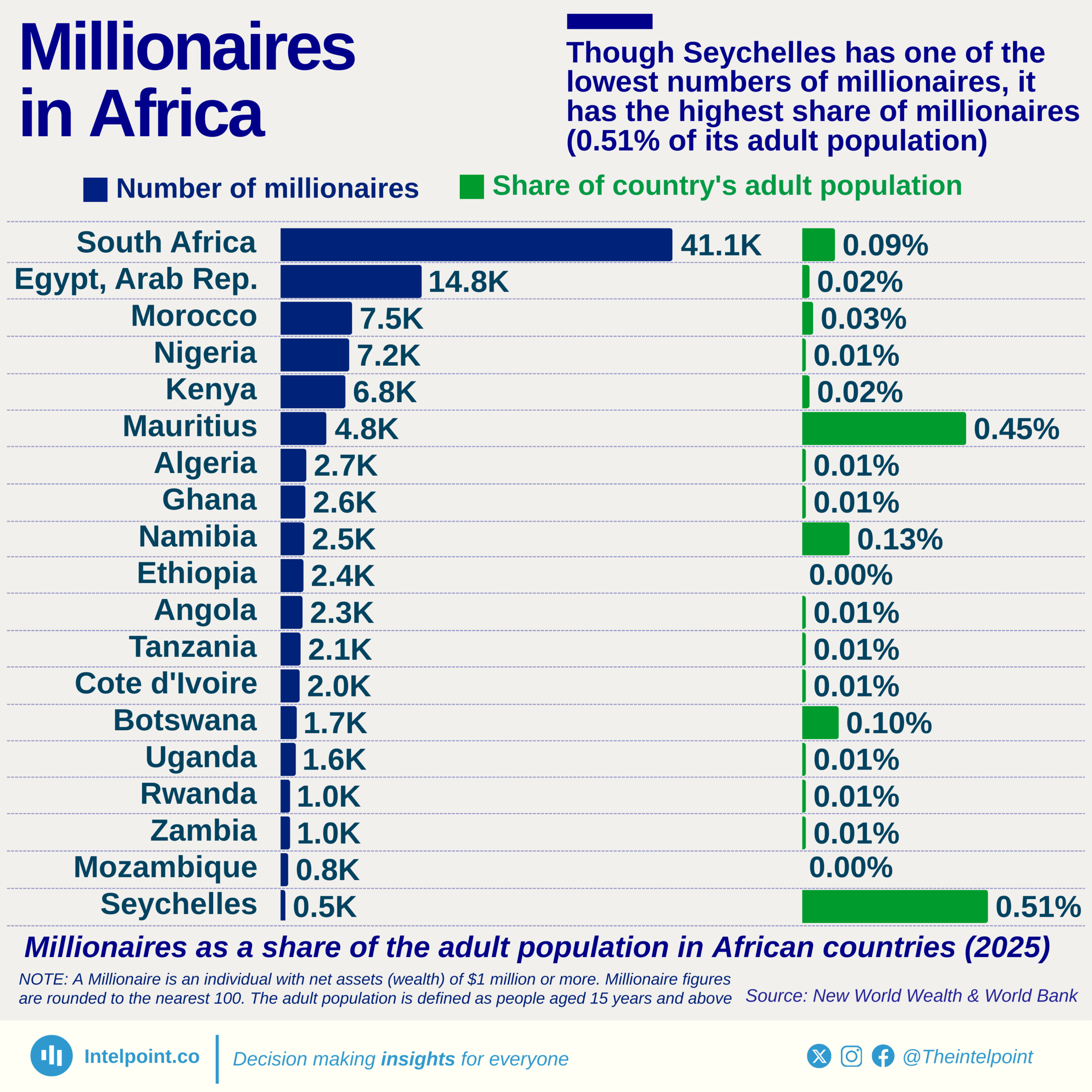
Though Seychelles has one of the lowest numbers of millionaires, it has the highest share of millionaires (0.51% of its adult population)
  • South Africa has the highest number of millionaires in Africa at 41,100.
  • Egypt follows with 14,800 millionaires, making it the second largest hub.
  • Seychelles has the highest millionaire share of the adult population at 0.51%.
  • Mauritius is close behind with 0.45% of its adult population being millionaires.
  • Ethiopia has 2,400 millionaires, but their share is almost zero due to its large adult population.

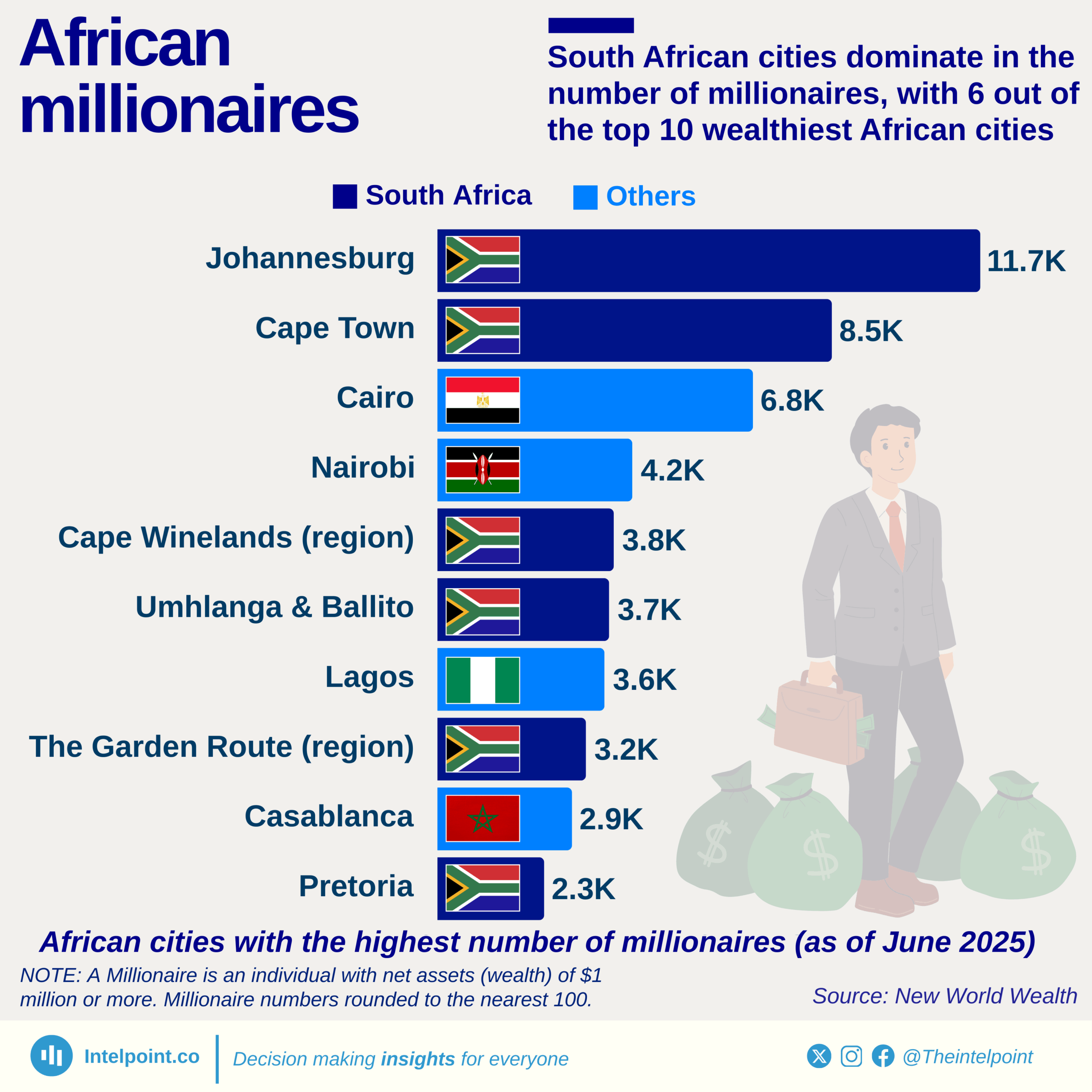
South African cities dominate in the number of millionaires, with 6 out of the top 10 wealthiest African cities
  • Johannesburg is home to the highest number of millionaires in Africa, with 11,700 individuals.
  • Six out of the top ten wealthiest African cities are located in South Africa.
  • Cairo leads North Africa with 6,800 millionaires, showing its dominance as a financial hub.
  • Nairobi has 4,200 millionaires, making it East Africa’s wealthiest city.
  • Lagos, with 3,600 millionaires, remains West Africa’s wealthiest city.
  • Lifestyle regions, such as the Cape Winelands and the Garden Route, feature prominently, reflecting the importance of property and lifestyle economies.
  • Casablanca, with 2,900 millionaires, underscores Morocco’s rising appeal as a North African wealth centre.

POPULAR TOPICS
SIGN UP TO OUR NEWSLETTER
Get periodic updates about the African startup space, access to our reports, among others.
Subscribe Here
Subscription Form

A product of Techpoint Africa. All rights reserved