Bite-sized Insights about
 
Providing you with data-based insights about things happening around you.
Popular Insights
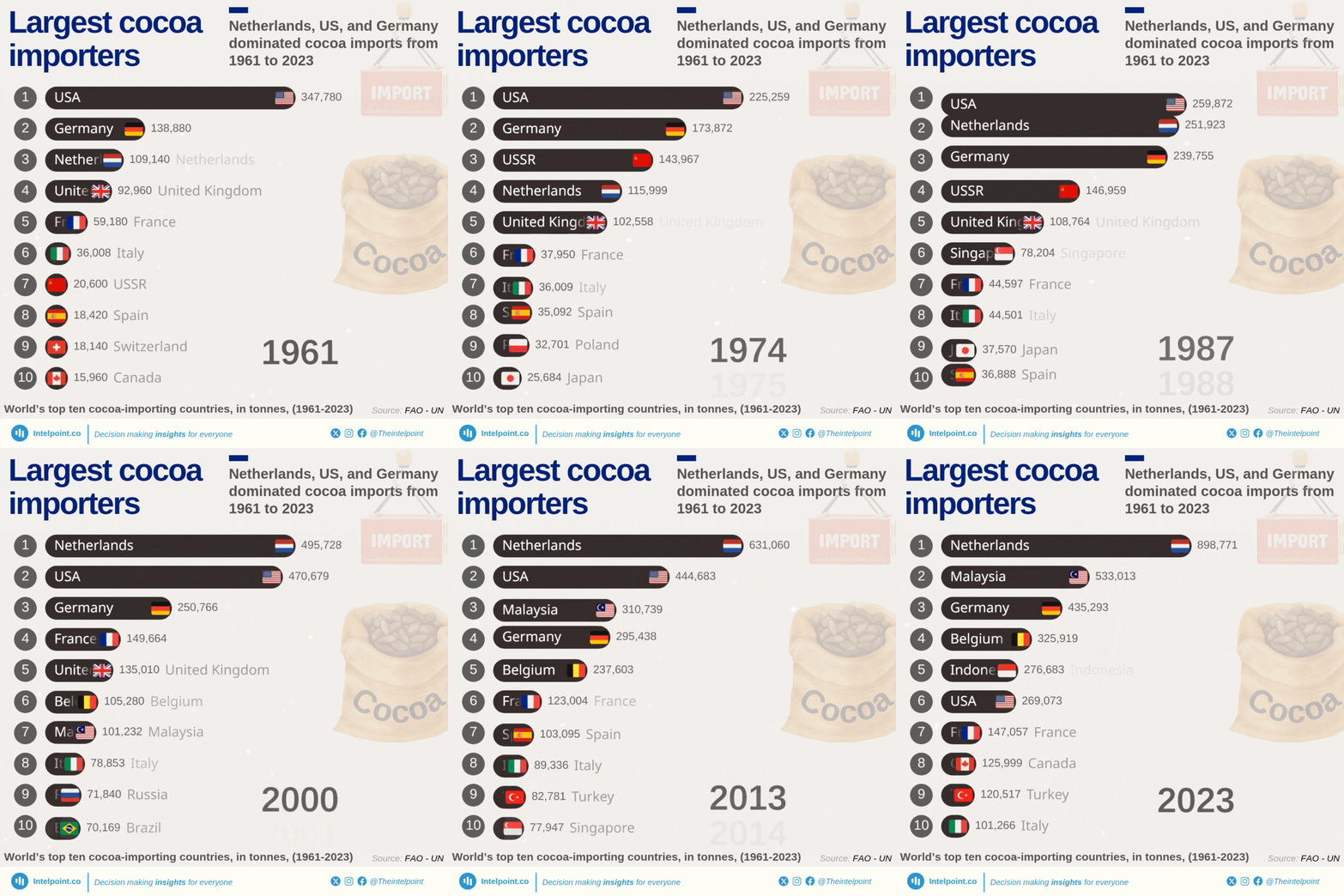
  • Cocoa beans are a vital commodity for many countries, driving their economies and supporting livelihoods. Over the years, cocoa production has seen significant fluctuations across different countries.

    The world's cocoa-producing countries produced 104.2 million tonnes of cocoa beans between 2000 and 2022, enough to fill about 2.084 billion 50kg bags. Côte d'Ivoire maintains its dominance, accounting for 35.3% of global production in the 23 years under review, with Ghana (16.5%), Indonesia (15.4%), and Nigeria (7.7%) completing the top four.

    These are the top ten countries in the period.

    See more

    Nigeria's export value rose by 16.8% quarter-on-quarter and 98% year-on-year, reaching ₦20.49 trillion in Q3 2024. Spain emerged as the top trading partner, with exports valued at ₦2.27 trillion (11%), while Italy rounded out the top five with ₦1.38 trillion (6.72%).

    See more
  • The 2024 Global Peace Index reveals a decline in peacefulness in 97 countries, the highest since the index began.

    Nigeria is among the nations affected by regional conflicts and rising violence. With a peace index score of 2.91, Nigeria is facing increasing challenges.

    A deteriorating peace score impacts foreign investment and economic stability. Global economic losses due to violence reached $19.1 trillion in 2023.

    See more

    The FAAC's revenue distribution from 2017 to August 2023 highlights the dominance of Delta, Akwa Ibom, Rivers, and Bayelsa states in allocations. Despite Lagos' economic prominence, it ranked fifth. Here is the distribution of revenue among states between 2017 and August 2023.

    See more
  • A Trend of Adult literacy rates of African countries

    Between 2018 and 2021, adult literacy rates across African nations exhibited significant disparities. Seychelles and South Africa led with literacy rates of 96% and 95%, respectively, indicating a high proportion of literate adults. Conversely, Chad had the lowest literacy rate during this period.

    These statistics underscore the uneven progress in educational attainment across Africa, highlighting the need for targeted interventions to improve literacy in lower-performing nations.

    See more
    Countries by Global Innovation Index 2024

    The Global Innovation Index 2024 reveals a striking contrast in innovation performance between countries globally and across Africa. Switzerland leads the global rankings with an impressive score of 67.5, followed by Sweden (64.5) and the USA (62.4), highlighting their sustained investments in research, development, and technological advancement.

    In Africa, Mauritius takes the top spot with a score of 30.5, followed closely by Morocco (28.8) and South Africa (28.3). However, even Africa's most innovative nations achieve less than half the score of global leaders, indicating a significant innovation gap.

    Nigeria ranks 15th in the African ranking and 113th globally, out of 133 countries, with a score of 17.1.

    See more

  • Nigeria was the seventh most populous nation in the world in 2020, with 206.1 million people. Projected to reach a population of 401.3 million by 2050, Nigeria will rank third after India (1st) and China (2nd). According to Institut national d'études démographiques' projections, Nigeria, Ethiopia, DR Congo, Egypt, Tanzania, and Kenya will be among the world’s top 20 most populous countries by 2050.

    See more
  • MTN Nigeria has dominated the country's telecommunications market over the years, accounting for the largest market share. All four operators, apart from 9mobile, recorded a significant increase in their subscriber base between May 2014 and March 2024.

    See more
  • The 2024 Global Peace Index reveals a decline in peacefulness in 97 countries, the highest since the index began.

    Nigeria is among the nations affected by regional conflicts and rising violence. With a peace index score of 2.91, Nigeria is facing increasing challenges.

    A deteriorating peace score impacts foreign investment and economic stability. Global economic losses due to violence reached $19.1 trillion in 2023.
    See more

Other Insights
Number of smartphone handsets in use around the world (2015 - 2025)
  • From 2.99B in 2015 to 7.42B in January 2025, the world has added more than 4.4 billion smartphone devices in a decade.
  • Annual growth dropped from a high of 23.1% in 2016 to 3.6% in 2025, a clear sign of global market saturation.
  • During 2016-2018, the world added nearly 2 billion new smartphones.
  • Since 2020, annual growth has been under 6%.
  • Most of the future growth will come from device upgrades or multiple device ownership, not necessarily new smartphone users.
See more
Number of individuals globally using the internet since the creation of the first website (1991 - 2025)
  • Between 1995 and 2000, internet users jumped from 39.4 million to 394 million, a 900% leap that marked the beginning of the digital era.
  • Just 14 years after the first website, over 1 billion people were online, showing how quickly the internet became essential.
  • Between 2010 and 2015, internet usage grew by 54.5%, slower than before but still powerful, especially in developing regions coming online.
  • With 5.6 billion users in January 2025, most of the world is now online, and future growth will be more about improving access, speed, and quality than just connecting new people.
  • Each phase had its catalyst. In the 1990s, it was websites and email. The 2000s brought broadband and Google. In the 2010s, it was smartphones. Now, it's AI, 5G, and IoT that are quietly shaping the future of internet use.
See more
CAGR of nominal GDP per capita of the top ten African economies (2020 - 2024)
 
  • At -16.02% CAGR, Nigeria's GDP per capita is shrinking fast, signalling deep economic strain on its population despite being a top 4 African economy.
  • Angola recorded 8.28% CAGR, showing that smaller economies can drive significant per capita progress when policies and investments align with citizen welfare.
  • With 8.23% CAGR, Algeria continues to transform national wealth into measurable benefits for its people.
  • Ethiopia’s 6.86% annual growth in GDP per capita highlights how consistent development efforts can raise living standards even in densely populated, developing nations.
  • A modest 2.52% CAGR for South Africa might not sound like much, but in a mature economy, this reflects resilience and relative stability in per capita income.
  • Egypt has a -1.41% CAGR, showing mild contraction, but far less severe than Nigeria’s economic shrinkage.
See more
Nominal GDP per capita of top 10 African economies (2024)
 
  • Despite being among the top 4 economies by size, Nigeria ranks low in GDP per capita, revealing a disconnect between total wealth and individual prosperity.
  • With the highest nominal GDP and highest per capita GDP, South Africa showcases balanced growth and better wealth distribution.
  • Countries like Ethiopia and Nigeria have huge populations, which dilutes their GDP and drags down per capita figures.
  • Though fifth in total GDP, Morocco performs better in GDP per capita, highlighting efficiency in wealth distribution.
  • This proves that a country’s economic “size” doesn’t always translate to individual opportunity, wealth, or standard of living.
  • Economies like Nigeria and Ethiopia must focus not just on increasing GDP but on ensuring that economic growth improves lives at the grassroots level.
See more

Key Takeaways:

  • The United States exported $318.7 million worth of agricultural products to Nigeria in 2024.
  • Wheat accounted for nearly half of the US' agricultural exports to Nigeria, valued at $148 million.
  • The trade balance substantially favours the United States, with exports to Nigeria ($318.7 million) nearly double imports ($114.7 million).
  • The top three products account for 74.49% of all agricultural exports to Nigeria.
See more

Key Takeaways:

  • Oilseed meal and cake constituted the United States' largest agricultural import from Nigeria, valued at $29.9 million.
  • Total US agricultural imports from Nigeria in 2024 amounted to $114.7 million.
  • Cocoa beans represented 19% ($21.8 million) of Nigeria's agricultural exports to the US.
  • Oilseed, cocoa, and tea collectively accounted for 59% of the total agricultural exports from Nigeria to the United States.
See more

Key takeaways:

  • Revenue grew impressively from ₦27.8 billion in 2015 to ₦129.2 billion in 2024, a 364% increase.
  • The company recorded profitable years between 2017 and 2022, peaking at ₦1.15 billion profit in 2015.
  • From 2015 to 2019, the company maintained consistent single-digit growth, averaging 9% each year.
  • The revenue more than tripled between 2020 and 2024, reaching ₦129 billion in 2024.
  • Losses were recorded in 2016, 2023, and 2024.
  • Despite revenue more than doubling between 2022 and 2024, profitability reduced dramatically.
See more
  • Rwanda is a global leader in gender-inclusive governance, with nearly two-thirds (63.8%) of its parliament occupied by women.
  • Latin American nations dominate the list, with Cuba (55.7%), Nicaragua (55.0%), and Mexico (50.2%) showing strong female political participation.
  • The UAE stands out as the only Middle Eastern country in the top 10, achieving 50% female representation.
  • Despite being a high-income European nation, Monaco has the lowest representation among the top 10, with women holding only 45.8% of seats.
See more
  • Only 4 countries have ever topped global oil production since 1973: the US, USSR, Saudi Arabia, and Russia.
  • The USSR and Saudi Arabia each led for 17 years, while Russia held 9 and the U.S. reclaimed the top with 8 years, mostly after the shale boom.
  • Top producers have peaked at 9–12 million barrels/day, but the US once dropped as low as 5 million in the 2000s.
  • Nigeria peaked at 2.5 million barrels/day in 2005 and 2011, but never reached the top five.
  • Global crude oil production grew by over 26 million barrels per day between 1973 and 2023—an increase of nearly 47% over 50 years.
See more

Key takeaways:

  • Revenue grew by 402% over a decade, from ₦14 billion in 2015 to ₦70 billion in 2024.
  • The company witnessed an extraordinary post-pandemic recovery, with 111% revenue growth in 2021.
  • There was a consistent strong performance from 2021-2024, with revenue more than tripling.
  • Transcorp Hotels recorded a profit of ₦14.9 billion in 2024, representing a 326% increase from 2015.
  • Despite setbacks, Transcorp Hotels’ performance improved notably from 2021 onward, marking strong growth.
See more

Key takeaways:

  • Despite a profit after tax record of ₦65.5 billion in 2024, Oando Plc recorded a negative growth rate from 2015.
  • The company faced significant profit losses for several years, with notable improvements in 2021 and 2024.
  • Profit after tax fluctuated, with a notable improvement in 2024, reaching ₦65.49 million.
  • The year-on-year growth rate of 148% in 2022 indicates great market positioning.
  • From ₦477.1 billion in 2020 to ₦4.1 trillion in 2024, Oando Plc's revenues increased by 764%.
See more
The average amount of time (in hours and minutes) that internet users worldwide aged 16+ spend with each medium or device each day (as of Jan 2025)
  • With nearly four hours daily, mobile internet is the primary way people interact with content.
  • At 3 hours and 13 minutes daily, TV remains relevant but is being outpaced by mobile consumption.
  • With 2 hours and 21 minutes daily, platforms like Instagram, TikTok, and X are where people spend much of their mobile time.
  • Digital press consumption (58 minutes daily) outpaces traditional print (42 minutes), signalling a continued decline in physical media.
  • Users spend 1 hour 25 minutes on music streaming, but gaming consoles only see 1 hour and 3 minutes, showing that on-the-go entertainment is preferred.
  • With podcasts at 52 minutes and radio at 51 minutes, audio content is still relevant but not as dominant as video and social media.
See more
1 61 62 63 64 65 126
  • Morocco’s GDP per capita has shown a fluctuating pattern in the last 25 years, with periods of steady growth and also fall.
  • The years 2003–2008 stand out as a high-growth phase, with GDP per capita rising rapidly from $1,941.9 to $3,183.2.
  • In 2021, a dramatic 15.9% rebound took GDP per capita up to $3,785.9.
  • In 2024, nominal GDP per capita stood at $3,993.4.
  • The last 25 years depict a more than twofold increase in Morocco’s GDP per capita, moving from $1,499.1 to $3,993.4.
Read more
  • Egypt remained the lead African country with the highest number of international scholars in the US, with 942 recorded in the 2023/2024 academic session.
  • As of the 2023/2024 academic session, 4,679 international scholars in the United States of America are from Africa.
  • A total of 931 international scholars in the US as of the same session are from Nigeria.
  • Africa produced 4.2% of the international scholars in the US for the session under review.
Read more
  • Nigeria has been the second leading source of African scholars in the US since 2008/09 to 2023/24, after overtaking South Africa.
  • By the 2023/24 academic session, the number of Nigerian scholars in the US reached 931.
  • Given past trends, it’s not unrealistic to predict that Nigeria could surpass Egypt in the near future, just as it did South Africa.
  • Approximately 20% of the African scholars in the US are Nigerians.
Read more
  • Only 37 countries produced bio-diesel in 2023.
  • No African country produced bio-diesel.
  • The US remained the dominant producer of bio-diesel with 15.25 million metric tons produced in 2023, which is 36% of the total quantity produced globally.
  • Germany was the top exporter of bio diesel with 2.18 million metric tons.
Read more
  • Nigeria leads Africa with 238 million people in July 2025.
  • Namibia, though the second largest in the South, has only 3 million people.
  • In Eastern Africa, Ethiopia (135M) and Tanzania (71M) dominate.
  • Egypt (118M) and Sudan (52M) are Northern Africa’s population leaders.
  • South Africa (65M) is Southern Africa’s most populous country, far ahead of Namibia.
  • In West Africa, Nigeria (238M) and Ghana (35M) are the most populous, showing a wide gap within the region.
Read more
  • Africa’s pig herd expanded nearly nine-fold, from 8.4 million in 1961 to 48.9 million in 2023.
  • Despite this growth, Africa accounts for only 5.1% of the world’s pigs in 2023.
  • South Africa led pig production for decades until the late 1980s, when Nigeria overtook and has remained the top producer since.
  • Malawi and Uganda emerged as major players in the 2000s–2010s, now ranking among the top three producers.
  • Nigeria, Malawi, and Uganda together hold nearly 50% of Africa’s total herd.
  • Africa’s pig farming is shifting from being dominated by one or two players to a more regionally balanced mix.
Read more
1 61 62 63 64 65 252

Can’t find what you’re looking for? Please fill the form below
Contact Form Demo
SIGN UP TO OUR NEWSLETTER
Get periodic updates about the African startup space, access to our reports, among others.
Subscribe Here
Subscription Form

A product of Techpoint Africa. All rights reserved