Bite-sized Insights about
 
Providing you with data-based insights about things happening around you.
Popular Insights
  • Nigeria's manufacturing sector contributed 9.2% (₦3.37 trillion) to the total GDP in H1 2024, mainly driven by food, clothing, and cement, which make up a combined 79.5% of the sector's GDP.

    Smaller sectors like Non-Metallic Products, Wood & Wood Products, and Motor Vehicles & Assembly could expand with targeted investments. The minimal impact of Oil Refining and Electrical & Electronics underscores the need for diversification.

    See more

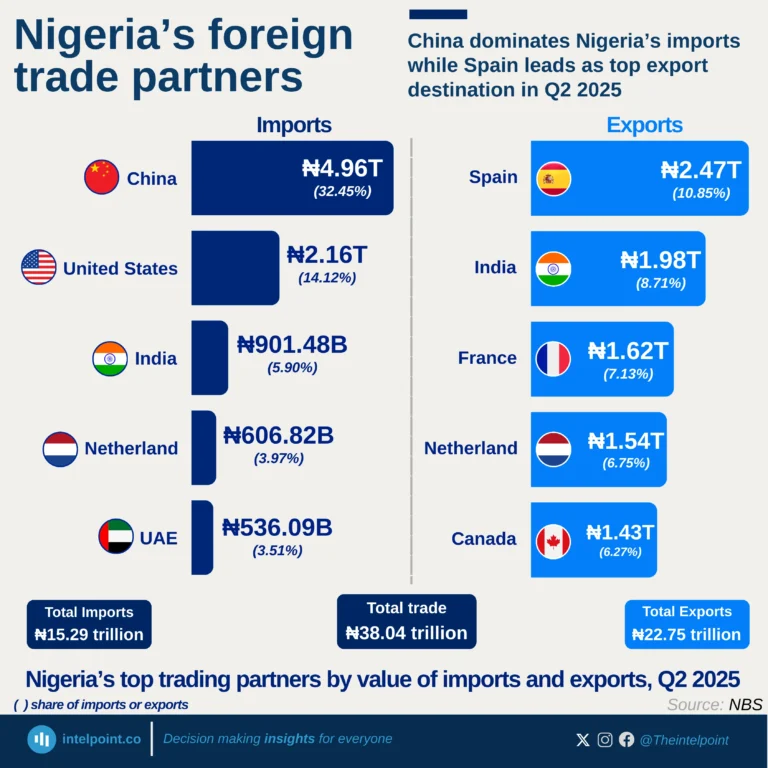
    Nigeria's export value rose by 16.8% quarter-on-quarter and 98% year-on-year, reaching ₦20.49 trillion in Q3 2024. Spain emerged as the top trading partner, with exports valued at ₦2.27 trillion (11%), while Italy rounded out the top five with ₦1.38 trillion (6.72%).

    See more
  • The 2024 Global Peace Index reveals a decline in peacefulness in 97 countries, the highest since the index began.

    Nigeria is among the nations affected by regional conflicts and rising violence. With a peace index score of 2.91, Nigeria is facing increasing challenges.

    A deteriorating peace score impacts foreign investment and economic stability. Global economic losses due to violence reached $19.1 trillion in 2023.

    See more

    The FAAC's revenue distribution from 2017 to August 2023 highlights the dominance of Delta, Akwa Ibom, Rivers, and Bayelsa states in allocations. Despite Lagos' economic prominence, it ranked fifth. Here is the distribution of revenue among states between 2017 and August 2023.

    See more
  • A Trend of Adult literacy rates of African countries

    Between 2018 and 2021, adult literacy rates across African nations exhibited significant disparities. Seychelles and South Africa led with literacy rates of 96% and 95%, respectively, indicating a high proportion of literate adults. Conversely, Chad had the lowest literacy rate during this period.

    These statistics underscore the uneven progress in educational attainment across Africa, highlighting the need for targeted interventions to improve literacy in lower-performing nations.

    See more
    Countries by Global Innovation Index 2024

    The Global Innovation Index 2024 reveals a striking contrast in innovation performance between countries globally and across Africa. Switzerland leads the global rankings with an impressive score of 67.5, followed by Sweden (64.5) and the USA (62.4), highlighting their sustained investments in research, development, and technological advancement.

    In Africa, Mauritius takes the top spot with a score of 30.5, followed closely by Morocco (28.8) and South Africa (28.3). However, even Africa's most innovative nations achieve less than half the score of global leaders, indicating a significant innovation gap.

    Nigeria ranks 15th in the African ranking and 113th globally, out of 133 countries, with a score of 17.1.

    See more

  • Bitcoin has seen remarkable growth since 2010. Starting from a high of just $0.5 in 2010, it reached an all-time high of $73.7k in March 2024.

    It recorded new peaks in 2011, 2013, 2017, 2020, 2021, and recently in 2024.

    See more
  • MTN Nigeria has dominated the country's telecommunications market over the years, accounting for the largest market share. All four operators, apart from 9mobile, recorded a significant increase in their subscriber base between May 2014 and March 2024.

    See more
  • The 2024 Global Peace Index reveals a decline in peacefulness in 97 countries, the highest since the index began.

    Nigeria is among the nations affected by regional conflicts and rising violence. With a peace index score of 2.91, Nigeria is facing increasing challenges.

    A deteriorating peace score impacts foreign investment and economic stability. Global economic losses due to violence reached $19.1 trillion in 2023.
    See more

Other Insights
Cellular mobile connections compared with total population (Percentage per region), as of Jan. 2025
  • Southern Africa is the global leader in mobile connectivity, with 183% mobile connections compared to its population, significantly ahead of all other regions.
  • The world’s most connected regions are outside North America and Western Europe, with Eastern Europe (144%), Eastern Asia (133%), and Southern Europe (131%) leading the charge after Southern Africa.
  • Africa is deeply divided in mobile adoption. While Southern Africa dominates, Eastern Africa (79%) and Middle Africa (66%) have a lower penetration.
  • Some regions have more mobile connections than people. The fact that multiple regions exceed 100% connectivity means that many individuals own multiple SIM cards, a trend driven by business needs, mobile money, and telecom competition.
  • Western Africa, at 85% connectivity, is doing better than Eastern Africa but still lags behind the global average, signaling potential for more growth in mobile adoption.
See more
Share of individuals in each generation (January 2025)
  • Generation Alpha is the largest generation, making up 24.4% of the global population.
  • Gen Z and Millennials still hold strong influence, comprising 22.9% and 21.2% of the global population.
  • The Baby Boomer generation (12.8%) is gradually declining, which will impact industries like retirement services, healthcare, and wealth distribution.
  • The Silent Generation is now just 2% of the population, highlighting the demographic shift away from the older generations.
  • Generation X, at 16.7%, remains a crucial but often overlooked group, balancing leadership roles in business and governance while supporting both older and younger generations.
  • The rise of Generation Alpha signals the dawn of an even more digital-native world, shaping the future of education, marketing, and work environments.
  • With Millennials, Gen Z, and Gen Alpha making up nearly 70% of the population, the global workforce, economy, and social dynamics will see rapid transformation in the coming years.
See more
Percentage of internet users globally aged 16+ who consume each media type (as of Q3 2024)
  • Social media is not optional; it’s universal, with 93% usage globally.
  • Traditional broadcast TV still sees 89.7% usage, and streaming TV (77.1%) isn’t far behind.
  • Individuals consume online news more than physical newspapers.
  • 66.4% still tune in to radio, showing that audio content still has a loyal base.
  • At 65.3% usage, platforms like Spotify and Apple Music are not just for entertainment; they’re part of people’s routines.
  • With 63.7% global engagement, podcasts are now a core part of modern media usage.
See more
Nigeria's capital expenditure as a percentage of GDP (1981–2024)
  • From an average of 4.33% in 1981–2001 to just 1.58% in 2002–2024, Nigeria’s capital expenditure as a percentage of GDP has more than halved.
  • The early 2000s marked a major turning point. After peaking at 9.1% in 1999, capital spending nosedived, rarely surpassing 2% in the last two decades.
  • Recent figures show Nigeria’s capital expenditure hovering around 1–2% of GDP.
  • The data suggests a move away from infrastructure investments, potentially prioritising recurrent expenditure such as salaries and overheads.
  • Low capital spending can slow infrastructure development, limiting productivity, economic expansion, and foreign investment attractiveness.
  • If Nigeria is to achieve sustainable growth, there needs to be a renewed focus on capital investments to drive industrialisation, improve public services, and create jobs.
See more
Total funding raised in East Africa, excluding exits (2019 - 2024)
  • Kenya is the absolute leader in startup funding, with $3.3 billion raised in the past six years.
  • The rest of East Africa is way behind, with Tanzania ($286M), Uganda ($183M), and Rwanda ($91M) being the next in line. But collectively, they don’t even match 20% of the funding Kenya received.
  • The total funding raised across East Africa from 2019 to 2024 is $3.94 billion, which means Kenyan startups alone secured more than 8 out of every 10 dollars invested in the region.
  • Investor confidence is highly concentrated in Kenya, largely due to its well-developed venture capital ecosystem, startup accelerators, and government support for innovation.
See more
Kenya's share of startup funds raised in East Africa, excluding exits (2019 - 2024)
  • Kenya dominates East Africa’s startup funding, securing over 83% of all funds raised between 2019 and 2024 — a clear indication of its position as the region’s startup capital.
  • Kenya’s startup funding share has remained consistently above 80% since 2020.
  • 2023 and 2024 saw Kenya secure nearly 89% of all funds, marking its strongest position.
  • Other East African countries combined have not received more than 30% of the funding in any year since 2019.
  • The lowest share of funding Kenya secured was in 2019 (69.81%).
See more
Percentage of internet users globally aged 16+ who own each kind of device (January 2025)
  • Smartphones are nearly universal, with only 2.2% of internet users worldwide not owning one.
  • Laptop and desktop ownership (58.3%) lags behind smartphones, reinforcing the shift toward mobile-first usage for internet access.
  • Smart TVs (48.2%) are closing in on traditional computing devices, showing how entertainment consumption is increasingly digital and on-demand.
  • Wearables are rising, with smartwatches (25.8%) and smart wristbands (12.9%) becoming more mainstream, signalling a growing appetite for health and fitness tracking.
  • Gaming consoles (18.9%) and smart home devices (17.4%) have niched but steady adoption, appealing to entertainment and home automation enthusiasts.
  • Virtual Reality (VR) remains a specialty product, with just 4.7% ownership.
  • For businesses, the mobile-first reality is non-negotiable —any service, product, or content must prioritise accessibility via smartphones to reach the widest audience.
See more
Share of Nigeria's federal government capital expenditure (1999 - 2023)
  • Economic services still receive the largest share of capital expenditure (47% on average), which has declined over time, raising concerns about long-term infrastructure development.
  • Spending on administration has risen, now accounting for a quarter of total capital expenditure (25%), highlighting a stronger focus on governance and institutional processes.
  • Social community services (such as education and healthcare) have seen growth in allocation, reaching around 12-19% in recent years, signalling a shift toward social development.
  • Transfers, which are funds allocated to specific entities or programmes, have fluctuated but occasionally spiked.
See more

Key takeaways:

  • Africa's ten most profitable banking institutions are concentrated in South Africa, Egypt, and Nigeria.
  • South African and Egyptian banks claim the first five positions among Africa's most profitable banks.
  • Nigeria's banking sector shows resilience, with three of its "FUGAZ" banks securing positions in the continental top ten.
  • The average profit after tax among Africa's top ten profitable banks reached $867 million.
  • The four most profitable banks in Africa each exceeded $1 billion in profit after tax.
See more

Key Takeaways:

  • MTN Nigeria's income tax payments consistently rose from ₦75.66 billion in 2018 to ₦170.1 billion in 2022.
  • In 2023, there was a significant drop in the payments, which fell to ₦40.87 billion, the lowest in the period under review.
  • In 2024, MTN Nigeria saw its income tax jump by 267% from 2023's figure.
  • The company achieved its peak income tax payment of ₦170.1 billion in 2022.
  • The income tax for MTN in 2023 dropped by ~76% due to substantial forex loss from naira devaluation.
See more

Key Takeaways:

  • Okomu Oil Palm Company's revenue expanded by 1,236%, from ₦9.74 billion in 2015 to ₦130.06 billion in 2024.
  • Profit after tax saw a substantial increase of 1,189%, from ₦2.66 billion in 2015 to ₦34.27 billion in 2024.
  • The most significant profit growth took place between 2021 and 2024, with profit almost tripling during this timeframe.
  • Although there have been some variations in profit margins, the company has consistently realised growth annually.
  • The figures for revenue and profit reached their peak in 2024.
  • The disparity between revenue and profit after tax in 2024 is significantly greater than in earlier years.
See more

Key Takeaways:

  • Dangote Sugar Refinery saw impressive growth rates of 68% in 2016 and 51% in 2024, marking periods of considerable expansion.
  • The company’s revenue rose from ₦101.06 billion in 2015 to ₦665.69 billion in 2024.
  • There were notable year-on-year fluctuations, with growth rates varying from -26% to 68%.
  • The period from 2020 to 2024 indicated particularly strong performance, featuring consistent positive growth.
  • The highest revenue allocation for the company was noted in 2024.
See more
1 62 63 64 65 66 126
  • Gabon (84%) is Africa’s most urbanised country, while Burundi (15%) is the least.
  • Five of the top 10 urbanised African countries have an urban share above 75%.
  • Small island nations like Cabo Verde (79%) and Sao Tome & Principe (78%) rank highly, reflecting their concentrated settlements.
  • Resource-rich countries like Libya (78%), Botswana (76%), and Algeria (74%) show strong urbanisation patterns.
  • Ethiopia (23%) and Uganda (30%) highlight the urbanisation gap among high-population countries.
  • Nigeria sits at 55%, ranked 19th, reflecting moderate urbanisation compared to other African giants.
  • Most of the bottom 10 countries, such as Malawi (20%), Niger (18%), and Rwanda (18%), are still heavily rural, signalling slower urban development.
Read more
  • Africa’s urban population has grown more than twelvefold, from 53 million in 1960 to nearly 700 million by 2025.
  • The share of Africans living in urban areas has risen from 18.7% in 1960 to 45% in 2025, and is projected to hit 57% by 2045.
  • Africa will reach a 50% urban population by 2035, where half of its population will reside in cities.
  • From 2000 to 2025, Africa’s urban population nearly tripled, highlighting the intensity of recent growth.
  • By 2045, 1.3 billion Africans will live in urban centres, making city development central to the continent’s progress.
Read more
  • More than 60% of the countries in Africa are commodity-dependent.
  • South Sudan leads the list with 99.5%.
  • Nigeria’s commodity export dependence is 96.3%, dominated by energy (89.7%), followed by agriculture (4.0%) and mining (2.6%).
  • Africa alone accounts for nearly 47% of all commodity dependent countries globally.
Read more
  • Of the 54 African countries, 46 earn more than 60% of export revenues from raw goods.
  • Algeria, Morocco, Eswatini, Lesotho, Djibouti, Mauritius, Comoros, and Egypt stand out with less than 60%.
  • Algeria and Morocco are the least dependent, pointing to stronger industrial and trade sectors.
  • Lower dependence means greater economic stability, while high reliance exposes countries to volatile global commodity markets.
Read more
  • Africa has the youngest population globally, with a median age of 19.3 years.
  • Europe has the oldest population, with a median age of 42.8 years.
  • North America follows closely behind Europe, with a median age of 38.7 years.
  • Oceania’s median age stands at 33.4 years, slightly higher than Asia’s.
  • Asia’s population is relatively younger than Europe and North America, with a 32.5-year median age.
  • The age gap between Africa and Europe is over 23 years, showing the stark global demographic divide.
Read more
  • Subscriptions peaked at 23.5 million in 2015 before a long decline.
  • The 2017 debt crisis and Etisalat UAE’s exit triggered sustained losses.
  • By mid-2025, active lines had plunged to 2.4 million, the steepest fall in the sector.
  • In August 2025, the firm rebranded as T2, unveiling a new plan to stabilise and grow again
Read more
1 62 63 64 65 66 252

Can’t find what you’re looking for? Please fill the form below
Contact Form Demo
SIGN UP TO OUR NEWSLETTER
Get periodic updates about the African startup space, access to our reports, among others.
Subscribe Here
Subscription Form

A product of Techpoint Africa. All rights reserved