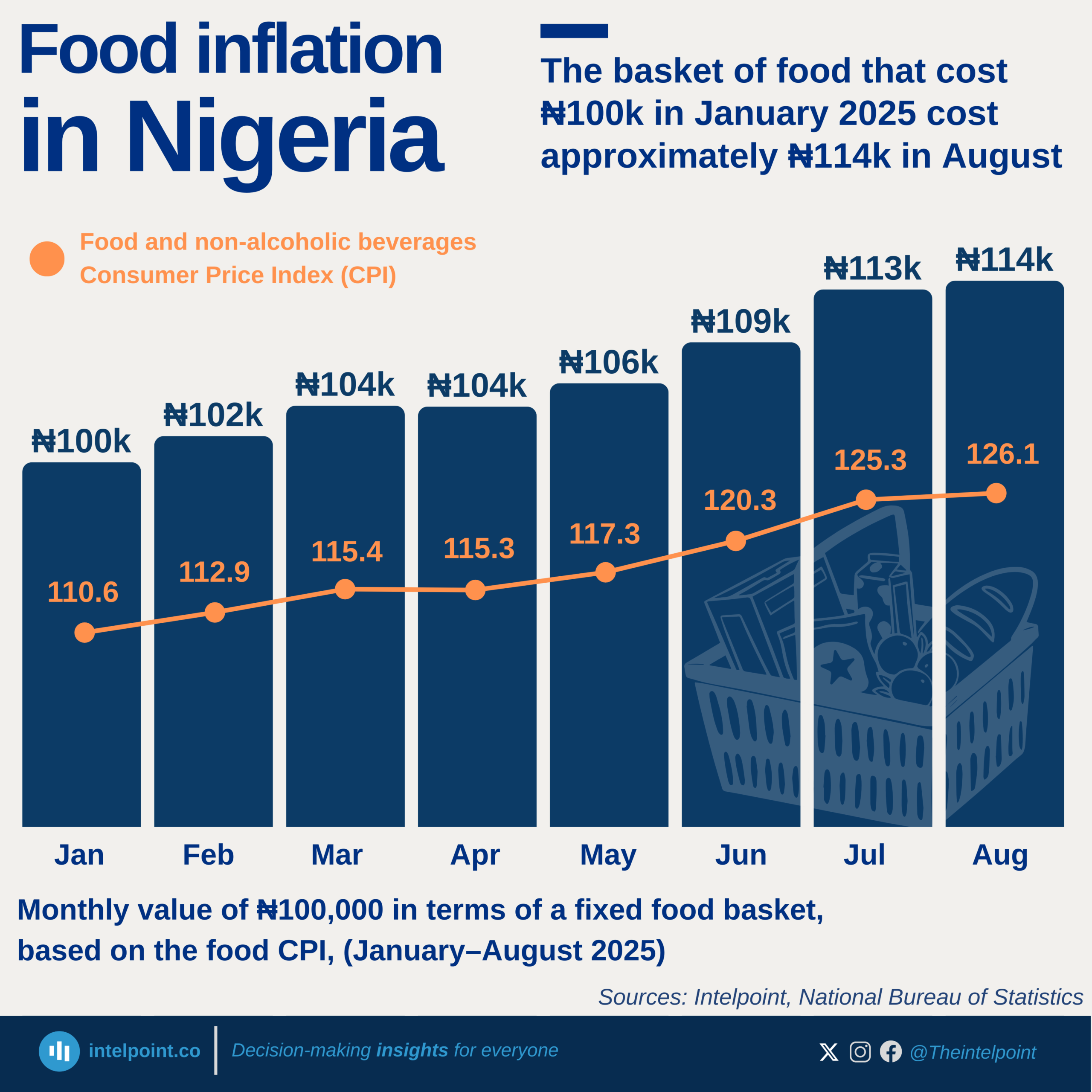
The basket of food that cost ₦100k in January 2025 cost approximately ₦114k in August

  • Food prices rose roughly 13.9% from January to August 2025, according to the rebased Consumer Price Index (CPI) from the National Bureau of Statistics.
  • Month-on-month inflation for food fluctuated, with some months seeing sharper increases than others.
  • Using January as a baseline, the purchasing power of money for food declined steadily, meaning households need more naira to buy the same items.
  • Food carries a large weight in the CPI basket, making it a major driver of overall inflation and cost-of-living increases.

This chart shows how much money you would need each month to buy the same food and non-alcoholic beverages that cost ₦100,000 in January 2025. The values are calculated using the month-on-month CPI for food, which tracks changes in prices over time.

Food prices have steadily increased in Nigeria this year. Based on the rebased Consumer Price Index (CPI) from the National Bureau of Statistics, the cost of the basket of food and non-alcoholic beverages rose about 13.9% between January and August 2025.

Using January as a baseline, this means that the amount of money that could buy a typical food basket in January increased by roughly 14% by August to purchase the same items, illustrating the erosion of household purchasing power due to inflation.
Source:

Intelpoint, National Bureau of Statistics

Period:

January-August 2025
HTML code to embed chart
Want a bespoke report?
Reach out
Tags
Related Insights

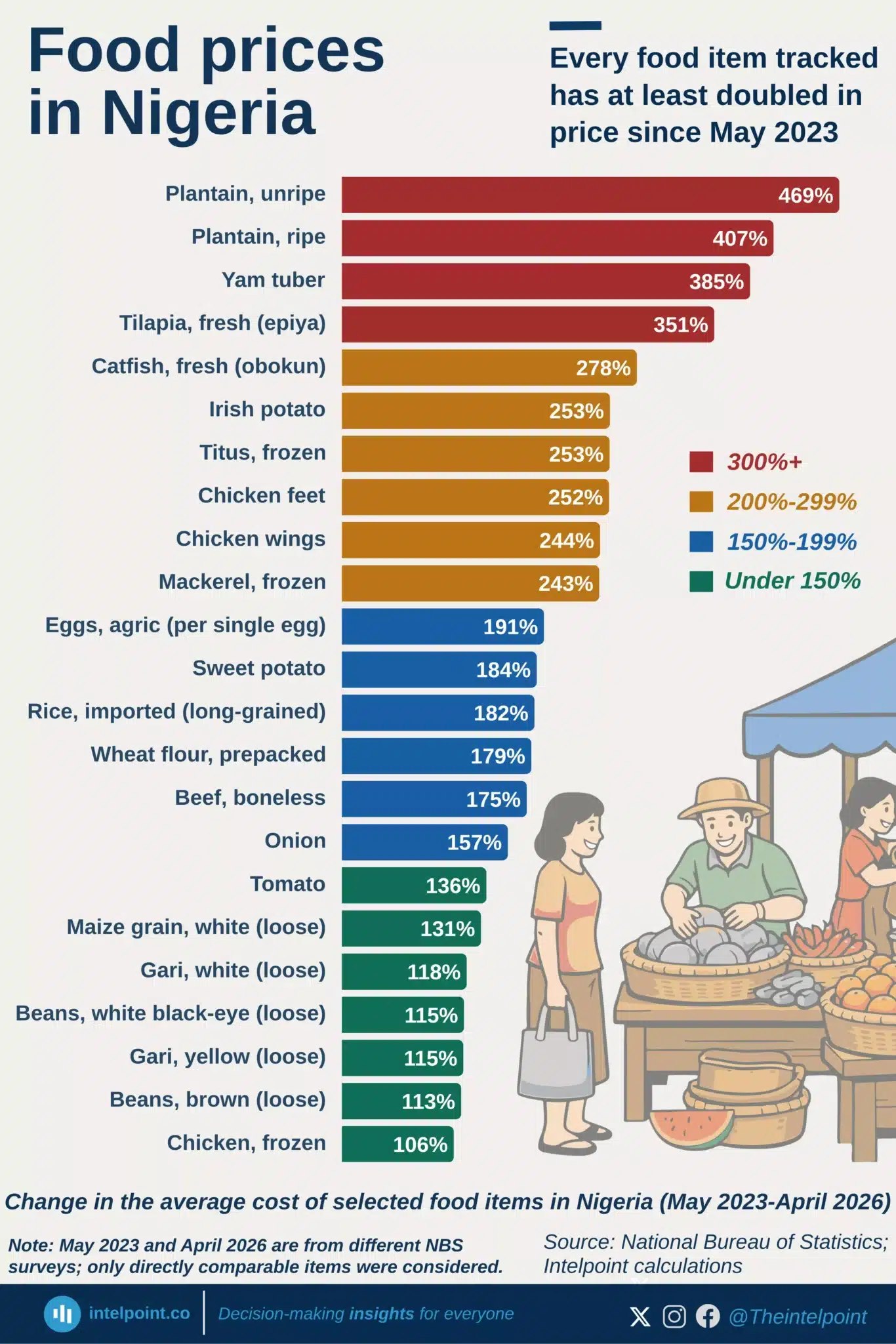
Every food item tracked has at least doubled in price since May 2023
  • Every comparable food item tracked is now at least twice as expensive as it was in May 2023.
  • Nearly half of the selected food items have more than tripled in price since the month before fuel subsidy removal.
  • Unripe plantain recorded the steepest increase, rising by 469% between May 2023 and April 2026.
  • Ripe plantain, yam tuber, and fresh tilapia also saw extreme increases of more than 300%.
  • Even the slowest-rising staples, including frozen chicken, beans, gari, and maize, still more than doubled in price.

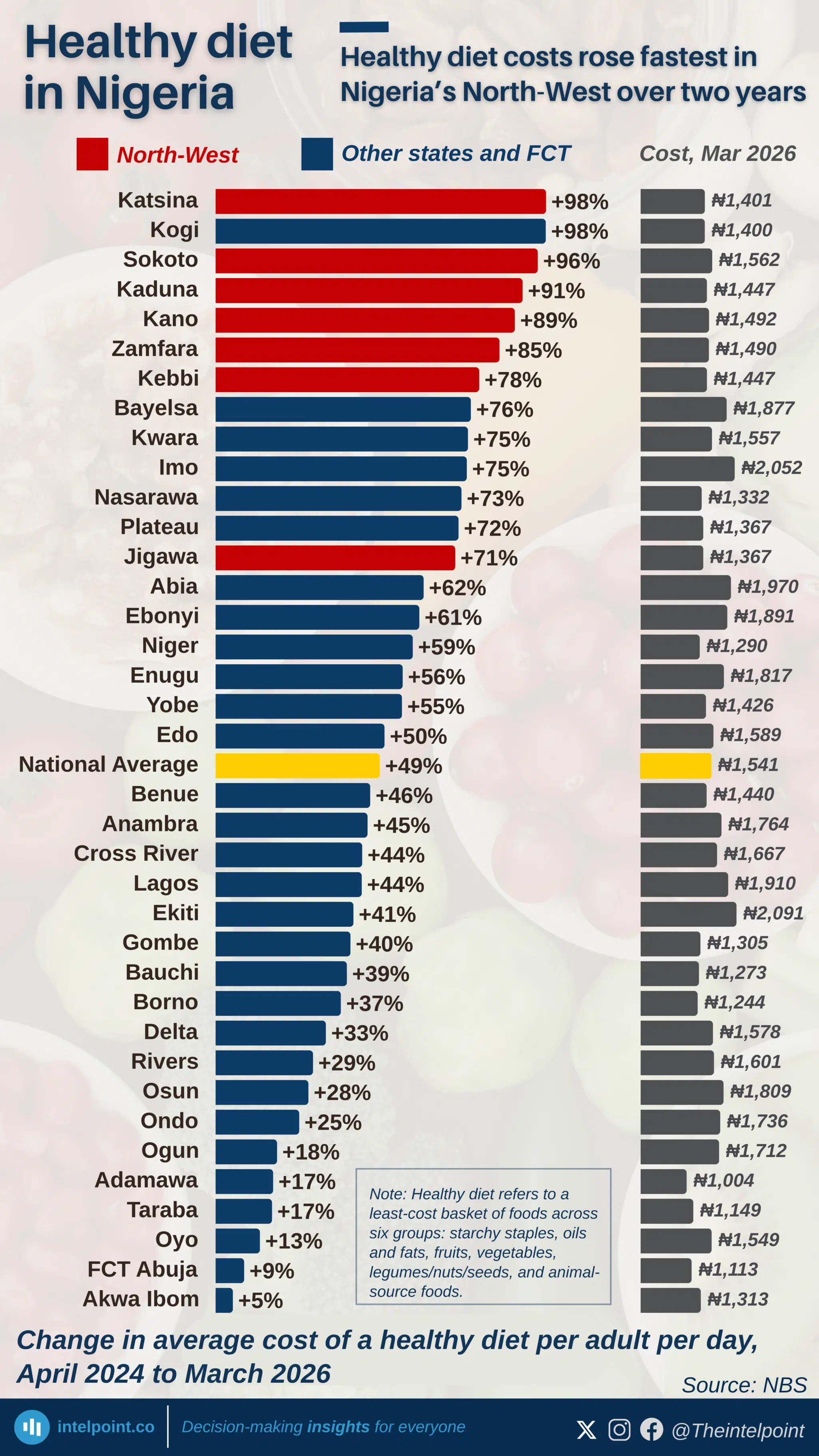
Healthy diet costs rose fastest in Nigeria’s North-West over two years
  • Healthy diet costs rose 49% nationally in two years.
  • North-West states recorded the fastest increases.
  • All seven North-West states rose above the national average.
  • Katsina and Kogi recorded the steepest increases, at 98%.
  • Akwa Ibom had the lowest increase, at 5%.

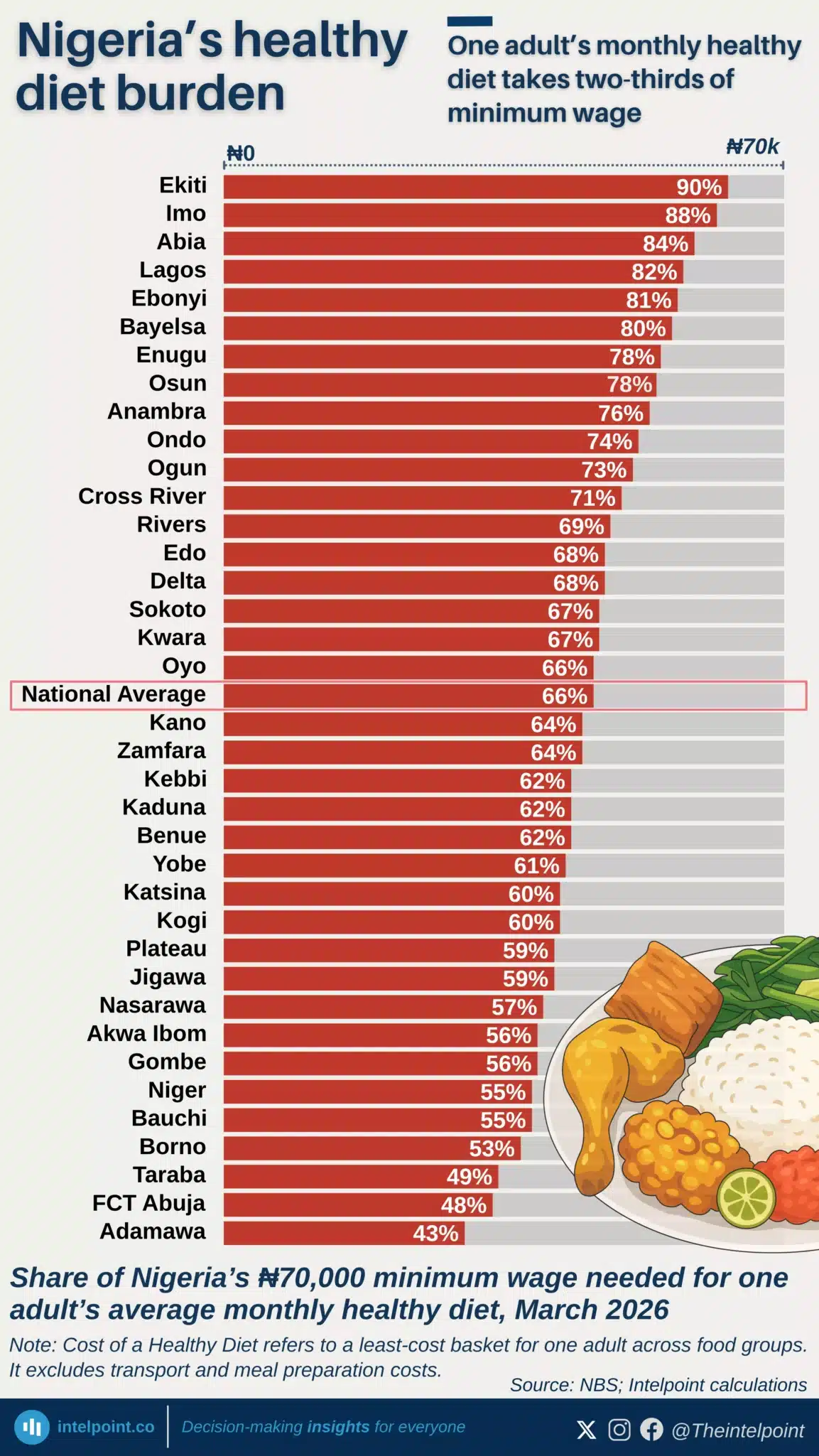
One adult’s monthly healthy diet takes two-thirds of minimum wage
  • One adult’s healthy diet takes 66% of Nigeria’s minimum wage.
  • The national average monthly cost is about ₦46,230 per adult.
  • Ekiti has the highest burden, at 90% of minimum wage.
  • Six states require over 80% of minimum wage for one adult’s healthy diet.
  • Adamawa has the lowest burden, at 43%.

South Sudan tops Africa's food inflation list with 106%; two other East African nations in top 5
  • South Sudan and Zimbabwe have crossed 100% food inflation.
  • Three of the top five countries with the highest food inflation in Africa are in East Africa, showing a regional pattern of vulnerability.
  • Nigeria ranks 7th in Africa for food inflation at 21.3%, underlining persistent cost-of-living pressures despite being a major economy.
  • Liberia and Zambia round out the top 10 with double-digit food inflation.
  • Djibouti, Somalia, and Senegal are experiencing food price deflation, setting them apart from most African countries.

In January 2025, the food inflation rate dropped to 26.08% from 39.84% in December 2024
Key takeaways:
  • The inflation rate experienced a growth rate of 60.5% from May 2023 to December 2024.
  • The May 2024 food inflation rate grew by 15.84% points higher than May 2023 levels.
  • The most significant monthly increase occurred in February 2024, when food inflation rose by 2.51% from January 2024.
  • Brief periods of relief were observed in July, August, and December 2024, when the rates showed slight declines.
  • The food inflation rate dropped by 13.76% between December 2024 and January 2025 due to CPI rebasing to 2024 from 2009.

The inflation rate of all items, excluding farm produce and energy, reached 29.28% as of December 2024, a 9.45% increase from May 2023
Key takeaways:
  • February 2024 saw the largest month-on-month rise in inflation, climbing nearly 2% from 23.59% in January 2024.
  • Nigeria experienced brief periods of relief, with slight drops in core inflation during November 2023 and September 2024.
  • From May 2023 to December 2024, the inflation rate fluctuated within the 20% to 30% range.
  • December 2023 registered the highest inflation rate during the first eight months of the observed period.
  • The core inflation rate dropped to 22.59% in January 2025 from 29.28% in December 2024 due to the Consumer Price Index rebasing from 2009 to 2024.

POPULAR TOPICS
SIGN UP TO OUR NEWSLETTER
Get periodic updates about the African startup space, access to our reports, among others.
Subscribe Here
Subscription Form

A product of Techpoint Africa. All rights reserved