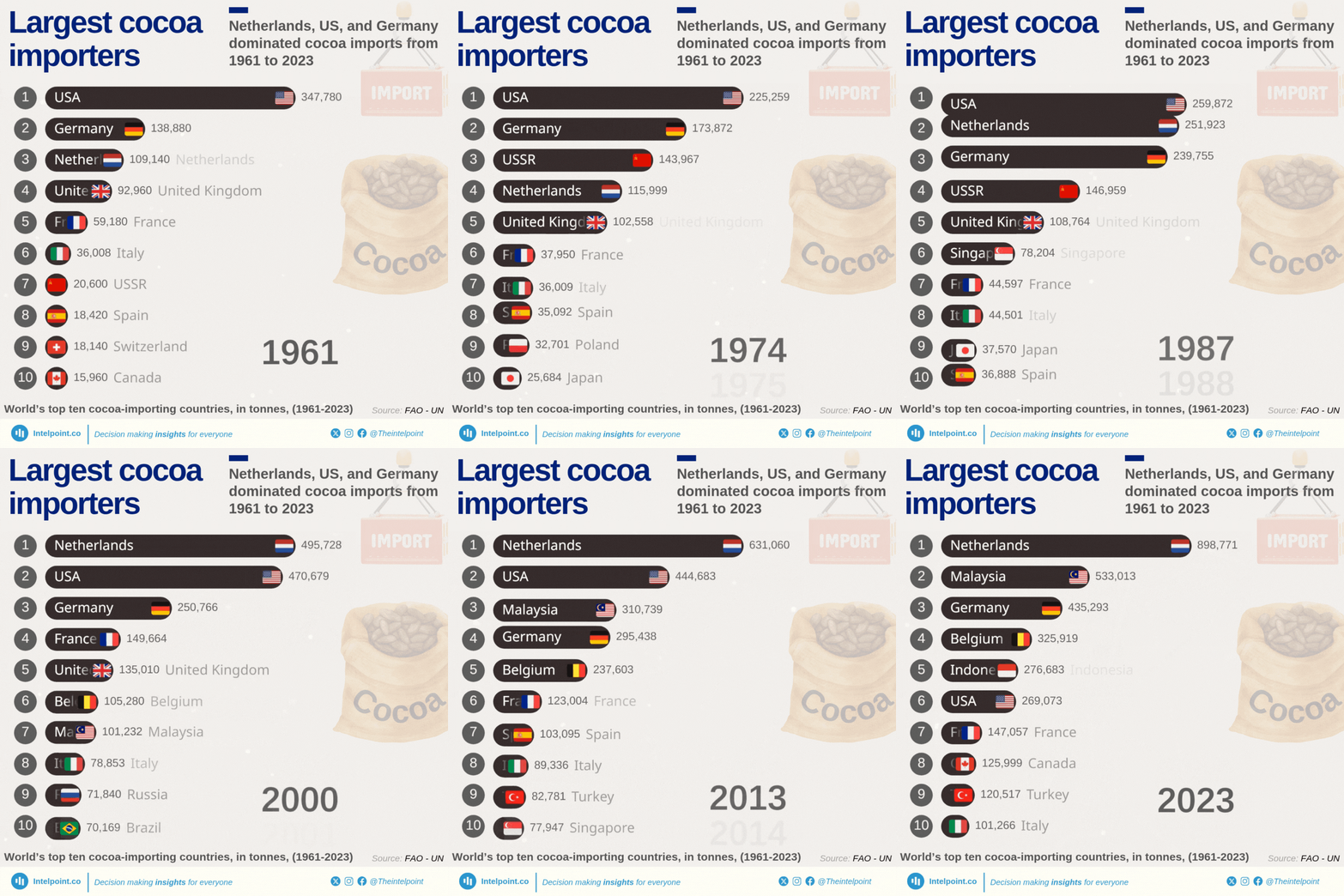
Netherlands, US, and Germany dominated cocoa imports from 1961 to 2023

  • Netherlands imported the most cocoa beans — 25.48 million tonnes (1961–2023)
  • US (21.1M) and Germany (16.8M) followed in total volume
  • These three countries dominated the top 5 nearly every year
  • Malaysia, UK, France, and Belgium also ranked high over time
  • USSR stayed in the top 10 despite dissolving in 1991
  • Global cocoa imports grew from 1M tonnes in 1961 to nearly 4M in 2023

If you eat chocolate or anything made with cocoa-based fillings, there’s a good chance the raw beans passed through the Netherlands. Netherlands imported more cocoa beans than any other country in the world — 25.48 million tonnes across the 63-year span.

The US followed with 21.1 million tonnes, then Germany with 16.8 million. These three rarely dropped out of the top five in any given year. Malaysia climbed into the upper ranks starting in the 1980s, while the UK remained a steady buyer throughout. France, Belgium, and Italy also posted strong import volumes. The USSR, despite going inactive after 1991, still finished in the all-time top 10.

The numbers go beyond consumption. In the case of the Netherlands, it’s backed by one of the world’s largest cocoa grinding and processing industries. Facilities in Amsterdam and Zaandam have made the country a key hub for turning raw cocoa into butter, powder, and other ingredients used by global food brands, as documented by the International Cocoa Organization and other trade reports.

This long-term growth mirrors a global trend: total cocoa bean imports quadrupled between 1961 and 2023, rising from just over 1 million tonnes to nearly 4 million.
Source:

Food and Agriculture organization of the UN

Period:

1961-2023
HTML code to embed chart
Want a bespoke report?
Reach out
Tags
Related Insights

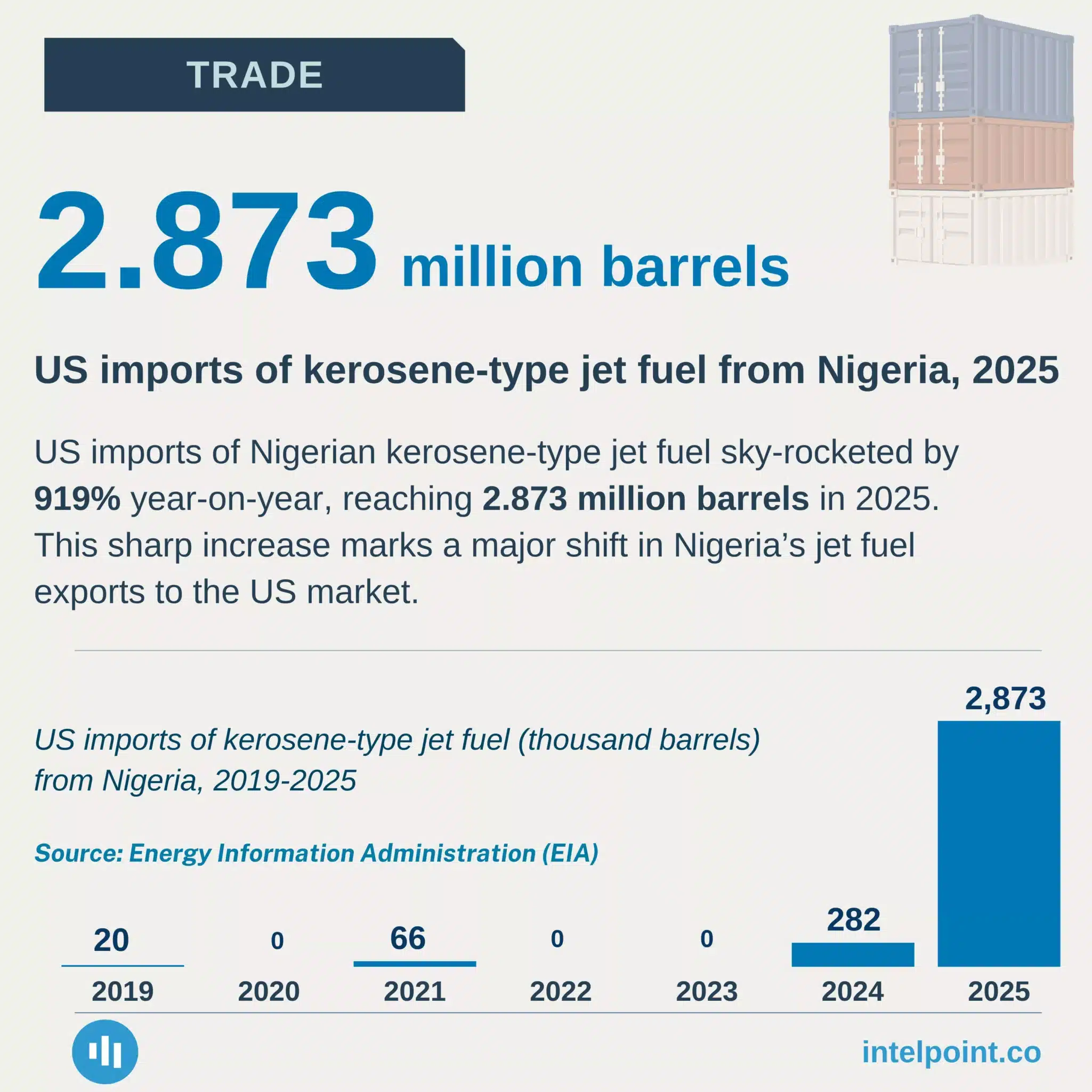
US imports of Nigerian kerosene-type jet fuel sky-rocketed by 919% year-on-year
  • Nigerian jet fuel exports to the U.S. jumped 10-fold to 2.87 million barrels in 2025.
  • Just 86,000 barrels were imported across the U.S. from Nigeria between 1993 and 2023.
  • The 2025 surge was concentrated in five months, amid East Coast refinery disruptions.
  • No Nigerian jet fuel imports were recorded through August 2026, suggesting the surge was temporary.

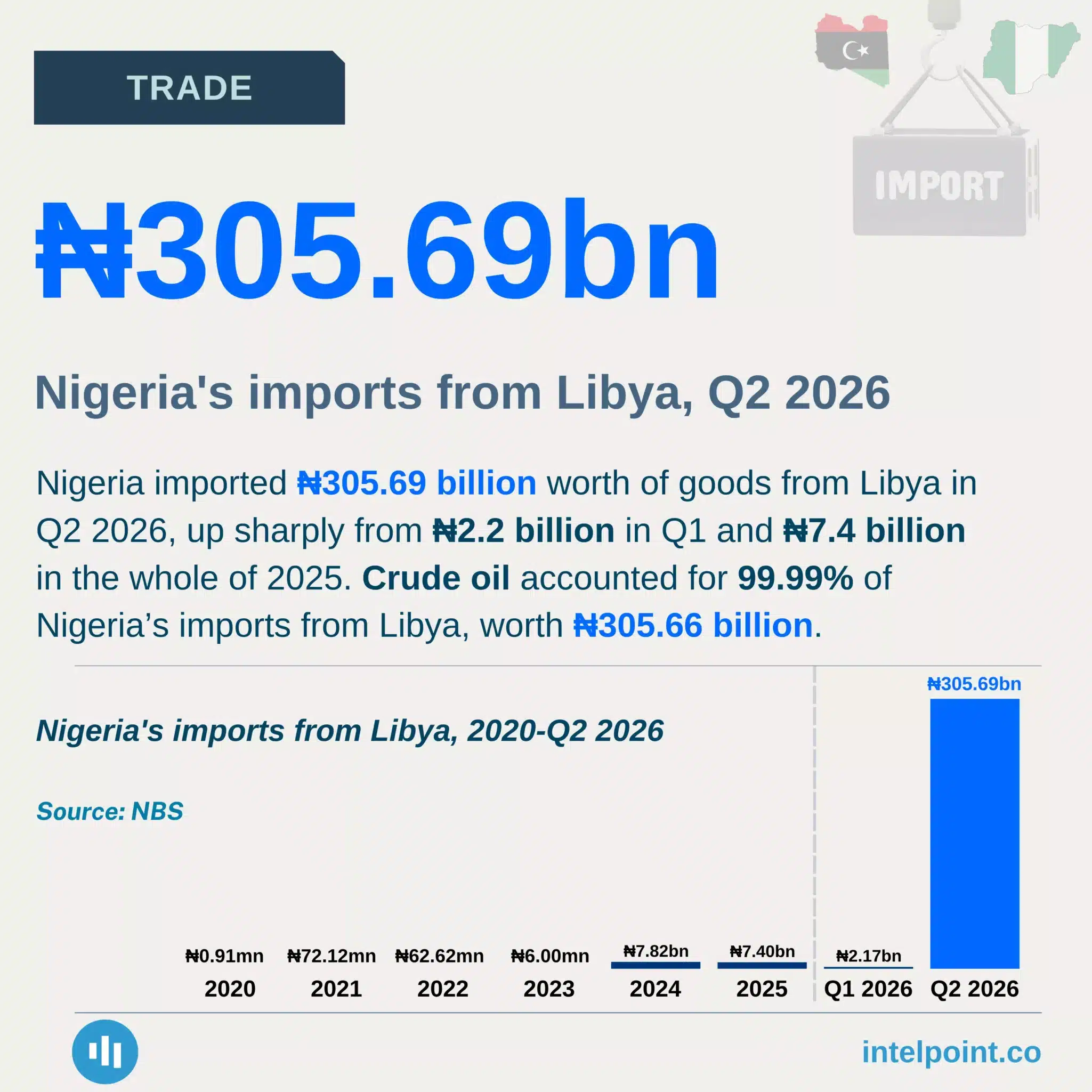
Nigeria bought ₦305.66 billion worth of crude oil from Libya in Q2 2026
  • Nigeria imported ₦305.69bn from Libya in Q2 2026, up from ₦2.17bn in Q1.
  • Crude oil accounted for 99.99% of Q2 imports, worth ₦305.66bn.
  • Libya’s Q2 exports to Nigeria surged from ₦7.4bn in 2025 to ₦305.69bn.
  • Libya became Nigeria’s ninth-largest import source, accounting for 2.12% of total imports in Q2.
  • Nigeria’s imports from Libya were previously dominated by much smaller values, with crude oil driving the sharp 2026 increase.

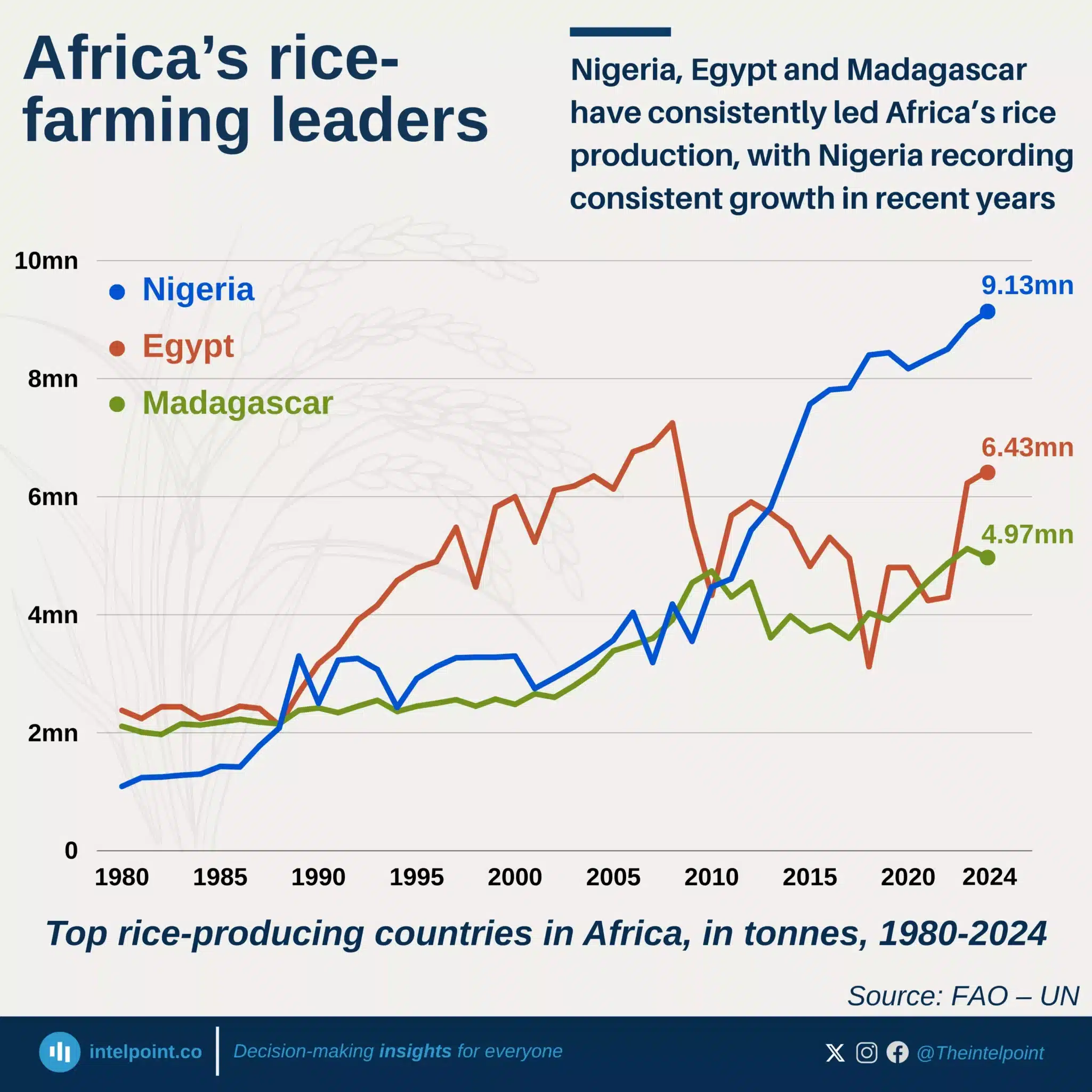
Nigeria, Egypt and Madagascar have consistently led Africa’s rice production, with Nigeria recording consistent growth in recent years
  • Nigeria's rice production hit 9.13 million tonnes in 2024, its highest level since 2021.
  • Egypt and Madagascar produced 6.43 and 4.97 million tonnes, respectively, in 2024.
  • Egypt and Madagascar combined produced 11.4 million tonnes, exceeding Nigeria's output.
  • Africa's rice production reached a record 44.8 million tonnes in 2024, up 421% since 1980.

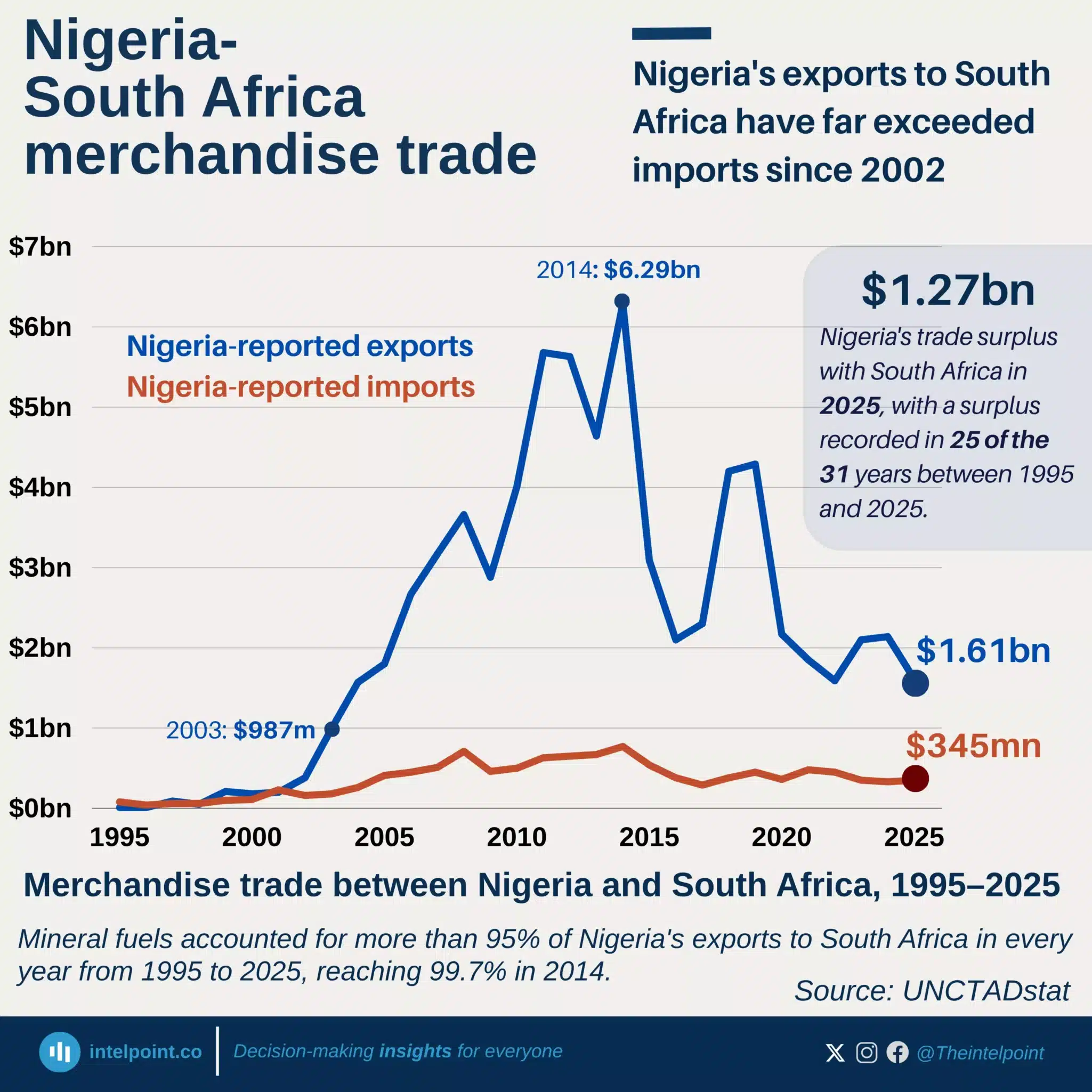
Nigeria's exports to South Africa have far exceeded imports since 2002
  • Nigeria has exported more to South Africa than it has imported every year since 2002.
  • Exports peaked at $6.29 billion in 2014, driven almost entirely by mineral fuels.
  • Imports from South Africa have remained below $1 billion annually.
  • Nigeria recorded a $1.27 billion trade surplus with South Africa in 2025.
  • Mineral fuels made up over 95% of Nigeria's exports throughout 1995-2025.

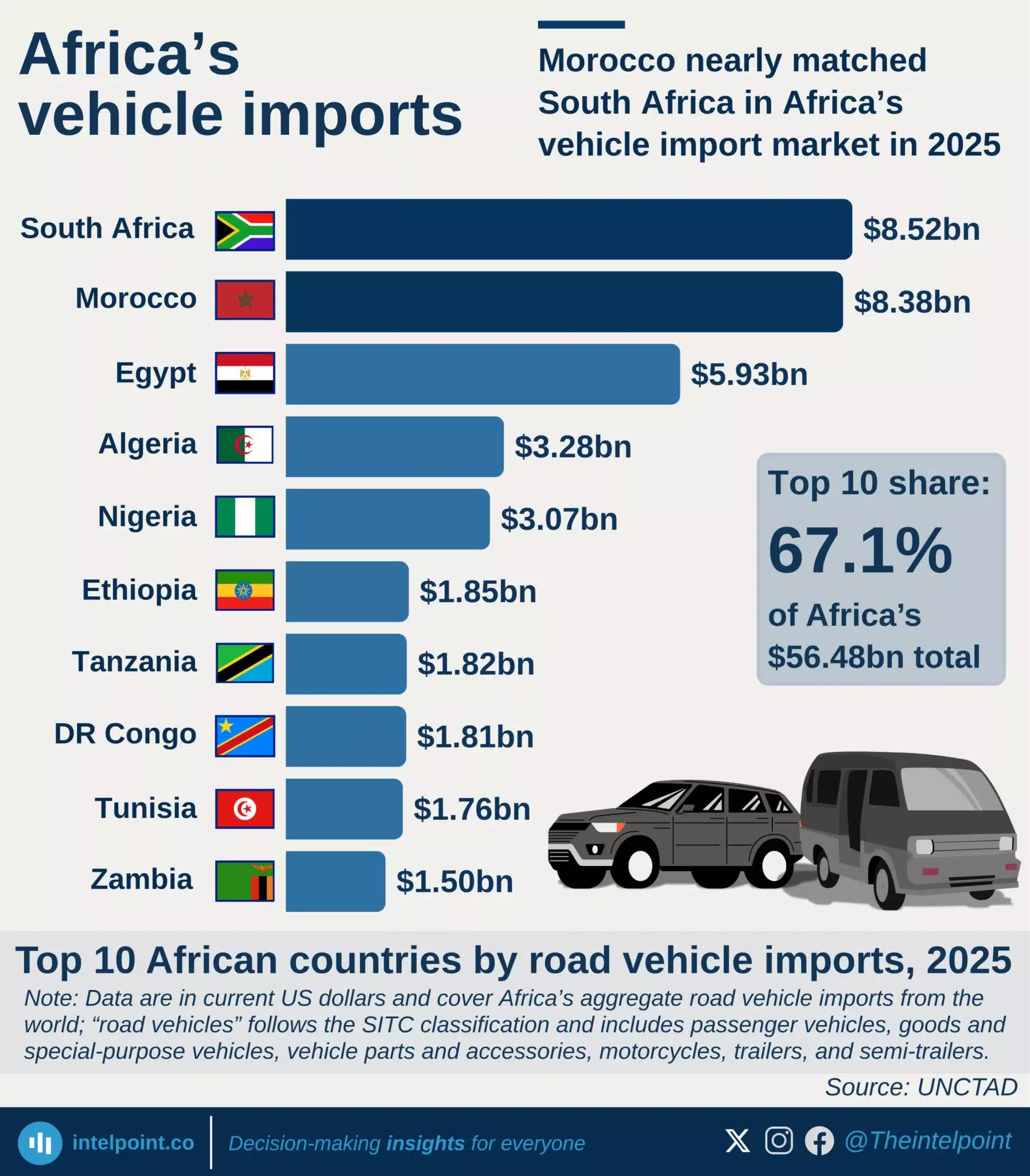
Morocco nearly matched South Africa in Africa’s vehicle import market in 2025
  • South Africa led with $8.52 billion, only $140 million ahead of Morocco.
  • Morocco’s imports have grown steadily, while South Africa’s 2025 figure was a recovery toward its 2012 peak.
  • Egypt ranked third, followed by Algeria and Nigeria.
  • The top 10 markets accounted for 67.1% of Africa’s $56.48 billion total.
  • Road vehicle imports include vehicles, parts, motorcycles, trailers, and semi-trailers.

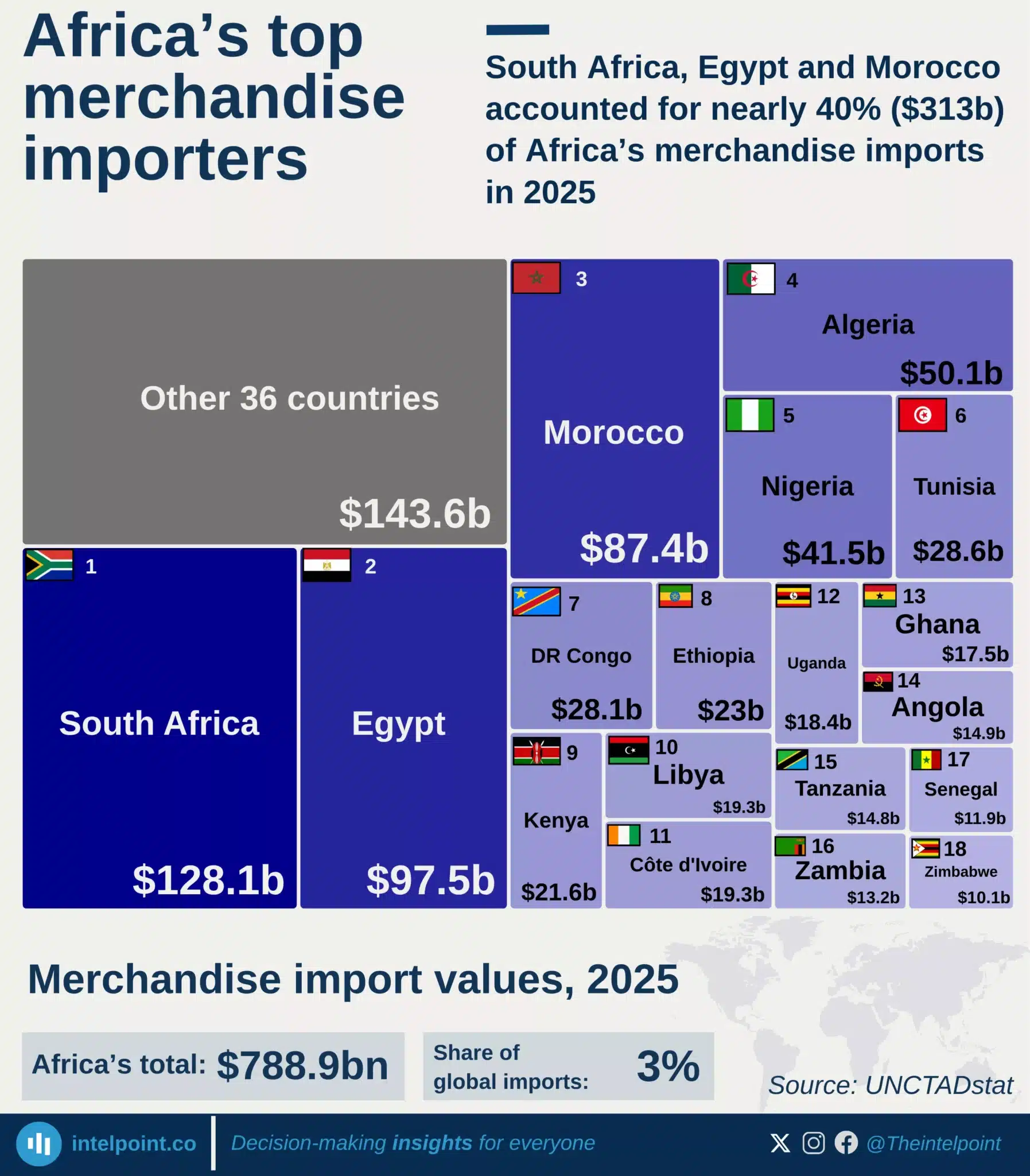
South Africa, Egypt and Morocco accounted for nearly 40% ($313b) of Africa’s merchandise imports in 2025
  • Africa imported merchandise worth $788.9 billion in 2025, representing about 3% of global merchandise imports.
  • South Africa was Africa’s largest merchandise importer, with imports valued at $128.1 billion.
  • Egypt ranked second at $97.5 billion, followed by Morocco at $87.4 billion.
  • The three largest importers accounted for $313 billion, or 39.7% of Africa’s total merchandise imports.
  • South Africa alone accounted for about 16.2% of the continental total.
  • The five largest importers, including Algeria and Nigeria, were responsible for $404.6 billion, or 51.3% of Africa’s imports.
  • Nigeria ranked fifth, with merchandise imports valued at $41.5 billion.

POPULAR TOPICS
SIGN UP TO OUR NEWSLETTER
Get periodic updates about the African startup space, access to our reports, among others.
Subscribe Here
Subscription Form

A product of Techpoint Africa. All rights reserved