Bite-sized Insights about
 
Providing you with data-based insights about things happening around you.
Popular Insights
  • Key Takeaways:  

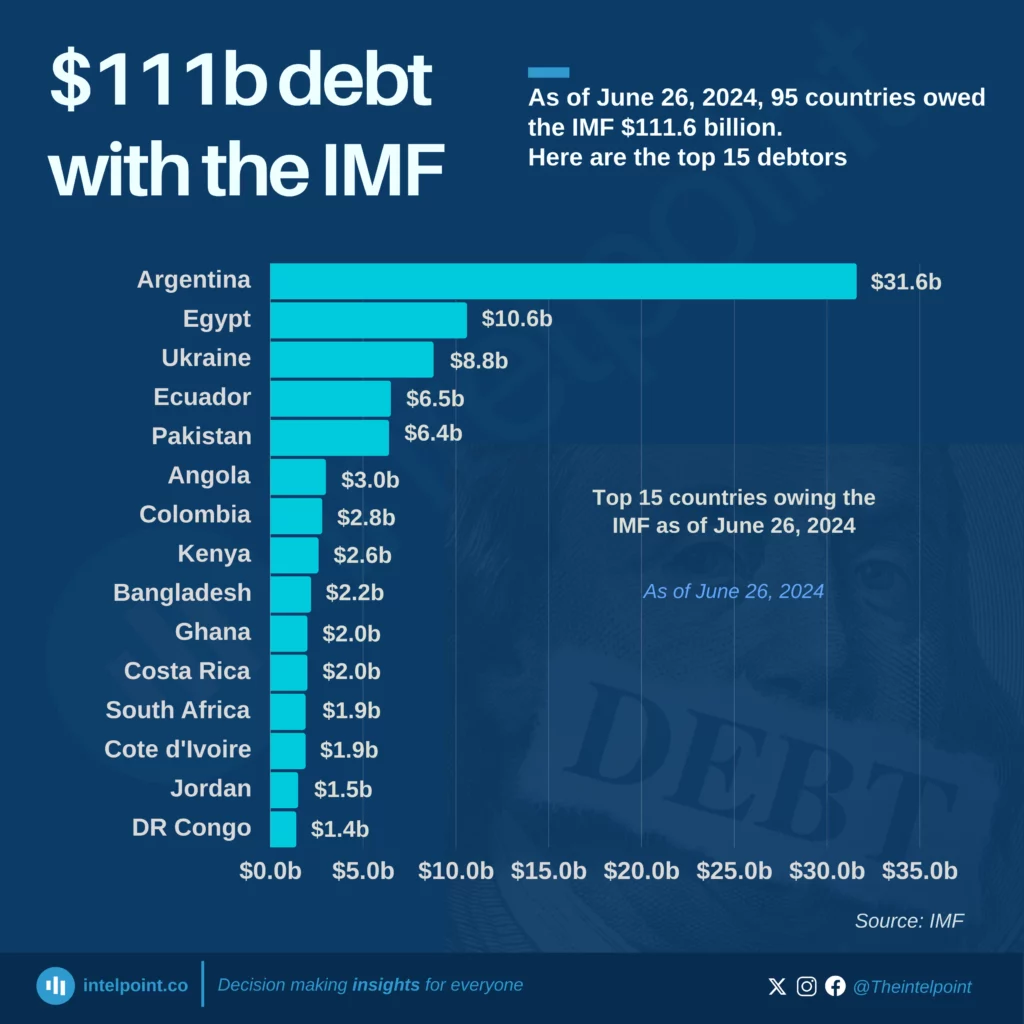
    • Argentina tops the list with SDR 31.1 billion in outstanding IMF credit.
    • The top three borrowers, Argentina, Ukraine, and Egypt, together hold over 45% of total IMF credit.
    • All 15 countries on the list have outstanding credit of at least SDR 1.4 billion.
    • African nations such as Kenya, Angola, Ghana, and Ethiopia rank among the top 15 IMF debtors.
    • The top 10 countries alone account for more than two-thirds of the IMF’s total outstanding credit.
    See more

    Nigeria's VAT collections have shown consistent growth over the past few years, hitting a record high in Q2 2024, declining only once (Q3 2021) in 13 quarters.

    The finance minister recently confirmed that the VAT rate remains at 7.5%, dispelling rumours of an increase.

    See more
  • The 2024 Global Peace Index reveals a decline in peacefulness in 97 countries, the highest since the index began.

    Nigeria is among the nations affected by regional conflicts and rising violence. With a peace index score of 2.91, Nigeria is facing increasing challenges.

    A deteriorating peace score impacts foreign investment and economic stability. Global economic losses due to violence reached $19.1 trillion in 2023.

    See more

    The FAAC's revenue distribution from 2017 to August 2023 highlights the dominance of Delta, Akwa Ibom, Rivers, and Bayelsa states in allocations. Despite Lagos' economic prominence, it ranked fifth. Here is the distribution of revenue among states between 2017 and August 2023.

    See more
  • A Trend of Adult literacy rates of African countries

    Between 2018 and 2021, adult literacy rates across African nations exhibited significant disparities. Seychelles and South Africa led with literacy rates of 96% and 95%, respectively, indicating a high proportion of literate adults. Conversely, Chad had the lowest literacy rate during this period.

    These statistics underscore the uneven progress in educational attainment across Africa, highlighting the need for targeted interventions to improve literacy in lower-performing nations.

    See more
    Countries by Global Innovation Index 2024

    The Global Innovation Index 2024 reveals a striking contrast in innovation performance between countries globally and across Africa. Switzerland leads the global rankings with an impressive score of 67.5, followed by Sweden (64.5) and the USA (62.4), highlighting their sustained investments in research, development, and technological advancement.

    In Africa, Mauritius takes the top spot with a score of 30.5, followed closely by Morocco (28.8) and South Africa (28.3). However, even Africa's most innovative nations achieve less than half the score of global leaders, indicating a significant innovation gap.

    Nigeria ranks 15th in the African ranking and 113th globally, out of 133 countries, with a score of 17.1.

    See more

    • The GDP contribution from the telecom sector increased from 14.13% in Q1 2023 to 16.36% in Q2 2024.
    • The highest contribution (16.36%) was seen in Q2 2024.
    • The telecom sector contributes significantly to GDP, maintaining values above 10% quarterly from Q1 2020 to Q3 2024.
    • The second quarter consistently contributed more to Nigeria’s GDP throughout the observed timeframe.
    • The first and second quarters of 2024 showed an improvement in the sector's contribution to GDP compared to the previous years.
    See more
  • MTN Nigeria has dominated the country's telecommunications market over the years, accounting for the largest market share. All four operators, apart from 9mobile, recorded a significant increase in their subscriber base between May 2014 and March 2024.

    See more
  • The 2024 Global Peace Index reveals a decline in peacefulness in 97 countries, the highest since the index began.

    Nigeria is among the nations affected by regional conflicts and rising violence. With a peace index score of 2.91, Nigeria is facing increasing challenges.

    A deteriorating peace score impacts foreign investment and economic stability. Global economic losses due to violence reached $19.1 trillion in 2023.
    See more

Other Insights
  • England tops the world women’s rugby ranking with 97.76 points, maintaining a clear lead over other nations.
  • Canada and New Zealand follow as the second and third-strongest women’s rugby teams globally.
  • South Africa ranks 12th and Kenya 20th, making them the only African nations in the global top 20.
  • Traditional rugby nations like France, Ireland, and Australia feature prominently in the top 10.
  • Asian teams such as Japan and Hong Kong highlight the growing spread of women’s rugby beyond traditional regions.
See more
  • South Africa leads the world rugby rankings with 92.78 points, ahead of New Zealand’s 92.06.
  • The gap between the first and second position is just 0.72 points, showing a close contest at the top.
  • Ireland remains the highest-ranked European team with 89.83 points.
  • France and England, with 87.82 and 87.64 points respectively, are in close competition for the fourth and fifth spots.
See more
  • Africa’s fertility rate in 2025 is estimated at 3.95, the highest in the world.
  • Europe’s fertility rate is the lowest in 2025 at just 1.41 children per woman.
  • Latin America and the Caribbean saw a steep drop from 5.83 in 1955 to 1.78 in 2025.
  • Asia’s fertility rate fell from 5.85 in 1955 to 1.87 in 2025.
  • Oceania’s fertility rate dropped from 6.58 in 1955 to 2.13 in 2025.
  • By 2025, all continents except Africa are at or below the replacement rate of 2.1.
See more
     
  • Gold bullion dominates exports, contributing ¢163.0B (55.3%) of total exports.

  • Petroleum oils follow distantly at ¢52.6B (17.8%).

  • Cocoa (beans, paste, butter) remains a vital sector, collectively worth ¢24.7B (8.4%).

  • Manganese, cashew, tuna, iron/steel, and shea oil are niche contributors, each under 2% of exports.

  • All other products still make up a significant 14.4% (¢42.4B), showing potential for export diversification.
See more
  • Petrol prices in Nigeria rose by 52% between August 2024 (₦830.5) and March 2025 (₦1,261.7).
  • The highest monthly increase was in September 2024 (+24.1%), while the sharpest drop came in April 2025 (-17.1%).
  • By July 2025, prices had eased to ₦1,025, still 23% higher than a year earlier.
  • NNPC retail outlets offered significantly lower prices than the national average, with Abuja as low as ₦880 at the March 2025 peak.
  • Dangote Refinery offered relatively competitive pricing, ranging from ₦840 to ₦899, creating an alternative supply option.
See more
  • France tops the world with 13 time zones, owing largely to its overseas territories spread across the globe.
  • The US and Russia follow closely, each spanning 11 time zones, reflecting their massive geographic spread.
  • In contrast, Africa remains highly unified, with just two countries, DR Congo and South Africa, operating two time zones each.
  • Most nations on the list, including Brazil, Mexico, and Spain, fall between 2–4 zones, underscoring how rare double-digit time zone coverage is.
See more
 
  • South Africa’s GDP per capita rose from $440 in 2000 to an all-time high of $2,692 in 2024.
  • Growth was relatively steady in the 2000s, with notable jumps after 2006 and again in the post-pandemic years.
  • Despite dips in 2008 (global financial crisis) and 2020 (COVID-19 shock), the economy showed resilience with quick rebounds.
  • By 2024, South Africa achieved its strongest per capita GDP on record, cementing its role as one of Africa’s leading middle-income economies.
  • The country recorded growth in 21 of the past 24 years.
See more
 
  • Algeria’s GDP per capita more than tripled in 25 years, rising from $1,772.9 in 2000 to $5,631.2 in 2024.
  • The 2000s boom saw rapid growth, peaking at $5,180.9 in 2008, fuelled by high oil and gas prices.
  • Between 2014 and 2016, GDP per capita fell from $6,094.7 to $4,425.0, reflecting oil price collapses and domestic fiscal strain.
  • After pandemic-era lows in 2020 ($3,743.5), Algeria rebounded to its second-highest level on record in 2024 ($5,631.2), regaining its regional standing.
See more
 
  • Egypt’s GDP per capita grew from $1,366 in 2000 to $3,339 in 2024, a 144% increase over 25 years.
  • The economy peaked at $4,233 in 2022, marking the highest point in the series before a two-year decline.
  • Sustained growth was driven by the 2000s and 2010s, with resilience after the 2008 financial crisis and Arab Spring disruptions.
  • The dip after 2022 reflects external pressures, currency adjustments, and inflationary challenges, though per capita levels remain well above early 2000s baselines.
See more
     
  • The United States dominates global natural gas production in 2024, contributing 1.03 trillion cubic metres (Tcm), nearly one-quarter of the world’s total.

  • Russia (0.63Tcm) and Iran (0.26Tcm) follow as the second and third largest producers.

  • China (0.25Tcm) and Canada (0.19Tcm) also feature strongly, rounding out the top five producers.

  • Collectively, these top five countries account for more than 50% of global production.

  • Emerging producers like Nigeria, Egypt, and Azerbaijan contribute significantly to the supply but remain far behind the leading nations.

See more
 
  • Burundi recorded its highest GDP per capita in 2015 ($280.97).

  • By 2024, GDP per capita dropped to $153.93, a decline of nearly 45% from its peak.

  • Burundi’s population exceeds 13 million (2024), which dilutes income per person even when overall GDP grows.

  • Structural challenges like limited industrialization, reliance on subsistence farming, and political instability contribute to stagnation.

  • Since 2015, Burundi has held the lowest GDP per capita in Africa—and at $153.9 in 2024, it is the poorest country in the world by GDP per capita.

See more
     
  • Zimbabwe’s GDP per capita nearly quintupled since 2000, marking a 472% increase over 25 years.
  • The country's GDP per capita declined consistently from 2001 to 2008.
  • It soared to $3,448.1 in 2017, which is still the highest in the country's history.
  • The GDP per capita plummeted to $2,271.9 in 2019, recording a (34.1%) decrease.
See more
1 31 32 33 34 35 126
  • Formal financial access in Kenya surged from 26.7% in 2006 to 84.9% in 2024, a threefold increase.
  • The share of financially excluded adults dropped drastically from 41.3% to 9.9% over the same period.
  • Informal access, through community-based and unregulated systems, has declined steadily as more people moved to formal systems.
  • Kenya achieved over 80% formal access by 2019, marking a turning point in its financial inclusion journey.
Read more
  • A total of ₦20.45 trillion in Internally Generated Revenue (IGR) has been recorded nationwide since 2008.
  • Lagos State generated ₦1.26 trillion in 2024, maintaining its position as the top revenue-generating state.
  • For five consecutive years, Yobe and Taraba have consistently ranked among the bottom five states in revenue generation.
  • FCT IGR records began in 2018.
  • Enugu State recorded a remarkable 433.03% year-on-year increase in 2024.
  • Ebonyi (–57.27%), Ondo (–24.70%), and Yobe (–0.99%) were the only states that experienced a decline in IGR in 2024.
Read more
  • China has dominated Nigeria’s imports from Asia, maintaining a 50–55% share for most of the period.
  • China’s share reached its highest level at 58.6% in H1 2025.
  • India's import share remained volatile, ranging between 11% and 25%.
  • Total imports from Asia surged from ₦2.6 trillion in 2013 to ₦16.4 trillion in H1 2025.
Read more
  • Agricultural imports fell from 83.9% in 2017 to 42.9% in H1 2025, indicating a significant decline in import dependency.
  • Agricultural exports grew from 16.1% in 2017 to 54.0% in 2024, surpassing imports for the first time since 2017.
  • Total agricultural trade increased from ₦1.1 trillion in 2017 to ₦8.2 trillion in 2024.
  • Between 2022 and 2024, the import share dropped significantly from 75.7% to 46.0%.
Read more
  • Crude oil imports into Nigeria in H1 2025 marked the first occurrence since 2017.
  • Crude oil imports accounted for 10.2% of total crude oil trade.
  • From 2017 to 2024, exports made up 100% of crude oil trade annually.
  • Total crude oil trade peaked at ₦55.3 trillion in 2024.
  • The emergence of crude oil imports can be linked to domestic refinery operations, especially the Dangote Refinery.
Read more
  • Asia and Europe have consistently represented over 70% of Nigeria’s imports since 2013.
  • Asia’s share of imports reached a record 53.5% in H1 2025.
  • Europe contributed 23.1% of total imports in H1 2025.
  • Imports from the American region averaged between 10%–14% over the period.
  • Africa’s import share remained below 10%, showing limited regional trade.
Read more
1 31 32 33 34 35 252

Can’t find what you’re looking for? Please fill the form below
Contact Form Demo
SIGN UP TO OUR NEWSLETTER
Get periodic updates about the African startup space, access to our reports, among others.
Subscribe Here
Subscription Form

A product of Techpoint Africa. All rights reserved