Bite-sized Insights about
 
Providing you with data-based insights about things happening around you.
Popular Insights
  • Real GDP Growth projection across regions (2023 - 2025)

    The Nigerian economy shows promise as the IMF projects an increase in the country's GDP growth, rising to 3.2% in 2025. This comes when projections show stagnant global growth at 3.2%, while sub-Saharan Africa outpaces other regions with an anticipated rise to 4.2% by 2025.

    See more

    A country with strong infrastructure, affordable services, and high digital literacy, enabling everyone to use fast and reliable mobile internet will have a perfect score (100) on the GSMA's Mobile Connectivity Index 2023. South Africa leads in Africa with 69.53.
    Globally, Singapore is first, with a score of 93.7, setting the benchmark for mobile internet adoption. Only four African countries — South Africa, Mauritius, Seychelles, and Egypt — surpassed the global average score.

    Tunisia, Ghana, and Nigeria scored below the global average.
    The Mobile Connectivity Index analysed measured 173 countries' mobile internet adoption from 2014-2023, normalising indicators to a 0-100 scale for consistency. The factors assessed include infrastructure, affordability, digital literacy, and policy frameworks.


    See more
  • The 2024 Global Peace Index reveals a decline in peacefulness in 97 countries, the highest since the index began.

    Nigeria is among the nations affected by regional conflicts and rising violence. With a peace index score of 2.91, Nigeria is facing increasing challenges.

    A deteriorating peace score impacts foreign investment and economic stability. Global economic losses due to violence reached $19.1 trillion in 2023.

    See more

    The FAAC's revenue distribution from 2017 to August 2023 highlights the dominance of Delta, Akwa Ibom, Rivers, and Bayelsa states in allocations. Despite Lagos' economic prominence, it ranked fifth. Here is the distribution of revenue among states between 2017 and August 2023.

    See more
  • A Trend of Adult literacy rates of African countries

    Between 2018 and 2021, adult literacy rates across African nations exhibited significant disparities. Seychelles and South Africa led with literacy rates of 96% and 95%, respectively, indicating a high proportion of literate adults. Conversely, Chad had the lowest literacy rate during this period.

    These statistics underscore the uneven progress in educational attainment across Africa, highlighting the need for targeted interventions to improve literacy in lower-performing nations.

    See more
    Countries by Global Innovation Index 2024

    The Global Innovation Index 2024 reveals a striking contrast in innovation performance between countries globally and across Africa. Switzerland leads the global rankings with an impressive score of 67.5, followed by Sweden (64.5) and the USA (62.4), highlighting their sustained investments in research, development, and technological advancement.

    In Africa, Mauritius takes the top spot with a score of 30.5, followed closely by Morocco (28.8) and South Africa (28.3). However, even Africa's most innovative nations achieve less than half the score of global leaders, indicating a significant innovation gap.

    Nigeria ranks 15th in the African ranking and 113th globally, out of 133 countries, with a score of 17.1.

    See more

    • Company Income Tax (Non-Oil) emerged as the largest contributor, accounting for over 30% of total tax revenue.
    • NCS-Import VAT followed closely, contributing 23.63%, emphasising the significance of import-related taxes to Nigeria's revenue.
    • Traditional oil-based taxes such as Petroleum Profit Tax/Hydrocarbon Tax and CIT (Oil & Gas) jointly contributed over 26%, showing that oil remains a vital but declining pillar.
    • Newer tax streams like the Electronic Money Transfer Levy and NASENI (National Agency for Science and Engineering Infrastructure) funding have emerged, but still make up less than 2% of total revenue.
    • Minor tax categories like Capital Gains Tax, NITDEF (National Information Technology Development Fund), and NPTFL (Nigeria Police Trust Fund) had negligible impact, each contributing less than 0.5%
    See more
  • Only 10% of Nigerians earn above ₦100,000, according to the Nigerian Financial Services Market Report. This aligns with most reports about Nigeria, and it's in sharp contrast to the narratives online.
    See more
  • The 2024 Global Peace Index reveals a decline in peacefulness in 97 countries, the highest since the index began.

    Nigeria is among the nations affected by regional conflicts and rising violence. With a peace index score of 2.91, Nigeria is facing increasing challenges.

    A deteriorating peace score impacts foreign investment and economic stability. Global economic losses due to violence reached $19.1 trillion in 2023.

    See more

Other Insights

The cost of damage caused by carbon dioxide emissions from fossil fuels in Zambia increased from 0.46% in 2009 to 1.77% in 2021. As of 2023, the southern African nation's population was estimated to be 20.6 million individuals.

See more

Since its inception, Binance has demonstrated remarkable growth, ending its first year with 1.5 million users and increasing its user base nearly eightfold the following year. Over six years, it has established itself as the largest cryptocurrency exchange in the world, reaching 150 million users by 2023. This growth highlights Binance's significant impact on the global crypto market and its commitment to expanding access to digital assets.

See more

Tanzania's Internet subscriptions surged from 9.31 million in 2013 to 39.3 million as of June 2024, reflecting an average annual growth of 2.72 million. Apart from slower growth in 2018 and 2020, with 148,000 and 284,000 new subscriptions, respectively, the East African nation has consistently expanded its digital reach.

Notably, mobile wireless subscriptions accounted for a staggering 99.75% of all Internet subscriptions in Tanzania.

See more

The 2024 Global Peace Index reveals a decline in peacefulness in 97 countries, the highest since the index began.

Nigeria is among the nations affected by regional conflicts and rising violence. With a peace index score of 2.91, Nigeria is facing increasing challenges.

A deteriorating peace score impacts foreign investment and economic stability. Global economic losses due to violence reached $19.1 trillion in 2023.

See more

According to 2022 and 2023 data for 40 African countries, Egypt leads in the value of manufacturing output reaching $59.6 billion in 2023 despite a 21% drop from 2022.

Nigeria follows with $55.7 billion, while South Africa comes third with $48.8 billion.

See more

Safaricom has maintained the largest share of telecom subscribers in the Kenya over the years. From 2008 to 2024, it has expanded its subscriber base from 10.2 million to 44.7 million, reflecting an average annual growth of 2.2 million subscribers. This consistent growth underscores Safaricom's strong market position and effective business strategy in Kenya's telecom sector.

See more

When Olusegun Obasanjo took office in 1999, the exchange rate was ₦97 to $1; it was ₦128 under Yar'Adua in 2007. During Jonathan's tenure in 2010 it was ₦151 while it was ₦199 when Buhari was in office.

Despite efforts to let market forces decide the rate, the naira continues to weaken. Will the current administration turn things around soon?

See more
 

Nigeria's manufacturing sector contributed 9.2% (₦3.37 trillion) to the total GDP in H1 2024, mainly driven by food, clothing, and cement, which make up a combined 79.5% of the sector's GDP.

Smaller sectors like Non-Metallic Products, Wood & Wood Products, and Motor Vehicles & Assembly could expand with targeted investments. The minimal impact of Oil Refining and Electrical & Electronics underscores the need for diversification.

See more
 

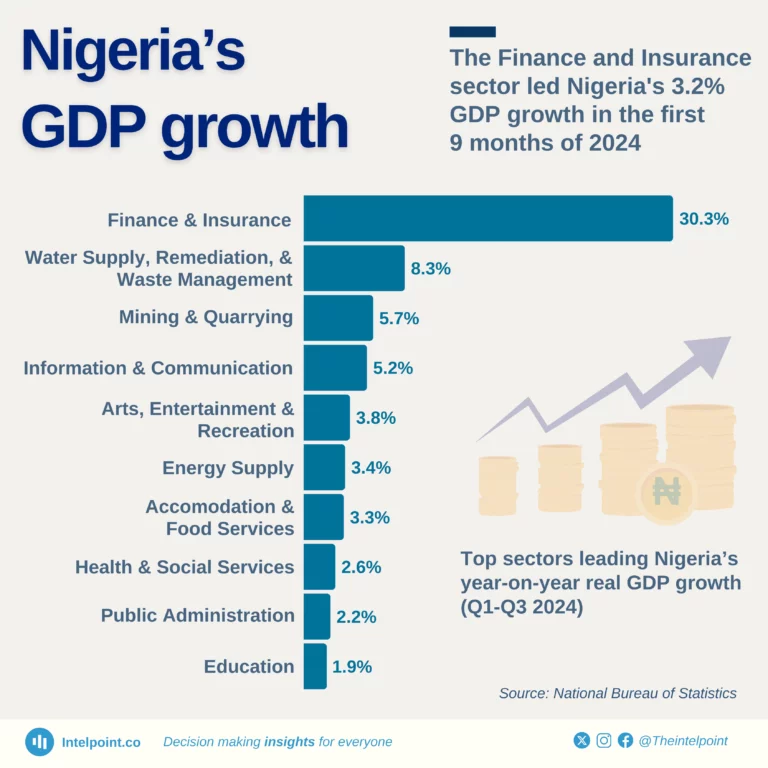
While Agriculture and Telecommunications remain the largest contributors to Nigeria's GDP in H1 2024, the Finance & Insurance sector stands out with a 30% growth rate.

Other sectors, including Water & Waste Management and Mining & Quarrying, also experienced significant growth.

See more
 

Nigeria's GDP in H1 2024 is driven by 22% from Agriculture, 19% from Information & Communication, and 16% from Trade, collectively accounting for 57% of the economy.

Total GDP grew by 3.08% during this period.

See more

President Tinubu's government recently added a new aircraft to the presidential fleet, sparking concerns over rising maintenance costs.

From 2017 to 2024, the cost of maintaining Nigeria's presidential air fleet has increased by 366%, jumping from ₦4.4 billion to ₦20.5 billion.

The Presidency argues that the new jet will save millions in maintenance and fuel costs.

See more

Nigeria, Egypt, and Morocco have consistently led Africa's diaspora remittance, contributing 67% of the continent's total inflows since 2000.

In 2023, African nations received $94.78 billion, with Egypt, Nigeria, and Morocco leading.

Here are the top ten countries since 2000.

See more
1 98 99 100 101 102 126
  • The United States holds the largest IMF quota by far, with 82,994.2 billion SDRs, accounting for 17.42%, more than double the quota of any other country.
  • Japan, China, and Germany follow as the next largest contributors, each holding between 5.5% and 6.5% of total quota shares.
  • European countries (Germany, France, the U.K., Italy) collectively maintain a strong presence, together accounting for nearly 17.21%, almost equal to the U.S. alone.
  • Emerging economies like India and Russia have relatively modest shares (2.75% and 2.71%, respectively) despite their growing roles in global economic affairs, indicating an imbalance between global influence and IMF voting power.
Read more
  • The number of female central bank governors rose from 21 in 2014 to 29 in 2024, a 38% increase over the decade.
  • The lowest point was in 2018, with just 14 female governors, marking a 33% drop from the 2014 figure.
  • A rebound began after 2018, with consistent annual growth from 2020 onwards, peaking in 2024.
  • The number remained under 20 for six consecutive years (2015–2021) before breaking past that mark again in 2022.
Read more
  • University of Maiduguri leads with 31,770 applications, indicating a significant demand for student loans in the North East.
  • North West institutions dominate the list, with five universities (Bayero University Kano, Federal University Dutsinma Katsina, Ahmadu Bello University, Usman Danfodiyo University, Sokoto, and Umaru Musa Yar'adua University) collectively accounting for a substantial portion of applications.
  • North Central is represented by University of Jos and University of Ilorin, highlighting the region's active participation in the student loan programme.
  • Federal University, Kashere's presence underscores the North East's engagement, with two institutions in the top 10.
  • All listed universities received over 11,000 applications, reflecting widespread awareness and utilization of the student loan initiative across these regions.
Read more
  • Male applicants dominate the Nigerian student loan landscape with 374,946 accounts, representing 68% of total applications.
  • Female applicants trail behind at 177,063, contributing just 32% to the total loan accounts.
  • For every 10 students who applied, approximately 7 are male and 3 are female.
  • The gender gap in student loan uptake is 197,883, with males nearly double the number of female applicants.
Read more
  • With 167,639 applications, the North West zone accounts for the highest number of student loan submissions, representing a significant concentration of demand in that region.
  • The North East follows with 134,359 applications, bringing the northern region's combined total to over 300,000, more than half of all zonal submissions.
  • The South West stands as the highest-contributing southern zone with 104,079 applications, showing a strong but comparatively lower demand than the North.
  • The South East recorded just 29,097 applications, the lowest across all six geopolitical zones.
Read more
Share of global active LinkedIn users by continent (Jan. 2025)
  • America leads globally on LinkedIn, with 465.6M users making up 38.8% of the user base.
  • Asia follows, contributing 397M users, or 33.1% of the global total.
  • Together, Asia and America make up 71.9% of all LinkedIn users, totalling over 862M.
  • Europe holds a solid 19.5% share, with 233.8M users.
  • Africa’s 83M users represent a smaller but growing 6.9% share of global users.
  • Oceania has the smallest share, at 1.8%, with only 21.5M users.
  • The distribution reveals that LinkedIn’s core strength lies in regions where digital employment and professional networks are deeply integrated into economic and career activity.
Read more
1 98 99 100 101 102 252

Can’t find what you’re looking for? Please fill the form below
Contact Form Demo
SIGN UP TO OUR NEWSLETTER
Get periodic updates about the African startup space, access to our reports, among others.
Subscribe Here
Subscription Form

A product of Techpoint Africa. All rights reserved