The 2024 Global Peace Index reveals a decline in peacefulness in 97 countries, the highest since the index began.
Nigeria is among the nations affected by regional conflicts and rising violence. With a peace index score of 2.91, Nigeria is facing increasing challenges.
A deteriorating peace score impacts foreign investment and economic stability. Global economic losses due to violence reached $19.1 trillion in 2023.

Between 2018 and 2021, adult literacy rates across African nations exhibited significant disparities. Seychelles and South Africa led with literacy rates of 96% and 95%, respectively, indicating a high proportion of literate adults. Conversely, Chad had the lowest literacy rate during this period.
These statistics underscore the uneven progress in educational attainment across Africa, highlighting the need for targeted interventions to improve literacy in lower-performing nations.

Nigeria was the seventh most populous nation in the world in 2020, with 206.1 million people. Projected to reach a population of 401.3 million by 2050, Nigeria will rank third after India (1st) and China (2nd). According to Institut national d'études démographiques' projections, Nigeria, Ethiopia, DR Congo, Egypt, Tanzania, and Kenya will be among the world’s top 20 most populous countries by 2050.
The 2024 Global Peace Index reveals a decline in peacefulness in 97 countries, the highest since the index began.
Nigeria is among the nations affected by regional conflicts and rising violence. With a peace index score of 2.91, Nigeria is facing increasing challenges.
A deteriorating peace score impacts foreign investment and economic stability. Global economic losses due to violence reached $19.1 trillion in 2023.
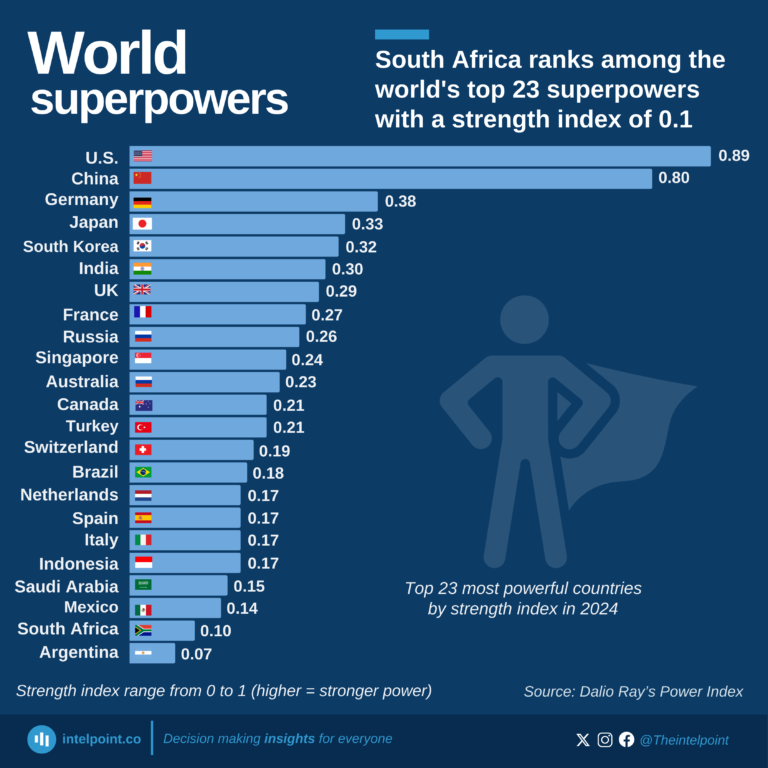
South Africa is rising on the global stage, showcasing its growing influence as it secures its spot as the only African country among the world's top 23 superpowers.
The United States leads with a strength index of 0.89, followed closely by China at 0.80. While traditional powers like Germany and Japan hold their ground, South Africa proudly stands among the top 23 superpowers with a strength index of 0.1. This is the only African country that made the top 23, coming 22nd on the list.
The ranking is based on analysis from Ray Dalio's Great Powers Index 2024. Dalio assessed each nation's strength based on a wide range of metrics, including education, innovation and technology, cost competitiveness, economic output, and military strength.
Note: The Eurozone, ranked third on the list, was removed as it cannot be considered a single country.

Known for its Elephant Cement brand, Lafarge Africa is on its way to reaching its highest annual revenue in the past decade, with its 2024 9-month revenue outperforming full-year revenues for 2023.

Lafarge Africa's journey over six decades is a tale of growth, transformation, and significant milestones. From its roots as WAPCO in 1959 to its current position, the company’s evolution continues, with an acquisition by Huaxin Cement in 2024, pending regulatory approval.

In 2023, 54% of bribes in Nigeria were directly solicited by public officials, while 23% involved subtle hints or indirect demands. Bribes were commonly exchanged in specific locations, with 36% occurring in the homes of public officials and 35% on the streets. These patterns highlight widespread and deeply entrenched corruption across different spheres of interaction.

Nigeria occupies the 30th spot globally in the English Proficiency Index, achieving a score of 557, just behind Kenya (581) and South Africa (594). As one of Africa's linguistic leaders, this ranking highlights Nigeria’s strength in English proficiency, a vital skill driving communication, business, and education across the continent.
This data comes from the EF English Proficiency Index, which aggregated the test results of 2.2m adults from 113 countries and regions. Countries where English is the primary native spoken language are not included in this ranking. Ranks are determined by each country’s average score in the EF Standard English Test (EF SET).

Over the years, many African countries, including Nigeria, have experienced economic turbulence caused by fluctuating global markets and domestic challenges. However, amidst these challenges, there’s hope as IMF economic forecasts point toward growth.
According to the IMF, GDP per capita in Nigeria and Africa is projected to increase from 2025 after years of stagnation and decline. Nigeria’s GDP per capita fell sharply from $2,197 in 2022 to $877 in 2024. Encouragingly, growth is expected with projections of $1,047 for Nigeria by 2029, signaling a slow but steady improvement in living standards.

In 2022, the top 50 terrorist attacks claimed 2,088 lives across 11 countries, with African nations significantly affected. Seven of these nations are African, and together they account for over half of the fatalities. Mali alone recorded 421 deaths, Burkina Faso recorded 317 deaths, while Nigeria and Somalia saw 212 and 200 lives lost, respectively.

Nearly half (46%) of Nigerian households struggle with electricity access, with the Northern region facing the most significant challenges. The three Northern geopolitical zones have access rates below the national average, whereas South East Nigeria has the highest access, with only 25.4% of households lacking electricity.

The average number of bribes paid per person in Nigeria marginally reduced from 5.4 to 5.1. However, this decrease had no impact in the North East, where bribe-payers nearly doubled the amount paid in 2019, increasing from 4.5 to 8.4. In contrast, other regions recorded slight declines in bribes paid.

On this International Day for the Abolition of Slavery, it’s important to face the harsh realities of modern slavery worldwide. As of 2022, 22 million people globally were forced into marriages, and 27.6 million were subjected to forced labour. Africa alone accounted for 3.8 million in forced labour and 3.2 million in forced marriages, making up a significant number of this global issue.
Africa’s numbers were lower than Asia & the Pacific’s, with a total of 29.3m modern slaves. In Africa, people face daily struggles in exploitative labour conditions, from children forced to work on farms to women coerced into early or abusive marriages. These realities explain the broader statistics and call for efforts to address modern slavery in all its forms.

While several African nations have state-controlled telcos, some private operators have extended their presence across the continent. Notably, none operates in all countries on the continent.
MTN Group and Orange are present in 17 countries, with MTN having a stronger presence in Southern Africa than Orange. Francophone West Africa and North Africa are Orange's primary markets.