Bite-sized Insights about
 
Providing you with data-based insights about things happening around you.
Popular Insights
  • Key Takeaways:

    • The average price for 5kg cooking gas ranges from ₦6,000 to ₦8,100.
    • The price difference of cooking gas between various Nigerian states is 25.09%.
    • Out of Nigeria's 36 states plus Abuja, fifteen have an average price for 5kg cooking gas above the national average.
    • Taraba State is uniquely positioned as the sole state in Nigeria with an average cooking gas price above ₦8,000.
    • The national average cost for 5kg cooking gas in Nigeria is ₦7,177.27.
    See more
    The New World Wealth's Africa Wealth Report for 2023 ranked Lagos 4th among African cities with the most dollar millionaires, below South Africa's Johannesburg and Cape Town, and Egypt's Cairo. Four of the cities in the top ten are South African.
    See more
  • The 2024 Global Peace Index reveals a decline in peacefulness in 97 countries, the highest since the index began.

    Nigeria is among the nations affected by regional conflicts and rising violence. With a peace index score of 2.91, Nigeria is facing increasing challenges.

    A deteriorating peace score impacts foreign investment and economic stability. Global economic losses due to violence reached $19.1 trillion in 2023.

    See more

    The FAAC's revenue distribution from 2017 to August 2023 highlights the dominance of Delta, Akwa Ibom, Rivers, and Bayelsa states in allocations. Despite Lagos' economic prominence, it ranked fifth. Here is the distribution of revenue among states between 2017 and August 2023.

    See more
  • A Trend of Adult literacy rates of African countries

    Between 2018 and 2021, adult literacy rates across African nations exhibited significant disparities. Seychelles and South Africa led with literacy rates of 96% and 95%, respectively, indicating a high proportion of literate adults. Conversely, Chad had the lowest literacy rate during this period.

    These statistics underscore the uneven progress in educational attainment across Africa, highlighting the need for targeted interventions to improve literacy in lower-performing nations.

    See more
    Countries by Global Innovation Index 2024

    The Global Innovation Index 2024 reveals a striking contrast in innovation performance between countries globally and across Africa. Switzerland leads the global rankings with an impressive score of 67.5, followed by Sweden (64.5) and the USA (62.4), highlighting their sustained investments in research, development, and technological advancement.

    In Africa, Mauritius takes the top spot with a score of 30.5, followed closely by Morocco (28.8) and South Africa (28.3). However, even Africa's most innovative nations achieve less than half the score of global leaders, indicating a significant innovation gap.

    Nigeria ranks 15th in the African ranking and 113th globally, out of 133 countries, with a score of 17.1.

    See more

  • happiness-2024-65fdcc8a1f311

    Nigeria has ranked the 102nd happiest country of 143 countries surveyed globally as of 2024; it ranked 11th of 40 African countries.​
    ​​
    ​Libya ranked 66th globally and 1st in Africa, followed by Mauritius and South Africa in 70th and 83rd positions, respectively.

    The World Happiness Report ranks happiness based on GDP per capita, life expectancy, generosity, social support, freedom, and corruption.

    See more
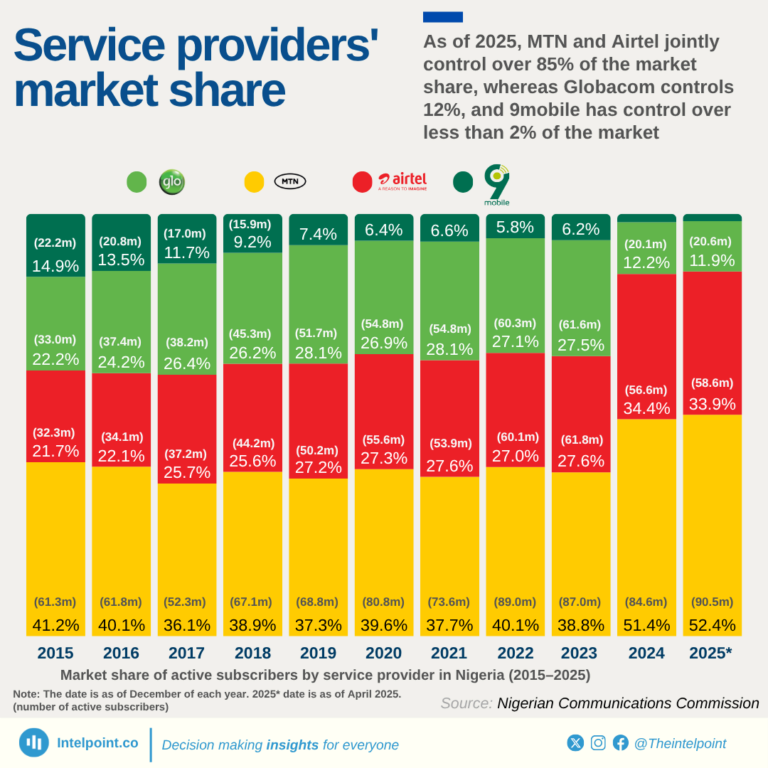
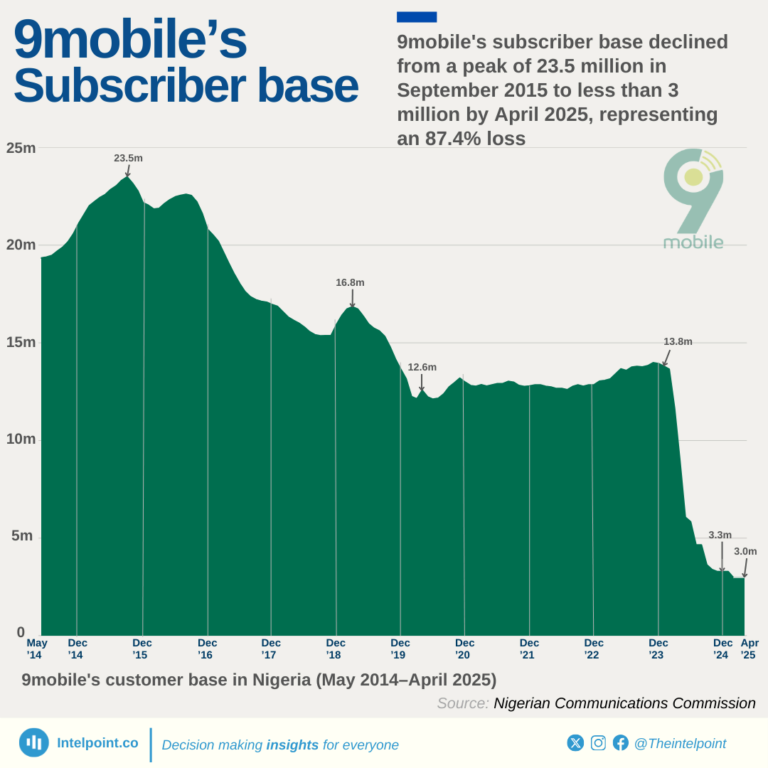
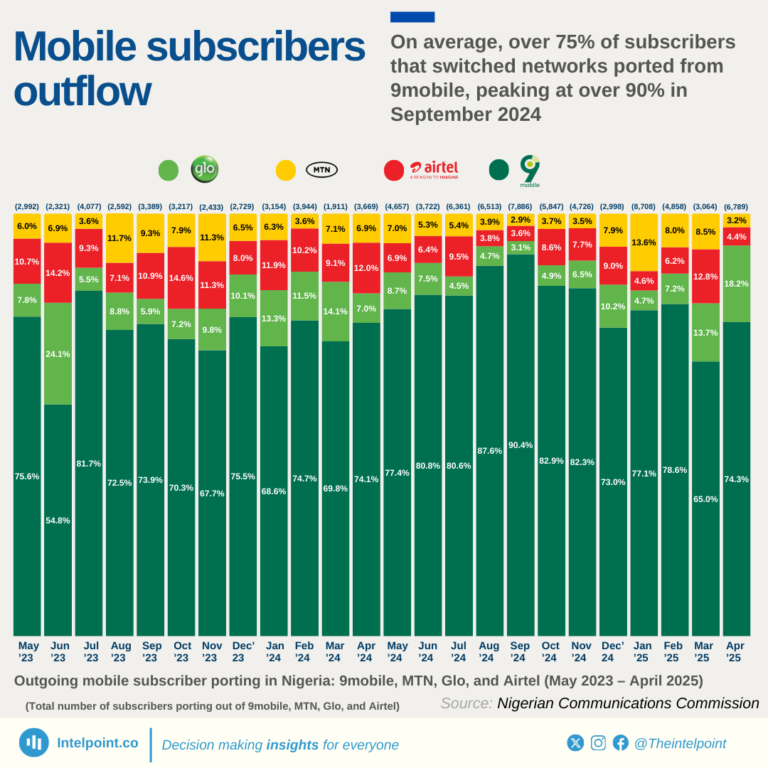
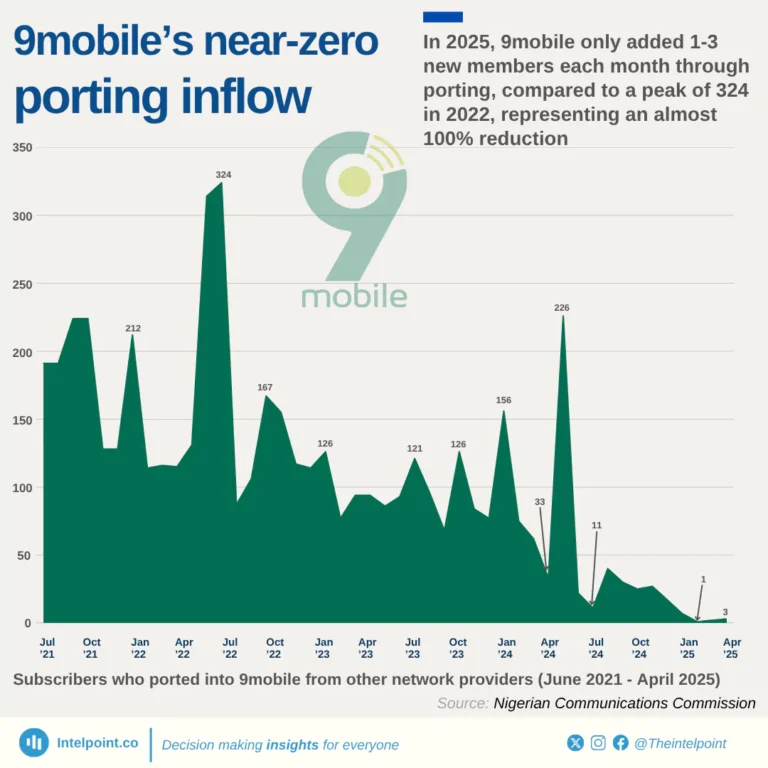
  • MTN Nigeria has dominated the country's telecommunications market over the years, accounting for the largest market share. All four operators, apart from 9mobile, recorded a significant increase in their subscriber base between May 2014 and March 2024.

    See more
  • The 2024 Global Peace Index reveals a decline in peacefulness in 97 countries, the highest since the index began.

    Nigeria is among the nations affected by regional conflicts and rising violence. With a peace index score of 2.91, Nigeria is facing increasing challenges.

    A deteriorating peace score impacts foreign investment and economic stability. Global economic losses due to violence reached $19.1 trillion in 2023.
    See more

Other Insights

Key Takeaways:

  • Between 2016 and 2020, Kenya's debt to the International Monetary Fund (IMF) declined steadily by 59%, from SDR 609.8 million to SDR 249.9 million.
  • This downward trend reversed dramatically after 2020, with public debt rising to SDR 3.02 billion by March 2025.
  • The most significant annual increase occurred between 2020 and 2021, when debt jumped by 178%.
  • The lowest recorded debt level during the study period was in 2020, at the height of the COVID-19 pandemic, when it fell to approximately SDR 250 million.
  • Kenya’s IMF debt grew more than elevenfold (1,109%) from its 2020 low to its 2025 peak.
See more

Key Takeaways:

  • Soybeans topped the US' agricultural exports in 2024, followed by corn and beef.
  • The top 10 agricultural commodities made up 56.6% of the total value of the US' agricultural exports.
  • Plant-based exports (soybeans, corn, tree nuts, soybean meal, wheat) contributed over 34% of the total agricultural export value.
  • The combined value of the top 10 exports exceeded $99.73 billion.
  • Animal proteins (beef, pork, and poultry) together represented 13.9% of total US agricultural exports.
See more
  • Over 36% of candidates earned a Second Class Lower.
  • One in every 27 candidates achieved a First Class Honours.
  • More than 16% secured a Second Class Upper.
  • 181 candidates were absent for the exam, roughly 2.5% of the total.
  • 327 candidates earned a Conditional Pass, requiring further requirements for full qualification.
See more
  • The Netherlands led with 18.6% of South Africa’s citrus exports in 2023.
  • The U.S. accounted for 5.8% of South Africa’s citrus exports, a small share compared to Europe and UAE.
  • South African citrus exports to the U.S. in 2023 was valued at $141 million.
  • Other markets, like the UK and UAE, played a larger role in South Africa’s citrus trade.
  • Market diversity may reduce the impact of the trending U.S. tariff on South Africa’s overall citrus export.
See more
  • Djibouti’s inflation reached a peak in 2022, with 5.18%, the highest in the past decade.
  • The lowest inflation rate occurred in 2015, with a negative value of -0.85%.
  • From 2014 to 2023, Djibouti experienced fluctuating inflation, with increases in 2016, 2019, and 2022.
  • Between 2022 and 2023, inflation decreased from 5.18% to 1.50%.
  • The year 2018 saw the lowest inflation among positive rates, with a modest 0.15%.
  • The overall trend shows periodic inflation spikes, particularly in 2016, 2019, and 2022, while other years maintained relatively stable or lower inflation.
See more
  • The total number of out-of-school children in primary education in Lesotho rose to 96,388 in 2023, an increase of 40,511 from 2015.
  • The number of children out of school in 2021 saw a sharp rise to 92,290, up from 69,906 in 2020.
  • The gender gap remained relatively stable, with more boys than girls out of school each year.
  • The overall trend shows a steady increase in the total number of children out of school, especially in the past five years.
See more

Key Takeaways:

  • Petroleum products (crude oil and other oil products) dominated Nigeria's export landscape in 2024, accounting for 88.26% of total export value.
  • Agricultural exports contributed 5.73% to export value, despite Nigeria's significant agricultural potential.
  • The manufacturing sector made up just 2.95% of the total export value.
  • Nigeria’s total export value reached ₦77.44 trillion in 2024 from ₦35.96 trillion in 2023.
  • Non-oil sectors collectively made up less than 12% of export value.
See more

Key Takeaways:

  • Crude oil remains Nigeria’s largest export, while refined petroleum products lead imports.
  • Natural gas ranks as the second-largest export, contributing 9.71% of the total export value.
  • The top five imported products account for 32.28% of Nigeria’s global imports.
  • The top ten exports represent over 95% of Nigeria’s total export value.
See more

Key Takeaways:

  • Maritime transport dominated Nigeria’s international trade in Q4 2024, accounting for 98.79% of total exports and 90.15% of total imports.
  • Air transport contributed significantly to imports (9.03%) but played a minimal role in exports (0.64%).
  • Road and other transport modes made negligible contributions to both imports and exports.
  • Total trade across all transport modes reached ₦36.6 trillion, resulting in a positive trade balance.
See more
Countries globally with the largest unconnected (internet) population (2025)
  • India tops the list with 651.6 million people offline — almost five times Nigeria’s number, but a smaller percentage (44.7%) of its population.
  • China has 311.9 million unconnected people, but that’s only 22% of its population.
  • With 78.7% of its population offline (105.2M people), Ethiopia has the lowest internet penetration among the top countries listed.
  • Bangladesh, Nigeria, and Pakistan all have over 50% of their populations unconnected.
  • Despite their smaller populations, over 70% of people in both Tanzania and Uganda remain offline.
  • While Nigeria is a regional tech hub, it still has over 128 million people offline, pointing to a major disconnect between urban tech growth and rural internet access.
See more
The average retail price of Automotive Gas Oil (Diesel) paid by consumers in Nigerian states in February 2025
  • Diesel prices in Adamawa skyrocketed by 92.77%, the most significant year-on-year increase nationwide, more than 4x the national average.
  • Many northern states, including Plateau (72.12%), Benue (60.57%), and Kano (54.76%), experienced steep diesel cost increases, intensifying regional cost disparities.
  • States like Gombe (-10%), Edo (-9.68%), and Kogi (-6.29%) bucked the national trend, offering some relief from rising energy costs.
  • The Federal Capital Territory recorded the highest absolute diesel price in the country.
  • Some states, such as Akwa Ibom (+2.17%) and Ebonyi (+2.23%), saw minimal changes.
  • Despite being a commercial hub, Lagos recorded one of the lowest diesel prices at ₦1,222.22, with a relatively small increase of 5.21%.
See more
The year-on-year change in average retail price of Automotive Gas Oil (Diesel) paid by consumers in Nigerian geopolitical zones in February 2025
  • Diesel prices in the North East soared by 36.26%, the highest increase nationwide.
  • All three northern zones—North East (36.26%), North Central (33.71%), and North West (15.44%)—saw the steepest fuel price increases, outpacing their southern counterparts.
  • The South East (6.97%) and South South (9.23%) recorded the lowest diesel price increases.
  • The South West experienced a moderate rise at 13.30%, positioning it between the extremes of northern and other southern zones.
  • The uneven price changes point to a broader issue of fuel supply chain challenges, infrastructure, and perhaps market inefficiencies affecting certain regions more than others.
See more
1 58 59 60 61 62 126
  • Capital expenditure accounted for the largest share of Lagos State’s Q1 2025 spending, at 52%.
  • Overhead costs consumed 22% of the total expenditure.
  • Personnel costs accounted for 18%, reflecting the importance of workforce expenses.
  • Debt servicing made up 5%, indicating relatively low pressure from debt obligations.
  • The balance between recurrent (personnel, overhead, debt, and other recurrent) and capital spending leans heavily towards long-term growth.
Read more
  • Internally Generated Revenue (IGR) accounted for 61% of Lagos State’s Q1 2025 receipts.
  • VAT was the second-largest funding source, contributing 22%.
  • Loans made up 8% of total inflows for the quarter.
  • Opening balance accounted for 4%, indicating a moderate carryover from the previous year.
Read more
  • South Africa has doubled from 317,000 units in 1999 to approximately 600,000 units in 2024.
  •  Major peaks were recorded in 2006 (588K), 2016 (616K), and 2018 (632K), while noticeable declines occurred in 2009 (374K) and 2020 (447K), reflecting global economic shocks.
  • South Africa remains one of the leading vehicle producers in Africa, manufacturing a wide mix of passenger cars, light commercial vehicles (LCVs), trucks, and buses/coaches.
  • The industry plays a critical role in exports, employment, and industrial development, making South Africa an automotive hub on the continent.
Read more
  • China built 31.3M vehicles in 2024, more than the U.S. and Japan combined, and over one-third of global output.
  • The U.S. and Japan are still major players, but each produced less than half of China’s volume.
  • India, rising with 6.0M vehicles, is cementing its place as a global automotive powerhouse.
  • Europe’s strength: Germany leads with 4.1M units, supported by Spain, France, and the Czech Republic.
  • Brazil, Thailand, and Turkey demonstrate strong regional growth.
Africa’s contribution:
  • South Africa (21st, 0.59M units) is the continent’s top producer.
  • Morocco (23rd, 0.56M units) follows closely. Combined, they reflect Africa’s small but developing presence in the global auto industry.
Read more
  • Algeria is Africa’s largest country, covering 2.4 million km², slightly bigger than the Democratic Republic of Congo (2.3 million km²).
  • Sudan (1.9 million km²) and Libya (1.8 million km²) complete the top four, showing that North Africa dominates the list of largest territories.
  • Nigeria, Africa’s most populous nation, has a landmass of 923,800 km², placing it 14th in size, much smaller than its population ranking.
  • The smallest among the top 20 listed is South Sudan, with 619,700 km², less than one-third the size of Algeria.
Read more
  • Samsung dominates with 26.42% of Ghana’s smartphone market, making it the clear leader.
  • Tecno (17.7%) and Apple (17.4%) are in a tight race for second place, separated by just 0.3 percentage points.
  • Infinix (10.5%) and Itel (5.2%) highlight the strong presence of Transsion Holdings brands in Ghana.
  • Global giants like Huawei (6.8%) and Xiaomi (2.5%) lag behind, showing Ghana’s preference for budget-friendly African-focused brands.
Read more
1 58 59 60 61 62 252

Can’t find what you’re looking for? Please fill the form below
Contact Form Demo
SIGN UP TO OUR NEWSLETTER
Get periodic updates about the African startup space, access to our reports, among others.
Subscribe Here
Subscription Form

A product of Techpoint Africa. All rights reserved