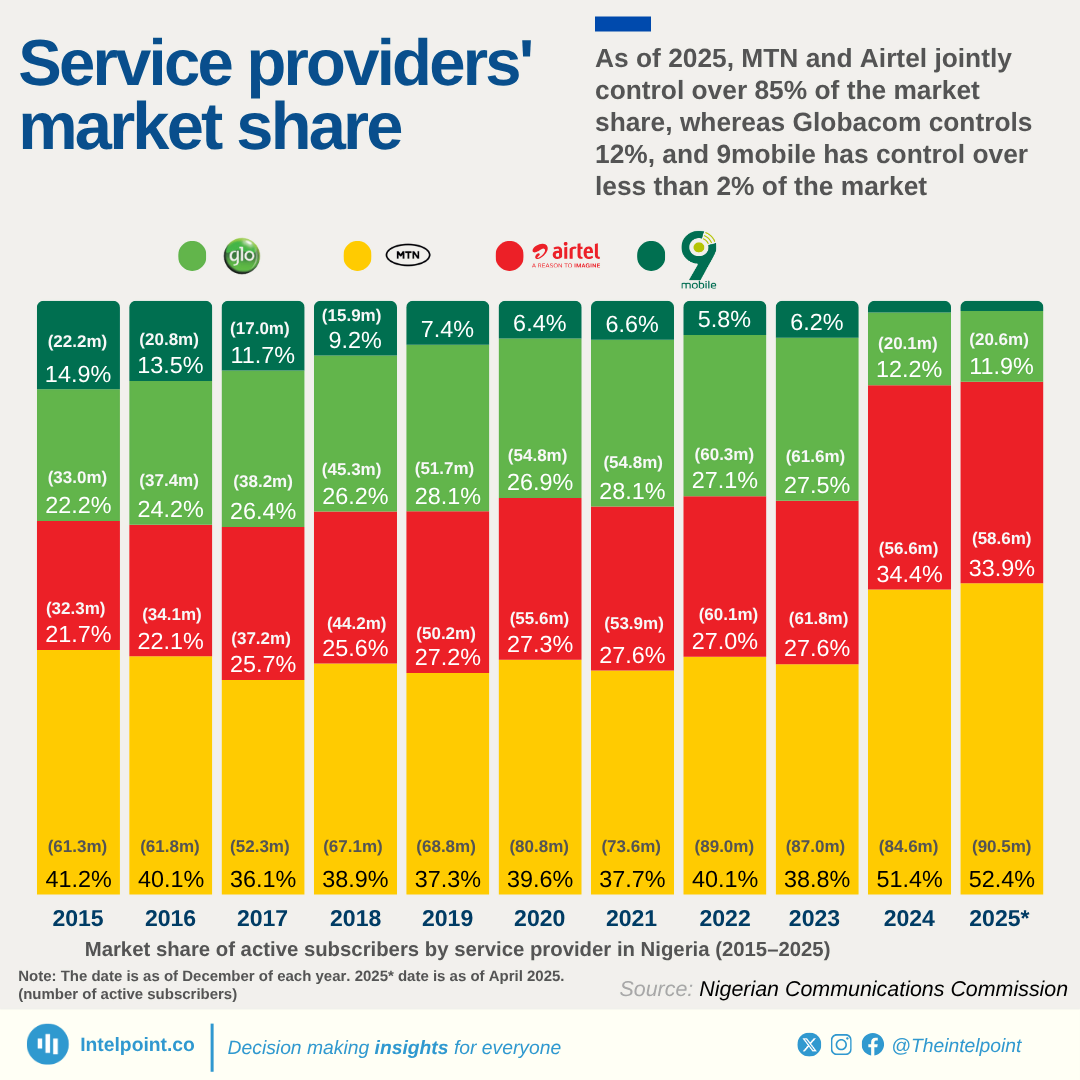
As of 2025, MTN and Airtel jointly control over 85% of the market share, whereas Globacom controls 12%, and 9mobile has control over less than 2% of the market

Key takeaways:

  • MTN maintained the highest market share, growing from 41% in December 2015 to 52% by April 2025.
  • Airtel grew significantly, expanding from 22% in December 2015 to 34% by Apr 2025.
  • 9mobile experienced a steep decline, falling from 15% to 2% over the same period.
  • Globacom maintained stability until 2023, then saw a dramatic fall from 27% to 12% by December 2024.
  • The total market grew from 148.7 million in 2015 to 172.7 million subscribers in 2025 (16% growth).
  • 9mobile's market share declined from 22.2 million subscribers (15%) to just 3.0 million (2%) in 2025.
  • Globacom lost 41.5 million subscribers between 2023 and 2024.
  • Airtel's market share expanded from 22% to 34%.

Over the last decade, Nigeria’s telecommunications sector has undergone significant market changes, with MTN solidifying its position as the undisputed leader. As of April 2025, MTN commands 52% of all active telephony subscribers, a significant rise from 41% in 2015. Its subscriber base grew from 61.3 million to over 90.5 million, indicating good customer retention and network expansion.

Airtel’s market share increased from 22% to 34%, bringing its subscriber base to approximately 58.6 million by April 2025. This upward trend highlights Airtel's growth in the sector, especially in recent years.

Globacom, whose market share had been constant at 26-28% for many years, has seen its grip on the market weaken sharply. By April 2025, its share had dropped to 12%, with subscriber numbers at roughly 20.6 million. On the more drastic side, from a 15% share in 2015, 9mobile's market share dropped to just 2% in 2025, with active users falling from more than 22 million to around 3 million.
Source:

Nigerian Communications Commission

Period:

2015-2025
HTML code to embed chart
Want a bespoke report?
Reach out
Tags
Related Insights

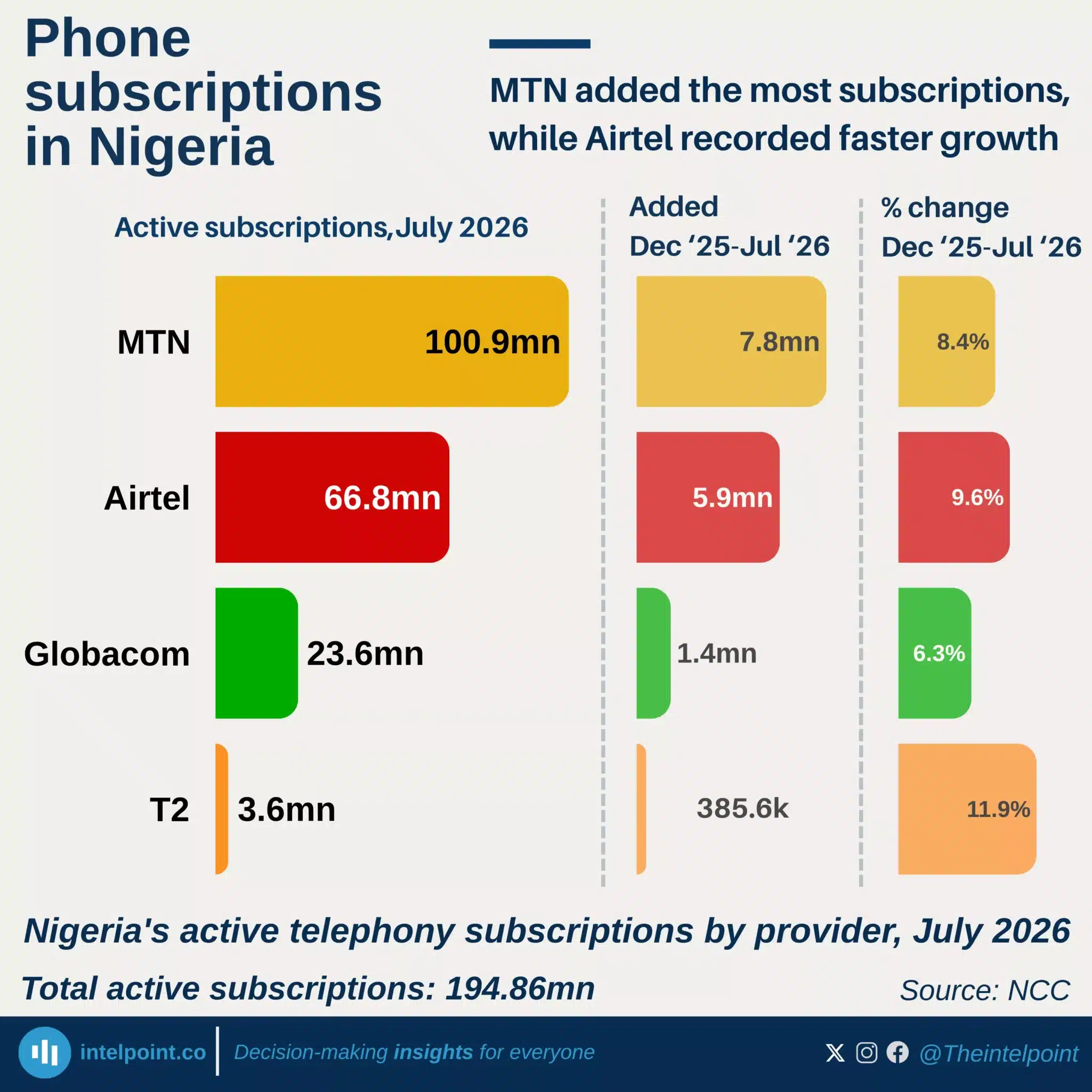
MTN added the most subscriptions, while Airtel recorded faster growth
  • MTN became Nigeria’s first operator to cross 100 million active subscriptions.
  • MTN added 7.8 million subscriptions between December 2025 and July 2026.
  • Airtel grew faster than MTN, despite adding fewer subscriptions overall.
  • T2 recorded the fastest growth at 11.9% over the period.
  • Nigeria’s active subscriptions rose by 15.5 million to 194.9 million.

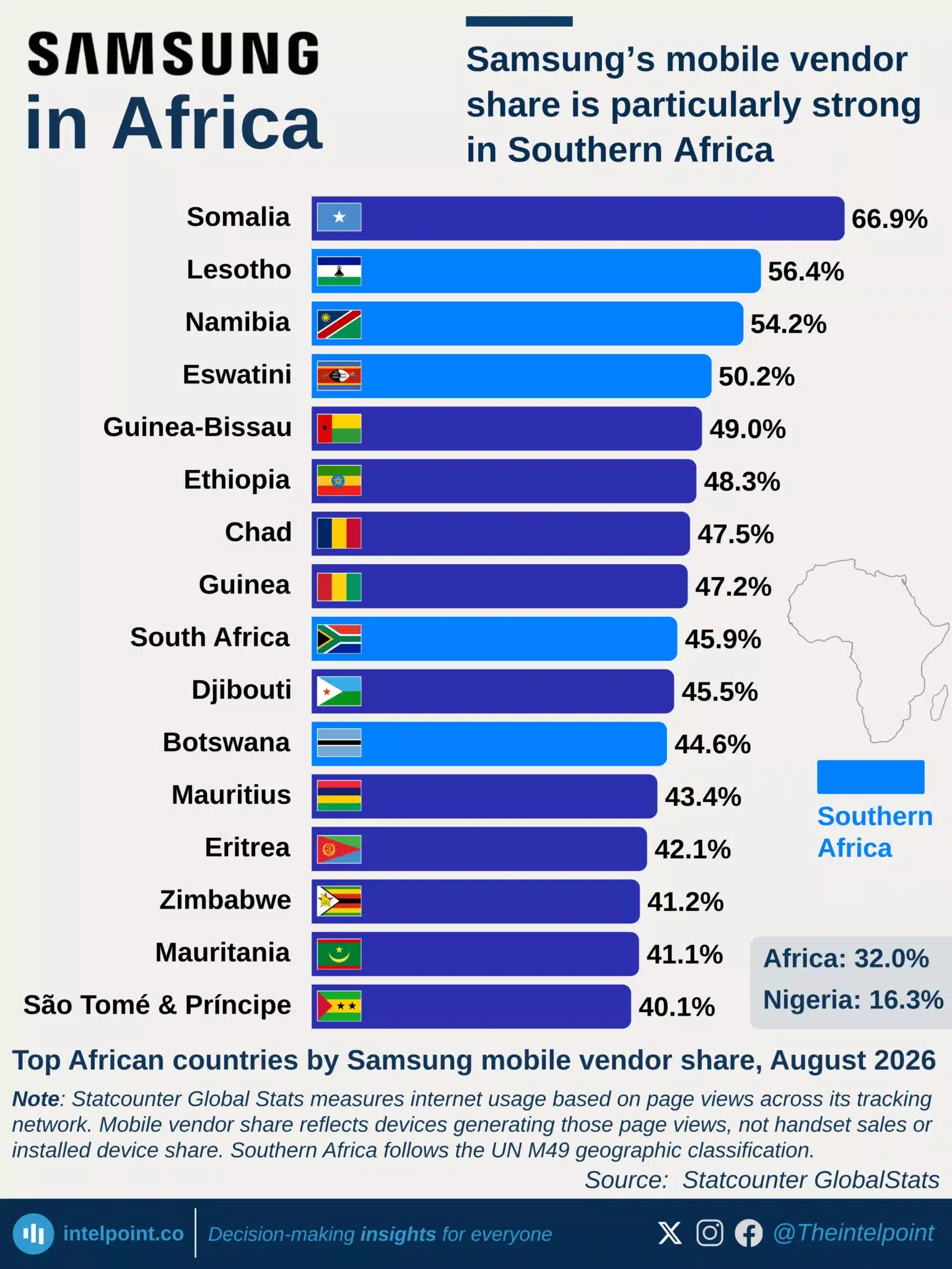
Samsung’s mobile vendor share is particularly strong in Southern Africa
  • Samsung exceeds 50% share in 4 African countries, led by Somalia at 66.9%.
  • Its share exceeds 40% in 16 countries, including Ethiopia, South Africa, Botswana and Zimbabwe.
  • Southern Africa shows particularly high Samsung usage, with all five UN M49 countries above 44%.
  • Samsung’s share is much lower in major markets, including Nigeria (16.3%), Egypt (22.9%) and Ghana (24.7%).
  • Samsung holds a 32.0% share across Africa, based on mobile web traffic rather than device sales.

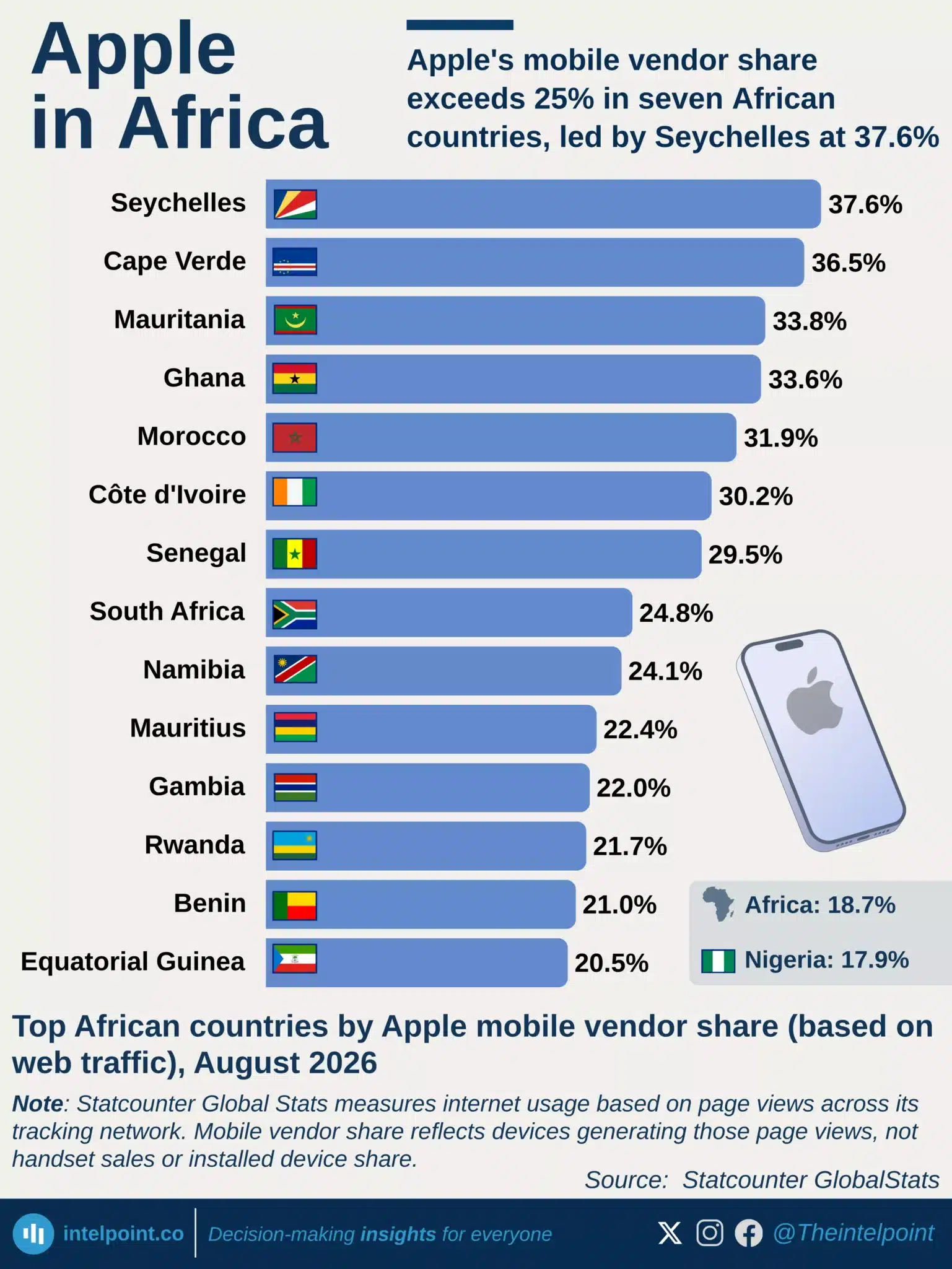
Apple's mobile vendor share exceeds 25% in seven African countries, led by Seychelles at 37.6%
  • Apple exceeds 25% share in 7 African countries, led by Seychelles at 37.6%.
  • Cape Verde and Mauritania follow, at 36.5% and 33.8%, respectively.
  • South Africa trails just below 25%, with a 24.8% share.
  • Nigeria’s 17.9% share is close to Africa’s 18.7% average, despite its market size.
  • These figures measure web traffic, not device sales or installed smartphone base.

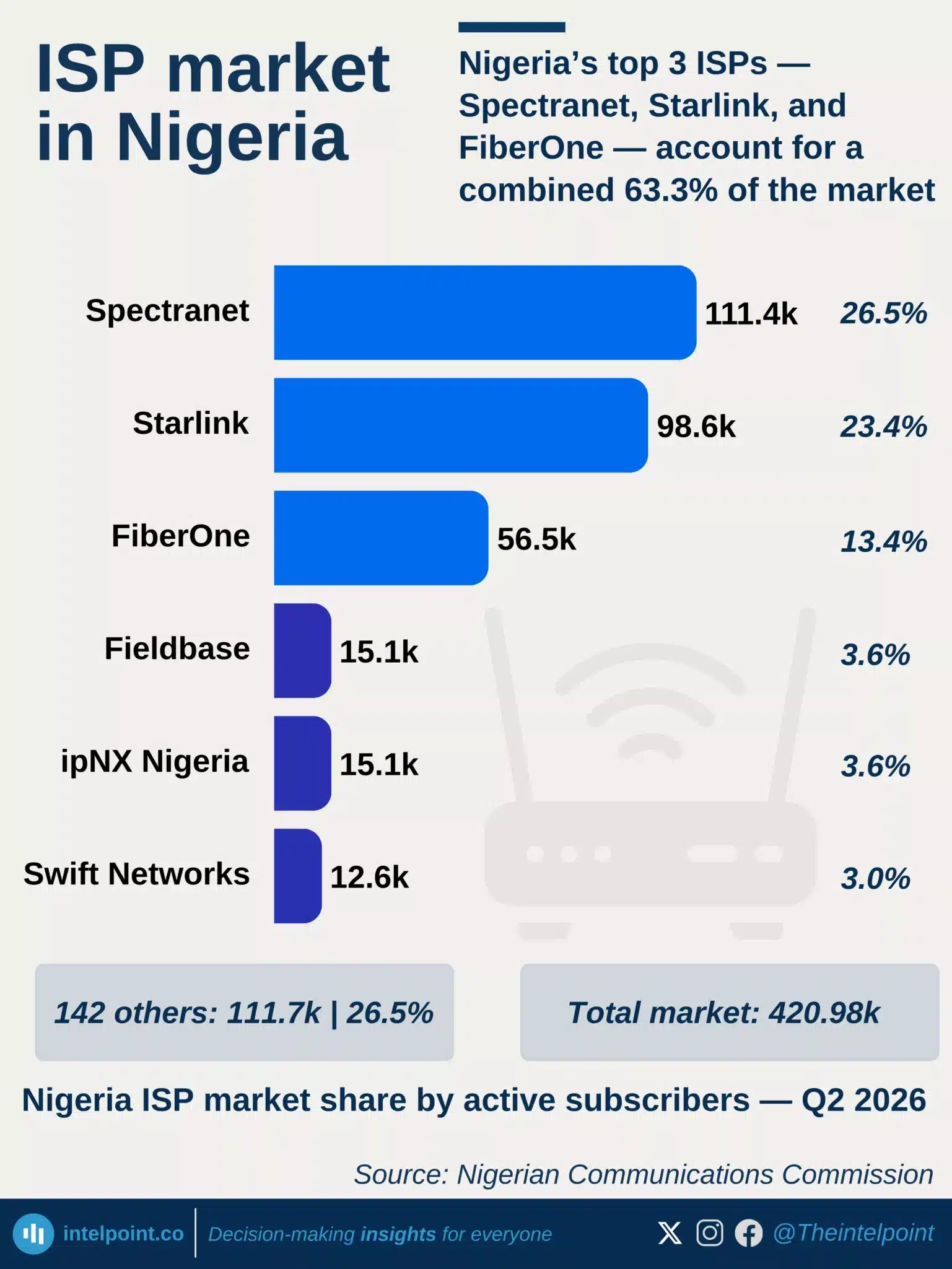
Nigeria’s top 3 ISPs — Spectranet, Starlink, and FiberOne — account for a combined 63.3% of the market
  • Spectranet leads with 111,384 subscribers, ahead of Starlink's 98,642.
  • Starlink added 6,651 subscribers since December 2025, narrowing the gap to 12,742.
  • Fieldbase Services overtook ipNX for 4th place by just 18 subscribers.
  • The top three ISPs account for over 63% of Nigeria's 420,989 active subscribers.

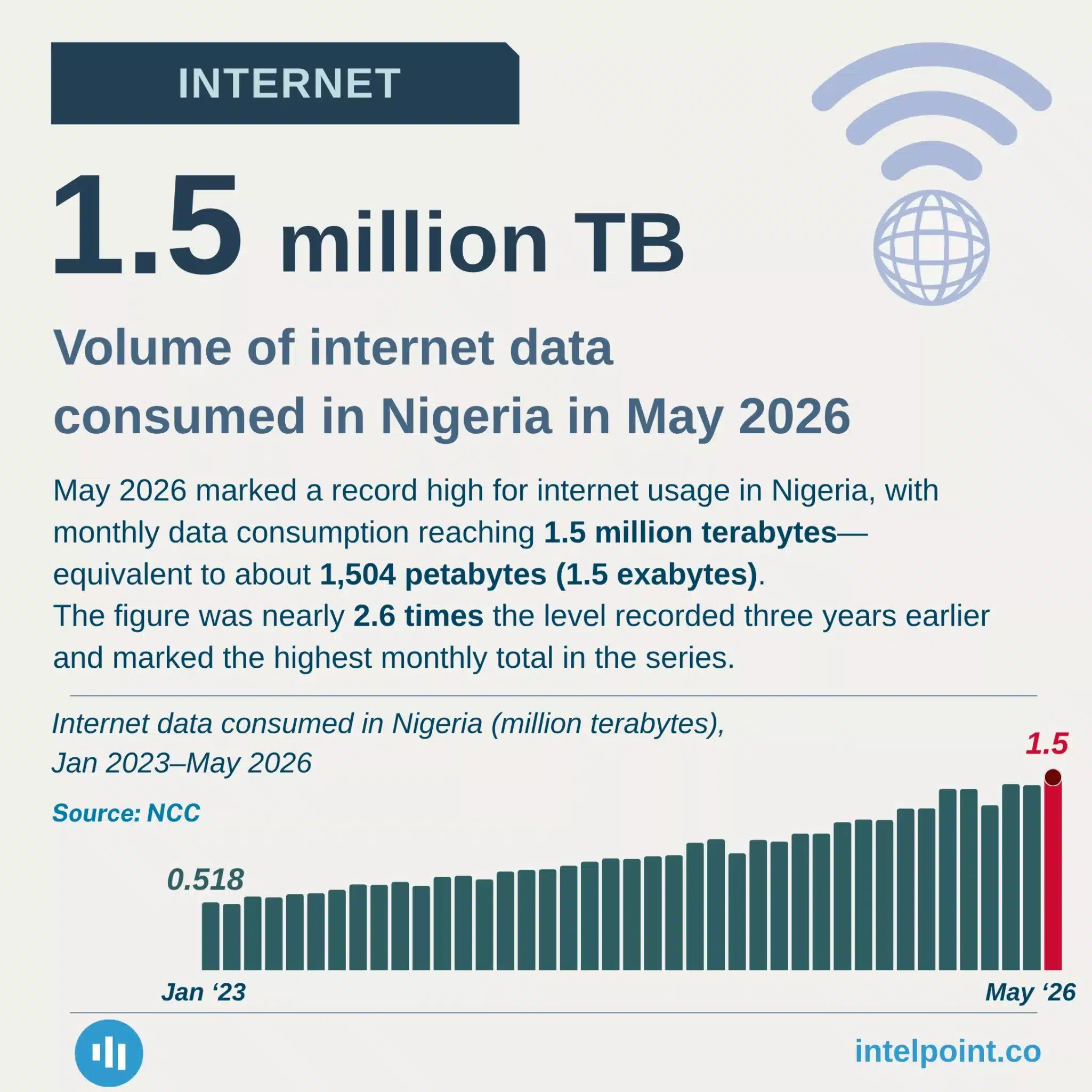
Volume of internet data consumed in Nigeria in May 2026
  • 1.5 million TB was consumed in May 2026, the highest monthly level on record.
  • 7 million TB was consumed in Jan–May 2026, up 42.1% from the same period in 2025.
  • Jan–May 2026 usage was 88.4% higher than in 2024 and 156.3% higher than in 2023.
  • May’s monthly usage was nearly 2.6× the level recorded three years earlier.
  • The surge points to rapidly growing demand for internet-based services, content and digital activity in Nigeria.

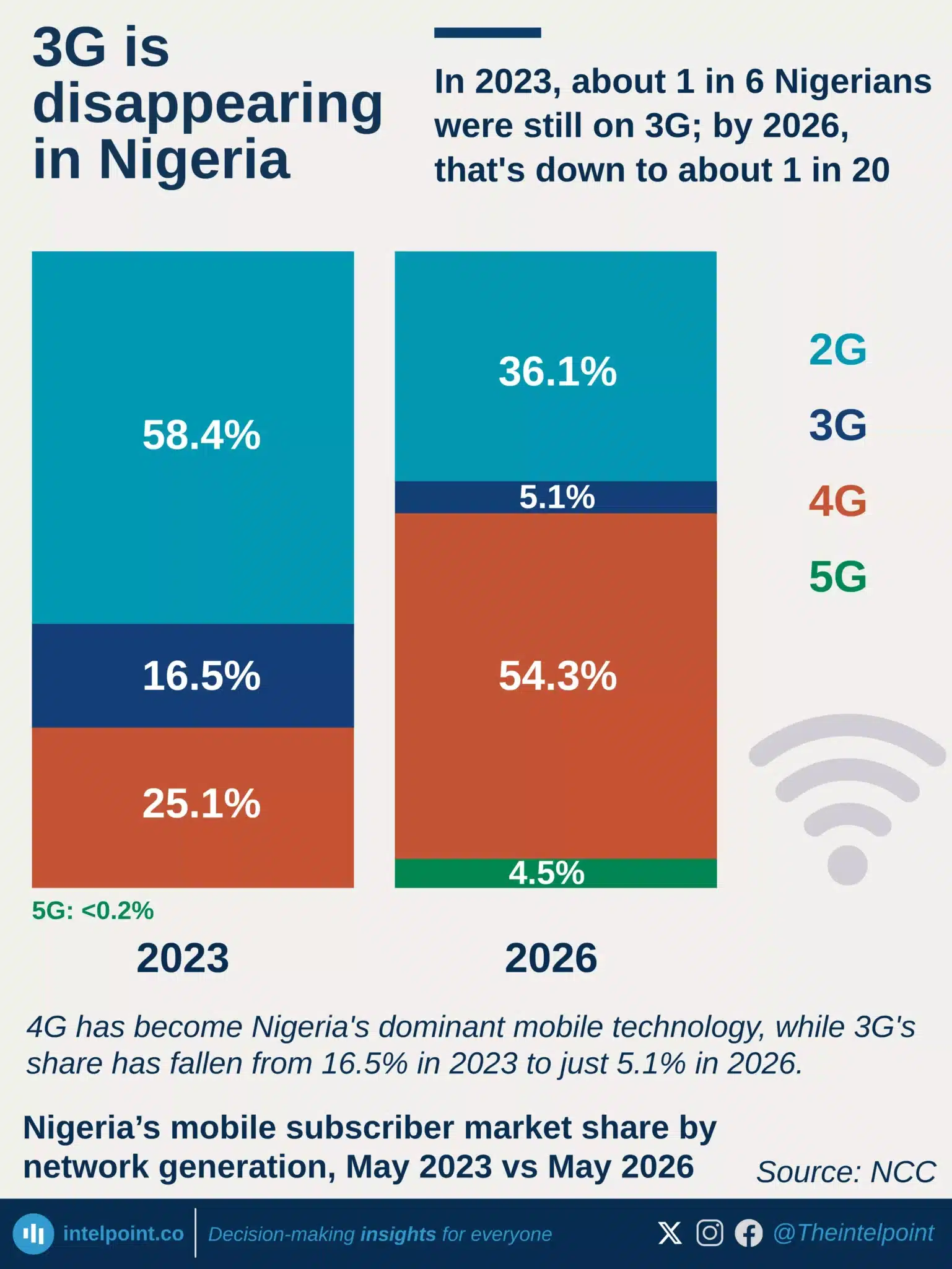
In 2023, about 1 in 6 Nigerians were still on 3G; by 2026, that's down to about 1 in 20
  • 3G's share of Nigeria's mobile market fell from 16.5% to 5.1% between May 2023 and May 2026.
  • 4G became the dominant network, with its market share rising from 25.1% to 54.3% over the same period.
  • 2G's share declined from 58.4% to 36.1% but still accounted for more than one-third of all mobile connections.
  • 5G expanded nearly 37-fold, growing from less than 0.1% to 4.5% of mobile subscriptions.

POPULAR TOPICS
SIGN UP TO OUR NEWSLETTER
Get periodic updates about the African startup space, access to our reports, among others.
Subscribe Here
Subscription Form

A product of Techpoint Africa. All rights reserved