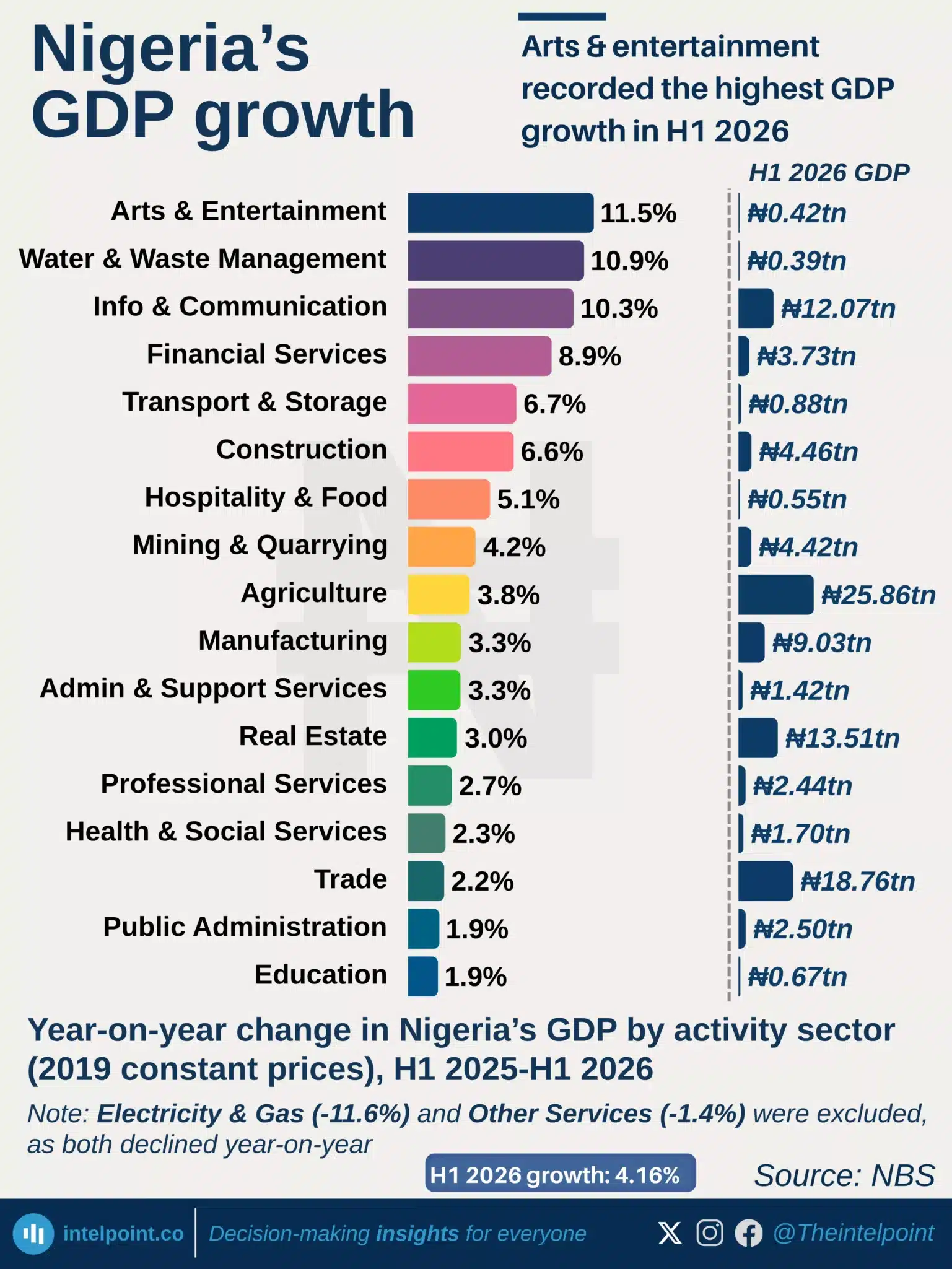
Nigeria: Every sector, except for Transportation & Storage, recorded a year-on-year GDP growth in Q3 2023

In Q3 2023, Nigeria's GDP soared, with almost every sector recording year-on-year growth. Noteworthy growth includes Information and Communication, which increased by 40% compared to Q3 2022. Check out the chart for a quick overview.
Source:

National Bureau of Statistics

Period:

Q3 2023
HTML code to embed chart
Want a bespoke report?
Reach out
Tags
Related Insights

Nigeria’s food inflation has risen every month since January 2026, climbing 8.07 percentage points to 16.96% in May
  • Nigeria’s year-on-year food inflation rose for the fourth consecutive month, from 8.89% in January 2026 to 16.96% in May.
  • The rate increased by 8.07 percentage points within the first five months of 2026.
  • May’s 16.96% rate means food prices were, on average, 16.96% higher than they were in May 2025.
  • Food inflation rose from 12.12% in February to 14.31% in March and 16.06% in April before reaching 16.96% in May.
  • Food inflation exceeded Nigeria’s 15.93% headline inflation rate in May, showing that food was a major source of renewed pressure on household expenses.

Among 44 African countries, Nigeria's 16.96% food inflation in May 2026 was lower only than that of Libya and Malawi
  • Nigeria recorded the third-highest food inflation rate among 44 African countries in May 2026.
  • At 16.96%, Nigeria’s rate was lower only than Libya and Malawi, both at 17.6%.
  • Nigeria’s food inflation was nearly 3.5 times the 4.88% average across the countries covered.
  • Eight of the ten countries with the highest food inflation recorded rates above 10%.

Company income tax collections declined across 13 sectors in Q1 2026
  • Thirteen of Nigeria’s 21 sectors recorded year-on-year declines in CIT collections.
  • Extraterritorial organisations recorded the steepest fall at 53.9%.
  • Construction collections fell by 52.4%, the second-largest decline.
  • Mining and agriculture declined by 39.4% and 40.8%, respectively.
  • Manufacturing still generated ₦74.5 billion despite a 31.0% decline.

Eswatini and Morocco have remained in the World Bank's lower-middle-income band for at least 38 consecutive years
  • Nigeria has remained in the World Bank’s lower-middle-income category for 17 consecutive years.
  • Eswatini and Morocco have spent at least 38 consecutive years in the category, the longest among African countries.
  • Africa has 23 lower-middle-income economies in the World Bank’s Fiscal Year 2026 classification.
  • Tunisia, Angola, and Namibia entered the category after falling from upper-middle-income status.

Portfolio investment into Nigeria hit a 13-year quarterly high in Q1 2026
  • Portfolio investment into Nigeria reached $9.86 billion in Q1 2026, the highest quarterly level in 51 quarters.
  • The Q1 2026 portfolio inflow was higher than the previous peak of $7.11 billion recorded in Q1 2019.
  • Portfolio investment accounted for 95% of Nigeria’s total capital importation in Q1 2026.
  • Foreign Direct Investment remained low at $135 million, far below portfolio inflows.
  • Other Investment stood at $374 million, making it the second-largest inflow category in Q1 2026.

Three African countries are projected to have debt exceeding their GDP in 2026
  • Sudan is projected to have Africa’s highest debt-to-GDP ratio in 2026, at 169.1%.
  • Only three African countries are projected to owe more than the size of their economies in 2026.
  • Senegal and Mozambique join Sudan among countries with debt-to-GDP ratios above 100%.
  • Africa’s average government debt-to-GDP ratio is projected at 60.7% in 2026.
  • Nigeria’s projected debt-to-GDP ratio of 32.3% is far below the African average.

POPULAR TOPICS
SIGN UP TO OUR NEWSLETTER
Get periodic updates about the African startup space, access to our reports, among others.
Subscribe Here
Subscription Form

A product of Techpoint Africa. All rights reserved