Bite-sized Insights about
 
Providing you with data-based insights about things happening around you.
Popular Insights
  • 10.7 million US non-immigrant visas were issued in 2023, 36% more than in 2022, with Mexicans receiving nearly 23% of the total. The top five countries received more than half of the total issuances. Nigeria — 15th on the list — received 1%.

    See more

    In Q1 2024, there was a 146% increase in Nigeria's foreign trade value from ₦12.9t in Q1 2023, with exports reaching ₦19.2t, and surpassing the whole of 2020's exports (₦12.5t).

    The total trade value in the quarter reached nearly half of the total trade in 2023.

    See more
  • The 2024 Global Peace Index reveals a decline in peacefulness in 97 countries, the highest since the index began.

    Nigeria is among the nations affected by regional conflicts and rising violence. With a peace index score of 2.91, Nigeria is facing increasing challenges.

    A deteriorating peace score impacts foreign investment and economic stability. Global economic losses due to violence reached $19.1 trillion in 2023.

    See more

    The FAAC's revenue distribution from 2017 to August 2023 highlights the dominance of Delta, Akwa Ibom, Rivers, and Bayelsa states in allocations. Despite Lagos' economic prominence, it ranked fifth. Here is the distribution of revenue among states between 2017 and August 2023.

    See more
  • A Trend of Adult literacy rates of African countries

    Between 2018 and 2021, adult literacy rates across African nations exhibited significant disparities. Seychelles and South Africa led with literacy rates of 96% and 95%, respectively, indicating a high proportion of literate adults. Conversely, Chad had the lowest literacy rate during this period.

    These statistics underscore the uneven progress in educational attainment across Africa, highlighting the need for targeted interventions to improve literacy in lower-performing nations.

    See more
    Countries by Global Innovation Index 2024

    The Global Innovation Index 2024 reveals a striking contrast in innovation performance between countries globally and across Africa. Switzerland leads the global rankings with an impressive score of 67.5, followed by Sweden (64.5) and the USA (62.4), highlighting their sustained investments in research, development, and technological advancement.

    In Africa, Mauritius takes the top spot with a score of 30.5, followed closely by Morocco (28.8) and South Africa (28.3). However, even Africa's most innovative nations achieve less than half the score of global leaders, indicating a significant innovation gap.

    Nigeria ranks 15th in the African ranking and 113th globally, out of 133 countries, with a score of 17.1.

    See more

  • The value of transactions conducted over Unstructured Supplementary Service Data (USSD) in Nigeria in 2021 was ₦5.2 trillion, 73% higher than 2020 figures. The total transaction value dropped by ₦685 billion in 2022, a 13.3% decline. The transaction volume also witnessed a 6% decline.

    See more
  • MTN Nigeria has dominated the country's telecommunications market over the years, accounting for the largest market share. All four operators, apart from 9mobile, recorded a significant increase in their subscriber base between May 2014 and March 2024.

    See more
  • The 2024 Global Peace Index reveals a decline in peacefulness in 97 countries, the highest since the index began.

    Nigeria is among the nations affected by regional conflicts and rising violence. With a peace index score of 2.91, Nigeria is facing increasing challenges.

    A deteriorating peace score impacts foreign investment and economic stability. Global economic losses due to violence reached $19.1 trillion in 2023.
    See more

Other Insights
Nigeria’s average daily fuel consumption in litres (2015 - 2024)
  • Nigeria’s daily fuel consumption peaked at 66.7 million litres in 2022.
  • Fuel consumption fell to 47.5 million litres in 2023 after the subsidy removal.
  • Consumption rebounded slightly to 51.8 million litres in 2024, but remains far below 2022 levels.
  • Between 2015 and 2022, consumption grew from 48.7m to 66.7m litres daily.
  • 2021 saw a notable increase to 61.9m litres, likely due to economic recovery post-COVID.
  • The lowest recorded consumption in the 10-year period was 47.5m litres in 2023.
  • The post-subsidy dip marks the largest single-year decline in consumption within the observed period.
See more
Bitcoin’s market capitalisation, monthly average (Jan. 2016 - Jan. 2025)
  • Bitcoin’s market cap grew from $6B in 2016 to $2T in 2025 — a 337x increase.
  • In 2021, Bitcoin’s market value peaked at $1.1T before reaching $1.2T in 2022.
  • Bitcoin experienced a sharp drop to around $525B in 2023.
  • Its recovery was strong in 2024, with the market cap rising again to $1.4T.
  • Despite periodic dips, the long-term chart shows a consistent upward growth trend.
See more
Nigeria’s estimated population share by generation (as of Jan 2025)
  • Gen Z and Millennials combined make up just over half of Nigeria’s population at 50.1%.
  • Gen Alpha alone represents 35.6% of the total population — the single largest generational cohort.
  • Gen Z, born between the late 1990s and early 2010s, accounts for 25.8% of Nigerians.
  • Millennials make up 24.3%, maintaining a strong influence across work, culture, and consumer trends.
  • Gen X, typically born between 1965 and 1980, represents only 9.2% of the population.
  • Older generations (Baby Boomers and Silent Generation) account for just 5.1% of the total population.
  • Nigeria’s entire population under the age of 44 (Gen Alpha, Gen Z, and Millennials) represents approximately 85.7% of the total population.
See more
Share of women members of the national parliament (upper and lower chambers), African top and bottom 10 countries (2024)
  • Rwanda leads Africa in female parliamentary representation with 61.3% women in its national legislature.
  • Nigeria has the lowest representation of women in parliament across the continent at just 4.3%.
  • South Africa and Cabo Verde also boast high female parliamentary shares, with 44.7% and 44.4% respectively.
  • Four of the top 10 countries have more than 40% women in their national assemblies.
  • Only five countries in the bottom 10 have over 10% female representation.
  • The gap between the top and bottom countries is massive: a nearly 57-percentage-point difference between Rwanda and Nigeria.
See more
All-time most popular TV shows (non-English-language content) by the number of views in their first 91 days on Netflix, global top 10
  • Squid Game (Seasons 1 and 2) dominates with 457.8 million combined views, securing the top two spots globally.
  • Money Heist appears three times on the top 10 list—Parts 3, 4, and 5—with 285.2 million combined views.
  • France’s Lupin makes a strong showing, with Part 1 and Part 2 totalling 167.9 million views.
  • The top 10 list spans shows from Korea, Spain, France, Mexico, and Colombia, indicating Netflix’s successful global strategy.
  • Latin American thrillers like Who Killed Sara? and La Palma feature prominently, proving demand for drama-rich storytelling.
  • All shows on the list surpassed 50 million views each in just 91 days, showing rapid global consumption patterns.
See more
All-time-most-popular-movies-non-English-language-content-by-the-number-of-views-in-their-first-91-days-on-Netflix-global-top-10
  • Troll leads with 103 million views, making it the most-watched non-English movie on Netflix in its first 91 days.
  • Under Paris follows closely with 102.3 million views, proving France's influence in Netflix's global content slate.
  • Society of the Snow (98.5M) and Nowhere (85.7M) show how survival and human drama resonate deeply with audiences worldwide.
  • Dystopian themes remain popular, with The Platform (82.8M) drawing strong viewership through intense, minimalist storytelling.
  • Five out of the top 10 movies pulled in more than 80 million views each, highlighting a huge appetite for international cinema.
  • Latin America and Europe dominate the list, with films from Spain, France, and Norway also attracting global attention.
See more
All-time most popular movies (English-language content) by the number of views in their first 91 days on Netflix, global top 10
  • Red Notice leads with 230.9 million views in 91 days, making it the most-watched English-language Netflix movie to date.
  • Carry-On and Don’t Look Up are close, with 172.1M and 171.4M views respectively.
  • Five of the top 10 movies surpassed 150 million views within their first 91 days on the platform.
  • The Adam Project and Bird Box are tied closely, each drawing around 157 million views.
  • Back in Action and Leave the World Behind also made strong entries with over 140 million views each.
  • The entire top 10 showcases a mix of action, sci-fi, family, and thriller genres, proving Netflix’s broad appeal across demographics.
See more
All-time most popular TV shows (English-language content) by the number of views in their first 91 days on Netflix, global top 10
  • Wednesday (Season 1) tops the list with 252.1 million views, by far the highest ever for an English-language Netflix series.
  • Stranger Things 4 follows at a distant second with 140.7 million views in the same 91-day window.
  • The limited series Adolescence secured third place with 137.8 million views
  • Monster: The Jeffrey Dahmer Story also performed strongly, gathering 115.6 million views.
  • Bridgerton Seasons 1 and 3 made the list, emphasising the franchise’s popularity.
  • Three of the top 10 shows had under 100 million views, with Stranger Things 3 closing the list at 94.8 million.
See more

Key Takeaways:

  • South Africa has been the leading wine producer in Africa from 1975 to 2022.
  • Algeria was the top producer from 1961 to 1974 but saw a significant decline in output in later years.
  • South Africa, Algeria, Morocco, and Tunisia have been the dominant wine-producing countries in Africa between 1961 and 2022.
  • On average, eight African countries have engaged in wine production annually during this period.
  • Sub-Saharan nations such as Zimbabwe, Ethiopia, and Tanzania have contributed small but steady wine to Africa’s production in recent decades.
  • Egypt has consistently ranked among Africa’s top wine producers, with its highest production recorded in 2008.
See more

Key takeaways:

  • As of January to June 2025, Nigeria had nine operational refineries.
  • Dangote Petroleum Refinery is the largest, with a capacity of 650,000 barrels per day (bpd).
  • The total combined capacity of all functional refineries is almost 975,000 bpd.
  • Government-owned refineries, Warri, Kaduna, and Port Harcourt (old), collectively have a capacity of 295,000 bpd.
  • Out of 27 licensed refineries by the Nigerian Upstream Petroleum Regulatory Commission (NUPRC), only nine were operational during this period.
  • Other operational refineries such as Aradel, OPAC, Edo, Waltersmith, and Duport Midstream collectively have a capacity of 29,500 bpd.
See more

Key Takeaways:

  • The former Sudan was the leading sesame seed oil producer in Africa for 48 years, from 1961 to 2011.
  • Nigeria topped Africa’s production rankings between 2012–2014 and 2016–2018.
  • The Central African Republic led sesame oil production in Africa for five years in a recent period.
  • East African countries, particularly Tanzania and Uganda, have seen significant growth in sesame oil production since the 1990s.
  • Six countries—Former Sudan, Somalia, Ethiopia, Tanzania, Mozambique, and the Central African Republic—have consistently played leading roles in Africa’s sesame seed oil production from 1961 to 1981 before the inclusion of some other African countries.
  • Following their separation, both Sudan and South Sudan have remained among the top sesame oil producers in Africa.
  • The top producers of sesame seed oil in Africa are mainly from Sub-Sahara African countries.
  • In SSA, sesame is often grown by small-scale farmers for export purposes.
See more
Top countriesterritories with the lowest net migrants per 1,000 population (2024) in Africa
  • Eritrea has the highest net migration loss in Africa at -8.7 per 1,000 people.
  • Nigeria's net migration rate of -0.2 is significantly lower than any country in the top 10 list.
  • Sao Tome and Principe and Eswatini follow Eritrea with rates of -6.5 and -6.0, respectively.
  • Lesotho also experiences substantial out-migration, with a net rate of -4.5 per 1,000.
  • Three countries—Rwanda, Uganda, and CAR—have the same net migration rate of -3.1.
See more
1 51 52 53 54 55 126
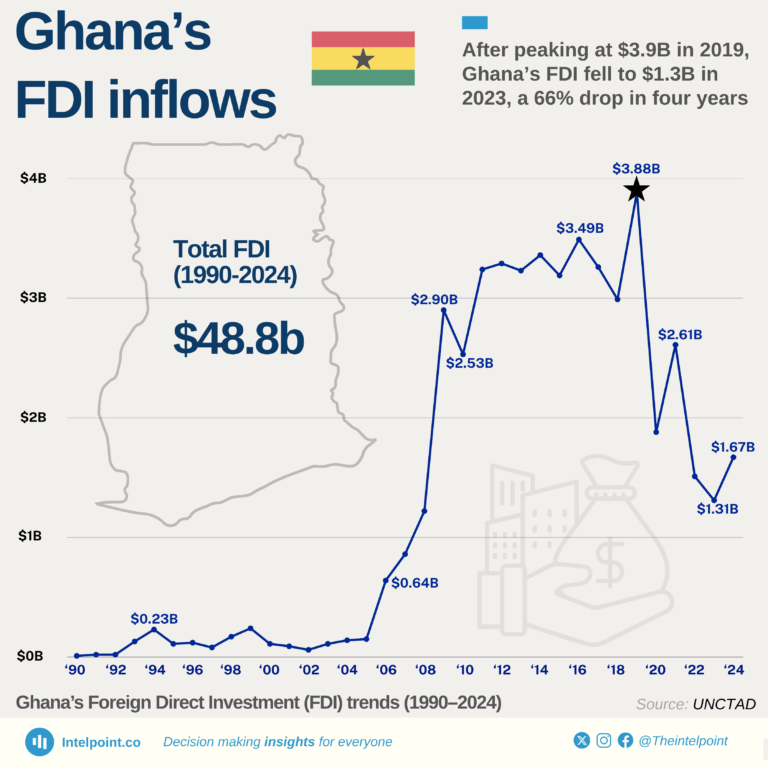
  • Ghana exported $49.11 billion in digital services between 2005 and 2024.
  • Digital services imports recorded during the same period was $53.00 billion.
  • Ghana recorded a $3.9 billion trade deficit across the two decades.
  • Exports grew from just $78 million in 2005 to $5.18 billion in 2024.
Read more
  • Egypt spends twice as much on digital services imports than it earns from exports, with $8.31b on imports and $4.03b from exports recorded in 2024.
  • Egypt exported $46.007 billion in digital services between 2005 and 2024.
  • Imports during the same period reached $101.98 billion.
  • The result was a trade deficit of $55.973 billion in over 20 years.
  • Export earnings rose from just $1.91 billion in 2005 to $4.03 billion in 2024.
Read more
  • Morocco recorded a total of $61.75 billion digital services trade exports and $35.31 billion imports, revealing a staggering $26.44 billion trade profit in 20 years.
  • Morocco has always been the leading country in Africa as far as digital services trade is concerned.
  • From 2005-2024, Morocco digital services exports have always outpaced imports.
  • Morocco digital export earnings have grown from $1.11b in 2005 to $6.74b in 2024, revealing over 500% growth in 20 years.
  • Imports during the same time-frame reached 3.17b from $780m in 2025.
Read more
  • South Africa led the continent with a massive 68.2% of Africa’s insurance market, far ahead of all others combined.
  • Morocco (8.7%), Egypt (4.0%), and Kenya (3.6%) were the next largest.
  • Major economies, such as Nigeria (1.7%) and Algeria (1.9%), played surprisingly small roles in insurance penetration.
  • “Others” refers to the rest of Africa, which held just 6.4%, indicating a heavy concentration in a few markets.
Read more
  • Financial services dominate Nigeria’s digitally delivered exports, contributing $1.15bn (over 74%).
  • Telecommunications ($184m) and insurance & pension services ($147m) follow, though far smaller.
  • Computer, information, and IP services registered almost no exports, highlighting untapped digital potential.
  • Nigeria’s digital exports remain highly concentrated in finance, leaving other sub-sectors underdeveloped.
Read more
  • Majority trust will be moderate to high: 92.6% of Nigerians are expected to have either high (43.9%) or moderate (48.7%) trust in financial institutions by 2025.
  • Transparency is the biggest driver of trust as 46.2% of respondents believe transparent policies and fees will most improve their trust.
  • Security is a rising priority; 30.2% of Nigerians highlight improved security features as a key factor in strengthening confidence in financial institutions.
  • Customer service and regulation still matter as 17% emphasise better customer service and 6.6% stronger regulatory oversight, showing that while oversight has a role, people prioritise fairness, safety, and service.
Read more
1 51 52 53 54 55 252

Can’t find what you’re looking for? Please fill the form below
Contact Form Demo
SIGN UP TO OUR NEWSLETTER
Get periodic updates about the African startup space, access to our reports, among others.
Subscribe Here
Subscription Form

A product of Techpoint Africa. All rights reserved