Bite-sized Insights about
 
Providing you with data-based insights about things happening around you.
Popular Insights
  • Key takeaways:

    • Zenith Bank Plc led the profitability ranking with a Profit After Tax (PAT) of ₦1.03 trillion.
    • Guaranty Trust Holding Company followed closely with ₦1.02 trillion in PAT.
    • Each of the top six banks recorded profits exceeding ₦600 billion.
    • The total PAT for the top ten banks rose by 53%, from ₦3.39 trillion in 2023 to ₦5.54 trillion in 2024.
    • FCMB Group Plc was the only bank among the top ten to record a year-on-year decline in PAT.
    • Ecobank, First Holdco, Fidelity Bank, and Wema Bank each recorded over 100% growth in PAT compared to 2023.
    See more

    As of December 2023, Johannesburg had the highest number of millionaires (12,300) in Africa; Cape Town followed with 7,400 millionaires. South Africa dominated the list, with its cities and regions claiming top spots.

    See more
  • The 2024 Global Peace Index reveals a decline in peacefulness in 97 countries, the highest since the index began.

    Nigeria is among the nations affected by regional conflicts and rising violence. With a peace index score of 2.91, Nigeria is facing increasing challenges.

    A deteriorating peace score impacts foreign investment and economic stability. Global economic losses due to violence reached $19.1 trillion in 2023.

    See more

    The FAAC's revenue distribution from 2017 to August 2023 highlights the dominance of Delta, Akwa Ibom, Rivers, and Bayelsa states in allocations. Despite Lagos' economic prominence, it ranked fifth. Here is the distribution of revenue among states between 2017 and August 2023.

    See more
  • A Trend of Adult literacy rates of African countries

    Between 2018 and 2021, adult literacy rates across African nations exhibited significant disparities. Seychelles and South Africa led with literacy rates of 96% and 95%, respectively, indicating a high proportion of literate adults. Conversely, Chad had the lowest literacy rate during this period.

    These statistics underscore the uneven progress in educational attainment across Africa, highlighting the need for targeted interventions to improve literacy in lower-performing nations.

    See more
    Countries by Global Innovation Index 2024

    The Global Innovation Index 2024 reveals a striking contrast in innovation performance between countries globally and across Africa. Switzerland leads the global rankings with an impressive score of 67.5, followed by Sweden (64.5) and the USA (62.4), highlighting their sustained investments in research, development, and technological advancement.

    In Africa, Mauritius takes the top spot with a score of 30.5, followed closely by Morocco (28.8) and South Africa (28.3). However, even Africa's most innovative nations achieve less than half the score of global leaders, indicating a significant innovation gap.

    Nigeria ranks 15th in the African ranking and 113th globally, out of 133 countries, with a score of 17.1.

    See more

  • While many living in Nigeria have already experienced the effects of the fuel subsidy removal on their daily expenses, this chart presents a clearer picture of reality. Will the prices of food items continue to rise? Is there hope of some respite soon?

    See more
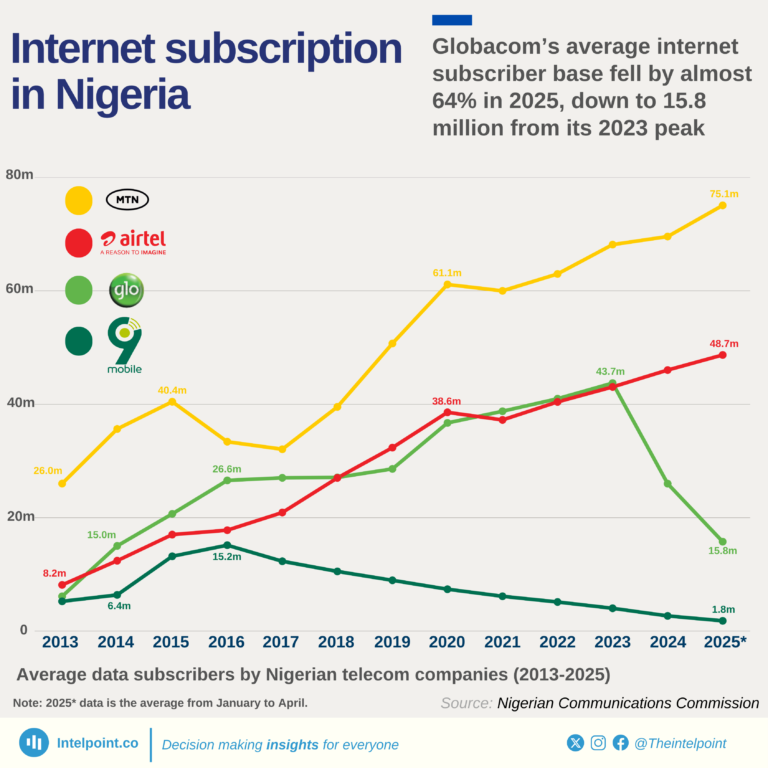
  • MTN Nigeria has dominated the country's telecommunications market over the years, accounting for the largest market share. All four operators, apart from 9mobile, recorded a significant increase in their subscriber base between May 2014 and March 2024.

    See more
  • The 2024 Global Peace Index reveals a decline in peacefulness in 97 countries, the highest since the index began.

    Nigeria is among the nations affected by regional conflicts and rising violence. With a peace index score of 2.91, Nigeria is facing increasing challenges.

    A deteriorating peace score impacts foreign investment and economic stability. Global economic losses due to violence reached $19.1 trillion in 2023.
    See more

Other Insights

Key Takeaways:

  • Africa’s sesame seed oil production grew from 23,706 tonnes in 1961 to 217,048 tonnes in 2022, an overall increase of 815%.
  • The highest production was recorded in 2012, with an output of 375,697 tonnes, which is more than 15 times the 1961 volume.
  • Between 1961 and 2012, production rose by 1,484.8%.
  • The largest single-year increase occurred between 1969 and 1970, when production jumped from 41,456 tonnes to 101,472 tonnes.
  • After reaching its peak in 2012, production experienced notable fluctuations, settling at 217,048 tonnes by 2022.
  • The sharpest annual decline occurred in 2013, with a 38.6% drop following the 2012 peak.
See more

Key takeaways:

  • Over the past six decades, global wine production has remained relatively stable, averaging around 28 million tonnes annually.
  • Wine production increased from 21.5 million tonnes in 1961 to 27.4 million tonnes in 2022.
  • The highest production was recorded in 1979, reaching 37.5 million tonnes.
  • The second-highest year was 1982, with a production of 37.4 million tonnes.
  • Wine production exceeded 30 million tonnes in ten different years between 1961 and 2022.
  • Between 2000 and 2022, production was consistently stable, averaging about 27 million tonnes.
  • The 2022 production of 27.4 million tonnes represented a 27.3% increase compared to 1961.
See more

Key Takeaways:

  • African wine production peaked in 1965 at 2.39 million tonnes, the highest level recorded during the entire period.
  • The most dramatic single-year drop occurred between 1965 and 1966, when production fell by 40%, from 2.39 to 1.44 million tonnes.
  • A gradual recovery began in the early 2000s, with production consistently exceeding 1 million tonnes from 2003 onward.
  • The most recent peak occurred in 2021, with production reaching 1.23 million tonnes, a 48.5% decline from the 1965 high.
  • Despite this partial recovery, current production levels remain well below the highs of the 1960s.
  • As of 2022, African wine production stood at 1.16 million tonnes, representing a 43% decrease from 1961.
See more

Key Takeaways:    

  • China’s exports to Nigeria increased from less than $100 million in 1992 to $20.2 billion in 2023, an overall growth of 22,074%.
  • The highest export value was recorded in 2022 at $22.3 billion.
  • China's exports to Nigeria dropped sharply in 2016 to $9.7 billion from $15.39 billion in 2014.
  • After a sharp 29% decline between 2015 and 2016, exports entered a period of sustained growth beginning in 2017.
  • The 2020–2022 period saw remarkable growth, with exports rising by 33% despite global pandemic challenges.
  • In 2023, exports declined by 9.5%, yet remained significantly above pre-pandemic levels.
See more
Value of startup funding deals in Francophone Africa by type of deal, 2024
  • 87.2% of startup deal value in Francophone Africa in 2024 came from equity funding.
  • Debt financing made up only 12.4% of the total startup capital raised, showing its limited role.
  • Grants accounted for just 0.4%, reflecting minimal non-dilutive support for startups.
  • Startups are more likely to trade ownership than take on debt or apply for grants.
  • The funding landscape remains investor-driven, with equity seen as the path to scale.
  • The near absence of grant funding may hinder innovation for startups that need early runway but aren't ready to give up equity.
See more
Nigeria's arts, entertainment, and recreation sector's contribution to GDP (2020 - 2050)
  • The arts, entertainment, and recreation sector contributed 4.12% to Nigeria’s GDP in 2020.
  • By 2025, this contribution is projected to rise modestly to 4.43%.
  • The growth rate maintains a steady pace, reaching 4.75% by 2030.
  • By 2050, the arts, entertainment, and recreation sector is projected to reach a 6.00% share of Nigeria’s GDP.
  • With only a 1.88 percentage point rise forecasted over 30 years, the pace of growth suggests the sector remains undervalued or under-leveraged relative to its potential.
  • The creative economy’s resilience, despite limited public infrastructure and policy support, demonstrates strong organic demand and global competitiveness.
See more
African Infrastructure Development Index (AIDI) of countries with the highest nominal GDP in Africa (2003 - 2024)
  • Morocco's AIDI score rose from 19.08 in 2003 to 70.32 in 2024, indicating substantial infrastructure progress over two decades.
  • Over the past 21 years, Egypt's infrastructure development, as measured by AIDI, has more than tripled.
  • Nigeria ranks 24th in infrastructure (AIDI) despite having the 4th largest GDP in Africa.
  • In 2024, Nigeria’s AIDI score was 25.70, significantly below peers like Morocco (91.43) and Egypt (82.54).
  • Algeria, with a GDP of $260.13B, achieved a strong AIDI score of 70.32, ranking 8th.
  • The AIDI gap highlights that economic size doesn’t guarantee infrastructure strength, underlining the need for intentional investment.
See more
Weakest African currencies by annual average official exchange rate (LCU per US$) in 2024
  • Eight East African nations made the list of the top 15 worst African currencies.
  • Somalia has the weakest African currency in 2024, with an exchange rate of 28,118.33 SOS per US$.
  • Guinea, with 8,613.26 GNF per US$, has the second weakest currency, but is still far behind Somalia.
  • Madagascar, Uganda, and Zimbabwe follow, each with exchange rates between 3,200 and 4,500 LCU per US$.
  • Nigeria’s currency traded at 1,478.97 Naira per US$, about 20 times stronger than Somalia's currency.
  • Despite economic turmoil, South Sudan’s currency remained below 2,200 SSP per US$, performing better than Somalia and Guinea.
  • The gap between Somalia and the rest of Africa’s currencies highlights extreme economic pressures unique to the Somali economy in 2024.
See more
Share of rural and urban population in Nigeria (1950 - 2050)
  • Nigeria's urban population is projected to grow from 9% in 1950 to 70% in 2050.
  • The urban population surpassed the rural population for the first time in 2020.
  • Between 1980 and 2020, Nigeria’s urban population more than doubled, from 22% to 52%.
  • The rural population share is expected to fall sharply from 91% in 1950 to just 30% in 2050.
  • In 2010, Nigeria’s population was still majority rural (57%), but within just a decade, that changed.
See more
  • Egypt led every single year from 1961 to the most recent year — 63 years of dominance.
  • Egypt peaked at over 10.2 million tonnes in 2009, no other African country came close.
  • As of 2023, Egypt ranked 5th globally, just ahead of Italy and behind the US.
  • Nigeria hit its highest level in 2015, with 4.2 million tonnes.
  • Nigeria was the only country that got within 1.5 million tonnes of Egypt in 13 different years.
  • Countries like Algeria, Morocco, and Tunisia remained consistent but far behind Egypt and Nigeria.
  • Egypt’s lead is backed by large-scale irrigation and strong export systems.
  • In 1987, Africa supplied 11.7% of the world’s tomatoes. But by 2023, its share dropped to 8.8%.
See more

Key Takeaways:

  • From 2014 to 2023, China’s imports from Nigeria fluctuated significantly, ranging between $907 million and over $3 billion.
  • A sharp 53% drop was recorded between 2014 and 2015, followed by a further decline to a decade-low in 2016.
  • China reached its highest import value in 2021, when it imported over $3 billion from Nigeria.
  • Imports fell by 47% in 2022 but recovered by 48% in 2023, reaching $2.37 billion.
  • The volatility in trade reflects the influence of global commodity prices, especially oil, and evolving bilateral trade dynamics.
  • Mineral fuels, oils, and distillation products accounted for more than 50% of China's imports from Nigeria during the period of study.
See more

Key takeaways:

  • China led global gold production with 378.16 tonnes, representing approximately 10.4% of global output.
  • The top five producers (China, Russia, Australia, Canada, and the United States) collectively produced 37% of the world’s gold.
  • African nations showed remarkable strength, with four countries in the top 15 (Ghana, Mali, South Africa, and Burkina Faso).
  • Ghana led Africa in gold production and ranked 6th globally, producing 135.11 tonnes in 2023.
  • China, Australia, and Russia together produced nearly 1,000 tonnes of gold, accounting for 27.3% of total world production.
See more
1 53 54 55 56 57 126
  • South Africa has the highest number of millionaires in Africa at 41,100.
  • Egypt follows with 14,800 millionaires, making it the second largest hub.
  • Seychelles has the highest millionaire share of the adult population at 0.51%.
  • Mauritius is close behind with 0.45% of its adult population being millionaires.
  • Ethiopia has 2,400 millionaires, but their share is almost zero due to its large adult population.
Read more
  • Africa exported $41.3 billion in digital services in 2024, less than 1 percent of the world total.
  • South Africa was the continent’s top exporter with $7.05 billion.
  • Morocco ($6.74 billion) and Ghana ($5.18 billion) followed closely.
  • Egypt ($4.03 billion) and Mauritius ($3.53 billion) also ranked among the top five.
  • The top five countries together made up about two-thirds of Africa’s exports.
Read more
  • Nigeria spent $57.67B on external debt interest from 1970 to 2023.
  • Payments were low initially but rose steadily as borrowing increased.
  • In the 1990s, interest payments fluctuated due to debt rescheduling and restructuring agreements.
  • In 2005, payments jumped to $5.31B following a strategic debt buyback that accelerated obligations.
  • Annual payments climbed 1,139.6%, from $0.31B to $3.79B, showing rising debt service costs.
Read more
  • Nigeria exported $10.81 billion in digital services between 2005 and 2024.
  • Imports during the same period reached $105.34 billion.
  • The result was a trade deficit of $94.53 billion over 20 years.
  • Exports rose from just $40 million in 2005 to $1.55 billion in 2024.
  • Imports were almost ten times larger than exports, showing a persistent imbalance.
Read more
  • Nigeria’s renewable energy capacity grew from 2.1 GW in 2015 to 3.7 GW in 2024.
  • This represents a 76% increase over the decade.
  • The compound annual growth rate (CAGR) was 5.7% between 2015 and 2024.
  • From 2015 to 2020, capacity was stagnant at around 2.2 GW.
  • The biggest growth year was 2022, with a sharp 34.9% increase.
  • Capacity stagnated in 2023 at 3.1 GW before climbing again in 2024.
  • Nigeria’s renewable growth remains modest compared to its population size and energy demand.
Read more
  • Morocco’s renewable energy capacity grew from 2.4 GW in 2015 to 4.0 GW in 2024.
  • This represents a 67% increase over the decade.
  • The compound annual growth rate (CAGR) was 5.3% between 2015 and 2024.
  • Capacity was stagnant at 2.4 GW from 2015 to 2017 before growth resumed.
  • The biggest single-year increase happened in 2022, with a 13.7% jump.
  • Capacity additions slowed in 2023 (3.7 GW) and 2024 (4.0 GW).
Read more
1 53 54 55 56 57 252

Can’t find what you’re looking for? Please fill the form below
Contact Form Demo
SIGN UP TO OUR NEWSLETTER
Get periodic updates about the African startup space, access to our reports, among others.
Subscribe Here
Subscription Form

A product of Techpoint Africa. All rights reserved