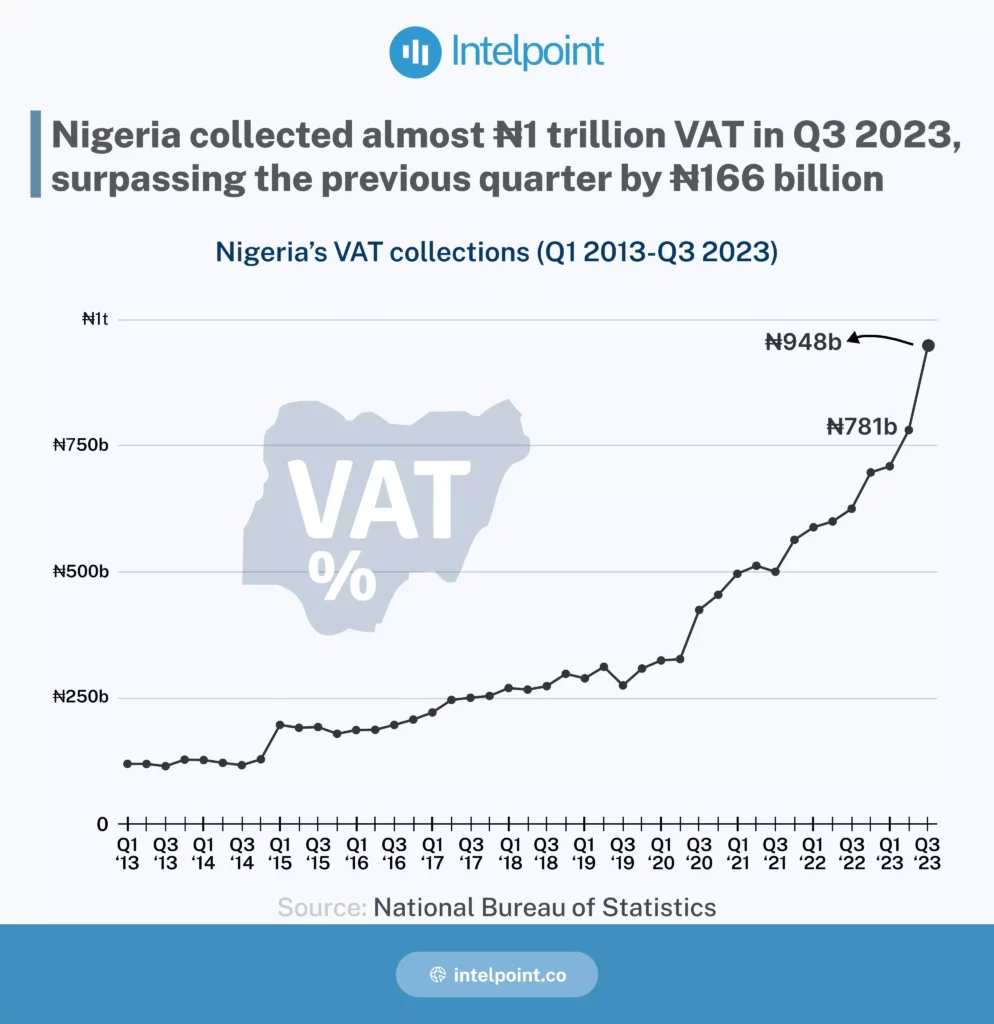
In Q2 2023, Nigeria collected 10% more VAT than in the first quarter, 30% more than in Q2 2022, 53% more than in Q2 2021, and 555% more than 40 quarters ago in Q2 2013. Do you see VAT collections reaching one trillion naira soon?
As of the end of September 2023, Starlink Nigeria had amassed a customer base of 11,207 active subscribers, growing 66% from 6,756 in June. It placed 4th in the market after Spectranet (113,747), Tizeti Network (19,126), and ipNX Nigeria (14,871).
The 2024 Global Peace Index reveals a decline in peacefulness in 97 countries, the highest since the index began.
Nigeria is among the nations affected by regional conflicts and rising violence. With a peace index score of 2.91, Nigeria is facing increasing challenges.
A deteriorating peace score impacts foreign investment and economic stability. Global economic losses due to violence reached $19.1 trillion in 2023.
The FAAC's revenue distribution from 2017 to August 2023 highlights the dominance of Delta, Akwa Ibom, Rivers, and Bayelsa states in allocations. Despite Lagos' economic prominence, it ranked fifth. Here is the distribution of revenue among states between 2017 and August 2023.
Between 2018 and 2021, adult literacy rates across African nations exhibited significant disparities. Seychelles and South Africa led with literacy rates of 96% and 95%, respectively, indicating a high proportion of literate adults. Conversely, Chad had the lowest literacy rate during this period.
These statistics underscore the uneven progress in educational attainment across Africa, highlighting the need for targeted interventions to improve literacy in lower-performing nations.
Nigeria was the seventh most populous nation in the world in 2020, with 206.1 million people. Projected to reach a population of 401.3 million by 2050, Nigeria will rank third after India (1st) and China (2nd). According to Institut national d'études démographiques' projections, Nigeria, Ethiopia, DR Congo, Egypt, Tanzania, and Kenya will be among the world’s top 20 most populous countries by 2050.
MTN Nigeria has dominated the country's telecommunications market over the years, accounting for the largest market share. All four operators, apart from 9mobile, recorded a significant increase in their subscriber base between May 2014 and March 2024.
The 2024 Global Peace Index reveals a decline in peacefulness in 97 countries, the highest since the index began.
Nigeria is among the nations affected by regional conflicts and rising violence. With a peace index score of 2.91, Nigeria is facing increasing challenges.
A deteriorating peace score impacts foreign investment and economic stability. Global economic losses due to violence reached $19.1 trillion in 2023.
The United States holds the largest IMF quota by far, with 82,994.2 billion SDRs, accounting for 17.42%, more than double the quota of any other country.
Japan, China, and Germany follow as the next largest contributors, each holding between 5.5% and 6.5% of total quota shares.
European countries (Germany, France, the U.K., Italy) collectively maintain a strong presence, together accounting for nearly 17.21%, almost equal to the U.S. alone.
Emerging economies like India and Russia have relatively modest shares (2.75% and 2.71%, respectively) despite their growing roles in global economic affairs, indicating an imbalance between global influence and IMF voting power.
University of Maiduguri leads with 31,770 applications, indicating a significant demand for student loans in the North East.
North West institutions dominate the list, with five universities (Bayero University Kano, Federal University Dutsinma Katsina, Ahmadu Bello University, Usman Danfodiyo University, Sokoto, and Umaru Musa Yar'adua University) collectively accounting for a substantial portion of applications.
North Central is represented by University of Jos and University of Ilorin, highlighting the region's active participation in the student loan programme.
Federal University, Kashere's presence underscores the North East's engagement, with two institutions in the top 10.
All listed universities received over 11,000 applications, reflecting widespread awareness and utilization of the student loan initiative across these regions.
With 167,639 applications, the North West zone accounts for the highest number of student loan submissions, representing a significant concentration of demand in that region.
The North East follows with 134,359 applications, bringing the northern region's combined total to over 300,000, more than half of all zonal submissions.
The South West stands as the highest-contributing southern zone with 104,079 applications, showing a strong but comparatively lower demand than the North.
The South East recorded just 29,097 applications, the lowest across all six geopolitical zones.
America leads globally on LinkedIn, with 465.6M users making up 38.8% of the user base.
Asia follows, contributing 397M users, or 33.1% of the global total.
Together, Asia and America make up 71.9% of all LinkedIn users, totalling over 862M.
Europe holds a solid 19.5% share, with 233.8M users.
Africa’s 83M users represent a smaller but growing 6.9% share of global users.
Oceania has the smallest share, at 1.8%, with only 21.5M users.
The distribution reveals that LinkedIn’s core strength lies in regions where digital employment and professional networks are deeply integrated into economic and career activity.
Kenya recorded the highest ivory seizure among the top 10 countries, with 130,432 kg confiscated over the 34-year period.
China and Hong Kong follow closely, with 106,069 kg and 75,707 kg seized, respectively, showing their long standing roles as critical players in the global ivory network.
Vietnam and Singapore, both located in Southeast Asia, had substantial seizure records; 71,256 kg and 29,882 kg, indicating persistent trafficking through the region.
Nigeria leads West Africa in ivory confiscations within the top 10, with 23,031 kg, signalling its importance as a key node in the transit chain.
All countries listed in the top 10 are either source, transit, or destination points in the global ivory supply chain, reflecting how widespread and interconnected the illegal trade remains.
Among the 113 countries measured in the 2022 Global Food Security Index, Nigeria is ranked 107th overall, putting it deep in the bottom ten globally.
Nigeria has the lowest affordability score globally in the GFSI 2022, scoring only 25.0 in that pillar.
The country performs marginally better in other pillars: its score in “Quality and Safety” is relatively higher (55.6), and “Sustainability and Adaptation” is 53.7. But other pillars like “Availability” (39.5) remain weak.
Globally, a group of countries, including Nigeria, DR Congo, Sudan, Venezuela, Burundi, Madagascar, Sierra Leone, Yemen, Haiti, and Syria, all cluster at low overall GFSI scores (below ~45), reflecting severe challenges.
China remains Nigeria’s largest import partner, accounting for ₦4.96T or 32.45% of total imports—more than double the U.S.'s share.
The United States holds second place in imports, contributing ₦2.16T (14.12%), while India, the Netherlands, and the UAE follow with smaller shares below 6%.
Spain tops Nigeria’s export market, receiving ₦2.47T worth of goods, representing 10.85% of total exports.
Europe features strongly among export partners, with Spain, France, and the Netherlands together absorbing nearly a quarter of Nigeria’s outbound trade.
Togo leads on both sides of trade, supplying ₦211.99B in imports and receiving ₦811.97B in exports, making it Nigeria’s strongest African partner by value.
South Africa ranks second, with imports of ₦115.15B and exports of ₦473.65B, reflecting deep bilateral trade ties.
Côte d’Ivoire also features prominently, sending ₦106.15B worth of goods to Nigeria while importing ₦408.97B, showing balanced engagement.
West Africa dominates Nigeria’s intra-African trade, with Togo, Côte d’Ivoire, and Ghana collectively accounting for a significant share of regional exports.