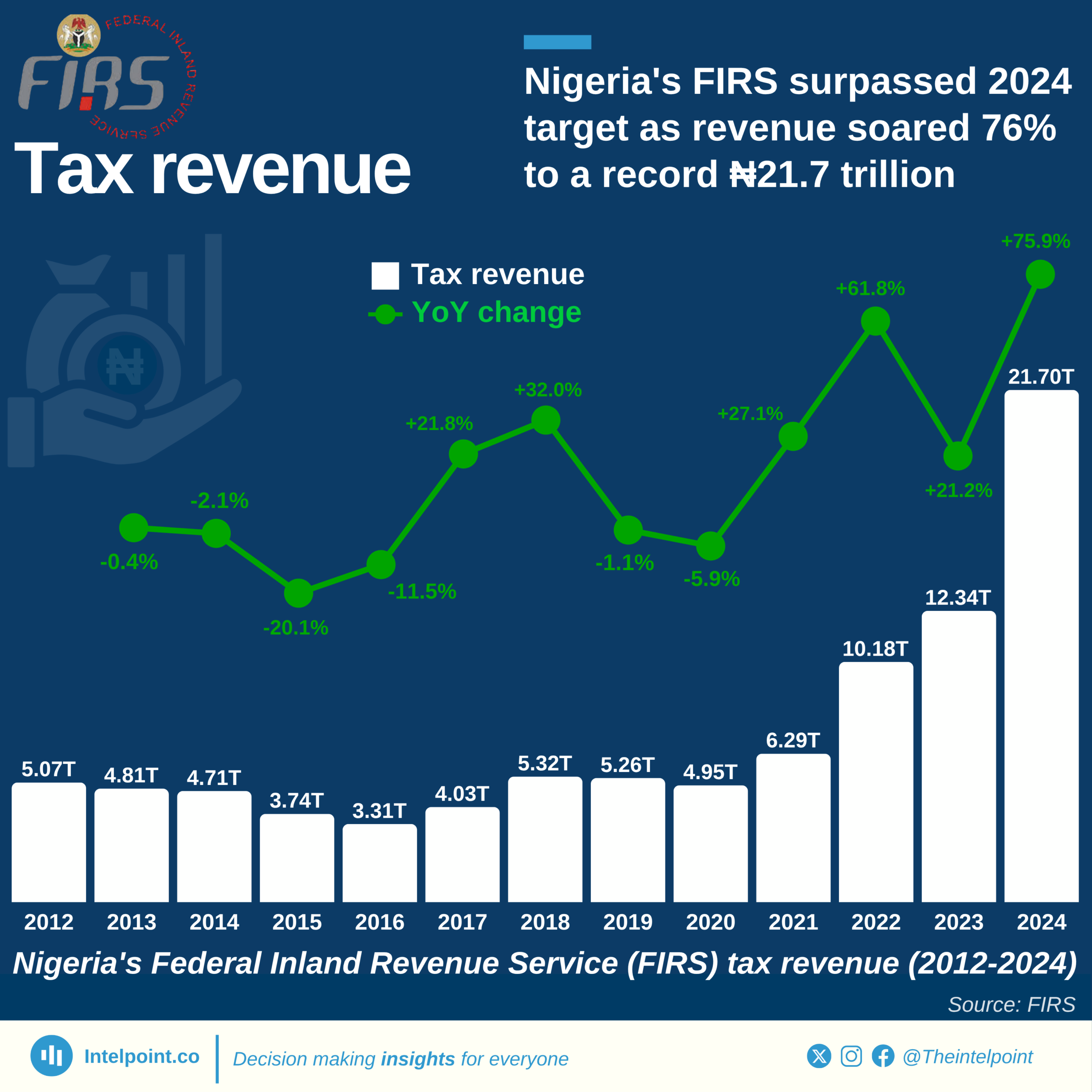
Nigeria's FIRS surpassed 2024 target as revenue soared 76% to a record ₦21.7 trillion

  • The FIRS collected ₦21.7 trillion, outpacing the target of ₦19.4 trillion set by the government.
  • FIRS grossed its highest revenue of all time since 2012 in 2024.
  • Comparing the values of 2021, 2022, 2023 and 2024 reveals a significant shift.
  • The tax revenue collected in 2024 surpassed the amount collected in 2023 by an outstanding 75.6%.

The Federal Inland Revenue Service (FIRS) recorded a landmark achievement in 2024 by collecting a total of ₦21.7 trillion, surpassing its government-set target of ₦19.4 trillion. This impressive performance marked the highest revenue ever recorded by FIRS since 2012. In fact, the 2024 tax revenue exceeded the amount collected in 2023 by a remarkable 75.6%, reflecting strong improvements in tax administration and compliance. When comparing the revenue figures from 2021, 2022, 2023, and 2024, a clear upward trajectory becomes evident. There was a significant shift in the values year-on-year from 2021, highlighting growth and efficiency in the system. This trend also signals increasing confidence in the nation's revenue generation framework.

The leap from previous years to 2024 is particularly notable given economic challenges faced globally. Enhanced digital systems and better enforcement strategies may have contributed to this growth. Onward, this development could shape future revenue policies and projections in Nigeria.
Source:

Federal Inland Revenue Service

Period:

2024
HTML code to embed chart
Want a bespoke report?
Reach out
Tags
Related Insights

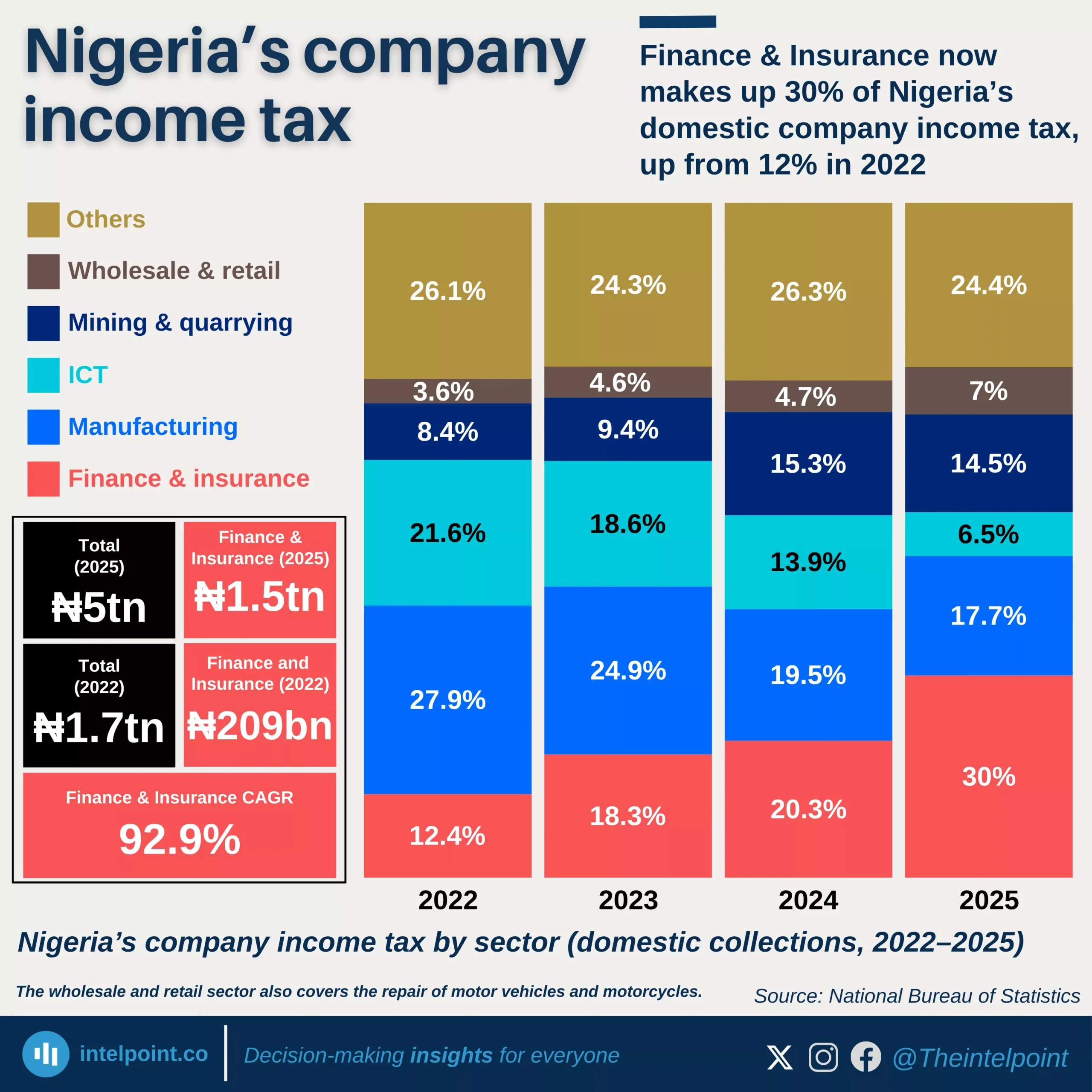
Finance & Insurance now makes up 30% of Nigeria’s domestic company income tax, up from 12% in 2022
  • Company income tax collections rose from ₦1.7tn in 2022 to ₦5.0tn in 2025.
  • Finance & Insurance more than doubled its share, from 12.4% to 30.0%.
  • Finance became the largest single sector in the tax mix by 2025.
  • Manufacturing remained important, but its share fell from 27.9% to 17.7%.
  • ICT saw one of the sharpest declines, from 21.6% to 6.5%.
  • Mining & quarrying gained weight, rising from 8.4% to 14.5%.
  • Wholesale & retail also increased, from 3.6% to 7.0%.
  • The tax base became less evenly distributed across sectors.

Nigeria's VAT collections have more than tripled in three years
  • Nigeria’s total VAT rose from ₦2.5tn in 2022 to ₦8.6tn in 2025.
  • VAT collections more than tripled in four years.
  • Local VAT remained the largest source of VAT throughout the period.
  • Local VAT increased from ₦1.5tn to ₦4.5tn.
  • Local VAT averaged 54.4% of total VAT between 2022 and 2025.
  • Import VAT also grew strongly, from ₦521.5bn to ₦2.0tn.
  • Other payment channels rose from ₦510.8bn to ₦2.1tn.
  • VAT growth is increasingly being driven by non-import activity.

Local companies have consistently contributed most of Nigeria’s Company Income Tax payments since 2016
  • Local companies dominated CIT contributions in most years, accounting for over 50% of payments in 9 of 11 periods between 2015 and 2025 (Q1–Q3).
  • Foreign companies briefly closed the gap in 2023, contributing 49%, the closest they have come to matching local firms.
  • Local companies recorded their strongest share in 2021 at 65%, marking the widest gap between local and foreign contributors.
  • “Other payments” peaked during the pandemic, rising to 17% in 2020 before dropping to 0% from 2022 onward.

Local companies have consistently contributed most of Nigeria’s Company Income Tax payments since 2016
  • Local companies dominated CIT contributions in most years, accounting for over 50% of payments in 9 of 11 periods between 2015 and 2025 (Q1–Q3).
  • Foreign companies briefly closed the gap in 2023, contributing 49%, the closest they have come to matching local firms.p
  • Local companies recorded their strongest share in 2021 at 65%, marking the widest gap between local and foreign contributors.
  • “Other payments” peaked during the pandemic, rising to 17% in 2020 before dropping to 0% from 2022 onward.

97% of businesses in Kogi are aware of Nigeria's 2025 tax reform, while 99% in Abia are not
  • Kogi entrepreneurs have the highest tax policy awareness in Nigeria (96.8%) in 2025.
  • Abia has the lowest awareness nationwide at just 1.4%.
  • Fewer than one-third of Nigerian states have awareness levels above 60%.
  • Major economic hubs like Lagos and Rivers have awareness below 50%.
  • Northern states dominate the top awareness rankings more than southern states.
  • Several states cluster around the 40–50% range, indicating partial reach.
  • States with low awareness risk lower compliance and higher friction during enforcement.
  • The gap between the highest and lowest states exceeds 95 percentage points, showing extreme disparity.

Lagos State generated the vast majority of Nigeria's IGR at ₦1.3 trillion, accounting for over 35% of the ₦3.7 trillion total IGR
  • Nigeria’s total IGR in 2024 was ₦3.7 trillion.
  • Lagos State generated ₦1.3 trillion, accounting for over 35% of the national IGR.
  • Rivers State (₦317.3 billion) and the FCT, Abuja (₦282.4 billion) ranked second and third, respectively.
  • The South West led regionally with ₦1.7 trillion in total IGR.
  • The North East recorded the lowest regional IGR at ₦129.8 billion.
  • Economic disparity between regions remains wide, with Lagos alone outpacing entire regions.

POPULAR TOPICS
SIGN UP TO OUR NEWSLETTER
Get periodic updates about the African startup space, access to our reports, among others.
Subscribe Here
Subscription Form

A product of Techpoint Africa. All rights reserved