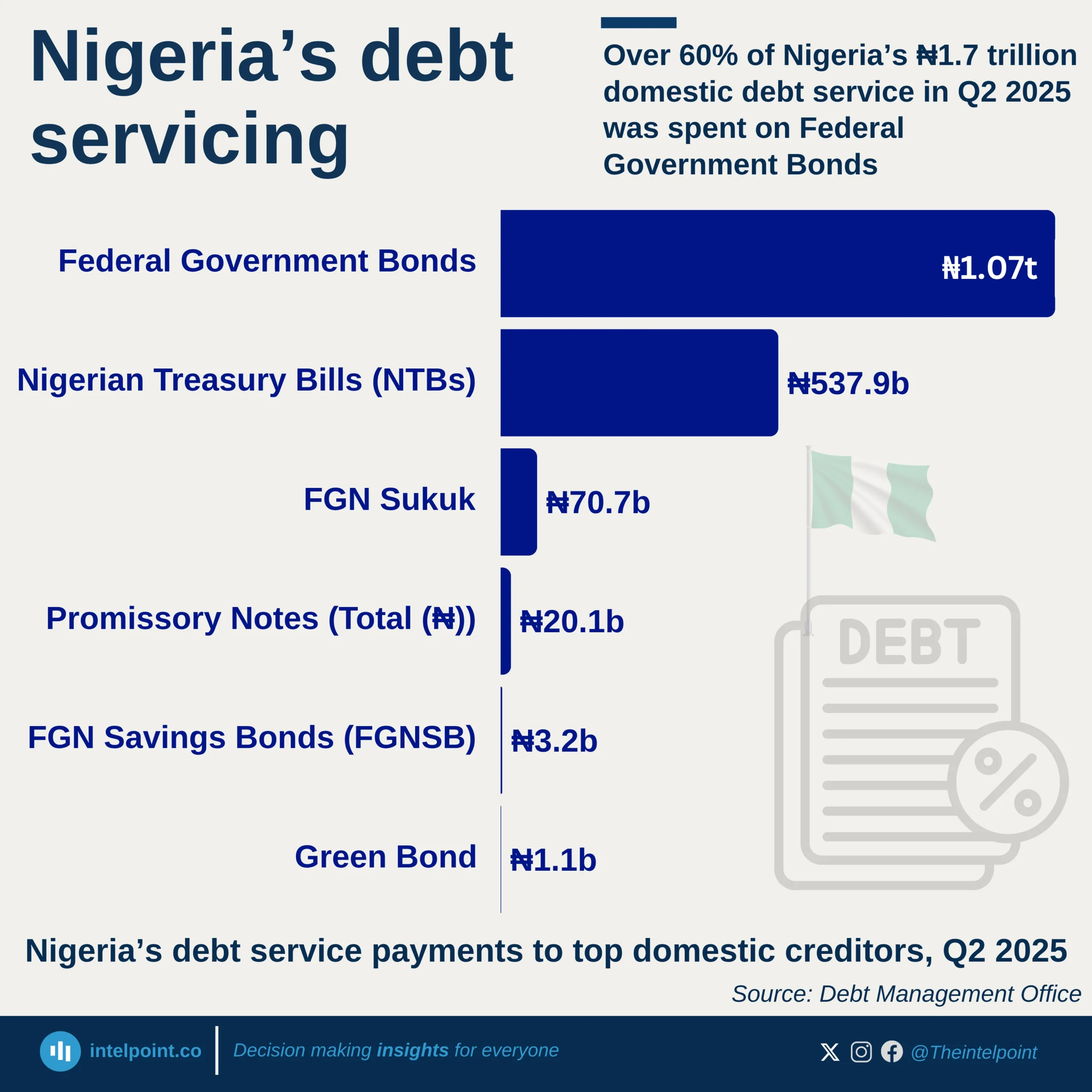
Over 60% of Nigeria’s ₦1.7 trillion domestic debt service in Q2 2025 was spent on Federal Government Bonds

Key Takeaways

  • FGN bonds dominated: ₦1.07 trillion went to Federal Government Bonds, accounting for about 63% of total domestic debt servicing.
  • Treasury bills followed: Payments on NTBs reached ₦537.9 billion, making up roughly 31% of the total.
  • Sukuk and promissory notes together cost ₦90.8 billion, reflecting Nigeria’s mix of infrastructure and settlement instruments.
  • Green and savings bonds remained minimal, together below ₦5 billion, showing limited traction for retail and sustainability-focused debt.

Between April and June 2025, Nigeria spent around ₦1.7 trillion repaying domestic debts, underscoring its reliance on internal borrowing to fund fiscal operations. FGN Bonds remained the government’s primary financing tool, taking up nearly two-thirds of total debt servicing, followed by Treasury Bills, which cover short-term funding needs.

Meanwhile, niche instruments like Sukuk, Promissory Notes, FGN Savings Bonds, and Green Bonds accounted for less than 6% combined, a reminder that while Nigeria has diversified its borrowing instruments, the debt burden still leans heavily on conventional bonds and bills. The pattern mirrors a government strategy balancing liquidity needs with long-term financing, but it also highlights persistent fiscal strain driven by high domestic interest obligations.
Source:

Debt Management Office

Period:

Q2 2025
HTML code to embed chart
Want a bespoke report?
Reach out
Tags
Related Insights

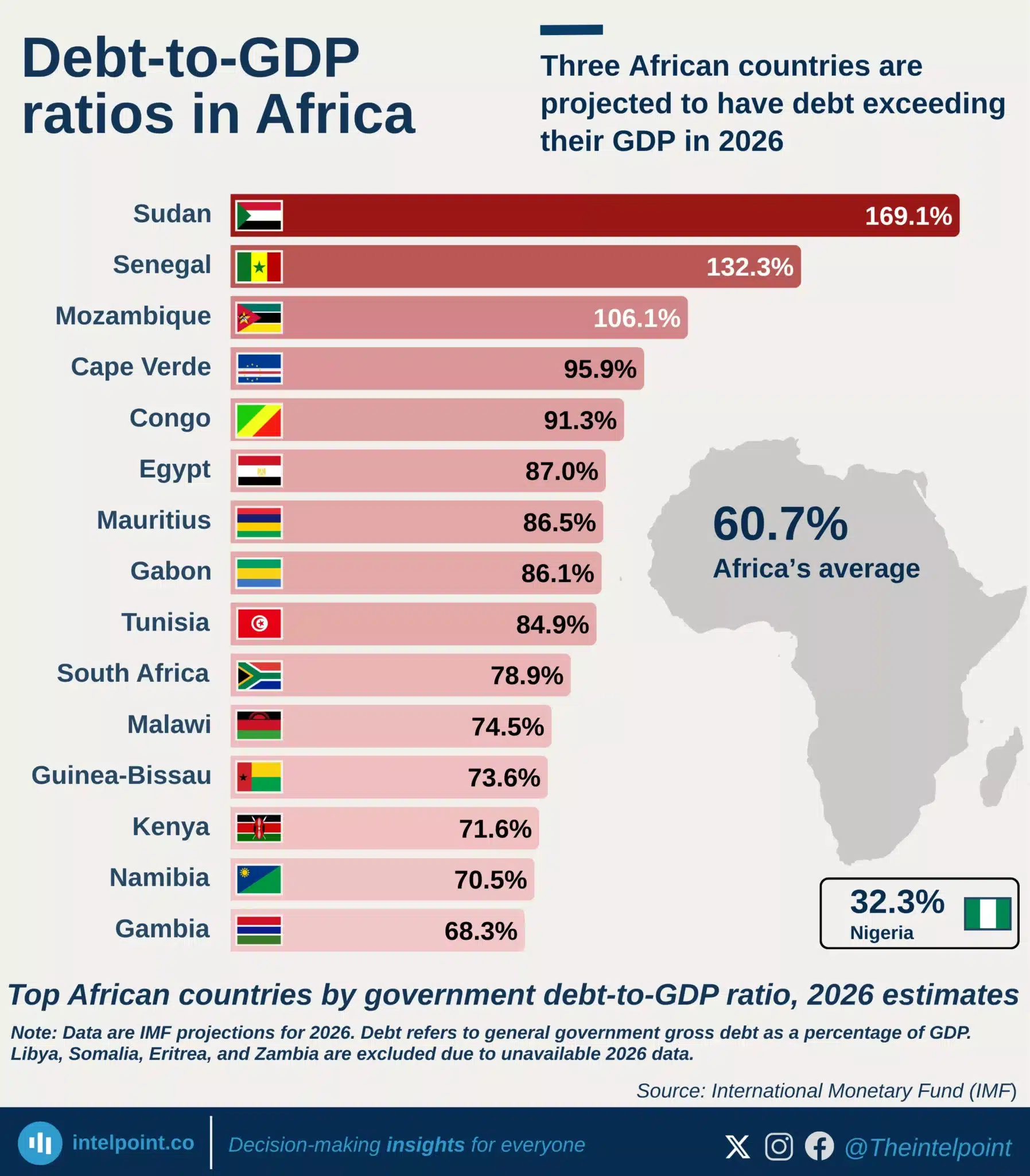
Three African countries are projected to have debt exceeding their GDP in 2026
  • Sudan is projected to have Africa’s highest debt-to-GDP ratio in 2026, at 169.1%.
  • Only three African countries are projected to owe more than the size of their economies in 2026.
  • Senegal and Mozambique join Sudan among countries with debt-to-GDP ratios above 100%.
  • Africa’s average government debt-to-GDP ratio is projected at 60.7% in 2026.
  • Nigeria’s projected debt-to-GDP ratio of 32.3% is far below the African average.

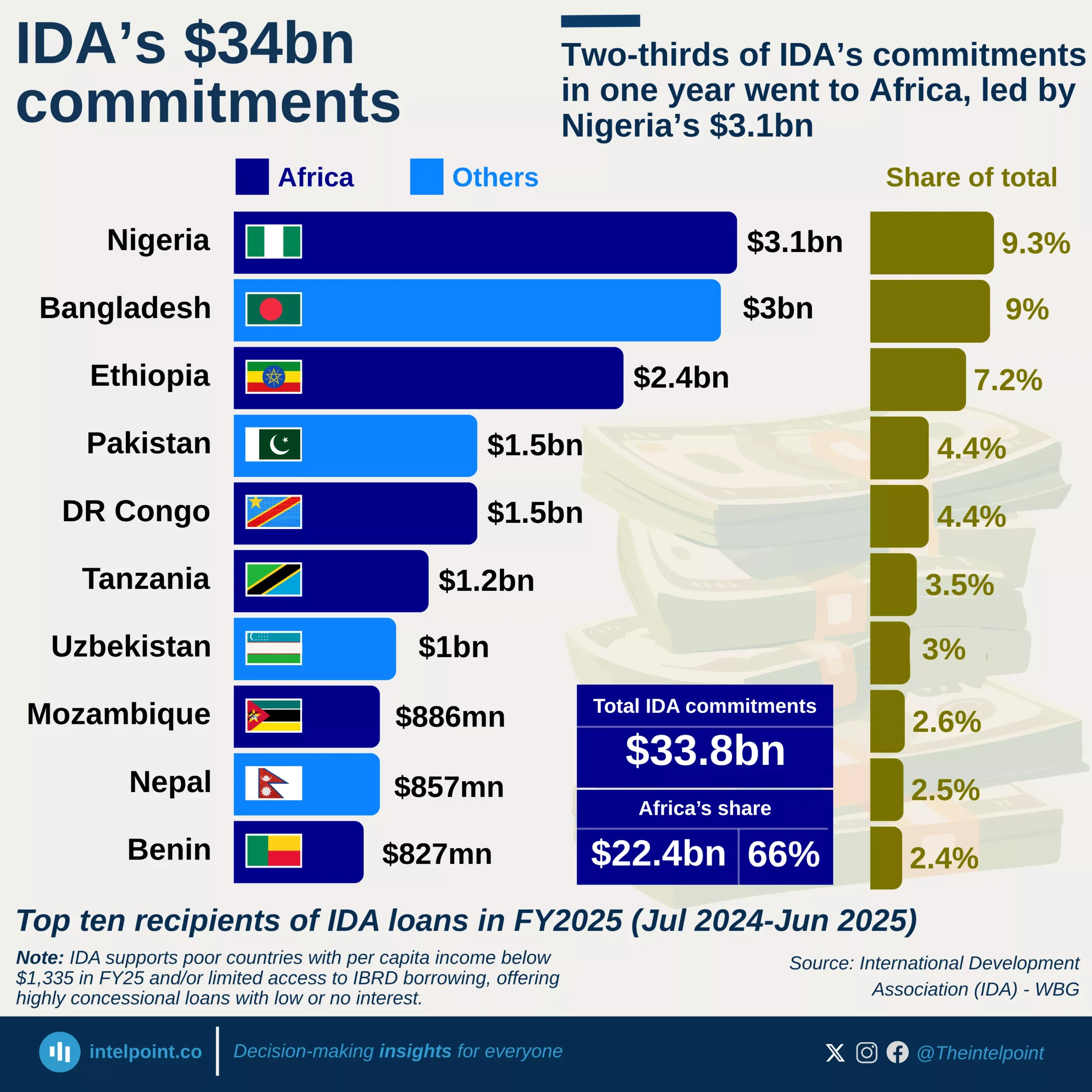
Two-thirds of IDA’s commitments in one year went to Africa, led by Nigeria’s $3.1bn
  • Africa received 66% of IDA’s FY2025 commitments.
  • Africa’s total IDA allocation was $22.4 billion out of $33.8 billion.
  • Nigeria was the largest borrower from the DA globally, with $3.1 billion in loans.
  • Bangladesh ranked second with $3 billion.
  • Six of the top ten borrowers were African countries.
  • Nigeria accounted for 9.3% of total FY2025 IDA commitments.

Oyo has reduced external debt by 36% and domestic debt by 22% under Makinde
  • Oyo reduced external and domestic debt by the end of 2025.
  • External debt fell faster than domestic debt.
  • External debt declined more consistently over the period.
  • Oyo’s local debt peaked around 2022–2023 before falling back.
  • The state appears to have prioritised reducing FX exposure.

Africa has been the world's biggest World Bank borrower since 2017, owing $152 billion as of 2024
  • Africa has been the world's biggest World Bank borrower since 2017, and the gap is widening.
  • Three crises drove it: an infrastructure gap, the 2014 commodity crash, and COVID-19.
  • The World Bank leaned in deliberately — 66% of all IDA funds went to Africa in 2025 alone.
  • It's not really "Africa's debt" — it's Nigeria's, Kenya's, Ethiopia's, Egypt's, Tanzania's, and Morocco's.
  • Every other region is slowing down, but Africa's curve is still climbing.

Under Sanwo-Olu, Lagos cut its external debt and more than doubled its domestic debt
  • Lagos cut external debt, but increased domestic debt.
  • The drop in external debt was meaningful, but the rise in domestic debt was much larger.
  • Stronger IGR gave Lagos more room to borrow and repay.
  • The state chose local funding over heavier dollar exposure.

Lagos's external debt has reduced by nearly three times more than the other six states combined
  • Lagos's debt reduction is larger than the other six combined.
  • Oyo posted the fastest reduction rate.
  • The biggest percentage cut did not equal the biggest dollar cut.
  • Debt reduction was concentrated, not broad-based.
  • Higher state revenues likely created room for repayments.
  • Lagos had the strongest fiscal capacity among the states shown.
  • Smaller debt stocks made percentage declines easier for some states.

POPULAR TOPICS
SIGN UP TO OUR NEWSLETTER
Get periodic updates about the African startup space, access to our reports, among others.
Subscribe Here
Subscription Form

A product of Techpoint Africa. All rights reserved