Bite-sized Insights about
 
Providing you with data-based insights about things happening around you.
Popular Insights
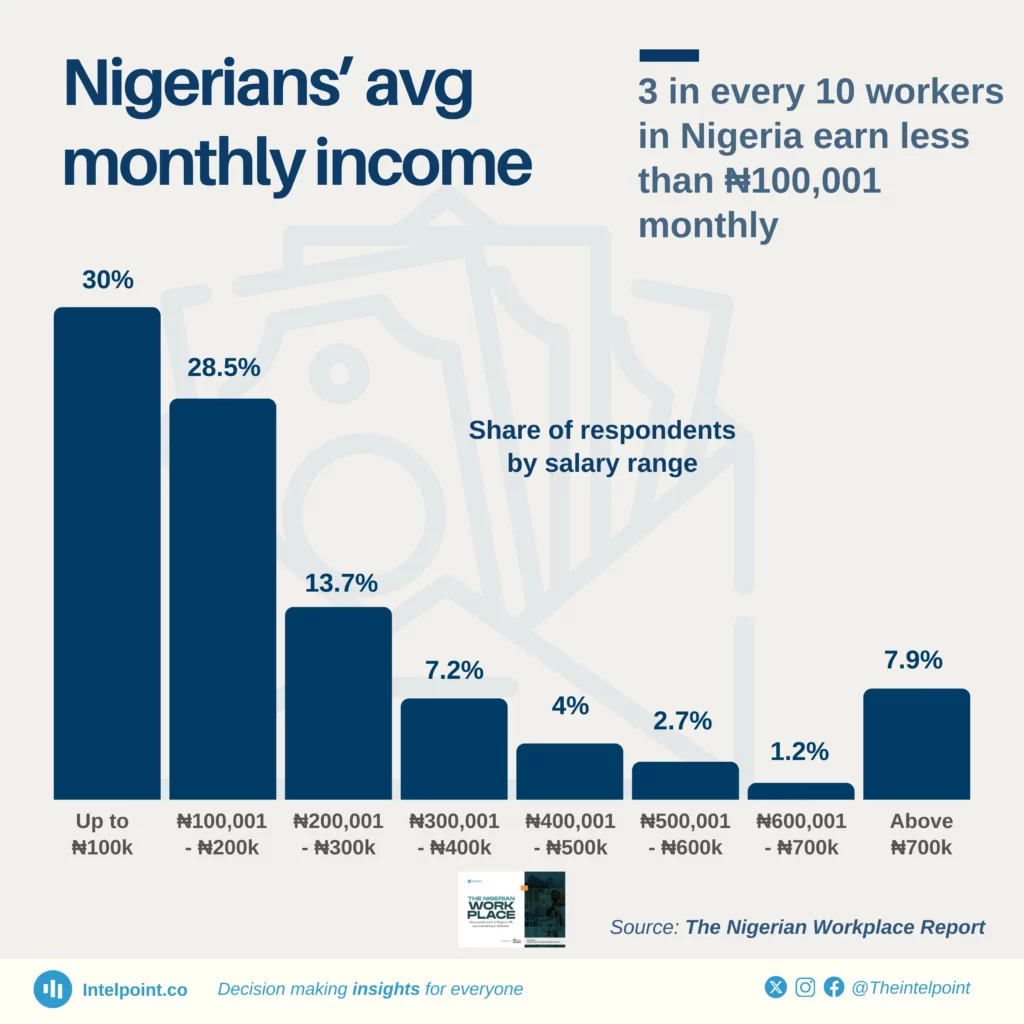
  • The Nigerian Workplace Report indicates that over 50% of Nigeria’s working population earns less than ₦200,001 monthly. It further highlights that individuals earning above ₦600k are among the top 10% earners.

    See more
    Miss Universe - Top countries by the number of wins since 1952
    • 2000–2005: Of the titles, two went to Venezuela and one to India and Puerto Rico. India's win in 2000 marked its first Miss Universe title.
    • 2006–2010: Mexico, Venezuela, and Puerto Rico each managed to win a single contest. Mexico's win in 2010 was particularly historic, given that it was the first time the country won the title of Miss Universe.
    • 2011–2015: While the Philippines and Venezuela each won two titles, Colombia took one.
    • 2016–2020: Mexico and South Africa managed one victory each; South Africa had consecutive victories in 2017 and 2019.
    • 2021–2024: India, Mexico, South Africa, and Denmark each secured one win. This win for India in 2021 is the third Miss Universe title in the country.
    See more
  • The 2024 Global Peace Index reveals a decline in peacefulness in 97 countries, the highest since the index began.

    Nigeria is among the nations affected by regional conflicts and rising violence. With a peace index score of 2.91, Nigeria is facing increasing challenges.

    A deteriorating peace score impacts foreign investment and economic stability. Global economic losses due to violence reached $19.1 trillion in 2023.

    See more

    The FAAC's revenue distribution from 2017 to August 2023 highlights the dominance of Delta, Akwa Ibom, Rivers, and Bayelsa states in allocations. Despite Lagos' economic prominence, it ranked fifth. Here is the distribution of revenue among states between 2017 and August 2023.

    See more
  • A Trend of Adult literacy rates of African countries

    Between 2018 and 2021, adult literacy rates across African nations exhibited significant disparities. Seychelles and South Africa led with literacy rates of 96% and 95%, respectively, indicating a high proportion of literate adults. Conversely, Chad had the lowest literacy rate during this period.

    These statistics underscore the uneven progress in educational attainment across Africa, highlighting the need for targeted interventions to improve literacy in lower-performing nations.

    See more
    Countries by Global Innovation Index 2024

    The Global Innovation Index 2024 reveals a striking contrast in innovation performance between countries globally and across Africa. Switzerland leads the global rankings with an impressive score of 67.5, followed by Sweden (64.5) and the USA (62.4), highlighting their sustained investments in research, development, and technological advancement.

    In Africa, Mauritius takes the top spot with a score of 30.5, followed closely by Morocco (28.8) and South Africa (28.3). However, even Africa's most innovative nations achieve less than half the score of global leaders, indicating a significant innovation gap.

    Nigeria ranks 15th in the African ranking and 113th globally, out of 133 countries, with a score of 17.1.

    See more

  • Per projections made by Goldman Sachs, China should lead the global economy in terms of GDP by the year 2075, closely followed by India and the US. Nigeria and Egypt are the only African countries expected to be in the top 15 by that time.

    See more
  • MTN Nigeria has dominated the country's telecommunications market over the years, accounting for the largest market share. All four operators, apart from 9mobile, recorded a significant increase in their subscriber base between May 2014 and March 2024.

    See more
  • The 2024 Global Peace Index reveals a decline in peacefulness in 97 countries, the highest since the index began.

    Nigeria is among the nations affected by regional conflicts and rising violence. With a peace index score of 2.91, Nigeria is facing increasing challenges.

    A deteriorating peace score impacts foreign investment and economic stability. Global economic losses due to violence reached $19.1 trillion in 2023.
    See more

Other Insights
 
  • Nigeria’s FDI share plunged from 35% in 1990 to 1.1% in 2024.
  • Africa’s FDI surged over the same period, leaving Nigeria behind.
  • Q1 2025 inflow was only $126.3 million, showing persistent weakness.
  • Decline mirrors structural hurdles — unstable policies, forex issues, and weak infrastructure.
See more
  • Nigeria recorded 971 protests and violent demonstrations in 2024.
  • Protest numbers have grown 50-fold since 2000, signalling a consistent rise in public mobilisation.
  • The most significant surge occurred between 2011 and 2015, under Goodluck Jonathan’s administration.
  • Muhammadu Buhari’s tenure saw the highest number of recorded protests — peaking at 1,008 in 2020.
  • Despite a change in leadership, protest activity remains elevated under Bola Tinubu.
See more
  • Kenya recorded 2,008 protests in 2024, the highest in its modern history.
  • The number of protest events increased seven-fold between 2022 and 2024.
  • Social media has become a major mobilisation tool for civic expression.
  • Rising cost of living, taxation, and unemployment remain the top drivers of unrest.
See more
  • Africa recorded 12,581 protests and violent demonstrations in 2024.
  • Morocco led the continent with 3,654 protests, far ahead of others.
  • Kenya ranked second with 2,008 protests.
  • South Africa (1,715) and Nigeria (971) followed, driven by economic and political frustrations.
  • North African countries, such as Morocco, Tunisia, and Libya, accounted for a significant share of protests.
  • The bottom 10 countries, including Lesotho, Gambia, and Seychelles, recorded fewer than 10 protests each.
  • Djibouti and Eritrea reported zero protests.
See more
  • India recorded the highest number of protests and demonstration events globally in 2024 (22.1K).
  • The United States followed with 10.5K protest events.
  • Yemen (8.2K) ranked third, reflecting the instability and ongoing conflict-driven unrest.
  • Pakistan (7.3K) and France (6.9K) rounded out the top five, underscoring the diverse sources of civic agitation.
  • Morocco (3.7K) was Africa’s leading country for protest activity, placing 12th globally.
  • The global total of protest and violent demonstration events reached 153,573 in 2024.
See more
  • The Protestants dominate church networks in Nigeria, counting 68.1 million adherents, making up 63.9% of all Christians.
  • Following closely are the independent churches, with 30 million members, representing 28.2% of Nigerian Christians.
  • The Catholic Church stands firm with 27.9 million Christians, or about 26.2% of the Christian population.
  • At the smaller end of the spectrum are the Orthodox Christians, just 3,100 strong, and 152,000 unaffiliated believers who walk their spiritual path independently.
See more
  • West Africa dominates Africa’s top 15, holding six positions on the remittance importance index.
  • Zimbabwe (78) ranks as Africa’s top country in terms of remittances' importance.
  • Senegal (77) and Nigeria (72) highlight the central role of diaspora inflows in West Africa’s economies.
  • Morocco (74) leads North Africa in remittance importance.
  • Smaller nations like Lesotho (68) and Liberia (68) depend heavily on remittances relative to their GDP.
  • The lowest-ranked countries, including Angola (9) and Djibouti (11), rely minimally on remittance inflows.
See more
  • Stablecoins lead the market, accounting for 38.3% of all crypto sent, highlighting Nigerians’ preference for stability and dollar-backed assets.
  • Bitcoin ranks second at 27.3%, showing it remains a major channel for store-of-value transfers and remittances.
  • Altcoins like SOL, ADA, SHIB, and DOGE (15.4%) attract younger and experimental users but remain secondary to stable assets.
  • Ethereum (10.2%) and BNB (8.9%) maintain moderate transaction volumes, suggesting users favor low-fee and widely accepted tokens for transfers.
See more
  • Students are the largest crypto-holding group (43.6%), underscoring the youthful nature of Nigeria’s crypto community and their early adoption of digital finance.
  • Entrepreneurs follow closely (25.7%), showing strong participation from self-employed Nigerians, traders, business owners, and hustlers who use crypto for investment and business flexibility.
  • Traditional employees make up 17.4%, indicating growing acceptance of crypto beyond informal or youth circles, even among salary earners.
  • Freelancers and gig workers (5.6%) also feature, reflecting crypto’s role in global online work and cross-border earnings. Unemployed and retired individuals remain a small minority, under 3.5% combined.
See more
  • About 60% of users make less than $50 per month, showing crypto activity is mostly at a small, retail scale.
  • The $10–$50 band (36%) is the single largest group, reflecting frequent, low-value trading or incremental investment returns.
  • Only about 30% of users earn between $50 and $500, suggesting that consistent moderate returns are less common.
  • Less than 3% of users earn above $1,000 per month, confirming that the Nigerian crypto market remains largely retail-driven rather than dominated by professional or institutional traders.
See more
  • 56.1% of users mostly send crypto, compared to 43.9% who mostly receive it, showing an active transaction culture.
  • Investing in other platforms or projects leads as the top reason for sending crypto (29.2%), indicating strong speculative and wealth-building motives.
  • Every 1 in 4 users (25.1%) use crypto for daily transactions like bills and subscriptions, showing rising integration into everyday finance.
  • Cross-border payments (7.7%) and donations (4.6%) remain small but notable niches, signaling growing utility beyond trading.
See more
1 13 14 15 16 17 126
  • Lagos alone hosts 51 licensed cinemas, accounting for over half of all exhibition premises in the dataset.
  • The next three states—Ogun, FCT, and Rivers—combined have just 30 cinemas.
  • Only five states have five or more licensed cinemas, highlighting strong geographic concentration.
  • Several large states have two cinemas or fewer, pointing to limited formal exhibition infrastructure outside key urban hubs.
Read more
  • President Tinubu has spent 237 days (about eight months) abroad since 2023.
  • France alone accounts for 89 days, making it his most-visited country.
  • The UK ranks second with 28 days.
  • The UAE, Brazil, and Saudi Arabia feature prominently.
  • Asia is well represented by China, India, and Japan, indicating growing engagement with Eastern economies.
  • Several African countries appear on the list, showing continued regional diplomacy.
  • Most countries recorded fewer than ten days, suggesting many short, targeted visits.
Read more
  • Lagos is Africa’s third-largest city and ranks 14th globally.
  • Cairo remains Africa’s largest city, with over 23 million people, keeping Egypt at the centre of the continent’s urban network.
  • Kinshasa’s position shows Central Africa’s rising urban influence.
  • There is a steep population gap after the top three cities.
Read more
  • Nigerian artistes have won 16 Grammy Awards in total since the awards’ inception in 1959.
  • Sade Adu and Seal lead all Nigerian-linked artistes with four wins each.
  • Tems represents the new generation, combining multiple wins with a high number of nominations.
  • Burna Boy’s 13 nominations and one win highlight the gap between recognition and awards.
  • Wizkid and several others have entered Grammy history but have yet to convert nominations into multiple wins.
  • Earlier Grammy successes were mostly by Nigerian-born artistes based abroad.
  • Recent wins have come from artistes rooted in Africa’s contemporary music scene.
  • The 2026 Grammys, with Tyla’s win and Fela’s recognition, highlight Africa’s growing influence in global music.
Read more
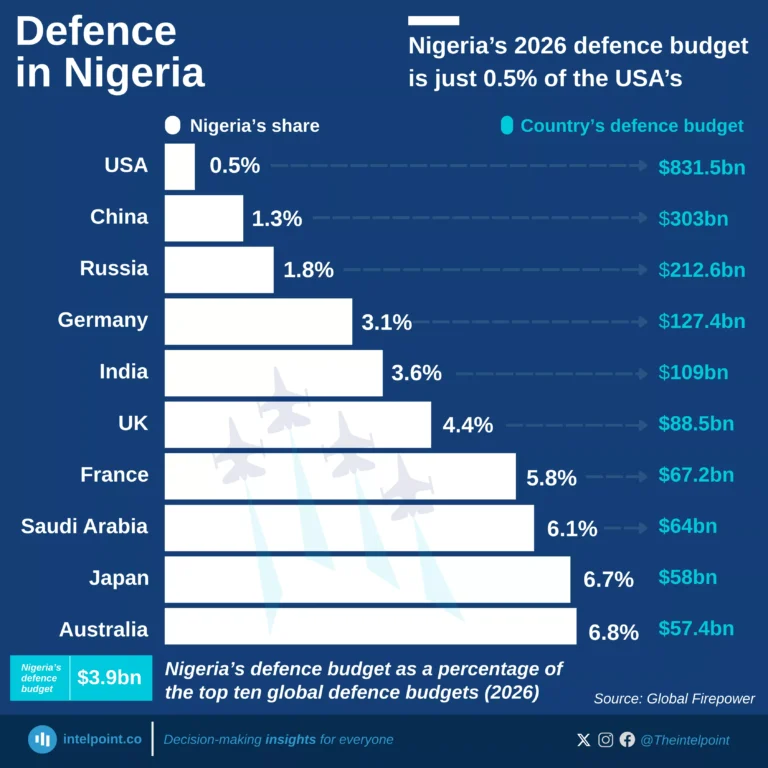
  • The Nigerian Army is allocated ₦1.5 trillion, surpassing the ₦1 trillion mark and making it the highest-funded force in the proposal.
  • Police formations and commands receive ₦1.3 trillion, exceeding the ₦ 1 trillion threshold in the 2026 budget.
  • The Nigerian Navy’s proposed allocation stands at ₦443.9 billion, keeping it well below the trillion-naira range reached by the top two.
  • The Nigerian Air Force is allocated ₦407.2 billion.
Read more
  • Deployed POS terminals grew from about 156,000 in 2017 to 8.4 million in 2025.
  • Nigeria added more than eight million terminals in eight years, indicating rapid adoption of digital payments.
  • Growth accelerated sharply after 2020, marking a major shift toward cashless transactions.
  • The highest year-on-year growth (116.8%) occurred in 2024, following the naira redesign.
  • About three million terminals were added in 2024 alone.
  • POS agents became critical financial access points during the period of cash shortage.
  • POS terminals now function as mini-banks in many communities.
  • Financial inclusion has expanded through agent-based banking and POS networks.
Read more
1 13 14 15 16 17 252

Can’t find what you’re looking for? Please fill the form below
Contact Form Demo
SIGN UP TO OUR NEWSLETTER
Get periodic updates about the African startup space, access to our reports, among others.
Subscribe Here
Subscription Form

A product of Techpoint Africa. All rights reserved