Bite-sized Insights about
 
Providing you with data-based insights about things happening around you.
Popular Insights
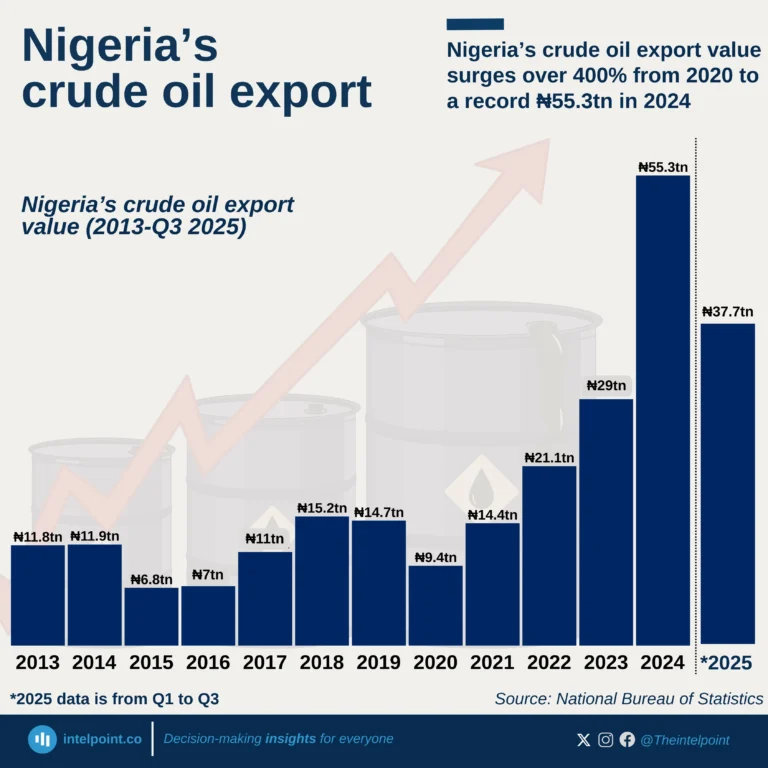
  • Between 2013 and 2022, Nigeria exported crude oil worth ₦123 trillion, with yearly figures ranging from ₦6.8 trillion to ₦21.1 trillion, and the highest (₦21.1 trillion) recorded in 2022. This chart shows the annual values.

    See more

    Data from Nigeria's National Bureau of Statistics shows that the Federal Allocation Account Committee (FAAC) disbursed at least ₦32.8 trillion net to the 36 states and the FCT since 2011.


    Five of Nigeria's oil-producing states — Delta, Akwa Ibom, Rivers, Bayelsa, and Lagos — have received 33.7% of the country's net federal allocation since 2011, with Delta State receiving the most. Kano, Katsina, Borno, Kaduna, and Ondo complete the top ten.

    See more
  • The 2024 Global Peace Index reveals a decline in peacefulness in 97 countries, the highest since the index began.

    Nigeria is among the nations affected by regional conflicts and rising violence. With a peace index score of 2.91, Nigeria is facing increasing challenges.

    A deteriorating peace score impacts foreign investment and economic stability. Global economic losses due to violence reached $19.1 trillion in 2023.

    See more

    The FAAC's revenue distribution from 2017 to August 2023 highlights the dominance of Delta, Akwa Ibom, Rivers, and Bayelsa states in allocations. Despite Lagos' economic prominence, it ranked fifth. Here is the distribution of revenue among states between 2017 and August 2023.

    See more
  • A Trend of Adult literacy rates of African countries

    Between 2018 and 2021, adult literacy rates across African nations exhibited significant disparities. Seychelles and South Africa led with literacy rates of 96% and 95%, respectively, indicating a high proportion of literate adults. Conversely, Chad had the lowest literacy rate during this period.

    These statistics underscore the uneven progress in educational attainment across Africa, highlighting the need for targeted interventions to improve literacy in lower-performing nations.

    See more
    Countries by Global Innovation Index 2024

    The Global Innovation Index 2024 reveals a striking contrast in innovation performance between countries globally and across Africa. Switzerland leads the global rankings with an impressive score of 67.5, followed by Sweden (64.5) and the USA (62.4), highlighting their sustained investments in research, development, and technological advancement.

    In Africa, Mauritius takes the top spot with a score of 30.5, followed closely by Morocco (28.8) and South Africa (28.3). However, even Africa's most innovative nations achieve less than half the score of global leaders, indicating a significant innovation gap.

    Nigeria ranks 15th in the African ranking and 113th globally, out of 133 countries, with a score of 17.1.

    See more

  • Top ten African countries by estimated number of films produced annually

    The Nigerian movie industry, mainly financed via public or private funding and international grants, produces the most films in Africa, yearly. Nigeria produced more than double the number of films that the Ghanaian and Kenyan movie industries produce annually.

    See more
  • MTN Nigeria has dominated the country's telecommunications market over the years, accounting for the largest market share. All four operators, apart from 9mobile, recorded a significant increase in their subscriber base between May 2014 and March 2024.

    See more
  • The 2024 Global Peace Index reveals a decline in peacefulness in 97 countries, the highest since the index began.

    Nigeria is among the nations affected by regional conflicts and rising violence. With a peace index score of 2.91, Nigeria is facing increasing challenges.

    A deteriorating peace score impacts foreign investment and economic stability. Global economic losses due to violence reached $19.1 trillion in 2023.
    See more

Other Insights
  • The Gambia leads Africa in remittance-GDP ratio, with remittance accounting for 21.1% of its GDP in 2024.
  • Lesotho (20.9%) and Comoros (18.3%) closely follow as highly remittance-dependent economies.
  • Somalia (17.5%) and Liberia (14.3%) also rely heavily on diaspora inflows to support their economies.
  • Nigeria (11.3%) remains a major player, highlighting its strong global diaspora network.
  • Cabo Verde (12.1%) and Senegal (11.6%) demonstrate that remittances are key drivers of income in smaller economies.
  • In larger economies like Egypt (7.6%) and Morocco (8.1%), remittances also make up a significant share of GDP.
See more
 
  • Europe ($12.58 trillion), Asia ($11.88 trillion), and the Americas ($11.49 trillion) are nearly tied after 35 years, each capturing roughly a third of global FDI
  • Asia grew from just $25 billion annually in 1990 to consistently attracting $600-700 billion per year, showing the most stable growth pattern
  • Major crises (2001, 2008-09, 2020, and 2022) caused dramatic swings, with Europe even recording negative flows in 2022
  • Africa and Oceania combined received just 6% of total FDI, remaining far behind despite Africa's recent acceleration to $97 billion in 2024
See more
 
  • Africa attracted $97 billion in total FDI inflows in 2024.
  • North Africa dominated with $51 billion (52%), remaining the continent’s top foreign investment hub.
  • West Africa ranked second with $15 billion (15.3%).
  • East Africa secured $13 billion (13.3%).
  • Central Africa remained the least favoured, with only $8 billion (8.2%) in FDI inflows.
See more
  • The naira buys the most in countries like Guinea, Uganda, Burundi, and Malawi, where local currencies have lost value faster.
  • High inflation and unstable monetary systems have eroded the strength of several African currencies.
  • Most of the weakest currencies are in East and West Africa.
  •  The naira’s higher value in these countries does not mean it has fully recovered.
See more
  • Anambra has the highest intercity transport fare at ₦9,862, exceeding the national average by ₦1,857.
  • Kwara recorded the lowest fare at ₦5,991, a difference of nearly ₦3,900 from Anambra.
  • The national average fare for intercity bus travel stood at ₦8,005 as of July 2025.
  • Imo (₦9,710) and Oyo (₦9,708) followed closely behind Anambra, rounding out the top three highest-fare states.
  • The South West (₦8,570) and South East (₦8,547) were the most expensive regions for intercity bus travel.
See more
  • Lagos State tops the list with the highest intra-city bus fare at ₦1,384, exceeding the national average by ₦355.
  • Abia State recorded the lowest average fare at ₦508, showing a stark difference of ₦876 between the highest and lowest states.
  • The national average fare for a bus trip within Nigerian cities stood at ₦1,028.40 as of July 2025.
  • Nasarawa (₦1,306) and Enugu (₦1,280) followed closely behind Lagos State, rounding out the top three highest fares.
  • The South West had the highest regional average fare (₦1,116), while the South South (₦985) and North West (₦995) had the lowest.
  • States like Taraba (₦1,250) and Zamfara (₦1,248) also featured in the top six, showing that high fares are not limited to Southern urban centres.


See more
  • Osun (₦1,867) has the highest CoHD, while Kaduna (₦1,227) has the lowest, a gap of ₦640.
  • The national average CoHD stood at ₦1,495 as of December 2024.
  • Southern states, particularly in the South West, record the highest diet costs.
  • Northern states dominate the list of the most affordable places to eat healthy.
  • Rising costs in urban centres like Lagos (₦1,702) and Rivers (₦1,780) reflect the impact of logistics and inflation.
  • The ₦640 state gap shows inequality in dietary access, which can deepen nutrition and welfare disparities.
See more
  • The share of minimum wage needed to afford a healthy diet fell from 124.1% in June to 54.2% in July 2024, when the minimum wage was increased from ₦30,000 to ₦70,000.
  • Before July, the cost of a healthy diet for a month exceeded 100% of [the] minimum wage, making it unaffordable for minimum-wage earners.
  • The sharpest burden was recorded in June 2024, when households needed their full salary plus 24% extra to eat healthily.
  • Between July and December, affordability worsened slightly from 54.2% to 64.1%, indicating that food prices continued to rise despite the wage boost.
  • The implementation of the ₦70,000 minimum wage in 2024 provided significant relief to Nigerian households struggling with the high cost of eating healthily.
See more
  • The Cost of Healthy Diet (CoHD) in Nigeria increased by over 74% in 2024.
  • The average cost rose from ₦858 in January to ₦1,495 in December.
  • June 2024 recorded the sharpest monthly jump at 19.2%, the highest of the year.
  • From August to December, CoHD rose steadily — showing no reversal in trend.
  • The persistent rise reflects food inflation, weak supply chains, and increasing import costs.
  • For many Nigerians, maintaining a healthy diet is becoming increasingly unaffordable, threatening nutrition and welfare outcomes.
See more
  • Animal source foods make up the largest share of Nigeria’s CoHD at ₦528 (35.3%) of ₦1,495.
  • Starchy staples follow at ₦344 (23%), showing the centrality of carbs in Nigerian diets.
  • Vegetables (₦233) and fruits (₦163) collectively account for over a quarter of the cost.
  • Legumes, nuts, and seeds (₦101) are the least costly food group, despite their nutritional value.
  • The national average CoHD stands at ₦1,495 per person per day as of December 2024.
  • Protein-rich foods are becoming increasingly unaffordable, contributing to dietary imbalance.
See more
  • South West has the highest Cost of Healthy Diet (₦1,764), surpassing the national average by ₦269.
  • South South follows at ₦1,714.
  • South East (₦1,436) and North East (₦1,430) sit close to the national midpoint.
  • North Central and North West record the lowest CoHD at ₦1,372 and ₦1,296, respectively.
  • The national average cost of a healthy diet stands at ₦1,495 per person per day as of December 2024.
  • The regional disparities in food cost highlight the uneven impact of economic realities across Nigeria’s zones.
See more
  • Nigeria exited the FATF grey list in October 2025, after 32 months of monitoring.
  • The country was added to the grey list in February 2023 due to technical compliance shortcomings.
  • FATF conducted an assessment of Nigeria’s AML/CFT measures in 2008, marking the beginning of its oversight of the measures.
  • Between 2010 and 2013, Nigeria appeared repeatedly in FATF statements for strategic AML/CFT deficiencies.
See more
1 12 13 14 15 16 126
  • Nigeria leads by a clear margin, receiving the highest export value at $24.91bn.
  • Large, diversified economies dominate the top tier, with South Africa and Egypt ranking among the biggest destinations.
  • Resource-linked trade remains significant, with countries like Liberia and Algeria absorbing substantial export value.
  • Trade reach is geographically diverse, spanning West, East, and North Africa, including GhanaTanzaniaKenyaMorocco, and Guinea.
Read more
  • Exports more than doubled in a decade, with trade rising from $92.27 billion in 2016 to $225 billion in 2025, a 144% increase.
  • The largest single jump occurred between 2020 and 2021, when exports surged by more than $34 billion.
  • From 2021 to 2024, exports climbed every year, reaching $178.91 billion before the latest surge.
  • The increase from $178.91 billion in 2024 to $225 billion in 2025 signals a new growth surge after several years of gradual increases.
Read more
  • The NFF’s allocation of ₦2.31 billion is under 1.1% of the total sports budget.
  • The National Sports Commission HQ gets the most, with ₦203.6 billion, over 96% of the total.
  • The National Institute for Sports is to receive ₦4.12 billion, highlighting minimal federal investment in sports development.
  • Budget heavily favours administration over football development and grassroots programs.
Read more
  • Active bank accounts grew from 65 million in 2016 to over 320 million in 2025 — almost a fivefold increase.
  • Bank accounts per 100 people rose from about 32 in 2017 to nearly 135 in 2025.
  • Nigeria now averages more than one bank account per person.
  • The fastest growth phase occurred between 2019 and 2024.
  • Digital banking and fintech adoption played a major role in the surge.
  • The jump after 2020 suggests technology-driven access, not just population growth.
  • Multiple account ownership is now common among users.
Read more
  • Jigawa has the highest share of unregistered businesses in Nigeria (96.1%) in 2025.
  • Over half (20) of Nigerian states have more than 50% of businesses operating informally.
  • Informality is not limited to poorer states; Lagos and Rivers both exceed 65%.
  • Southern and northern states alike show high informality, indicating a nationwide challenge.
  • Only a small group (10) of states have informality rates below 30%.
  • Kaduna records the lowest share of unregistered businesses (10.3%)
Read more
  • Only nine African artistes have won multiple Grammy Awards, highlighting how rare repeat wins remain at the global level.
  • Angélique Kidjo and Ladysmith Black Mambazo lead Africa with five wins each, but Ladysmith holds the record for the most nominations (17).
  • High nomination counts do not guarantee wins; Seal (15 nominations) and Tems (8 nominations) have fewer wins than peers with far fewer nominations.
  • Recent entrants are closing the gap quickly, with Tyla converting 100% of her two nominations into wins.
Read more
1 12 13 14 15 16 252

Can’t find what you’re looking for? Please fill the form below
Contact Form Demo
SIGN UP TO OUR NEWSLETTER
Get periodic updates about the African startup space, access to our reports, among others.
Subscribe Here
Subscription Form

A product of Techpoint Africa. All rights reserved