Bite-sized Insights about
 
Providing you with data-based insights about things happening around you.
Popular Insights
  • Nigeria’s public debt decreased in dollar terms between June 2023 and June 2024. However, when converted to naira, it jumped to ₦134.3 trillion, largely due to currency devaluation. This sharp increase in debt could lead to tighter budgets, potentially affecting public services and everyday costs for Nigerians.

    See more

    Key Takeaways:

    • Crude oil remains Nigeria’s largest export, while refined petroleum products lead imports.
    • Natural gas ranks as the second-largest export, contributing 9.71% of the total export value.
    • The top five imported products account for 32.28% of Nigeria’s global imports.
    • The top ten exports represent over 95% of Nigeria’s total export value.
    See more
  • The 2024 Global Peace Index reveals a decline in peacefulness in 97 countries, the highest since the index began.

    Nigeria is among the nations affected by regional conflicts and rising violence. With a peace index score of 2.91, Nigeria is facing increasing challenges.

    A deteriorating peace score impacts foreign investment and economic stability. Global economic losses due to violence reached $19.1 trillion in 2023.

    See more

    The FAAC's revenue distribution from 2017 to August 2023 highlights the dominance of Delta, Akwa Ibom, Rivers, and Bayelsa states in allocations. Despite Lagos' economic prominence, it ranked fifth. Here is the distribution of revenue among states between 2017 and August 2023.

    See more
  • A Trend of Adult literacy rates of African countries

    Between 2018 and 2021, adult literacy rates across African nations exhibited significant disparities. Seychelles and South Africa led with literacy rates of 96% and 95%, respectively, indicating a high proportion of literate adults. Conversely, Chad had the lowest literacy rate during this period.

    These statistics underscore the uneven progress in educational attainment across Africa, highlighting the need for targeted interventions to improve literacy in lower-performing nations.

    See more
    Countries by Global Innovation Index 2024

    The Global Innovation Index 2024 reveals a striking contrast in innovation performance between countries globally and across Africa. Switzerland leads the global rankings with an impressive score of 67.5, followed by Sweden (64.5) and the USA (62.4), highlighting their sustained investments in research, development, and technological advancement.

    In Africa, Mauritius takes the top spot with a score of 30.5, followed closely by Morocco (28.8) and South Africa (28.3). However, even Africa's most innovative nations achieve less than half the score of global leaders, indicating a significant innovation gap.

    Nigeria ranks 15th in the African ranking and 113th globally, out of 133 countries, with a score of 17.1.

    See more

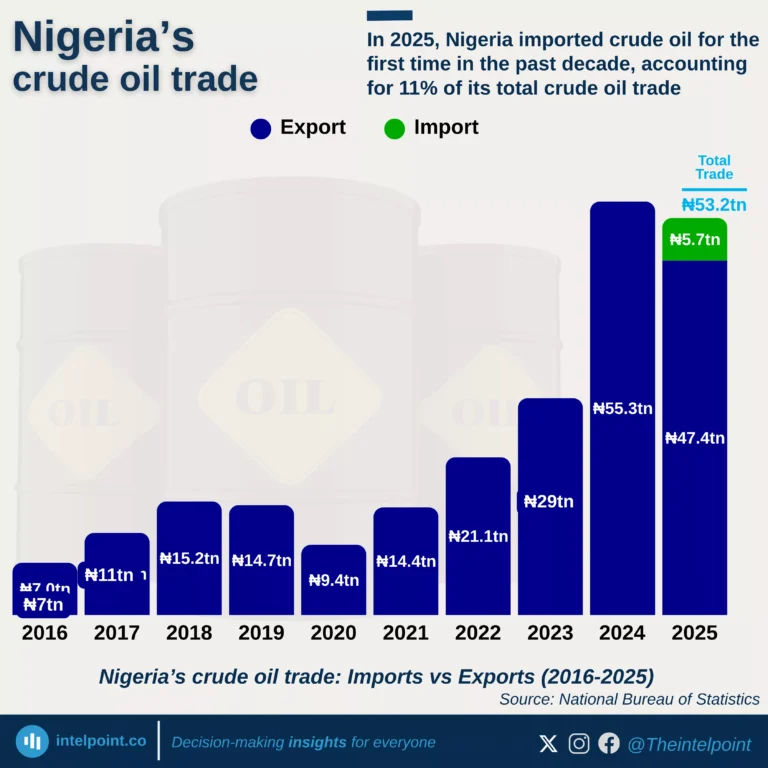
  • Crude oil exports, which made up 81% of Nigeria's export value in 2023 have increased in three consecutive years since 2021. After a 36% decline in 2020, exports increased by 53% in 2021, 46% in 2022, and 37% in 2023 to reach ₦29 trillion.

    See more
  • MTN Nigeria has dominated the country's telecommunications market over the years, accounting for the largest market share. All four operators, apart from 9mobile, recorded a significant increase in their subscriber base between May 2014 and March 2024.

    See more
  • The 2024 Global Peace Index reveals a decline in peacefulness in 97 countries, the highest since the index began.

    Nigeria is among the nations affected by regional conflicts and rising violence. With a peace index score of 2.91, Nigeria is facing increasing challenges.

    A deteriorating peace score impacts foreign investment and economic stability. Global economic losses due to violence reached $19.1 trillion in 2023.
    See more

Other Insights
  • The Nigeria Immigration Service received the highest share — ₦618.7 billion (55.8%) — of the Interior Ministry’s 2025 budget.
  • This allocation emphasises border security and migration management as national priorities.
  • The NSCDC follows with ₦240.9 billion (21.7%), highlighting the government’s focus on civil protection and internal security.
  • The Nigeria Correctional Service received ₦184.6 billion (16.7%).
  • Other agencies, including the ministry headquarters, received ₦64.5 billion (5.8%).
See more
  • The Federal Ministry of Arts, Culture, and Creative Economy received a total of ₦71.7 billion in the 2025 budget.
  • The National Commission for Museums and Monuments got the highest allocation of ₦15 billion.
  • Visual and film industries received notable funding of ₦10.1 billion for the National Gallery of Art and ₦8.4 billion for the Nigerian Film Corporation.
  • The National Council of Arts and Culture was allocated ₦7 billion.
  • The National Film and Video Censors Board received ₦4.4 billion, emphasising regulation and content oversight.
  • Institutions like the Centre for Black and African Arts and Civilisation, which promotes African identity, received ₦3.5 billion.
See more
 
  • Enugu led the country in IGR growth in 2024 with a 433% increase.
  • Bayelsa, Jigawa, Kano, and Osun also experienced large year-on-year increases, indicating widening fiscal activity across regions.
  • Lagos, Rivers, and the FCT recorded slower growth rates but still generated the largest total revenues.
  • The fastest growth often came from states focused on reforming tax systems or broadening local revenue sources, rather than from being traditionally big or wealthy states alone.
See more
 
  • Lagos drives most revenue in the South West, accounting for the clear majority of the region’s IGR.
  • Each geopolitical zone has one dominant state that shapes its revenue profile.
  • Fiscal capacity remains heavily skewed toward a few urban and resource-rich states.
See more
  • Every subsidiary reported profit in H1 2025, compared to three loss-making units in H1 2024.
  • Nigeria’s profit eased, but stronger performance across other African markets helped support overall group results.
  • Zambia, Sierra Leone, the DRC, Cameroon, and Kenya showed notable turnarounds from previous low or negative earnings.
  • The UK operation remained a major contributor, reinforcing the benefits of Access Holdings’ diversified regional presence.
See more
  • FUGAZ posted a combined ₦2.91 trillion in profit from Q1 to Q3 of 2025.
  • Access Bank recorded the lowest PAT among the FUGAZ
  • UBA recorded a 3% year-on-year increase in PAT
  • FUGAZ recorded an average year-on-year percentage change of -11.2% for the period
See more
     
  • Nigeria’s total IGR in 2024 was ₦3.7 trillion.
  • Lagos State generated ₦1.3 trillion, accounting for over 35% of the national IGR.
  • Rivers State (₦317.3 billion) and the FCT, Abuja (₦282.4 billion) ranked second and third, respectively.
  • The South West led regionally with ₦1.7 trillion in total IGR.
  • The North East recorded the lowest regional IGR at ₦129.8 billion.
  • Economic disparity between regions remains wide, with Lagos alone outpacing entire regions.
See more
  • ₦310.6 billion is the total allocation for Nigeria’s 110 foreign missions in 2025.
  • The New York (Permanent Mission) received the highest allocation at ₦9 billion.
  • Three US missions (New York PM, Washington, and New York CG) together account for ₦21.9 billion.
  • London (₦7.2 billion) and Geneva (₦6.6 billion) complete the top five highest allocations.
  • European cities such as Paris, Madrid, Berlin, and Berne remain strong diplomatic priorities, collectively drawing over ₦20 billion.
See more
     
  • The South East is the only region where the revenue of MDAs (60.9%) exceeded tax revenue (39.1%).
  • Other regions relied more heavily on tax revenue, with the South South leading at 85.25%.
  • The North East and North Central followed closely, with tax contributions of 79.9% and 79.15%, respectively.
  • The South West generated 75.04% of its IGR from taxes, indicating a strong formal revenue structure.
  • The North West maintained a more balanced mix, with 58.54% tax and 41.46% MDAs’ revenue.
See more
  • Profit Before Tax (PBT) surged 471% from ₦2.15 billion (2020) to ₦12.28 billion (2023); Profit After Tax (PAT) jumped 585% to ₦9.87 billion.
  • Both metrics declined ~11% from the 2023 peak but remained well above historical averages.
  • Effective tax rate fell from 38% (2012) to 20% (2024), allowing the company to retain 80% of pre-tax profits.
  • Absolute tax payments increased from an average of ₦1.01 billion (2011-2020) to ₦2.30 billion (2021-2024), reflecting higher profitability.
See more
  • The Federal Ministry of Information and National Orientation received a total of ₦108.3 billion in the 2025 budget.
  • The National Orientation Agency (₦24.4 billion), FRCN (₦21.5 billion), and NTA (₦21.3 billion) account for over 60% of the total allocation.
  • The National Institute for Cultural Orientation was allocated ₦11.8 billion.
  • Regulatory bodies like ARCON (₦3.8 billion), the Nigerian Press Council (₦3.2 billion), and NBC (₦2.4 billion) received the smallest allocations, suggesting limited funding for oversight functions.
  • A separate ₦8.9 billion was allocated to the Ministry’s headquarters for administrative operations.
See more
1 11 12 13 14 15 126
  • Rack Centre leads Nigeria’s live capacity with 13.5 MW
  • Africa Data Centres (10 MW) and Equinix (8.8 MW) form the next tier of large operators
  • Lagos dominates capacity, reinforcing its role as Nigeria’s primary digital infrastructure hub
  • Several operators have major expansion plans, including Africa Data Centres (+10.65 MW addition) and OADC Lagos (+24.5 MW addition)
Read more
  • Lagos hosts 21 of Nigeria’s 25 data centres.
  • Only Lagos, Abuja, and Kano currently host data centres.
  • Abuja holds 12% of the country’s data centres despite being the capital.
  • Kano’s single facility accounts for just 4% and highlights the limited digital infrastructure in northern Nigeria.
  • The distribution shows a high geographic concentration risk; national digital operations rely heavily on Lagos.
  • Lagos’ dominance reflects its advantages: commercial activity, connectivity, and proximity to submarine cable landings.
Read more
  • The proposed 2027 election budget of ₦873.8 billion is the highest in Nigeria’s history.
  • The 2027 figure is 2.5 times higher than the ₦355.3 billion spent in 2023.
  • Election costs have increased every cycle since 1999.
  • Spending has grown from ₦32 billion in 1999 to ₦874 billion in 2027.
  • In dollar terms, the 2027 cost is estimated at about $625.9 million.
  • Nigeria has spent approximately ₦1.9 trillion—including the 2027 proposed cost—on elections since the start of the Fourth Republic.
  • Currency depreciation has influenced the dollar-equivalent fluctuations over time.
Read more
  • Export value more than doubled from $9.72 billion in 2016 to $24.91 billion in 2025.
  • Trade rose steadily between 2016 and 2019, then surged sharply in 2021.
  • Exports declined for three consecutive years (2022–2024) after the 2021 peak.
  • 2025 marks the highest export value in the ten-year period.
Read more
  • Rivers, Lagos, and Ogun lead the ranking, covering most operating costs from their own revenue.
  • Jigawa, Bayelsa, and Yobe are the most dependent on federal allocations, with internal revenue covering only a fraction of expenses.
  • Higher-ranked states demonstrate stronger economic resilience and better domestic revenue mobilisation.
  • Lower-ranked states need to grow internal revenue or reduce operating expenses to improve financial self-sufficiency.
Read more
1 11 12 13 14 15 252

Can’t find what you’re looking for? Please fill the form below
Contact Form Demo
SIGN UP TO OUR NEWSLETTER
Get periodic updates about the African startup space, access to our reports, among others.
Subscribe Here
Subscription Form

A product of Techpoint Africa. All rights reserved